Showing posts with label FindMyPast. Show all posts

Tuesday, 12 July 2016

Researching Family Stories

 Did Aunt Ruth work for the grandson of William Ewart Gladstone Prime Minister ?


Family Photograph in possession of Gary Gadsby, digital copy supplied to Hilary Gadsby


I have wanted to prove this Family Story ever since I was told about it in a letter from her nephew.

Gary Gadsby Mr ([STREET ADDRESS FOR PRIVATE USE]; Wantage, England) to Hilary Gadsby, letter, not dated circa 2003/2004; privately held by Gadsby, [STREET ADDRESS FOR PRIVATE USE]. Cit. Date: 10 Jul 2016.  


So with the launch of the 1939 Register at Find My Past I started looking for her. I had her exact date of birth from the death registration and knew she had never married.

Ancestry.com., England & Wales, Death Index, 1916-2007; digital images, Ancestry.com Operations Inc, Ancestry.com (http://.ancestry.co.uk/). Rec. Date: 10 Jul 2016.

Despite various research strategies I had been unable to find her or anyone faintly resembling her in the indexes.
Even when I was able to view the images I could find no trace so I decided to leave it and come back later.

On 9th July The Surname Society held the first of their hangouts for July and I joined in as Colin Spencer presented on the 1939 register. He pointed out that some of the redacted images had been altered and that due to poor transcribing we may have to do a wider search.
Whilst he was presenting I decided to try and find some of those that had been elusive previously and by using a wildcard I managed to find an entry which could be Aunt Ruth, I also found her missing brother, and both were counties away from their birthplace. But importantly the residence matched what I had been told by her nephew. The birth year had been transcribed as 1910 instead of 1901.


Now to prove that the Stephen (P should have been a D) Gladstone was in fact a grandson of William Ewart Gladstone.
Searching at Find My Past I was able to find several documents to prove my assertion.

He was born too late to have appeared on the 1891 census so I needed to find a birth registration and a 1901 census entry that showed him living with his parents.

 FindMyPast.co.uk, England & Wales births 1837-2006; digital images, FindMyPast, FindMyPast.co.uk (http://.findmypast.co.uk/). Rec. Date: 10 Jul 2016.


FindMyPast.co.uk, 1901 England, Wales & Scotland Census; digital images, FindMyPast, FindMyPast.co.uk (http://.findmypast.co.uk/). Rec. Date: 10 Jul 2016. 

Find My Past also has scanned images of the registers for Hawarden, Flint and I found an entry for Stephen Deiniol Gladstone on 29th December 1891 with a birth date recorded as 9 December 1891.


FindMyPast.co.uk, Flint Baptisms; digital images, FindMyPast, FindMyPast.co.uk (http://.findmypast.co.uk/). Rec. Date: 10 Jul 2016. 

His father was the Parish - Priest and was recording much more than was required. If you look in the margin he has recorded, what appears to be, the maiden name of the mother. This is great news for anyone looking for those common surnames.

So what about the 1911 census, was Stephen who would have been 19, still living with his parents?

I can find no trace of Stephen Deiniol Gladstone in 1911 census for England and Wales. I have however found other records which may add to my knowledge of his life but are not relevant to this research question.

Where was Stephen Edward Gladstone the father? 
He is shown here in 1911 living in Barrowby with numerous servants. 

Here is the 1911 census for Stephen Edward Gladstone,


FindMyPast.co.uk, 1911 Census for England & Wales; digital images, FindMyPast, FindMyPast.co.uk (http://.findmypast.co.uk/). Rec. Date: 10 Jul 2016. 

and below is his burial in Hawarden, Flint.


FindMyPast.co.uk, Flint Burials; digital images, FindMyPast, FindMyPast.co.uk (http://.findmypast.co.uk/). Rec. Date: 10 Jul 2016. 

Did Ruth work for him before his death in 1920?
Barrowby and Gunby, where Ruth was born, are not far apart.


So we know who the parents were the next stage is to find a link to the parents of Stephen Edward Gladstone.
I looked at several census records and found that in 1861 he was a scholar at Eton and not with his family. 


FindMyPast.co.uk, 1861 England, Wales & Scotland Census; digital images, FindMyPast, FindMyPast.co.uk (http://.findmypast.co.uk/). Rec. Date: 10 Jul 2016. 

and on the 1851 census he is listed as nephew of the head of household.

FindMyPast.co.uk, 1851 England, Wales & Scotland Census; digital images, FindMyPast, FindMyPast.co.uk (http://.findmypast.co.uk/). Rec. Date: 10 Jul 2016. 

Can I find anything more to help my search?
How about a marriage record.


Ancestry.com., Liverpool, England, Church of England Marriages and Banns, 1813-1921; digital images, Ancestry.com Operations Inc, Ancestry.com (http://.ancestry.co.uk/). Rec. Date: 10 Jul 2016.


and to complete the puzzle a christening record would be great.


FindMyPast.co.uk, Westminster Baptisms; digital images, FindMyPast, FindMyPast.co.uk (http://.findmypast.co.uk/). Rec. Date: 10 Jul 2016.

We can prove those stories even when they were relatively recent but I would say I am extremely lucky here.
Most, if not all, of these records were not available online when I started my research and many areas have little available on the major websites. 
Even proving a connection to the famous can be difficult.

For anyone who is interested here are a couple of Wikipedia pages about the Gladstone Family.
Gladstone Baronets
William Ewart Gladstone

Friday, 22 April 2016

Lost in 1939 - The Misleading Map

When Findmypast launched the 1939 Register, Infographic maps which pin-point the place of residence were heralded as a valuable extra.  My grandparent's household at 30 Manor Road, Birmingham is pinned like this:
1939 Regsiter location map for 30 Manor Road, Birmingham

See the problem? The pin is in Sutton Coldfield, not Birmingham.

Mapping locations is a revealing technique for family and local history when the source contains spatial information.  The 1939 Register contains 3 pieces of location information for each household:
  1. Borough or district.  Counties were divided into four  types of units, County borough (C.B), Municipal Borough (M.B.), Urban district (U.D.) and Rural district (R.D.).  These units are listed in Understanding 1939 Registration Districts.
  2. Enumeration district.  Boroughs and districts were divided into manageable areas for an enumerator to cover.  They are denoted by the E.D. letter code.  The One Place Studies blog published a helpful explanation of the 1939 enumeration districts and provide a list of these administrative units.
  3. Street address. No explanation needed.
Extract of 1939 Register with location information highlighted

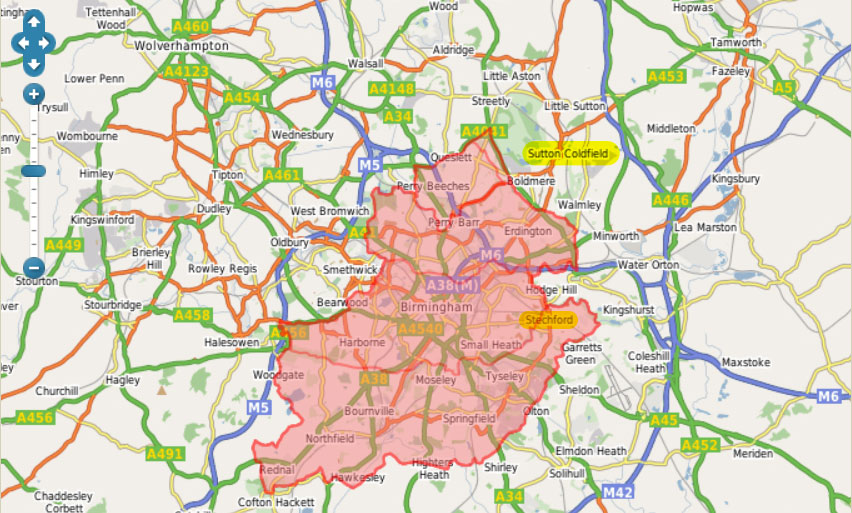
My grandparents lived in Stechford which was in the Birmingham County Borough.  A Vision of Britain through Time is a comprehensive resource for jurisdictions in the UK.  Sutton Coldfield was a Municipal Borough until it was merged with Birmingham in the 1974 re-organisation of local government.  In 1939 the boundary of Birmingham County Borough was:

Birmingham County Borough, with Sutton Coldfield and Stechford highlighted.  Source: A Vision of Britain.

Sadly smaller units like enumeration district QBEZ are not mapped in A Vision of Britain.  Census enumerators books included a place to enter as description of the area covered, but I don't know if 1939 Register booklets did.  Browsing the 23 images in the district reveals that only pages with personal entries have been published, so the context of the enumerator's work is missing.  From the street addresses, it is possible to gain an insight of the area covered.  Seven roads are named: Lyndon Road, Manor Road, Church Road, Station Road, Rosemary Road, and Yardley Fields Road.

All of the roads in enumeration district QBEZ are incorrectly scattered around Sutton Coldfield on Findmypast's maps.  Here is a Google maps comparison of the real locations and Findmypast's locations:
Enumeration district QBEZ.  Roads denoted by lines are actual locations, those denoted by pins are the 1939 Regsiter locations
 
A road is a linear feature, so is better represented by a line than a point.  Road names like Manor, Station, and Church are common. There are even several Lyndon Roads. These roads have been matched with other roads of the same name.  Matching locations using a gazetteer, a geographical index of place names with co-ordinates or grid references, is fraught with difficulty.  Red House, Rosemary and Yardley Fields roads were all pinned to the same spot as the incorrect Manor Road pin.  It is likely that the more uncommon road names could not be matched, so were assigned to a pin thought to be in the enumeration district. 

Findmypast's pins mislead even when correctly placed.  A point or pin suggests accuracy, so one might expect it to identify a house.  An jurisdictional area like an enumeration district or borough is best represented by a polygon, a shape which denotes the boundary of the feature.

Mapping technology is now widely and freely available.  Findmypast used open source mapping software, Leaflet, to present the maps, delivering a smooth user experience.  That was a smart move.  Using the digitised historical maps from the National Library of Scotland and modern OpenStreetMap was another smart move.  All of that came free.

It is clear that the jurisdictional boundaries from A Vision of Britain weren't used.  Adding that data layer could have unleashed the power of spatial queries, eliminating the type of errors discussed here.  The data seems to be available only for academic use, but the website was built over a decade ago, so would greatly benefit from serious investment.  Investing in the development and expansion of A Vision of Britain would be, well visionary.

Monday, 14 March 2016

Irish Catholic parish registers - which is the best site to search?

It's St Patrick's Day on the 17th, so it's probably not surprising that FindMyPast Ireland chose this month to release its collection of Irish Catholic parish registers. With the same records available on Ancestry, that brings the number of sites - and ways - to search these records to three, which is a giant bonus to those of us researching Catholic ancestors from Ireland.

Free Irish records

In July last year, the National Library of Ireland first released these records, which were warmly welcomed by genealogists all round the world. It's not just that they help us trace our Irish ancestors, a notoriously tricky thing to do (but not as hard as I thought when I started out). The other wonderful thing is that they're free to access.

At the time, I posted on Worldwide Genealogy about my first impressions of using this wonderful resource, which the NLI provided without an index. I wasn't going to look such a ground-breaking gift horse in the gob. But now, with FMP and Ancestry both providing access to the parish registers, it's possible to search them using the methods that many genealogists are used to on these two sites.

So this month I'm going to conduct a genexperiment and try all three out, looking for the same person, and see if any of them will become my favourite for Irish Catholic parish register research. I also want to know if I can search all three for free.

Catholic parish register search

I'll start with the first publishers of the Irish Catholic parish registers, the NLI's own website. Because you need to know which parish you want to search, I'm going to look for Daniel Delaney of the parish of Tomacork (Carnew). He may be related to my ancestor Nicholas Delaney, who was from the same parish. It's a fairly unusual surname in the area.

Shane Wilson has a useful tool on his excellent website for finding RC parishes.

NLI

Going to the home page, I entered the parish name (Tomacork, in this case). This took me to a page offering three microfilms. I needed the earliest:


Selecting any of the categories or the image all took me to the same page, the first image in this collection:


And from then on it was a case of scrolling through the records, looking out for the name Carnew (usually at the right-hand side of the page).

This took a while, and I found Daniel only as a father, here with his wife Mary as parents to Anne in February 1794:


The display's fairly small and I recommend switching to full screen view using the button on the top right. You can also adjust brightness using the buttons, but here I'm just giving you the image as is, for comparison.

Daniel's baptism and marriage must have taken place before these records were compiled, or else he moved to Carnew from another parish.

Ancestry

Next I searched for Daniel in the Catholic parish registers on Ancestry. I've got a subscription, but I wanted to see whether I could find Daniel without logging in. From the Birth, Marriage & Death, including Parish screen I selected Ireland as my collection focus and opened the card catalogue. Ireland, Catholic Parish Registers 1655-1915 is the last collection on the second page, so I hope I've saved you some time!


If you want to just browse, you'll need to know which diocese you're searching for to use Ancestry. I'm looking for Ferns. You then have the option to enter the parish name and year range - for me, it's Tomacork and 1785-1845. However if you just hit the year range it takes you to a page asking you to sign up for a free trial, which I don't need. I still wanted to see how far I could go in searching records which are available free elsewhere. So don't browse if you haven't got an Ancestry sub, you need to actively search.

So going back to the screen above I entered my search. I found that entering the exact diocese brought up a few results but not the one I wanted - but if I didn't enter the diocese I got 240 results and none of them were the one I wanted. That told me that I couldn't search baptisms by parents. So if I hadn't known that I was looking for the father of Anne, I'd have had to browse, just as with the NLI records. So I searched for Anne, and...


The first record! But to check, I hovered over View Record, and...


The right record (though Mary's name in the original is Costolough, not Cossolough). And that's as far as you can go without signing in. I don't know if you can go further by opening a free account because I don't need one. But I wanted to check the quality of the image, so I signed in, and here it is:
It's a slightly lighter image that the NLI's, but (peering at the screen) I think it's not quite such good quality. While using Ancestry, I found it fairly easy to navigate around the record set, so that will save me time researching these records in the future. If I hadn't got an Ancestry sub, I could use it as an index and get the images from the NLI. Or is there an easier way?

FindMyPast

FMP offers its Irish Catholic parish registers for free. Again without signing in, I went to the Ireland Birth, Marriage, Death & Parish Records screen. But when selecting the record set, I found that FMP has separated the baptisms, marriages and deaths into three different record sets, so unlike with the other two sites, I had to choose.
Luckily, I knew I was looking for a baptism. But this time I got zero results. Once again, it was lucky I knew Daniel and Mary's daughter's name. Searching for Anne, I got zero results again. Was this because I'd gone straight to the record set, which is a method of searching FMP recommended by several genealogists with much more experience than me?
Back to the Search screen, and selecting only Births & Baptisms as a subcategory, no record set:


And there was Anne, the first record.


Clicking on the image icon brought me to a register/sign in dialogue box. I know that FMP Ireland has promised that the registers will be 'free to search, forever', but there's no mention of whether the images are free to view. Again, I don't want to open a new account just to check this because I already have a subscription to FMP. (How do I afford these subs, you may ask? I grab the special offers.) So I signed in, and here's the image:


It looks very similar to the NLI one. You can navigate using the < and > arrows, but there's no jumping to a page as there is with Ancestry.

So there you have it - three ways of accessing the NLI's Irish Catholic parish registers. Which will I use in the future? Obviously, it's a huge help to be able to search, though you need to know who you're looking for first (eg the daughter's name, not the mother's or father's, in this case).

I think I prefer the NLI site for scrolling through the images, though, as I said, I'll be using full screen. But for jumping around the records, Ancestry's the easiest. I suppose, in the end, it's a very personal choice.

And I'm hugely grateful to all three providers for making these superb records accessible.

It's a long post, so thanks for staying with me. There's so much more to say about these records! 


I'd love to know your thoughts if you've used the Irish Catholic parish registers via any of these sites. Have you got any favourites, or tips? Is there a clever shortcut I've missed?


Irish genealogy webinars

PS: There are some free Irish genealogy webinars taking place this week:

Family Search is hosting two sessions a day on Thursday 17th and Friday 18th. Full details over at Claire Santry's unmissable Irish Genealogy News blog.

FMP is holding its webinar tomorrow (Tuesday 15th) at 1600 GMT and the link is available here (this works for the UK; please check for your own area).
Thursday 17 March: Where is That? Finding and Understanding Places in Ireland. Starts 11am MST; 6pm GMT.

Thursday 17 March:
Ireland & Census and Census Substitutes. Starts 1pm MST; 8pm GMT.


Friday 18 March: Ireland Catholic Church Records. Starts 11am MST; 6pm GMT.

Friday 18 March: Irish Protestant Records. Starts 1pm MST; 8pm GMT. - See more at: http://www.irishgenealogynews.com/2016/03/family-search-four-irish-genealogy.html#sthash.f3itwe7R.dpuf
Thursday 17 March: Where is That? Finding and Understanding Places in Ireland. Starts 11am MST; 6pm GMT.

Thursday 17 March:
Ireland & Census and Census Substitutes. Starts 1pm MST; 8pm GMT.


Friday 18 March: Ireland Catholic Church Records. Starts 11am MST; 6pm GMT.

Friday 18 March: Irish Protestant Records. Starts 1pm MST; 8pm GMT. - See more at: http://www.irishgenealogynews.com/2016/03/family-search-four-irish-genealogy.html#sthash.f3itwe7R.dpuf

Friday, 12 February 2016

My First Impressions of Twile - Winner of The Peoples Choice Award at Rootstech 2016

File 06-02-2016, 19 03 42

This photograph is from the Twile Blog to find out more see the link below.

What is Twile?

Twile is a website which creates a timeline of your family memories that you can share with those in your family who may not be the avid genealogist that you are. 
Only the people you allow can see what you share but it allows us to share all those moments that we forget to record in our software programs.
Here is a link to why it was created and I shall leave you to explore their blog to find out more.

How I found the site

I first found out about this website when the semi finalists for the Innovator Showdown at Rootstech 2016 were announced and decided to sign up for the trial to see what it was all about. 

The Demonstration at Rootstech 2016

Life got in the way and I saw the video of the Innovator Showdown Semi-Final and decided I needed to get my GEDCOM file uploaded to the site so that I can start adding memories and sharing with my family. I know that many others are interested in this site as it won the vote from the audience including those watching online. Here is a link to the Innovator Showdown Finals 2016 if you have not had a chance to see it.


Exploring the website

I am only just starting to use this but I am impressed by the feedback from the team who run the website. They will be inundated with people wanting to join and try out the website. They are still managing to get back to answer individual queries and provide a solution in a timely manner.
Customer service is so important if you want the users to keep coming back.

Gedcom is up and working and I am adding profile pictures to my ancestors and adding living members. You can invite your family by email, and as the website can be accessed by tablets and smartphones, I expect it to be popular with the younger generations of the family.

The comment from my son after I sent an email invite  was " I received an email saying you added me to your family tree, I thought I was already a member! ". This sparked a conversation and I showed him the family timeline I am building which currently has only my side of the family and my husband. He looked at the date his grandfather died, knowing it was the same day that his cousin was born and the date the following week when we had the cremation, these are things that he remembers. 
He also asked if it was private so I told him that only the family could see this if I invite them. 
The more of them that join, even just the free part of the site, the better it will be for everyone. 
I love the timeline as it really helps to put things together in relation to each other in a way that those in the family, not "doing genealogy", can interact with and add contributions.
I like that you can add more than just the usual things like births, marriages and deaths. 
I have uploaded a few photographs from a couple of family get togethers today as milestone events.

From what I have seen so far I am almost certain I will sign up to be a premier member. 

We should all share in the mission to get the younger generations engaged, to ensure that the stories and memories we are creating today and have created or had passed on to us are saved, in a way that our families will want to share in the future. 
Photographs and stories are what inspire us to find out more. 
We have so many ways to record and store them but the best thing we can do is to share.

Just as I finish writing this there is more good news for Twile in this announcement
I already have an ongoing subscription with find my past so hopefully this will lead to integration between the sites.

Thursday, 12 November 2015

How useful have you found the 1939 Register ?

It's finally online!


Find My Past in association with The National Archives finally launched the long awaited 1939 Register on Monday 2nd November 2015. 
Probably the biggest announcement and dataset launch this year.

I am not going to explain what it is or how to use it as you can find everything you need in the links.

You can also out find how they brought the register online.

Find My Past also have a blog dedicated to the 1939 Register.

Audrey Collins of The National Archives explains more in this video.


Peter Calver of the Lost Cousins website has also put together a page with information.

So with all the information available how have the genealogy community responded.
On the launch day Chris Paton of the British GENES blog posted an initial review. With a further follow up on the following day.
Sunday saw some changes made to the search facility and another post. Yesterday he posted a link to a webpage with a tool you may find useful.

There has been much discussion about the price of accessing the scanned images and the Who Do You Think You Are Magazine website published a blog post  about this on the day of the launch.

So how have I found the register. I made a few comments on the day of the launch on Mondays with Myrt which were very much my initial reaction with barely 30 minutes of searching.


Even now I have not found those members of the family who I wanted to find. Is it poor transcription or were they missing for some other reason? I have searched with the exact date of birth but still not found them in the index.

So whilst there may be complaints about the cost I have as yet to make a purchase. I know that I will eventually decide to buy the household records for my direct family but it is not them who intrigue me, it is those who appeared as children on the 1911 census and were siblings of my ancestors. 
Those with common names can be difficult to find. I have found some WARDs in the town where I have been looking for some, without any forenames. In the same town I have found a couple who I believe to be my husband's gt grandmother and her husband but the surname was presumably unreadable as it is transcribed as ~???.

I am not sure that many individuals will be prepared to supply evidence of death to open a record as this is what Find My Past say about the proof needed "You will be required to scan and send a copy of a fully certified death certificate from General Register Office (GRO) or the equivalent Governing body if the death occurred in a country other than the UK. By certified copy, we mean the original certificate as registered and provided when the death occurred. This can be a copy as opposed to an original however it must contain the full registered details. If the criteria are not met, you may be requested to either re-submit or provide further evidence, such as a birth certificate."
How many researchers who already have a copy of a death certificate issued since 1991 are going to go to the trouble of asking for a record to be opened? 
Is it going to provide any great evidence for that individual given that they are likely to have known that person?

I'll carry on hunting for my missing relatives.
If anyone finds Ruth Ellen Gadsby born 1901 or Charles Reuben Gadsby born 1910, Please let me know. 

If you had family living in England or Wales in 1939 please give some feedback on any searches you have done.
Are you prepared to wait up to 24 years until all the entries will become available?


Wednesday, 31 December 2014

Genealogy 2014 - 2015: Successes and Goals

Mary Peacock nee Hugill
Mary Peacock (nee Hugill)
After today, someone else is taking over my '31st-of-the-month' time-slot. My previous posts were about sources and strategies for family history worldwide. Today I want to reflect upon the highlights of 2014 and my goals for 2015.

In 2014, unforeseen events (ranging from a back injury to moving house) meant that there were many disruptions to my usual genealogical activities. A health scare reminded me that spending quality time with family and friends is more important than being an educator, a genealogy professional or a blogger!

Genealogical highlights of 2014:   (links open in a new window)
  1. Collaboration via CuriousFox.  I have been swapping information with a distant relative who contacted me via CuriousFox. She sent me certificates and other information for our PEACOCK and HUGILL ancestors from Yorkshire, and confirmed that my Mary PEACOCK (nee HUGILL) died 17 Feb 1900 at Stockton-on-Tees, Durham, England.

  2. New data via National Probate Calendar.  I found many relevant entries in the National Probate Calendar (Index of Wills and Administrations, England and Wales 1858-1966). For some, I've already ordered copies of the wills. Others are on my wish list, but in the meantime they gave me locations, death dates, occupations and relationship details that helped with research in other sources.

  3. New data via FindMyPast.  Many record sets released on FindMyPast during 2014 revealed new information for my family history. For example:
    • 'British in India' collection has 5 pension fund documents for Mary PORTER (a widow in England) with names and exact birth dates (between 1811 and 1821) for her five children.

    • Yorkshire collection has records such as parish registers and Bishop's Transcripts for my many family lines in that county.

    • Trade Union records refer to my John William CORDUEX in registers of two different railway unions.

    • New South Wales will books 1800-1952 in which I have already found 13 records for my family (including some people who lived outside NSW). I expect to find more when I do a systematic search for all names in my family tree.

  4. Newspaper notices.  In the York Herald, Yorkshire Gazette and Sheffield Daily Telegraph (digitised and available via FindMyPast and the British Newspaper Archive) I found obituaries and other items for some of my families including HUDSON of Barton-le-Willows and BATTY of Bolton-upon-Dearne.

  5. HUDSON family at Crows Nest.  I added another generation to the family tree after finding clues in Queensland funeral records and cemetery burial registers.

My genealogy goals for 2015:

  • Change my priorities.  Spend more time on my own research and less time on answering emails from people who expect everything to be free!

  • Share my knowledge more efficiently.  (1) Write more mini-guides.  (2) Use my Twitter page more often (because it is a quick way to share genealogy tips and links).

  • Organise my records.  Before scanning or taking digital photos of all my family history material, I need to write down a 'style guide' for naming and filing the images. I will use a modification of the system described by Nancy Loe (a.k.a. 'Sassy Jane') in Cataloging Digital Family Photographs and Records and Organizing Genealogy Research Using Archival Principles. My paper filing system has always been source-based, so Louis Kessler's idea of a source-based incremental fix will suit me perfectly.

  • Use DNA for genealogy.  I need to become more familiar with various tools for analysing DNA results, and to persuade more of my distant cousins to do the FamilyTreeDNA Family Finder test for autosomal DNA and the X-chromosome.

  • Plan my genealogy cruise presentations.  Prepare my talks well in advance of Unlock the Past's 'Barrier Reef' cruise in March 2016. (You can get AUD$40 discount by quoting the code UTPC-WEB06 when you book any Unlock the Past cruise.)

  • Research the HUGILL family.  My top priority is to find parents' names for Mary HUGILL (born c.1813, Hull, Yorkshire) and confirm that George HUGILL (born Hull, later of Stockton-on-Tees) was her brother. (Perhaps the wills and probate documents that I've ordered will help.)

  • Write about my ancestors.  Many of those posts (which I will put in Jottings, Journeys and Genealogy) will be quite brief initially, but I'll update them as my research progresses. Hopefully people who read them will contact me and help fill the gaps in my knowledge.

Someone else is now taking over my '31st-of-the-month' time-slot, but watch for additions to my own blogs, which include UK / Australia GenealogyGenealogy LeftoversQueensland Genealogy;  and Jottings, Journeys and Genealogy.
~ ~
You might also like:
(This post first appeared on http://worldwidegenealogy.blogspot.com/2014/12/genealogy-2014-2015-successes-and-goals.html.)

Thursday, 12 June 2014

Online Trees. Why have one? My Experience

Why do I need to put my tree online?

I am not going to answer this question but hope that by the time you get to the end of this post you will know whether or not you want to do  this and your reason for doing so.

Where can I share my family trees with others?

There are a number of sites where you can upload information about your family I may not have included all of them here but these are the one I have used and I want to discuss my experiences with using these sites.


With almost all of these sites I have uploaded a GEDCOM file, I am going to assume you know what this is, if not I suggest you do a search as this is a standard term.
The only one where I have not used this method is Family Search, but I believe there is a facility to do this. Randy Seaver has at least 2 posts on this at his blog http://www.geneamusings.com/ .

The software I use on my computer uses a GEDCOM file as standard. I have a facility which allows me to create only a part of my tree and to privatize living individuals and those who have recently passed. 
If you are unable to do this, and you want to remove individuals from your file before you upload anything you may find this link useful http://www.werelate.org/wiki/Help:GEDCOM#How_should_I_prepare_my_data_for_GEDCOM_upload.3F

Help with uploading from the database on your computer can often be found on forums e.g http://www.familytreeforum.com/

Alternatively genealogy user groups or blogs can have help pages or discussion of how to do this from a specific program. Try http://ftmuser.blogspot.co.uk/ for Family Tree Maker or http://buddinggenealogist.blogspot.co.uk/2014/05/ancestral-quest-simple-but-powerful.html for Ancestral Quest.


How do I choose which site I am going to use?
To be sure that you have chosen the best site for your tree you need to ask yourself a few questions.

  1. Why am I putting my tree online?
  2. Who are my audience?
  3. How much do I want to pay to keep my information on the website?
  4. Does the website have records I want to access?
  5. Can any records on the website be added to my tree?
Most of us put up our tree in order to connect with others researching the same family. 
We may also use it as a backup to the tree on our computer.
Who do you want to see the tree or even add or edit the tree close family or just you?
If you chose a website that charges a fee can you access your records if your subscription expires?
Some websites have records that can be added to the tree to support your conclusions. 
Does  the website have records that cover the areas where you are researching?
If privacy is an issue then be sure to read the contract terms.
I would always recommend reading the terms and conditions before you upload anything.

Are all websites the same?

So you have decided you want to create an online tree and you know what you want from the website.  
What you are willing to pay? 
Do you want a free site or a free trial? 

What do the sites I have used offer and how do they differ?
 This link will take you to a brief comparison of the sites as I see it  https://docs.google.com/spreadsheets/d/1pqUJVXh2x1pAPgTmZIt0kAoCvmHUabhxFGPn265dm4Q/edit?usp=sharing . 
(apologies if things have changed or I have misinterpreted anything) 

Recently I have used Ancestry as a back up tree, my main tree, which I have as a work in progress, so have kept it as private. 
This means that anyone who thinks we may have a connection needs to contact me via the messaging service. 
Most of the websites work along similar lines if they allow for collaboration and you will need a subscription if you want to initiate the conversation.

Genes Reunited was bought by brightsolid who own Find My Past this means the site has changed. It may not be the best option if your research does not extend to the UK but there are also sites for Australia, New Zealand and South Africa.

WikiTree is set up to build a single collaborative tree and actively encourages you to merge individuals to connect families. If you have a profile for an individual it cannot be merged unless you allow, by giving trusted status to the other profile manager. This video explains the merging process https://www.youtube.com/watch?v=6Waad3pFg74 .
For US researchers who want to collaborate this is a good choice and you can choose your level of privacy for each individual in your tree. You can share trusted status with others researching individuals you share, but they can only edit those individuals you want them to, not your entire tree.

Whatever you choose to do remember this. 
Your living family will not know you are looking for them unless you tell them.
Go make those cousin connections you may get a nice surprise.


For further reviews please have a look at this website which also has links to other sites I may have missed.
http://genealogy-websites.no1reviews.com/


Please leave your comments as we may all have different experiences of the same website and it may help others decide what is the best option for them.
If you are a new researcher many of the websites offer good advice as to where to start and free software to help get you started.