Showing posts with label #WWgenealogy. Show all posts

Friday, 22 January 2016

Get Blogging!

As Worldwide Genealogy has just turned two, it is time to take stock.  Thanks to my co-authors this blog is still going strong.  The total number of page views currently stands at 170,000, which attests to a real audience.  At the end of 2014, the blog had attracted 38,000 page views.  Posts published in 2015 have attracted 41,000 views. Posts published in 2014 were also viewed a further 91,000 times during 2015.

The original objective was a daily post achieved by each of the 31 authors committing to post on a particular day of the month.  In 2015 most authors followed a bi-monthly posting schedule, with a few sticking with the original monthly schedule.  This change allowed 41 authors to contribute from the UK, USA, Canada, The Netherlands, Germany and Australia.  216 posts were published in 2014, but the number of posts dropped to 159 in 2015.  I wonder if the less frequent schedule is harder to keep to.  

Collaboration has certainly helped Worldwide Genealogy build an audience, but now is not the time to be complacent.  Reasons commonly given for bloggers giving up include lack of:
  • commitment - making time 
  • patience - not expecting instant results like a large audience or profit 
  • persistence - most bloggers give up too soon 
  • writing skills - requires practice
  • passion for the blog topic - motivation

Passion for genealogy certainly is not lacking for this blog's authors.  Posts cover a variety of genealogy-related topics.  The most popular posts include discussions of technology, tools, resources, research methods and telling of family tales:
Digital preservation, or why I worry about Evernote
Using Time Lines as a Family History Writing Tool
My three Rs of Genealogy
Criteria for Assessing the Quality of Genealogy Websites and Online Data
Use FreeBMD postems to find new relatives
A Transcription Toolbox
Why the Genealogy Do-Over is not for me
Al Capone’s bullet proof car and my great-uncle
Saying Goodbye Too Soon

For anyone who would like to join in, the resource links in Want To Be A Geneablogger? are a good starting point.

Get Blogging!

Tuesday, 19 January 2016

The War of 1812 Can Be Your Friend

The United States wasn't the only country that was affected by the War of 1812.
If it weren't for the War of 1812 Pensions many wouldn't know maiden names for their female ancestor, nor marriages among many other beautiful treasures that can be found in the War of 1812 Pension Files.I support the Preserve the War of 1812 Pensions Project because I think everyone that has a story needs to have that story heard and found. Believe me there are a lot of stories in those files.
This day, however, I am going to share another reason why I am grateful for the War of 1812.It was a source for one of my Hero's ancestor coming to the New World. William Stephen Sackley left England in the Service of His Majesty King George III to fight wars on other Lands' soil. In 1814, according to his Land Petition or later called a Land Warrant, he was in Canada in 1814 to fight for Canada's rights as their British Colony.This gave me fruit for thought looking at the war from a Canadian Perspective. Of course, they were the only representation of England at America's back door and so they would be considered a threat from a military way of thinking.There were those in power however, who thought of it as a opportunity to grab Canada as their own land if they won the war with England.The Canadians, on the other hand, didn't have any desire at that time to be "liberated" from Britain nor to be a part of America, which some Canadians had fled when the American Revolution was fought. Reading many sites about the Canadian Perspective of the War of 1812, I developed a great respect for their side of the story. This site has a nice write up and video "A Canadian Perspective on the War of 1812". The War of 1812 Overview is a place to learn from too.
Going back to why I, an 8 generation American girl, would be researching a Canadian Perspective, since I don't have any Canadian ancestors.
The Hero's (my special guy) ancestor John Sackley appeared on his pedigree chart as just a name. Nothing was known about him other than his siblings names from a note in a cousin's baby book.
Permission to use From Barbara Bonner.

As we started researching, we found from Census records he was from Canada West. Nice, but when I first started researching this, Canada was an huge unknown for me... My neighboring country and I knew more about Mexico (and no ancestors from here) than Canada, crazy right. Why hadn't I paid more attention in World History, for that matter American History. John became my brick wall in my research until I turned my attention to his siblings. His sister married a prominent man who founded a town in Indiana, and they mentioned her name as his wife and her father's name in passing. Now, I had John's father's name William Sackley. My first thought was to grab a William Sackley listed on the IGI who was born in Nova Scotia...wrong, not old enough... Another sibling, as a pioneer of a Nebraska township, had his biography written up in a history book of Nebraska. It gave when the family came to America, and the place that they came from in Canada...Napean, Carlton, Quebec,which now gave me a place to focus on. However, it wasn't until I found my wonderful Gene-Friend Lorine McGinnis Schulze's Blog The Olive Tree Genealogy which led me to her unbelievable website The Olive Tree Genealogy that is one of the most helpful resource guides for Early American, and Canadian research I have found. Ship Passenger lists, Censuses, Immigration, Land records,Canadian Census links to name a few things that you can find here. Through her links, I was able to order the Land Records which lead me find William Stephen Sackley (he went by Stephen until he came to America) and it in turn gave me the information on his service in the 37th (North Hampshire) Regiment of Foot, in the English Military. The following is what I have gleaned from Canadian sites, and Researching the 37th Regiment.
I admit I am just starting here, but it was an awesome exercise in finding my Hero's ancestor's story. I know he joined the military during the Napoleon War, which for him extended to the War of 1812 between America and England. At the end of the War he found himself in Canada, a brand new country (for him), with an opportunity to stay and own land.Apparently he thought that was the best idea, for he stayed.
This has been my, so far, findings...What the British government offered what was described as very favorable conditions. Each private was to receive 100 acres, a sergeant, 200 acres, a Lieutenant, 400, a captain, 800;  and a colonel, 1000 acres.  The land was distributed through a "Land Petition" initiated by an ex-soldier, which would be converted to a "Land Warrant" after a certain amount of time. They would also receive their army pension (officers were placed on half-pay) as well as rations for the first 12 months. Each family was to receive a shovel, ax, hoe, scythe, knife, hammer, kettle, bed tick and blanket, hand saw, 12 panes of glass, one pound of putty for glazing and twelve pounds of nails (in three sizes). The community itself would receive two sets of carpenters’ tools. For the sake of protection and militia duties, muskets and ammunition were retained by the ex-soldiers. In addition clergyman and schoolteacher were to be dispatched. (4.)
A few 37th Regiment men can be found in the Richmond Military Settlement at Carlton. The 37th was in garrison in Canada from 1814-1825.  Many of these men took land grants in the settlement of Goulbourn near Richmond. The 37th (North Hampshire) Regiment had its beginnings in 1702 and continued until 1881
In the Land Records, Stephen is shown as having been granted 100 acres in Goulbourn and being part of the 37th Regiment.  The 100 acres shows he was a private according to the amount allotted.  He is shown in the 1st Carleton Regiment 1828 Militia Muster Roll, as Stephen Sackley age 35 having serving previously in the 37th Reg't.

Scrapbook page I created with what I have found. 

My next step is to see if I can obtain his English Military Records that hopefully will help be back to England.
Thanks for listening to my journey to Canada and hope your New Year of 2016 will find you breaking through brick walls. My journey was not an overnight one, it took many years to get here...

References:
1. National Army Museum, 37th (North Hampshire) Regiment of Foot., 7 July 2014, Online, 2 March     2015,   http://www.nam.ac.uk/research/famous-units/37th-north-hampshire-regiment-foot .
2. Wikipedia, Results of the War of 1812, 19 January 2016, Online, 11 November 2014,          https://en.wikipedia.org/wiki/Results_of_the_War_of_1812
3. FamilySearch Wiki, Canada in the War of 1812, 30 January 2015, Online, 6 July 2015,
     https://familysearch.org/learn/wiki/en/Canada_in_the_War_of_1812
4. Ron Dale and Wes Cross, The Regiments of the Richmond Military Settlement, The 37th, 99th and    100th Regiments, April 2008, 2 January 2014, Online, 5 May 2013,    http://freepages.genealogy.rootsweb.ancestry.com/~crossroads/barry/99th_regiment.html

Monday, 19 October 2015

Reminiscing About Blogging


The reason I started my internet genealogy journey, was to blog my sweetheart's stories so my children would have them. I blogged Sentimental Sunday stories which I also called my Hero stories. I looked forward to that date with my blog every Sunday. Then I branched out in my posts as I found the group "GeneaBloggers" started by Thomas MacEntee, and a few special bloggers like Carol Stevens who has the blog Reflections From the Fence, FootnoteMaven, who at the time was doing themes of Carnival Of Genealogy, until her health became a challenge. Lisa of Smallest Leaf was also one who gave me encouragement. I loved the memes they had and the comradery. As with all things, many branched to another area, health issues, we lost a few, and I became involved deeper into my mission with FamilySearch, which I love, and soon, I found it hard to make that blog post more and more.
yes, I felt like I was running away. 

Today, I revisited my blog going back to the beginning and saw why I had loved it.  I wasn't trying to meet a standard or show I had an understanding of writing, genealogy, etc. I was just sharing and having fun.  Which unless you are a business and trying to show your professional side, that I believe is what it should be.  I am going to start making an effort to go back to my personal blogging and sharing with my family again.  I am not a professional and would hope that the blog would not be judged by such standards.
There are memes by Thomas...the Geneablogger Daily Prompts, Amy Crow has a 31 Days of Genealogy, Olive Tree still has a prompt Sharing Memories, Aine of BlueRaspberrySundays posts a prompt on Sundays. You can even find Family History Writing Prompts on Pinterest which is helpful for blogging if you think you are having a challenge with subject matter.
If you are like me, and see your posts have dwindled down over time, go back and see why you started, why you were excited.  It is almost like a marriage, you have to work at the relationship to keep it alive.  I have seen some move to a different server to perk up their blog; this I am not going to do as I have seen their pain as they went through that process.  I am looking to renew my blog relationship not start a new one. I digress. Use the memes again, post fun things as well as great finds.

This has been my thoughts and I am sorry to use your time to help myself find what I have been missing. Hope it helps you.  

Sunday, 19 July 2015

Write Your Own Stories

I have been pondering how to write this blog post for several weeks. It is with great hope that the spirit of the post will speak to you.
I have blogged in the past about writing our ancestors stories to make them people and not just names. This time I want to focus on writing our personal stories, some think in terms of personal history, or journals.  I am simply going to put it in terms that most of us cringe... write about yourself. You can tell why you did something or why you felt some way better than another will be able to interpret your motives, etc after you are gone.
So, today I am going to write a little about myself and some of the events and people that had a great influence on me; helping to make me who I am.
I had many events in my younger years that, when I reflected as an older person, I can see why I act the way I do.
When I was 3, my father lost his leg above the knee in a logging accident. I won't go into the story, but you can read it here on my blog. His attitude of not giving in to the circumstances and striving to be better, shaped my way of handling crisis situations and challenges in life.
A picture of my mom and dad and I that was used in a State wide promotion of  handicap people overcoming. 
When I reached 5, my mother and dad decided for my mother to go back to college.  She had been waiting tables to assist with the cost of living because my dad was still recovering. She went away for a week at a time, working for an elderly lady to pay for her schooling and to cover her room and board. From this I took away doing what it cost to take care of your family.  This helped me many years later when my husband had to work far from home for an extended length of time.

My father's mother came to live with us off and on while I was growing up.
Lenorah Gildon Langley
Every day she read the bible and devotionals that someone gave her.  She attended church when she could, because my mom was Methodist and she was Church of Christ, so my dad would just lay low for no conflict.  I learned from her the value of having a spiritual side to your life for balance.

My mom's mom did not live with us, but she did visit.  She had had arthritis all her life. She had 13 children, and raised 6 of them and 2 grandchildren alone after her husband died of cancer. She earned a living, sewed, and was a supporter of her church circles.
Matilda Roberts Whitson and Cecil Whitson grandson
 She had a sense of humor too. She became an ideal person to me of how to face life, if you're given lemons.

Both of my grandfathers had died before I was born.  My grandmothers never remarried.  They helped their children when and how they could.  My life has been similar. My husband died at 62.  I am content as a widow, neither of my grandmothers had complained, why should I. My time is spent serving my six children, 25 grandchildren, and the genealogy community at large.

Love of genealogy was not something that came from any influence of my family. However, the desire for stories and encouraging others to grab family stories came from dealing with my dad's family who was closed mouthed, and never spoke of family or their ancestors.
These are examples of  a few of the people and moments that have influenced my life, and now you know more about me probably than my children.

I am writing my stories on FamilySearch Memories. After I am gone, they will be able to see my stories that I have written for them and my grandchildren (on FamilySearch only that attached to the deceased is visible.)

See you next month... 

Sunday, 21 June 2015

Starting out with a computer package – tips I wish I’d been given

I started using a package in 2013 and it was really exciting, just putting in a few facts and having a tree grow on the screen in front of my eyes, five generations ranging from my son to my great-grandmother in a matter of minutes, just like that.  Get me, amateur genealogist!

But later when I went back to that initial information I wished I’d done a few things differently, so thought I would share those things with you. Some of these apply in principle to any record keeping, others are more specific.

Starting out with your tree [Image from FamilyTreeMaker2012]
Get your timings right
In the excitement of entering data and building a tree don’t race ahead – when I first started using a genealogy programme I would put the year of a specific event and the fact, just so the tree would be as big as possible.  Bad plan.  While census entry dates are easy to check on, eg using Genuki, dates things like baptisms can be a faff to find again and without the precise dates you may be wasting your time, perhaps looking for a census entry in April when that person actually died in February.

Note all you know
So your ancestor lived with her six brothers and sisters? When using census returns don’t just enter the data on your ancestor, put in all the information relating to every family member into their own individual Person profile: estimated DOB, birth town, occupation. I've found that later on this has been useful, eg discovering someone I’d feared had died in childhood was actually living with a married aunt.

Note what you need
I've found it really useful customising my tasks within Family Tree Maker. Recently I've added my own categories specific to counties, specific to resources and specific to actions.

For example I could select my Cornwall, Visit & Photograph and Check with Council categories. This will filter tasks to respectively let me search for a clump of Cornish records on one online resource, plan a trip to see what my great-grandmother would have seen as she ran along her street, and to pop all enquiries relating to a particular cemetery into one email and not have to trouble a helpful but very busy Council employee several times.

Avoid horror and nausea
Always, always, make sure your information is backed up. The feeling of losing data is nauseating, like realising you've accidentally overspent by using the wrong debit card.  And indeed it would be an expensive mistake, all those years of subscriptions wasted, money down the drain. In addition to uploading my Family Tree Maker tree to Ancestry I use Outlook Cloud to upload a copy of my entire FTM tree file as back-up.  I use Outlook because my main email account is my Hotmail one but, as they say, other products are available.  I also upload my e-copies of original census returns downloaded from various sites.

I hope some of these will be helpful. And now I'm off to back up my family tree; after recommending it to you I'm feeling guilty for not doing it myself for a couple of months...

Text copyright Lynne Black 21 June 2015
First published on World Genealogy Collaboration blog site: http://worldwidegenealogy.blogspot.com/2015/06/CompGeneTips.html

Wednesday, 27 May 2015

If April Showers Bring May Flowers....

Lady Banks Roses on trellis in Helen's garden


If April showers bring May flowers, then what do May flowers bring?  Pilgrims!


My daughter told me this joke recently, and of course, it is the perfect genealogy joke! Hope you enjoy! Since we are still in the month of May as I write this, I thought it a good time to live out this joke and explore my Mayflower ancestors! As a girl from the Southern United States, it never dawned on me that I might have had ancestors who arrived in America on the Mayflower, but I did! (Jamestown being Southern, was more likely and also true.) Today we are talking about the Pilgrims, my Pilgrims, and maybe my May flowers as well, since I am a gardener. In fact, gardening and genealogy are two of my greatest passions.


I don’t know about you but in my opinion, passion and flowers create romance. Moonlight, with gardenias, moon flowers, and roses-- set the mood. Maybe that’s exactly the scene poet Henry Wadsworth Longfellow was thinking of when he wrote the poem The Courtship of Myles Standish.

Painting of John Alden and Priscilla Mullins by Jean Leon Gerome Ferris, 1907


The poem tells the love story of Priscilla Mullins and John Alden of the Mayflower. Priscilla’s parents, William and Alice Mullins and only brother Joseph all died during that first severe winter in Plymouth. Orphaned, young Priscilla caught the eye of newly widowed Captain Myles Standish, who asked his friend John Alden to propose marriage to her on his behalf!  Priscilla responded with that famous line, “Why don’t you speak for yourself, John?”  John Alden and Priscilla Mullins, real people, did indeed marry, and became my tenth great grandparents! It is so amazing to me, so incredulous to learn that this poem was based on fact to begin with, and that these pilgrims were actually my grandparents! The relationship chart goes like this:

John Alden (1599 - 1687) and Priscilla Mullins
are your 10th great grandparents
daughter of John Alden
daughter of Elizabeth Alden
daughter of Elizabeth Pabodie
daughter of Ann Rogers
son of Sarah Witt
son of Abner Harbour
daughter of Moses Harbour
daughter of Joyce Harbour
son of Nancy J Houchins
daughter of Walter Houchins
daughter of Katherine Steptoe Houchins
You are the daughter of Margaret Steptoe Kerse


Can't you just visualize John and Priscilla strolling through the garden, the nighttime air filled with the romantic scent of roses, moonlight dappling their path...aaaahhhh...genealogy, gardening, moonlight and romance...can it get any better than this!


 Flower pictures are from my own garden.


Wednesday, 20 May 2015

Original Records Are Always the Best

I finally came to the place in my tree while cleaning up, that made me acknowledged that for years I had let stand another person's research that was based on an abstracted record.  It was time to search for the records that the other person had abstracted.  This was not new to me.  I had done this with my Hero's line and discovered an abstracted record in respected published book had left out a child entirely.
The search in the probate records on FamilySearch was a bust.  The records did not go back far enough.  I then turned to the FamilySearch Wiki , search for my county and state, which helped me find there was a searchable database for the county. Had I gone there first, I might not have found it as it is not intuitive to discover... The area of records is under holdings... I did find the probate indices and searched. They were there, the two men who died within months of each other and the focus of my research.  They had come to Madison County, Mississippi Territory as Squatters apparently as one shows up in the 1809 Mississippi Territory Squatter's Census.  The hash marks with him indicate the other man and his family in the household.
I ordered the files, and lo and behold, the previous abstracts did have some relationships incorrect. Yep, the original is ALWAYS best!  My problem now is to try and figure out the relationships.  On the 1809 Squatter's Census the dates are not helpful as to if it would brother or father and son relationship as, it just lists 21 and up.  They died in late 1814 and early 1815.  I always love it when more information flows in, but wish some could have been definitive.
What I did learn was some of the life style and crops they must have grown.  They did not have slaves, so they must have done most of their work as a family.  Which is pretty much the way the Mississippi Territory Squatters were described.There was a Flax Spinning Wheel for sale, and cloth. I gather they grew the flax, spun it into cloth.
One of the women in the file had made a coat. It apparently was for the burial of the one who is thought to be the older of the two men. So they must have also made clothing for others. There were also, sheep, wool, and cotton mentioned. They purchased a 5 gal jug of whisky for use as  the property was being sold.
They apparently were not teetotalers and knew how to loosen people up, ;-)  or all were friends and it was a type of social.  Maybe someone has a better understanding of the people of that time.  I love reading Judy Russell's, The Legal Genealogist, blog posting.  They have broadened my look as I search through the files.  If you haven't subscribed to her posts, it is not too late.
I am now digging into Mississippi Territory and Georgia Territory records in the hopes to discover something to clarify the relationships.  Another researcher has found a family they think could be this one in South Carolina.  Deed Records, here I come.
This post has really served as a thinking ground for me as I am trying to sort out what I have found.  Maybe you have suggestions or it will help you in your journey too.
See you next month!

Friday, 27 March 2015

How the American Civil War Affected This Southern Woman and Many of Us--150 Years Later!


-illustration shared on ancestry.com


At my current age of sixty-six years, it was mostly my 2nd Great Grandfathers, eight in number, who fought in the Civil War. That whole generation was affected--those born in the 1830’s and 1840’s and dying in the war or after 1880. I remember how surprised I was to look at my family tree and realize that. I had put a little picture beside all the folks who fought in the war, and when I looked at my pedigree, there they were, all lined up--my 2nd Great Grandfathers!  One young 1st Great Grandfather lied about his age and entered the war early, and a couple of elderly 3rd Great Grandparents served as well, but mostly this was a tragedy for my 2nd Great Grandparents, who, thank heavens, had children before the war, or after, so that here I am, a product of all eight of them.


“The Civil War” as we call it in America, was fought between April, 1861 and April 1865. Many issues entered into the conflict, but the overriding matter of the day was slavery, especially the expansion of slavery into the western areas of the growing United States. Altogether, eleven  Southern States of the United States seceded, decided they no longer wanted to be a part of the United States of America, but wanted to join together as the Confederate States of America, often called the Confederacy, the South, or the Rebels. The United States forces were called the Union, the Yankees, or the North! After four years of battles, burning, and destruction, Wikipedia reports http://en.wikipedia.org/wiki/American_Civil_War that there were an “estimated 750,000 soldiers and an undetermined number of civilian casualties. One estimate of the death toll is that ten percent of all Northern males 20–45 years old, and 30 percent of all Southern white males aged 18–40 died.” We genealogical researchers in America have all probably noticed the many, many widows and fatherless families on the 1870 and 1880 censuses due to this terrible war.


The Confederacy lost, the slaves were freed, and the South had to slowly rebuild and learn a new way of life.
After the war, almost everyone in the South was poor, their confederate money was no good.  Even the plantation owners were “land poor,” unable to afford to hire their former slaves or other workers to work their large fields!


This is the world in which I find my 2nd Great Grandparents living. For some reason, this was a shock to me. Until I started my genealogical research in 2012, I cared little for history, I am sorry to admit.  A person with a Master’s Degree, I did poorly in history classes, as they only meant dates and event names to memorize to me. Why didn’t someone ever explain to me that my family was there? It wasn’t just the movie “Gone With The Wind” that I should have modeled my scant knowledge of the Civil War upon--of all historical events. Did my parents really not know that their 1st Great Grandparents fought in the war, or was it that they were so busy surviving the depression and World War II, that history paled in comparison. Now that I am more aware, I am trying to correct that situation by writing stories of our ancestors and how they participated in and were affected by historical events. Now I know, that their participation in those events, affected me and my family’s choices in life, experiences in life...let me give you some examples:
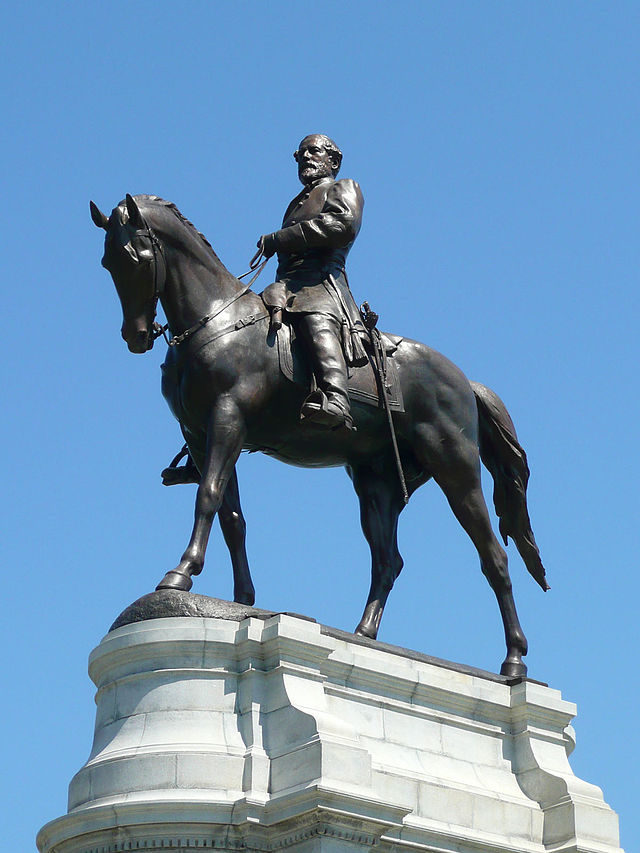
Monument_Ave_Robert_E._Lee, public domain Wikicommons.jpg
Robert E. Lee, public domain, wikicommons


Growing up in Richmond, Virginia, the former Capital of the Confederacy, with statues of Robert E. Lee, Jefferson Davis, Stonewall Jackson, and JEB Stuart adorning our major thoroughfare, Monument Avenue, one could not help but feel a sense of pride in being “Southern.” Stories were everywhere, and the pride of being Southern lay not in the reality of the war, but in little girls’ visions of verandas and sweet tea, white gloves and hoop skirts! It had nothing to do with slavery, especially since even in 1960, when I was eleven years old, blacks were pretty much completely segregated from whites.  As a white child, I didn’t know it should be different, I am sorry to say. By the time I was six, I knew the “Rebel Yell,” which we used to summon our playmates when we went outdoors to play. The South was highly glorified of course. As I grew up, I learned that there was so much more to the story, of course.  My genealogical research helped me truly understand.


One of my four maternal 2nd Great Grandfathers  was Robert Kerse, an Irish emigrant arriving in America in  1850 at age 18.  He married and had three of his ten children by 1861, then fought in the Civil War as a Confederate, protecting his own city of Richmond, Virginia.  His one and only horse was shot out from under him! Right on Fold 3, a genealogical site for military research, I can find his muster roll sheets, and letters from his superiors attesting to the fact that his horse was shot out from under him in battle, and that his claim against the US government after the war, to get a new horse, should be honored.  Oh my gracious!

Robert Kerse-- in the U.S., Civil War Soldier Records and Profiles, 1861-1865

Name:
Robert Kerse
Rank at enlistment:
Private
State Served:
Virginia
Service Record:
Enlisted in Company B, Virginia 2nd Infantry Regiment.
Sources:
Index to Compiled Confederate Military Service Records


Another maternal 2nd great grandfather, James Steptoe Langhorne, called Steptoe, was blind, but owned a huge, 13,000 acre plantation in Patrick County, Virginia. His family stretches back to Jamestown. He did not fight in the war obviously, but he did have the experience of having the Yankee forces steal his horse! The story, involving Steptoe and his daughter Fannie  was originally told to me by my cousins. (cousins found through genealogical research) brothers, and Fannie’s grandsons: Harvey Langhorne Spangler and Dr. Daniel Patrick Spangler, PhD)     

“At the time Miss Fannie Langhorne was ten, and the Civil War was being fought, Stoneman brought his Yankee army from Tennessee down what is now the J.E.B. Stuart highway. In passing they annexed one of Mr. Langhorne’s horses which happened to be his favorite. He, though blind, accompanied by his small daughter Fanny, insisted on following the army to Stuart in search of his horse. There the captain agreed to allow him to retrieve his horse if he could recognize him. Mr. Langhorne set Fanny to hunt the animal. After walking down the long line of horses hitched to the racks along the road and back again, she was unable to find him. On her return, however at one side, away from the rest, she saw her father’s mount and immediately squealed in delight. Mr. Langhorne was led over to a tall roan mare, not his, but near the one Fanny had discovered, and told to see if that were his. Fanny squealed to the contrary, but Mr. Langhorne turned to her and said, “You don’t understand the joke”. Then his hand was placed on another, his own; this time he said, “This is my horse, but not my bridle”.   (If you’d like, you can find this story here: http://www.mtnlaurel.com/mountain-memories/406-fannie-langhorne-spangler-an-interview-from-1935.html )  That took courage and audacity, on his and young Fannie’s part!   


My third maternal 2nd great grandfather, William W. Stoops also served in the Civil War. He served in Company G, 21st Regiment, Virginia Cavalry.  It was made up of older men who could not do the long marches so it was a cavalry that stayed close to home to protect railroads, bridges, and mines.


My fourth maternal 2nd Great Grandfather was an Italian Immigrant, Louis Botto. It looks like he arrived in America perhaps about 1844, and he and his wife, my grandmother, Catherine Revaro Botto, had their first child in Richmond, Virginia, in 1857. I believe he had a brother named Frank Botto, and we can clearly see Frank registered to fight in the Civil War. Unfortunately, although I can find Louis Botto in the 1860 census, I’ve yet to find him anywhere else, except that his wife is listed in the phone book as the widow of Louis Botto and by 1866, she has remarried.  I wonder if Louis was killed in the war? Did he get sick and die? Did he leave the family, as I find Louis Bottos in several other areas of the country? I still have a ways to go in my research to prove this.


While part of my mother’s family traces back to Jamestown, the founding colony of America, as you can see, my family is a melting pot of nationalities. So as I grew up “basking in the glory” of being a “Southern Belle” (not really, not from age 12 on), what about my paternal side?  I did realize, as I grew older,  that my father’s side of the family were Yankees.  Not only that, when I started doing my genealogical research, I discovered that my father's  Grandfather, my first great grandfather, Lewis Jacob Youngblood, 1846-1919, fought in the Battle of Petersburg,Virginia, as part of a New Jersey Cavalry Regiment!  After the war, he came back and lived in Petersburg where he had fought, because supposedly he “thought it was such a beautiful area.”  This past year, one of my cousins’ found Lewis’s discharge papers from the Civil War!  I got to see them as well as his sword, and his gun, all owned now by different cousins!  Kay Youngblood Fuller, my cousin, owns not only his discharge papers, but found his own journal which explains that he was an IRS tax collector for the Federal Government, and that he readily foreclosed on farms, and often bought them himself--farms in the Petersburg area-- when recovering Confederates were unable to pay! What a way to get revenge on your enemies! He was a carpetbagger! My own Great Grandfather was a carpetbagger! “In United States history, a carpetbagger was a Northerner (Yankee) who moved to the South after the American Civil War, especially during the Reconstruction era (1865–1877), in order to profit from the instability and power vacuum that existed at this time.”   --http://www.history.com/topics/american-civil-war/carpetbaggers-and-scalawags--also the source for this illustration below:
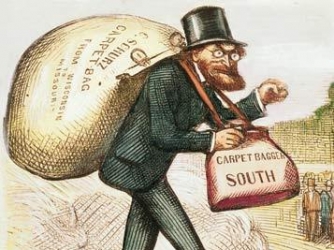

carpetbagger-AB.jpeg

One cousin told me that when Lewis moved to Petersburg, he joined the local Methodist Church, Gary’s Methodist Church.  They say he was so hated, that when he came into the church and sat down, the whole congregation stood up and moved to the other side of the church! My poor grandfather and his siblings had to grow up this way! How would Lewis Jacob  feel to think that 100 years later, he had a great granddaughter who prided herself in her Southern heritage!
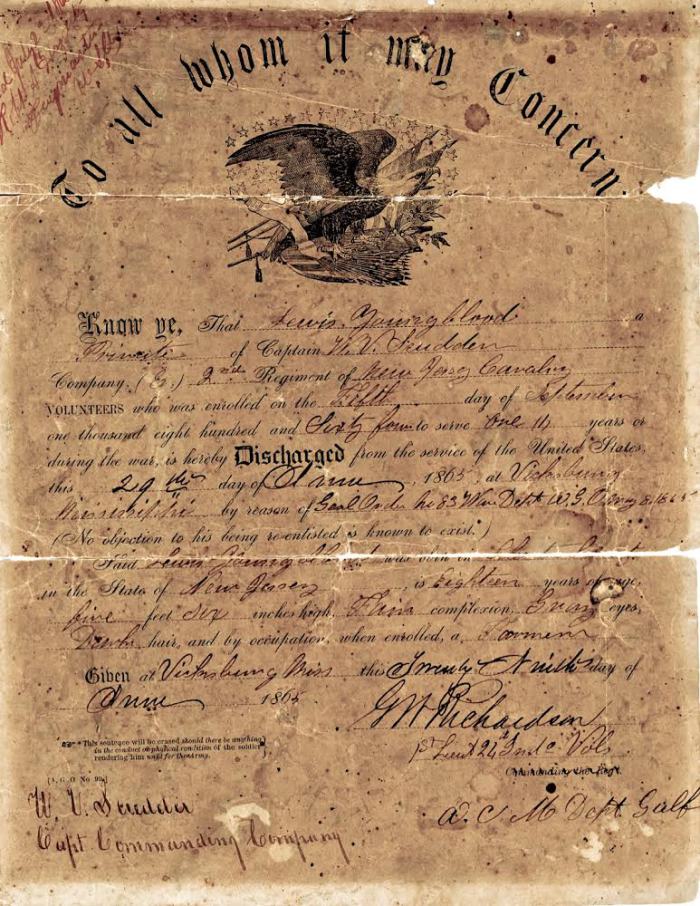
Youngblood, Lewis Jacob, discharge papers from Civil War.jpg
-for pictures of Lewis Jacob Youngblood’s rifle and sword from the Civil War, see my blog post at Heart of a Southern Woman, heart2heartstories.com   http://heart2heartstories.com/2014/11/05/lewis-jacob-youngblood-1846-1919-52-ancestors-in-52-weeks-44/


Hugh Jackson Hogue, 1825-1870, Pennsylvania is my 2nd great grandfather on my father's side, and is of Scottish descent. He, along with his son, my great grandfather, Robert Fulton Hogue, 1850-1924, also fought at the Battle of Petersburg, and Robert came back to settle there as well! Robert was underage, only 15,  when he joined his Dad in Petersburg, and served as a bugle boy, a water boy, and took care of the horses. In later  years,  Robert’s daughter, Helen Blanche Hogue married Edwin Spear Youngblood, son of Lewis Jacob Youngblood, both children of Yankees who relocated to Petersburg, Virginia, both families members of Gary’s Methodist Church.  Had the fathers met in the war, or did they meet in church when being shunned by others?  What would it have been like to grow up in a small southern town, a yankee revenue agent for a father, just after the Civil War? How is it that Edwin  and Helen’s son married a Southern girl from Richmond, Virginia? Of course, she was only partially a  “Southern girl”--she, my mother, was Irish and Italian also, and proud of those heritages.


My other two paternal great grandfathers did not participate in the Civil War, one, Edwin Speer whose ancestors hailed from the Netherlands and Germany,  was too old, with the next generation too young. The other was a German emigrant, Gustavus Voelkler who only arrived in America about the time the Civil War was ending. Lucky them.


Again, the melting pot is evident. Dad’s family includes Scots, Germans, and Netherlanders mostly. Mom’s English, Irish, and Italian mostly. It always amazes me! The Kerse’s of Ireland, were originally the DesCearsais family of France!


One hundred fifty years from now, 2015, will be the year 2165. It’s possible I will have a 2nd or 3rd great grandchild who is my age by then. What will I have done that they might discover that will affect the way they think of me, or the way they think period, the way they regard history? Wow, that’s a humbling thought, yet now I know that my ancestors affected history, they fought, they struggled, they were there. They have affected me by sharing their beliefs, their courage and strong wills, their desire to make a difference--traits I feel in myself today!  


Would I have been a Confederate or Yankee if I were alive during the Civil War?  If I were a child, of course, I’d have done whatever my family did, and possibly been a southern Confederate. However, after all these years of being proud of my Southern heritage, I could never support slavery...so I suspect I would have been a Union sympathizer if not an outright flag waving Yankee! I see this same type of civil strife continuing everyday of my life. Our country in 2015 is about as polarized between the Democrats and Republicans as it was in 1861! Some even think we’re moving again towards a Civil War! While I feel very strongly about my political views, would I pick up a gun and shoot someone over it? I can’t imagine!  I might get angry at a neighbor or family member who believes so very differently from me-- that doesn’t mean I don’t respect their right to have those views, just not to force them on me. Having strong beliefs can lead to conflicts, broken families, even wars, I see it in my own family, and in our world.


What might your descendents think of you, of your lifetime? --our lifetime? It’s a lot to consider, but our genealogical research leads us to these questions.


Sunday, 22 March 2015

Time for Formal Genealogy Education?


Once bitten by the genealogy bug many people want to enhance their knowledge and skills.  Education comes in many forms, including guide books, webinars, podcasts, magazines, lectures, workshops, conferences, fairs, and informal and formal courses.  For those who want recognition of their achievement, academic credit or are preparing for a career in genealogical research, how do you compare educational opportunities?

I will restrict the comparison to a selection of current offerings in the UK and USA.  Education systems differ between countries, but I am going to assume that postgraduate courses are more advanced and intensive than undergraduate courses.  Academic awards of degree, diploma and certificate qualifications require an extended duration of study of a range of topics.  Component parts of academic qualifications are also offered as stand-alone courses or modules.  Courses with academic credit involve assessment of the knowledge and research skills gained.

It is harder to compare courses without academic credit.  Recognition of participation may be given in the form of an informal certificate.  Course descriptions such as beginners, intermediate and advanced give an indication of the level of study, but may not have been benchmarked against academic standards.  Typically non-credit courses are of short duration.  Continuing professional development (CPD) is a recognised method updating and acquiring skills in many professions.  Non-credit courses can be part of CPD.

The total number of hours of study can be compared between credit and non-credit courses.

Academic Qualifications

Two UK universities offer postgraduate programs culminating in Masters degrees.  The University of Strathclyde program in Genealogical, Palaeographic and Heraldic Studies progresses through the postgraduate certificate and diploma and MSc.  The University of Dundee program in Family and Local History also progresses through postgraduate certificate and diploma to MLitt.  Each of the phases are rated at 600 hours of study, so a Masters degree totals 1800 hours.

Though not a university, the Institute of Heraldic and Genealogical Studies (IHGS) offers a Certificate, Higher Certificate, Diploma, and Licentiateship in Genealogy.  The Higher Certificate is at a similar level to the Strathclyde University Postgraduate Certificate, indicated by the two institution's reciprocal entrance requirements.

In the UK, there are no undergraduate (bachelor level) degrees in genealogy.  In contrast, in the USA there is an undergraduate degree, but no postgraduate qualifications in genealogy.  Brigham Young University offers Bachelor degrees with a major or minor in Genealogy-Family History, and an undergraduate Certificate.  By my calculation, the major equates to 1833-3080 hours of study, a little less than the 3600 hours of a typical UK Bachelors degree.  The minor equates to 792-960 hours and the certificate to 600-720 hours.  The degree hours include some non-genealogical courses required to meet the university's broader education remit.

Courses without Academic Credit

Universities are not the only institutions offering genealogical education, and some universities offer  courses without academic credit.

In the USA, 5 day residential institutes, Institute of Genealogy and Historical Research (IGHR), Genealogical Research Institute of Pittsburgh (GRIP), and Salt Lake Institute of Genealogy (SLIG) offer mostly intermediate and advanced courses in methodology and specialist topics that equate to 40-50 hours of study.  The Virtual Institute of Genealogical Research offers shorter 2 day courses.  The residential institute format is well regarded, so this year it crosses the pond with the University of Strathclyde's introduction of the Summer Institute of Genealogical Studies (SIGS).  It is aimed at professional genealogists and intermediate to advanced level hobby level genealogists.

Family History Skills & Strategies, presented by Pharos tutors and the Society of Genealogists, may be taken with assessments earning the student a certificate, which is not currently recognised by other institutions. It is comprised of 10 courses, rated at UK  'A’ level or first-year undergraduate level, that total 168-210 study hours.

Non-academic credit courses include the Certificate in Genealogy and Family History from the University of Washington, which represents 90 hours of study, and  the Certificate in Genealogical Research from Boston University, which I estimate represents 75 hours of study.

What education do you expect a professional genealogist to have?

What level of genealogy education do you, as a member of the public, expect a professional genealogist to have attained?  Where would you draw the line in this list:
  • Masters degree 
  • Postgraduate diploma
  • Postgraduate certificate
  • Bachelors degree
  • Non-credit certificate
  • no formal courses, but researched own family

Would you hire people with different levels of expertise for simple and complex work?

Is there a minimum number of study hours needed before a person can be considered a competent genealogist?

Doing genealogy for money is unregulated, so anyone can set up a genealogical research  business.  The debate about what makes a professional genealogist is ongoing and at times heated, but few would deny that genealogical education is a significant component.  Following a symposium, The Future of Professional Genealogy? last August, a Register of Qualified Genealogists has been proposed.  Input on public expectations and preferences will help make the register more useful for those seeking professional help.  So, please contribute your answers to the questions above.