Showing posts with label United States. Show all posts

Friday, 19 June 2015

New Indexing Project Challenge...Gift of Love...African American Freedmen's Bureau Records

Today in celebration of the Juneteenth, there was a special news event announcing the Freedmen's Bureau Project. Juneteenth is the oldest known celebration commemorating the ending of slavery in the United States.  Specifically it dates back to 1865. It was on June 19th that the Union soldiers, led by Major General Gordon Granger, landed at Galveston, Texas with news that the war had ended and that the enslaved were now free. This was two and a half years after President Lincoln’s Emancipation Proclamation. It was the end of southern resistance to President Lincoln’s proclamation. It is a Holiday in Texas commemorated every year.
Reproduction of the Emancipation Proclamation at the National Underground Railroad Freedom Center in Cincinnati, Ohio from Wikipedia
If you do not have a good understanding of what the African American Freedmen's Bureau Records are the FamilySearch Wiki page will give you a greater understanding of what records are involved. At the end of the page are some great links to give you further information.

FamilySearch International, the National Archives and Records Administration (NARA), the Smithsonian National Museum of African American History and Culture, the Afro­-American Historical and Genealogical Society (AAHGS), and the California African American Museum are partnering to make the images available, and free for anyone to view and search.  The main focus at present is for volunteer indexers to join the effort to get the records indexed in record time.  Would you like to help?  Go to the Afro­-American Historical and Genealogical Society (AAHGS) website and click on the image of Juneteenth, or go to The Freedmen’s Bureau Project and click on the volunteer now button.
Volunteer Now page for the project.

This comes at a time that the United States needs a healing element of love. The gift of volunteering to make these records searchable will be just that a labor of love.  All help will be greatly appreciated,
See you next month. 

Tuesday, 25 November 2014

The Importance of Planning

My husband commutes to Albany, New York, a couple of times a month for work. Last month I accompanied him on one trip, and we drove instead of flying. Neither of us have any known ancestors near Albany, but his paternal ancestors lived in the Hazleton, Pennsylvania, area. We are stopped there to do some research and visit the cemetery where his grandparents and several aunts and uncle are buried.

We’ve been to Hazleton before, but I was a neophyte about genealogy trip planning and did none. We found the cemetery but not their graves; found and photographed their house; and learned a bit about what the lives of anthracite coal miners were like.

The Saints Peter and Paul Lithuanian Roman Catholic Church Cemetery in
Hazleton, Pennsylvania

 This time I followed Heather Wilkinson Rojo's advice. Before we left I did the following:
  • Called the Saints Peter and Paul Lithuanian Catholic Church only to discover the church closed in 2009 and their records are now housed at Transfiguration Church.


Saints Peter and Paul Lithuanian Roman Catholic Church
in Hazleton, Pennsylvania, which closed its doors on
8 July 2009


  • Called Transfiguration Church and learned they do not allow the public to look at their records. They were, however, willing to provide information if you knew specific ancestors’ names and birth and death dates of the events. The church secretary very thoughtfully emailed me the plot locations the day before we left.
  • Made an appointment with the Hazleton Historical Society Museum, which is open only by appointment. The appointment needed to be made at least a week before the trip.  The society has some back issues of the local newspaper and old city directories. 
  • Learned the Luzerne County Historical Society's collection of Hazleton newspapers is not available to researchers because they are being digitized (yeah!) So I struck this stop off our list.
So how how was our trip? Much more fruitful than our 2009 trip when we arrived with a map no plan. We photographed the headstones of Adam and Cecelia Dagutis, my husband's grandparents; his first cousin, who was killed in a sledding accident at the age of 4; his uncle's grave; and his by-marriage uncle, father of the little boy mentioned previously. We also made some stops along the way to photograph and transcribe war honor roll memorials for Heather's Honor Roll Project.


My husband's paternal grandparents' headstones at the Saints Peter and
Paul Lithuanian Cemetery
The host for our private tour of the Hazleton Historical
Society and Museum. He said he was Tyrolean; Pete
was Lithuanian; and I was a disappointment because
I had no ancestors from Hazleton. Quite a character!

I certainly learned the importance of planning a trip as we would have been disappointed at every turn if we thought we could just drop in and start researching! Thank you, Heather!

The church secretary later sent me copies from their "death book" of the entries for my ancestors. There is just one wee problem. The church secretary thought they were in Lithuanian and my work colleague, who emigrated from Lithuania and can read and speak the language, doesn't recognize it but thinks it Latin. 

Sunday, 19 October 2014

Halloween Traditions Past and Present.


This post is totally a personal post and relating to the United States. It is nearing Halloween. My children have always loved the fun of this day.  I wanted to write my parents story, learn a bit more, and share how it has changed for my children. It was not surprising when my children asked my dad how he dressed up when he was young.  This is his answer.
His most memorable Halloween was when he and about 6 other teenage boys got together and decided to trick one of their "grumpy" neighbors.  His neighbors were not next door like what you think of today, more like miles apart.  I digress, back to the story. 
According to him they would begin thinking up mischievous things to do weeks ahead of Halloween.  They had to have a plan in order to carry out their trick and make a clean get away.  He did not remember any treats associated with Halloween. This is his story.
“We waited until dark and met in the field to carry out our plan (how they did these things I don't know). We carefully lifted up his team of mules up on the top of his shed, quickly dispersed to our homes quietly.  The next day we heard our parents talking about what had happened to Farmer ___.
We didn’t own up to anything, because we’d get a whipping.” (If it were my boys, there would have been serious consequences). He said no one ever  told.

“The other farmer we just moved the outhouse behind the pit. We heard that his son went out in the night and fell in the hole where the outhouse had been.” (I don’t know about you, but I when I was little we had an outhouse. Yuck! ) 
http://en.wikipedia.org/wiki/Outhouse 


My dad still thought at 60 years of age that the face of the farmer would have been funny to see when he saw his mules on top of the barn. My dad was born in 1915, so he fell in the years of the expensive prank time period.  The Historyof Halloween  sheds some light on this time period.
It was not a relatable story for my children, because it would be another 8 years before they would even see an outhouse.  I thought it was a neat story, but was glad my sons were not old enough to understand. J
My mom on the other hand did not have a Halloween story at all.  She was too scared to even think about ghosts and such.  Her brother would wait until she was in the outhouse (there is that word aging) and then make ghost sounds, which would almost make her fall in the hole. 
He loved telling her the murder story of a couple in town (only 5 houses down) and how they laid in the store overnight that scared her so badly, she never forgot the story. She ended up researching it and writing about it when she became an adult. Scary things were never something she relished, but she did love having a big bowl of candy for the kids to chose from Halloween. She also loved decorating her class room at school and seeing the kids come dressed up to school on that day...another thing of the past. 
For myself, I fell in the post World War II group which also appears to relate to lack of sugar rationing and the beginning again of treats.
I only remember one time of going out trick or treating.  I was dressed up like a princess and went with a group of kids. What I remember most, was one house had really gone all out to have a scary haunted looking house.  I went up with a couple of kids to knock on the door, and a really scary looking witch opened the door.  I was so scared, I ran down the steps to run across a vacant lot.  I did not see the wire some surveyors had stretched along the property line and did a flip and ended face down in the moist cold ground.  That was it. I was up and down the road to return home as fast as I could go.  This is my only personal trick or treating Halloween childhood memory. The rest of the time it was handing out treats to those that came to our house. Something occurred to me, when I say treats, it was not always candy.  It could be popcorn balls, cookies, or many different homemade treats.

­­­­Just before my first child was born there were a series of murders in Houston that took trust of your neighbors down a huge notch.  Then a man covered up his murdering his son with putting poison in candy.  That really changed the thought on Halloween trick or treating for me.  Funny I never really thought about the trick part.  That brings us to my children and grandchildren and how trick or treat happens for them at this time period.  It appears to me it is all about costumes, well there still is candy or “alternative treats” like sugar free gum.   The treats must be in undisturbed company packaging.
They were just starting community Halloween activities in our area when my first daughter turned 5.  That was still in the 1970s.  When we moved to the country it was in full swing. Our first Halloween there was celebrated at a local maintenance barn for the “city”.  My daughter was Bianca of “The Rescuers”.   She was not into scary. 
The Hero and my mom in the background, daughters and son in foreground. I made the costumes. J

We had several years of our church creating their own Halloween activity night to keep the children off the streets.  They had games, class rooms became “homes” for the kids to drop by and trick or treat for candy.  It was a fun event that my children loved.  Then some became anti Halloween and called it Fall Festivals, it quickly died as an event, which brings me to what I see today.
In my area, the number of house to house trick or treating or church festivals the night of Halloween has gone down to almost none existent.  We have what is called trunk or treat.  I don’t think I have seen anything this elaborate, but I can understand the thought behind it. There are also Malls or department stores that have "Halloween Trick or Treat Night".  The most fun was the Assisted Living at my mother in law's. 
My mother in law at 91 in her assisted living waiting on trick or treaters.
My grandchildren, in a small town, still have house to house trick or treating and it is very important to them. This is an example of their letters to me:
my grandson

My granddaughter that decided to make her own mermaid costume. J

I really have had fun making costumes through the years.  Still do occasionally when there is special request.  I hope the fun of dressing up never goes away.  From ghosts, to pirates, to princesses, it is a fun thing to see the imaginations and creativity of youth fly to come up with the best costume ever. 
I wrote a blog on this here.  I think it is a good thing. J

Do you have a Halloween tradition or story from your area?  
See you next month.

Saturday, 4 October 2014

A Baker's Dozen of Genealogy/Family History Books

A few from my list - you can find many of these at your local library!

Last month at this time I shared ten books (well I cheated a bit with some series books but hey, what is a bibliophile to do) that have had an impact on my life. I promised that I would be back this month and share ten books that have had an impact on my genealogy life (could not fit all that in the title - too long!). That might seem like a tall order, but I think I can handle it. So let's get sharing (if you have a book that has impacted you, please share it so we can all benefit!).

(1)  Evidence Explained: Citing History Sources from Artifacts to Cyberspace by Elizabeth Shown Mills - this book is simply the best! If you want to understand how citations work and why they are important, look no further than Evidence Explained. Ms. Mills not only explains the reasoning behind various citations, she also shares examples of most every type of source citation. And if you read the beginning chapters and pay attention, you will be able to craft you own source citation for any work for which she did not provide an example. I am a huge fan of "watching/reading and learning" and Ms. Mills' writing is clear, concise, and gently nudges genealogists and family historians to reach for the next level. Every genealogist needs to own this book.


(2)  Professional Genealogy: A Manual for Researchers, Writers, Editors, Lecturers, and Librarians edited by Elizabeth Shown Mills - what can I say, this woman is on a roll! Whether you want to take your hobby, passion, or profession seriously and understand all the important business, financial, and ethical requirements or you simply want to understand how to make the best use of a genealogy professional, this is the book for you (put it right next to Evidence Explained). Professional Genealogy serves as the textbook for ProGen Study Groups. You will definitely wring everything out of this book if you join a ProGen group. Whether you join a ProGen group or go it alone, you need Professional Genealogy.

(3)  Destination America: The People and Cultures That Created a Nation by Chuck Wills - do you want to understand how all of the people who came to America shaped and added to our nation's rich tapestry of multiculturalism? This gorgeous book (spoiler alert - maps and lots of photos - you won't be able to put it down) was the basis of a PBS series by the same name put together by David Grubin. Destination America contains amazing stories of where immigrants came from and why they left their native lands, lovely photos and maps (oh yes maps!) and the chance to gain a better understanding of how our freedoms (freedom to worship, freedom from oppression, freedom from want, freedom from fear, and freedom to create) have been strengthened due to the efforts of all our people. Destination America introduces us to the original native Americans as well as most religious or ethnic groups that joined them here. As a country, we don't always get it right (and sometimes we get it very wrong) but we do aspire to be better. Destination America will remind you of what your own group(s) went through and help you appreciate the stories of other groups of your fellow Americans.

(4)  Our America: A Hispanic History of the United States by Felipe Fernandez-Armesto - American history is often taught through a prism of British history, but that is only a part of our story (think about the Native American population, as well as French, Russian, and Spanish interests). Our America serves as a reminder that the United States' history is just as much the story of Spanish colonization as any other group's colonization. Our America reminds us of the Southwest and West regions' rich history. Our Hispanic past is just as important as any discussion of the Pilgrims and the 13 colonies.

(5)  Geography and Genealogy: Locating Personal Pasts edited by Timothy Dallen and Jeanne Kay Guelke - this one is a bit hard to find (go to your college and university libraries) but is worth the trouble. Geography is such an important aspect in genealogy and it usually gets short shrift. I recently took several courses in cultural and physical geography and they opened my eyes to all the factors that affect people, culture, and place. Whether you want to understand the questions of why people settled where they did, how they lived, how natural and man-made barriers affected their lives, what migration patterns were and how they have changed over time, the push-pull factors of migration, and a host of other topics - the study of geography provides the answers. This book provides an introduction to the field of geography as it relates to genealogy. Combine Geography and Genealogy with a few classics like Longitude: The True Story of a Lone Genius Who Solved the Greatest Scientific Problem of His Time by Dava Sorbel and Geography: Realms, Regions and Concepts by Harm J. De Blij and Peter O. Muller (the newest edition is available as a rental eBook!), as well as the very readable newer entries that combine history and just plain fun, including The Discoverers: A History of Man's Search to Know His World and Himself  by Daniel J. Boorstin and Maphead: Charting the Wide, Weird World of Geography Wonks by Ken Jennings - and you will see our world in a whole new light.

(6)  Tracing Your Irish Ancestors: the Complete Guide by John Grenham - this book is an excellent primer on Irish family history research. It is important to understand the history of a place, its physical layout and system of record-keeping and, of course, what is available (offline and online). For anyone serious about researching their Irish ancestors this is the book. Mr. Grenham has a number of other publications (in both book and CD-ROM format) that are also especially helpful - Clans and Families of Ireland, Grenham's Irish Surnames and Grenham's Irish Recordfinder. Combine Tracing Your Irish Ancestors with A New Genealogical Atlas of Ireland by Brian Mitchell and Irish Records: Sources for Family and Local History by James G. Ryan, and you will have your Irish research resources covered.

(7)  Finding a Place Called Home: A Guide to African-American Genealogy and Historical Identity by Dee Parmer Woodtor - for African-Americans researching their genealogy and family history and for all those wanting to understand the family history of African-Americans in our county, this is the book. An excellent resource to find out about how slavery (and the concept of people as property) affects our research from as early as 1790. Finding a Place Called Home is not only a genealogy resource but a fascinating history of a people through time - slavery, the Civil War, Reconstruction, WWI, WWII, the Civil Rights movement, and migration resulting from these events. African-American history is American history and African-American genealogy is American genealogy - it touches all of us and this book is an excellent introduction.

(8)  The Source: A Guidebook of American Genealogy by Loretto Dennis Szucs and The Red Book: American State County & Town Sources edited by Alice Eichholz are essential genealogy reference books, so much so that Ancestry.com puts them front and center on their learning page (in front of their pay-wall - run don't walk there - okay use the magic of the internet!). If you want to figure out what records are available - whether on the Federal or local level, where those records are located in various State and County repositories, and how to get your hands (real or virtual) on them, these two books are the place to start. A note: researchers need to take the contact information and update it as more information becomes available online and datasets and office information change - but these books provide the history, the guideposts, and those all important breadcrumbs for further research. These books are at many libraries and sit happily alongside my copies of Evidence Explained and Professional Genealogy - they are that good and that useful.

(9)  Albion's Seed: Four British Folkways in America by David Hackett Fischer - a look at four waves of immigration to America: the Cavaliers to the Atlantic Southeast (Virginia), the Puritans to New England, the Quakers to Pennsylvania, and the Scots-Irish or Borderers to the Appalachians. This is an interesting book that speaks to English culture and its impact on populating the colonies in the 1629-1775 time-frame. I would encourage readers and researchers to take Mr. Fischer's conclusions and generalizations with a grain of salt - I don't think everything is so neat and tidy, but Albion's Seed does provide lots of information on the cultural and social history of these groups, together with references and suggestions for additional reading.

(10)  Organizing Your Family History Search: Efficient & Effective Ways to Gather and Protect Your Genealogical Research by Sharon DeBartolo Carmack - if you are anything like me you would like to know that you are on the right track and that you are approaching your genealogy and record-keeping in an efficient and effective manner. Simply put, genealogists want to know how to put all the information we gather together. Well Ms. Carmack does a fine job of helping us out in an easy to read and incorporate way. Sometimes you will nod your head (done that) and other times you will have an "aha moment." The best method of organizing our research and results is the method that we will actually use day in and day out. Check out Ms. Carmack's suggestions and get organized!

(11)  The Surnames Handbook: A Guide to Family Name Research in the 21st Century and DNA and Social Networking: A Guide to Genealogy in the Twenty-First Century both by Debbie Kennett - these areas of research are relatively new to most of us. Both DNA and Social Networking and The Surnames Handbook are well-written and contain a wealth of website links and resources to assist us in our studies. Ms. Kennett's clear and concise explanations of DNA studies (so much has changed since my university biology classes!) and social networking (how to best use all the tools at our disposal and not be overwhelmed by them) help genealogists and family historians understand how to make the best use of both. Ms. Kennett's guide to surname research is thorough and quite readable. Surname research, as a facet of family history, is expanding on a worldwide basis and Ms. Kennett's guide is an especially helpful introduction.

(12)  Seven Pillars of Wisdom - The Art of One-Name Studies edited by the Guild of One-Name Studies and Putting Your Ancestors in their Place: A Guide to One Place Studies by Janet Few - those of you who know me, know that I am working on a one-name (surname) study and a one-place (location) study. At some point I hope to encourage enough Keoughs to join the existing Keough-DNA study (but that is still a future thought). While our own family history and genealogy is interesting, I do think that putting those who share our surname or our place in context is a fascinating area of specialized family history research. The methodology and projects suggested in Seven Pillars and Putting Your Ancestors in Their Place are incredibly helpful to the family historian who wants to take her/his research further and connect it to the bigger picture or puzzle out possible connections.

(13)  A People's History of the United States: 1492-Present by Howard Zinn - what can I say - a history of the United States told from the viewpoint and in the words of the people who have made this country and who are not often heard from - the women, the Native Americans, the immigrants, the factory workers, the farmers, the laborers, and the working poor. This is not the history you learned in your unwieldy and cursory high school or college textbooks. This is not the history told by the establishment. Be sure to take Mr. Zinn's A People's History with a grain of salt, but also realize that history is written by the winners. It is important to understand our past and look at all sides of the story. Wear your critical thinking eyeglasses with this one, but it is just as important to not wear our rose-colored glasses while we read either.

(14)  And because I am a bit of a cheat (I am sure you have counted more than my baker's dozen here) EVERYTHING by Ken Burns & Company is, in my humble opinion, brilliant and shines a light on our American family history. We and our extended families exist in a time and place and our experiences affect other people and other countries as well as our own. Be sure to check out these books which serve as companions to the Ken Burns for PBS documentary films. Although the films are wonderful, these books include much more detail (no time constraints, unlike film productions), provide additional resources, and explore the American experience from a variety of events or topics, large and small. My choices include the following:
    • The Civil War: An Illustrated History by Geoffrey C. Ward, Ric Burns and Ken Burns
    • Lewis & Clark: The Journey of the Corps of Discovery by Dayton Duncan and Ken Burns
    • The National Parks: America's Best Idea by Dayton Duncan and Ken Burns
    • Jazz: A History of America's Music by Geoffrey C. Ward and Ken Burns
    • The War: An Intimate History, 1941-1945 by Geoffrey C. Ward and Ken Burns
    • Mark Twain: An Illustrated Biography by Geoffrey C. Ward, Ken Burns and Dayton Duncan
    • Not for Ourselves Alone: the Story of Elizabeth Cady Stanton and Susan B. Anthony by Geoffrey C. Ward and Kenneth Burns
    • The Shakers: Hands to Work, Hearts to God by Amy Stechler Burns and ken Burns
    • Horatio's Drive: America's First Road Trip by Dayton Duncan and Ken Burns
    • The Roosevelts: An Intimate History by Geoffrey C. Ward and Ken Burns
Books - Glorious Books! (image made with wordle.net)
Okay - there you have it! Did I miss anything that you think is a must read? You will notice that I have a bit of an American bent (hey I'm American), but I hope I have included enough varied topics and types of genealogy and family history books so that there is something you know and agree with and something that is new to you. Please share your choices of genealogy or family history books that have had an affect of you in the comments section. 

Cheers and Enjoy!
Tessa 

Wednesday, 5 March 2014

Sources - source of pride and envy

Two weeks ago, I flew to London to attend Who Do You Think You Are? Live! Although most genealogists I met were from the British Isles, I also got to meet genealogists from Belgium, Bulgaria, Canada, United States, Australia, South Africa and India. Worldwide Genealogists In Real Live.

One of the most fun aspects of this year's visit was being an expert on 'Ask the Expert,' where visitors can book free 20-minute consults. You can read about my experiences as an expert on my blog. I also met fellow members of the Association for Professional Genealogists and talked to many people at the stands.

Yvette with a Dutchgenealogy.nl bag standing at the balcony at Who Do You Think You Are
Me with my Dutchgenealogy.nl bag
(easier to spot than a rose in my lapel when meeting new people)
There was one thing I noticed while talking to this range of genealogists: how much we identify ourselves with our sources. Two genealogists from the UK independently told me, a bit smug, how their birth, marriage and death records go all the way back to 1837. Only to be surprised when I told them that in the Netherlands these records start in 1811, when the civil registration was introduced by Napoleon. Comparing our sources almost felt like a 'mine is bigger than yours' competition.

I must admit I take pride in the excellent records we keep in the Netherlands. I often work with genealogists from the US, where records typically start later or are less informative than their Dutch counterparts. Take US census records, for example. These only record families every 10 years (or 5 years if you are lucky and the state held a census in between the federal censuses). In the Netherlands, since 1850 we have had population registers that describe whole households, but they were kept up-to-date. Families were required to report their departure and arrival so the municipality could make sure the registers accurately reflected its residents. These records are so useful for genealogy and I love educating Dutch Americans about the possibilities for research in the Netherlands.

Example of a population register (Breda, 1917-1938)
It wasn't until I talked to these UK genealogists that I realized that pride in our sources can come across as snobbery. I'm used to being at the 'high end' of these comparisons, where my sources 'trump' those of my discussion partner. These UK genealogists were obviously used to that as well. The way we talked about our sources was almost like we felt superior to the other, which is strange since none of us have any influence on the hand we are dealt.

Genealogy Standards1
In fact, I think there is an upside to having fewer sources available. Over the last two years, I have been emerging myself in genealogical methods and standards as they are taught in the US, to prepare myself to become a Certified Genealogist. The Americans are light years ahead in terms of methodology, compared to genealogical education in the Netherlands. When you have fewer and less informative sources to work with, you must learn how to make the most of them.

In the Netherlands, the solution to almost any brick wall is always "find more sources." Building a case using indirect evidence even seen as sloppy genealogy by some, because you did not put in the effort to make another trip to the archives to find real evidence. In the US, genealogists need to learn how to combine indirect evidence from a range of sources to prove their case.

Reading about their techniques has been an epiphany for me and has helped me to solve several of my own brick walls. Techniques that work for finding enslaved ancestors have helped me trace serf ancestors. Lesson learned: no matter how wonderful our sources are, we can all learn from each other.

Notes
  1. Board for Certification of Genealogists. Genealogy Standards, 50th-anniversary edition. Nashville, Tenn.: Ancestry, 2014. 100 pp., paper, ISBN 978-1-63026-018-7.

Tuesday, 25 February 2014

My Favorite Virginia Genealogy Resource

The first successful English settlement in the new continent called America began in 1607 at what is now the Commonwealth of Virginia on a spit of land at the mouth of the James River. Everyone is likely aware that settlement was known as Jamestown. By the 1630s English settlements dominated the eastern portion of the Virginia Peninsula, though Indians still attacked intermittently.  Middle Plantation was established in 1638 halfway between the James and York rivers on high ground. By 1699 Middle Plantation was renamed Williamsburg in honor of the English king, William III, and replaced Jamestown as capital of the colony. The College of William and Mary began holding its first classes in temporary quarters at Williamsburg in 1694.

Print of the Bodleian Plate, depicting the colonial architecture of Williamsburg, Virginia. 
The plate, discovered in the Bodleian Library at Oxford, was critical to the reconstruction of Williamsburg 
in the early-mid 20th century. Courtesy of Wikimedia Commons.

The College of William and Mary includes the Omohundro Institute of Early American History and Culture. The institute publishes a wonderful resource for history buffs and genealogists entitled William and Mary Quarterly, which began publication in 1892. Chronologically it ranges from the first Old World-New World contacts to about 1820. The focus is North America and includes articles about all disciplines.

Why should family historians and genealogists care about the William and Mary Quarterly? Here’s one page from the table of contents of the July 1904, issue:

Index page from a William and Mary Quarterly

We should care because it’s loaded with 122 years of useful information. The trick is finding exactly the information you need. That’s when the Earl Gregg Swem Library’s Special Collections Database becomes very helpful. Some of the content is digitized, but not all. When something I am looking for has not yet been made available in an online format, I Google the issue specifics. I’ve found the issues I need on Ancestry.com’s Card Catalog, eBay, Google Play, available for sale at used bookstores through Amazon or ABE Books or I look it up on WorldCat and find the nearest library with a copy. I hope I’ve been able to help you discover a new source to use when tracing your Virginia ancestors.

I'll be attending the Fairfax Genealogical Society's Annual Spring Conference on 28-29 March 2014. I hope to see some of you there.

I'm using #WWGenealogy when tweeting about this collaboration project on Twitter (@TweetTRnT).

Saturday, 25 January 2014

Hello from the Old Dominion

I first heard about Worldwide Genealogy -- A Genealogical Collaboration from Fran Ellsworth, author of the Branching Out Through the Years blog. She sent me to Julie Goucher, of Anglers Rest, who told me there was one spot still available -- the 25th. Today is my day; but, after reading all of the previous posts, I feel seriously outclassed as a genealogist. I am a rank amateur. I am obsessed, though.

I hang out at my blog, Tangled Roots and Trees, Facebook, Twitter and now here. My social media goal for 2014 is to become active on Google+. I got my love of family history and genealogy from my father. He was the genealogist in our family for years, starting before the Internet made it so much easier than it was then. He wasn’t the best typist in the world so he would save up all his data entry tasks for my next visit. We spent hours together in his home office as I entered his latest research into the computer – all the while Dad would tell stories about our ancestors. He was a natural born teacher and storyteller.


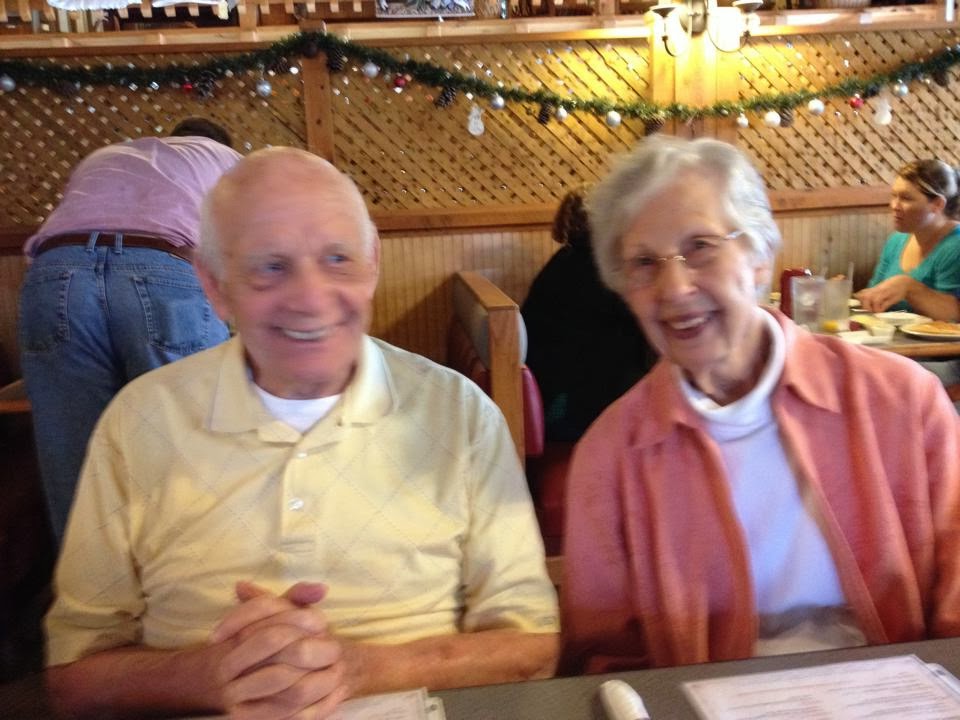
My octogenarian parents 

When I got a personal computer in 1994, the first software application I bought was for family trees. Since Dad was working on our family, I started on my husband’s. I didn’t get very far.  His parents were first-generation Americans whose parents came from Lithuania (Russia at the time), Austria, and Serbia (though they considered themselves German). My first big discovery was on the Ellis Island website when I found my husband’s paternal grandfather on a passenger list.

I would put down my research for months and years at a time and then pick it back up again. I’d find some new bits and pieces of information before hitting another brick wall. And so it continued until last year.

Dad suffered a massive cerebral hemorrhage and could no longer research our family. After seven months of brutal physical, occupational and speech therapy, he is again able to walk and understand what we are talking about, but he is not able to speak. I’m a Daddy’s girl so I was suffering. When Mom decided it was time to move into an assisted living facility with Dad, I brought all Dad’s genealogy files home when we emptied out their house.

Dad's genealogy files and old photo albums

And so began my obsession. I’ve connected with several genea-cousins online, and a couple of them have become friends and research collaborators. I purchased more old, musty books than is reasonable and haven taken a few genealogy vacations (thankfully I have a very understanding husband who goes with me). My biggest find that caused a happy dance, lasting for days, was connecting with a woman who owned two unpublished manuscripts written by my aunt’s brothers. Their father was a Church of God missionary, who took the family to British East Africa (now Kenya) in 1920. The family lived there for nine years. The stories of that time from the memoirs are wonderful and I’ve written about them on my blog in an ongoing “Out of Africa series.” Dad and I now have plenty to talk about, and we’ve discovered that while he can no longer speak, he can read. (The brain is a mysterious thing!) So I print out my posts and take them me when we go to visit. I also tell him about new genea-cousin connections I’ve made and how we are related.

Showing Dad how I was related to a recently discovered 4th cousin from New Zealand

Google Play has become a favorite app for my research. So many old county histories, written for the country's centennial anniversary, which contain biographical sketches, and old genealogy books are available. I also spend a lot of my research time on newspaper archive sites. Many require a subscription but others located at county historical societies or on Google are free. I do this because I enjoy learning more about an ancestor than just dates and places. I have discovered my ancestors did two things well: marry into interesting families and die in very creative ways!


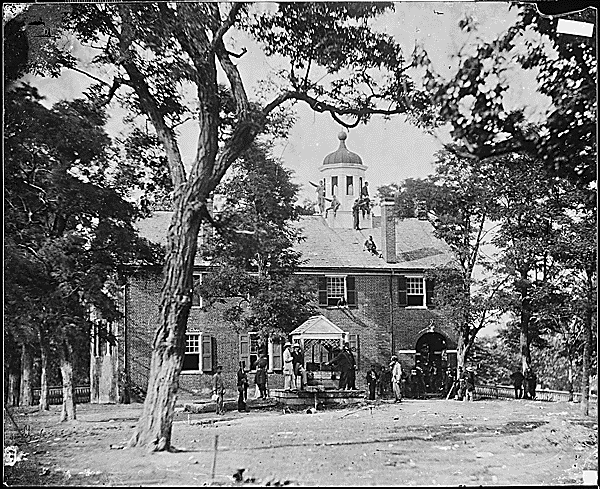
I live in Fairfax County, Virginia, and am more than willing to photograph headstones in the northern Virginia, Washington, DC, and southern Maryland area. I keep an up-to-date bibliography on my blog of books I own (digital and old fashioned). If I can look anything up in one of those books for you, I am happy to do so.


Union soldiers at the Fairfax County Courthouse in 1863 during the Civil War.
Photograph by Timothy H. O'Sullivan and courtesy of Wikimedia Commons

I work full-time and that seriously cuts into my research obsession, but it won’t last forever. When I retire I would like to start writing books. I consider my blog and this collaboration project good practice! Tangled Roots and Trees is not a typical genealogy blog; I leave the documents and the source citations on my tree. I tell stories instead about incidents in the lives of my ancestors and places in which they lived. I enjoy being able to marry my life-long love of history with my genealogy obsession.

Sunday, 19 January 2014

Howdy, From Texas... This Month

Hi, I am Fran Langley Ellsworth, also known as the Hummer.  It fits, as I “flit” from state to state visiting and loving on my children and grandchildren.
I was born an Okie (means I am from Oklahoma) but found my heart lies in my ancestor’s state of Texas, where I live now. Hmm, that means I must be from the United States.  I was married 39 years to my Hero. He was the reason I started blogging. I wanted to write his stories, and now it has branched out to our (his and my) ancestors.  Stop by and visit at the garden gate on Branching Out Through the Years to find out about the Hero stories, and my genealogy progress. I also have a blog about the joys of my life, Joyous Tomorrows. The Hero and I had 6 children, 4 girls and 2 boys.  Now, I have 23 grandchildren with one on the way. Life is so interesting. 
My six loves with the Hero.
You will find me on Twitter, Facebook, and Google+. I never started out to be a Social Media butterfly, I mean Hummer J, but after the hero died in 2008, I joined the ranks of the FamilySearch Genealogy support missionaries. I have worked in support in FamilySearch Indexing, in FamilySearch Wiki, in FamilySearch product support, and on Facebook Genealogy Research pages, I am struggling at present, as many are, to master the FamilySearch Family Tree, and, in general, social media support for FamilySearch. It has been wonderful and so many I have met this way have mentored my growth in blogging. I love the genealogy community and their loving support. 
Blogging about Indexing.
I love the sleuthing it takes to find an ancestor. It is better than putting a 1000 little pieces of a puzzle together, which my mother-in-law did as a hobby.  The Hero’s mom was from a Southern heritage, while his dad’s side of the family came from England and Ireland to Canada to the United States. Well, with one exception, his great grandmother’s parents were from Germany. Their story has been fun to tell. My family on the other hand, came to the United States on the Mayflower, my mom’s side and my dad’s, or so early I haven’t found my way back across the pond.  I have my hopes.  I have also entered the world of Autosomal DNA genealogy trying to prove some of my paper trails.  DNA is a new learning curve. I am now looking forward to the journey on the Worldwide Genealogy Collaboration  Project. 
The hardest part is staying focused. 
So that is pretty much me, I may be in California pinning my blog or in Idaho, maybe Oklahoma, but mostly in rural Texas with my birds, trees, and woodland critters keeping me company.