Showing posts with label history. Show all posts

Wednesday, 25 January 2017

Secret Wife of John Wilkes Booth, Presidential Assassin?

With the recent inauguration of a new United States president, I was reminded of some of the odd bits of presidential history. I found once such story in my sister-in-law's family tree. Martha Lizola Mills; her daughter, Ogarita Elizabeth Bellows; and her granddaughter, Izola Louis Hills, all believed Martha was the secret wife of John Wilkes Booth, the person many witnessed assassinated then president Abraham Lincolon. They also believed Booth escaped and lived several more years and that he fathered a son with Martha Lizola after Lincoln's assassination.

Documentation and the recollections of Martha Lizola's granddaughter, which she included in a book, This One Mad Act, agree. Her parents were Abraham Standish and Izola Maria (Mendosa) Mills. Abraham was the owner and captain of a trading schooner in the China Trade. He met his wife in Spain. According to Martha's granddaughter, Izola Maria died giving birth to her only daughter on board ship off the coast of Martha's Vineyard, during a storm. Martha Lizola was primarily raised by her aunt, Abraham's sister, Fanny (Mills) D'Arcy.

Martha Lizola (Mills) Bellows Stevenson
Photograph from This One Mad Act

Charles Bellows is never mentioned in This One Mad Act but Massachusetts marriage records indicated he and Martha Lizola were married 30 Jul 1855 in Boston. Rhode Island birth records listed Charles and Martha as the parents of Ogarita Elizabeth, who believed she was actually John Wilkes Booth's daughter. Navy muster rolls seem to prove that Charles could not have been the father as he was stationed on a ship off Montevideo, Uruguay, during the critical period.

The 1860 census indicated Martha Lizola was living in Boston with Ogarita and a son, Harry, aged  five. Little Harry disappeared from the records after that; so I assume he died as a child. Martha's story was that she was a young actress and met John Wilkes Booth in Richmond in 1858 or 1859. It was love at first sight. She said she and Booth lived on a small farm in Virginia's Shenandoah Valley and that Booth would return to their home between acting engagements.

After the Civil War, Martha Lizola married John Stevenson on 23 Mar 1871 in Boston. This is supported by Massachusetts marriage records. She claimed it was a marriage of convenience and that the son born to them a month earlier, Harry Jerome Dresback Stevenson, was actually the son of John Wilkes Booth. She claimed she married Stevenson, a friend of Booth's so she could travel to California and meet Booth while he was in hiding before leaving the country. It was during that meeting that Harry Jerome was conceived.

Harry Stevenson; photograph from This One Mad Act

Martha Lizola died in 1887 and is buried in Plains Cemetery at Canterbury, Connecticut.

Her daughter, Ogarita, was also a stage actress, and began using Booth as her stage name in 1884, six years before her death at the age of 32. Ogarita's daughter, Lizola Louise (Hills) was adopted by George Forrester, a Chicago newspaper man, after her mother's death. Her second husband, Mann Page, was my sister-in-law's 8th cousin once removed.

Ogarita Elizabeth (Bellows) Wilson Henderson
Photograph from This One Mad Act

So do you believe Martha Lizola (Mills) Bellows Stevenson married John Wilkes Booth and that he fathered two of her children?

_______________
Related posts: Izola Forrester: American Author and She Seemed Rather Fantastic and Extravagant.

Martha Lizola Mills was born at Stamford, Fairfield, Connecticut, in 1837 to Abraham Standish and Izola Maria (Mendosa) Mills. Her father was a sea captain. She married first Charles Still Bellows on 30 Jul 1855 at Boston, Suffolk, Massachusetts; second John H Stevenon on 23 Mar 1871; and third, according to her granddaughter, but no documentation has yet been found, Edwin S Bates two or three years before her death. She died in Nov 1887 in Canterbury, Windham, Connecticut and is buried in Plains Cemetery at Windham. She went to her death believing she had been married to John Wilkes Booth, that both her children were his, and he escaped capture at the Garrett farm and died in 1879.

According to Wikipedia, muster rolls indicate Charles Still Bellows was aboard a ship near Montevideo, Uruguay, for the critical time period, making it impossible for him to be the father of Ogarita (Bellows) Henderson, Izola Forrester's mother.

Thursday, 19 February 2015

Journeying Back to Your Ancestor's Time; My Person Journey

The process of journeying back to your ancestor's time has been the discussion in many videos lately, which brought me post this.

First I started at home.  I was wanting to know about the pictures I saw in my mother's picture box of men on horses that were obviously military, but I did not know who or where. I started by asking my mom about this. She said they were her father's, he served in the Spanish American War and her mother received a pension from that. She emphasized that he died when she was 2 months old, and so he did, which was why she didn't have any stories.
Picture owned by Fran Ellsworth 
My second step was looking for his military pension. I did not find it in the Spanish American War files.  I found their pension indexes mixed in with the Civil War indexes from the NARA T289. Pension applications for service in the US Army between 1861 and 1900, grouped according to the units in which the veterans served.   This discovery was on Fold3. I now knew that he was in Company B of the 38th Infantry Battalion.  I also had his muster in and muster out dates, as well as his death date. He enlisted September 11 1897 in the U.S. Army Volunteer Infantry and fought in the Philippine American War,
If you are wondering about your ancestor and the Spanish or Philippine Wars this site Spanish American War Vs Philippine American War is a great one to read.

On Ancestry.com, I found him and his 2 brothers, Robert C Whitson, and Oscar Whitson on the 1900 US Federal Census at Battalion at Batangas, Philippine Islands, Military and Naval Forces in the same battalion.
Ancestry.com, Online image, Year: 1900; Census Place: Batangas, Philippine Islands, Military and Naval Forces; Roll: 1841; Enumeration District: 0191; FHL microfilm: 1241841
My next move was to go to my favorite newspaper sites, Newspapers.com GenealogyBank.com , and Chronicling America to search the newspapers of that time to see what was being said.  Sad to say, the press was very negative about this war and coverage wasn't great, but the political cartoons were rampant.

Newspapers.com clipping Decatur Daily Republican
(Decatur, Illinois)
25 Apr 1898, Mon • Page 1

Chronicling America, The Houston daily post., May 31, 1902, MAILABLE EDITION
The worse article to read was about a battalion being charged with atrocities. I breathed a sigh of relief that my grandfather was not in that battalion.  His service summary card said service Honest and Faithful.  A description I would not mind to have. Finally I found an article that told of the end of the volunteer army. It described when they would come home, and the transports that would be involved.

I also used Google search where I also found the book Annual Report of the Secretary of War, Volume 1, Part 3 US Gov. 1901.  In there was the chart that gave the exact ship ‘Thyna’ that his battalion came home on, the date in port and the date they were discharged on which matched his pension card.   I then searched for the names of the transports which gave me the dates and places that they arrived in.
Someone (there wasn't a name) had transcribed two Oregonian Daily articles that included the arrival of the ship.

THE MORNING OREGONIAN, THURSDAY, JUNE 13, 1901. Thyna And KINTUCK.
Two Big Transports Will Return to Portland From Manila.
“The United States transports Thyra and  Kintuck will both return to Portland
from Manila, and the former has already sailed for Portland with a company of
volunteers, which will be mustered out in San Francisco. The Thyra was turned over
to the Government in this city, and It is supposed that she Is coming back to Port,
land to be returned to her owners. Otherwise, she would probably go direct to
San Francisco with the troops. Just why the troops should not be mustered out In
Portland is a matter which is not easily explained, except that the San Francisco
pull is heavier than that of Portland. The Kintuck will probably bring a few
soldiers when she returns. She had excellent luck with her outward cargo of
horses and mules from Portland, losing but four animals on the voyage.”

THE SUNDAY OREGONIAN, PORTLAND, JUNE 30, 1901. ASTORIA:  June 29. Arrived at 8:50 A.M. and left up at 12:30 P. M.
 Norwegian steamer Thyra, from Manila. From San Francisco.
“The Norwegian steamship Thyra, which has been In the Government transport
service for several months, arrived at Astoria yesterday morning, and after a
short stay at quarantine, proceeded up the river. She brings 237 passengers,
nearly all, of them returning volunteer Infantrymen. The officers on board were
Captain D. F. Allen, Captain Ross A. Nichols, First Lieutenant A. J. Brown,
Second Lieutenant A. C. Davis, First Lieutenant S. Friedman and Captain W.
G. Fleischhauer. The present trip of the Thyra will be her last
 in the Government service, and she will probably drift back
into the merchant service.”

From this, I was able to see they had a long hard trip aboard a steamer.  They had to wait another
month before they were discharged to go home.  It was amazing to see they were transported to the upper North West of the United States to be able to get back to their homes.  The newspaper article said they still had to wait for their last 5 days of pay because of not being mustered out until 5 days after the expiration of the time the congress had set for the volunteer army.
I hope they got it. These men did not get a ticker tape parade or a pat on the back.

I know from my great uncle Ray Whitson, and from what my mother said, that my grandfather volunteered because he wanted to serve his country. During WWI, he couldn’t volunteer to go serve as a soldier, so he went and volunteered to drive a taxi at Fort Sill, Oklahoma to help the soldiers.  He apparently kept hitting his knee on the door. When his knee hurt enough, he went in to the doctors and they discovered he had cancer in his knee.  His service days were over. According to his Pension Index card, it was the 19th of June 1920 that they deemed him to be sufficiently handicapped to receive his military pension.  My grandmother, continued to receive this pension, thankfully, as a widow, It was a blessing because they had lost everything because of medical bills and she still had 6 children at home.

I close saying that I am grateful my grandfather was a man who stood for his country and desired to serve to help other’s be free.  He was a good man.  I made a scrapbook page to depict his military journey, from where he lived when he volunteered to where he returned to the United States.
Created utilizing facts found about his journey in newspapers, military records, Historical records of the time. by Fran Ellsworth
This was my journey. I love books on History such as Spanish-American war and battles in the Philippines that were written in the time period you are searching. The Internet Archive is a great source for all countries and wars. I also use Newspapers, and Military Records that give descriptions. All countries have their own newspapers that give their perspective of a war.  I even found articles written by other countries used by American newspaper companies.   By the time I was through, I felt I had had a moment to see what it was like for him, I am sure not his exact feelings but at least what the forces were that he was dealing with. 

Friday, 7 November 2014

Researching Your Mayflower Ancestors

Celebrating our Mayflower ancestry!
Every year, just before Thanksgiving, some folks  want to know if they have a ancestor from the 1620 ship Mayflower.  My first advice is that it will probably take you more than a few weeks to prove a lineage back to someone born in the late 1500s, who might qualify as a passenger on this ship.  After all, it has been about thirteen or fourteen generations since those passengers were born.  But, if you work hard at it, you might be able to introduce your Mayflower passenger ancestor to your friends and family around the 2015 Thanksgiving table.

Mayflower descendants live all over the globe.  There are active Mayflower Societies in all 50 states, Washington DC, and Canada.  Societies are being considered for the United Kingdom and Australia because there are descendants living there, too.  Many descendants live in the Netherlands, because the Pilgrim families left siblings and married children behind in Leiden.  There are good numbers of other descendants scattered across the map.  Are you one of them?

1.   Start with yourself and work backwards in time.  It is impossible to start with a passenger and try to work forward to yourself along a lineage.  Besides, there were 102 passengers.  Even if grandma swears you descend from William Bradford, you just might be a descendant of Myles Standish or Priscilla Mullins. You will never know unless you follow proper genealogical practices of starting now and working back through the generations.

2.  Become familiar with the surnames of the 102 passengers, their descendants and where they lived.  Yes, BREWSTER is one of the Mayflower names, but there was also an early Brewster family in New Hampshire.  They were not related. Some of the passengers had common names like BROWN and WHITE.  However, if your BROWNS lived in southeastern Massachusetts in the 1600s and 1700s, this is worth researching.   You can find a complete list of passengers with known descendants are at these links:


Scroll down to “Mayflower Research” on this page to read sketches on each Pilgrim family from early Plymouth, Massachusetts: http://www.americanancestors.org/articles-topics/

3.  If you can work your family tree back to about the mid 1700s your next step is to review the Silver Books published by the General Society of Mayflower Descendants.  These are books produced by the “Five Generations Project” to document the first five generations of each Mayflower passenger. Some of the finest colonial genealogists have been part of this project.  Most of these lineages have been published, and the project is now called “Mayflower Families in Progress” as they continue researching the sixth and seventh generations.  You can find these books in good genealogy libraries, book stores, and for sale online at this link: https://www.themayflowersociety.org/membership-info16   For a good listing of all the books, see this link: http://mayflowerhistory.com/mayflower5g 

4. Use primary source documents (birth, marriage and death records) if you are planning to submit your research to a lineage society.  Deeds, probate (wills), gravestones, diaries and family bibles have also been used to establish lineage.  Some of this is available on the internet, and are acceptible if they are scanned images of original documents such as censuses and birth records.  Note all records with proper citations (page numbers, microfilm numbers, etc.).   User submitted trees on www.familysearch.org and www.ancestry.org are not acceptable because they lack documentation, but you can use them as clues to help you find primary source materials.  Don’t forget to make photocopies of everything you find.  Click this link to read about “The Best Records to Prove your Case” by Mayflower genealogist Alicia Crane Williams:

5.  In rare cases, you might want to consider DNA testing.  Many of the Pilgrim family associations have DNA projects.  However, for acceptance into a lineage society such as the General Society of Mayflower Descendants, DNA testing must be backed up with a paper trail.  DNA can help establish that two men descend from a common ancestor.   Several DNA tests have been used to in the lineage application process for GSMD. 

Let’s say you find a link to one of the Mayflower families.  What happens next?

1.  Congratulations!  You are connected to some of the most well researched group of immigrants on the planet earth.  There are endless books, articles, blog posts and all sorts of stories, documents and things to learn about your ancestor to keep you busy for quite some time. New research is being published every year.

2.  You've earned your bragging rights.  Not just that you have a famous ancestor, but you have done an impressive job at researching thirteen or fourteen generations.  You can now take those documents and research papers and apply to family associations (more than half the Mayflower families have family associations), to the General Society of Mayflower Descendants, Colonial Dames, or any number of other lineage societies.  Here is a link to the “Join GSMD” webpage: https://www.themayflowersociety.org/membership-info16

3.  Double check your research against these links to common Mayflower genealogy hoaxes:


4.  If the historian of a lineage society questions your lineage application papers, don’t worry.  They are just asking you to clarify a point with additional documentation.  They usually can help point you where to look for that additional piece of information.  Remember that lineage societies are actively recruiting for new members, they don’t want to keep you out of the club!

---------------------------

Some good links for online information on the Mayflower Passengers:

The General Society of Mayflower Descendants  https://www.themayflowersociety.org/

Leiden, Netherlands Pilgrim Archives  http://www.pilgrimarchives.nl/

Leiden American Pilgrim Museum Foundation  http://www.leidenamericanpilgrimmuseum.org/

The Pilgrim Hall Museum, Plymouth, Massachusetts   http://www.pilgrimhallmuseum.org/  

Plimoth Plantation Museum, Plymouth, Massachusetts  www.plimoth.org

The New England Historic Genealogical Society  www.americanancestors.org 

Caleb Johnson’s Mayflower History website   http://mayflowerhistory.com/

Sail 1620 (Pilgrim Biographies)  http://sail1620.org/


Thru the Looking Glass:  Mayflower Families   http://mayflowerfamilies.com/

------------------------------------------

Good Books (there are many, but here’s a good place to start):

The Great Migration Series, The Great Migration Begins (3 volumes)  and The Great Migration (7 volumes) by Robert Anderson published by the New England Historic Genealogical Society

The Pilgrim Migration: Immigrants to Plymouth Colony, 1620 – 1633  by Robert Anderson, NEHGS, 2007

William Bradford’s Of Plymouth Plantation, edited by Caleb Johnson, 2006

The Mayflower: A Story of Courage, Community and War, by Nathaniel Philbrick, 2007

Strangers and Pilgrims, Travellers and Sojourners: Leiden and the Foundations of Plymouth Plantation, by Jeremy Dupertuis Bangs, 2009

Making Haste from Babylon: The Mayflower Pilgrims and Their World: A New History, by Nick Bunker, 2010


Tuesday, 14 October 2014

Rear view mirror

Flickr: photo Big Grey Mare, Icky Pic
A light-hearted post this month. I’ve been reading an article about ‘mirror years’ on the History Today website. "To put your lifespan into historical perspective," it says, "start with the year you were born, then subtract your age. The result is your 'mirror year'." Or just double your age and take it away from 2014, if you like.

For instance, if you’re 40 years old now, your mirror year is 1934. That means the start of your life – 1974 – is as close to the middle of the 30s as it is to today. Your birth is as near to the US dust bowl drought, the shooting of Bonnie and Clyde, Hitler declaring himself Fuhrer, the Flying Scotsman reaching a record-breaking 100 miles an hour, the first-ever photo of Nessie and Donald Duck’s first film as it is to what you had for breakfast today. Eek. As the article says, your date of birth is "often closer to events that seem in the distant past than to the present day."

Baby's behaving herself today
What’s this got to do with genealogy? Well, for me, one of the pleasures of researching my ancestors is finding out how they lived – family social history, if you like. And looking though my own rear-view mirror makes me think how much life has changed since I first gave my parents a sleepless night.

Not everyone had a telephone (and I mean a round-dialled, wall-connected one, kids, not a smartphone). You could park in the centre of town. Washing was done by hand or sent to a laundry. The only pasta dish most people knew was macaroni cheese. TVs were black and white. And playing on the street was normal, not dangerous, for us children. How much more would be different in my mirror year?

And of course the older we get the further back our mirror year stretches. If you’re 50 this year, it’s 1914, the start of the First World War. 60? Welcome to 1894, when The Jungle Book was published, the Manchester Ship Canal opened, Coca-Cola was sold in bottles, Nicholas II became Tsar of Russia, women in South Australia gained the vote and Coxey's Army, the first significant US protest march, arrived in Washington, DC.

A (very) small part of the spreadsheet...
If I could go back through time the other way, to my mirror year, I’d love to meet my ancestors and ask them a few questions. Well, I’d like to ask a lot of questions, but I’m thinking about battering at those brick walls. I’d like to ask my paternal great-grandfather just exactly which of the 13 or so Griffith Owens born on Anglesey around 1847 was him. Then I could delete the spreadsheet I’m using to try and track him down. (Argh!)

I’d like to sit down with my maternal great-grandmother Mary Maude and tease out of her everything she knew about her father, Thomas Robert Sandon Wilson. We don’t know when or where he was born, or died, or even where he disappeared to when she was a girl.

Then I’d like to move on to the social history. Ask another paternal grandfather, Rhys Lloyd, what life was like as a saddler in rural Wales. Find out how Minnie Richards and Thomas Winter, who lived in the Rocks, a notorious area of Sydney, got by and what it was like to be so poor they sent their daughter, my gran, to live with another family. Get Griffith to tell me yarns about his life as a mariner. Those questions might be answered by research, but... how much better it would be to hear their stories in their own words.

If you could go back to your mirror year, who would you like to meet? What would you ask them?

Monday, 28 July 2014

A Little Town Called Berrima.

During my recent holiday in Sydney, my Aunt and I drove to Canberra for a couple of days. On the way there, we stopped for lunch at a beautiful historical town called Berrima. Berrima is recognised as the best preserved example of a Georgian village in Australia. The town, founded in 1831, is 125km south-west (80 minutes) of Sydney and 162km north-east (100 minutes) of Canberra. 


Between 1831 and the 1860s, Berrima prospered and had a population of 400. There were hopes that it would continue to grow with the construction of the Southern Railway Line from Sydney in 1867, however, it ended up bypassing the town. As a consequence, the population decreased to less than 80. Since 1867, there has been little development in the town (Source: Historic Berrima Village).

I must say that I was surprised by its quaintness and history, and fell in love with the town instantly. When we first entered the town, I noticed a very old sign that said 'Berrima Cemetery.' The sign was in the shape of an arrow, and looked like one of those wooden signs with the letters carved into it. We did not have time to go to the cemetery on the way to Canberra, but we made it a must on the drive back, and that we did! 


Because Berrima was founded in 1831, I knew there would have to be some very old graves. Here are some of the interesting ones I discovered -

Thomas Westbury died on December 16, 1883
whilst trying to save two drowning men.
John Mulligan died on June 28, 1886.
He was an officer at the Berrima Gaol.
Edward Armfield died on September 15, 1866. According
to his grave, he was a very old colonist and arrived in 1800.
The oldest grave I found!
Mary Hancock died December 28, 1842, aged 25.
William White died in the 1860's. His stone was erected
by his employers.
Berrima Cemetery

I definitely want to go back to Berrima one day and explore more of its history. It's a beautiful little town and I wish we had more time, but alas, we did not. Apparently Berrima is an ideal wedding location too, but somehow, I do not think my boyfriend will allow that. It's worth a shot though right? I can say we're going on a historical/genealogy trip, and secretly scout wedding locations at the same time! 

Until next time genea-friends!

Friday, 4 July 2014

Independence Day - Happy Birthday USA!

Image courtesy of  FreeDigitalPhotos.net ID-10042229

This month's topic for Worldwide Genealogy was an easy choice for me since my posts appear on the 4th of each month. I am a citizen of the USA and July 4th is a big day for us - it is our birthday - the USA turns 238 today

We celebrate on a grand scale - it is a federal holiday and there are events all weekend at the Mall in Washington, D.C., at Liberty Hall in Philadelphia, at the Charlestown Navy Yard and Harbor in Boston, and in most major cities. The day's events often culminate with a concert and fireworks display (two of the most famous - the Boston Pops and the Capitol Fourth - are shown live on television). We celebrate on a local scale with parades, festivals, rodeos, revolutionary war-era reenactments, baseball games, classic movies, scavenger hunts, concerts, picnics, barbecues, carnivals, fairs, family reunions, political speeches and ceremonies, and local and individual fireworks displays. 

But what exactly are we celebrating? We commemorate July 4, 1776 as the date when a small band of the men finished the work of writing, arguing, persuading, rewriting, and finally encouraging each other to come to agreement on a 1,337 word document that took a stand and told their sovereign king "thanks but no thanks - we have had enough, you don't listen, you don't respect us, you don't treat us right - we don't want to work it out, we want to break up (oh, and it is you, not us!)." 

And so began the long, hard struggle for independence. Although Great Britain's heavy-handed actions (unfair taxes as well as refusing to allow real representation or self-governing) had brought matters to a political standoff between the British government and the colonists, it is one thing to complain - and quite another thing to act on it. In fact we now know that many of the colonists thought the British government would understand the seriousness of their position and finally work out more reasonable governance. However, the colonists found out that Great Britain had no intention of listening to them and no interest in walking away from their investment in land and resources, and so that final break was made. Since the winners get to write history, that little matter of treason is often forgotten. But it is important to understand what our forefathers said and wrote, what they were willing to fight and die for, and what they wanted their fellow countrymen to embrace. 

Today many focus on the Declaration as being about individuals and recall only 7 words "life, liberty and the pursuit of happiness" to the exclusion of the other 1,330 words. But a serious reading of the Declaration shows the larger and true meaning of this document. Today is the perfect day for Americans and those all around the world to read the expertly crafted Declaration of Independence in its entirety and put all the words in context. The Declaration has a conclusion (read the last sentence first) with supporting arguments for that conclusion (the rest of the document). The Declaration is about working together to form something bigger than ourselves and our self-interests. All Americans should put Our Declaration: A Reading of the Declaration of Independence in Defense of Equality by Danielle Allen on their summer reading list. She provides some food for thought and an opportunity to gain a better understanding of this important document. 

Our form of government has never been an easy thing. It took the Declaration of Independence, the Revolutionary War, the Articles of Confederation, the Constitution, the Bill of Rights, the Civil War, and the Civil Rights Acts to work at getting it right. And that never-ending process continues today. The Declaration and the Constitution are blueprints for where we have been, how we see ourselves (our aspiration or ideals), and how we plan to achieve our ideals. The hard work is in embracing and living up to our ideals not only on July 4th but every day. 

Happy Birthday USA - thanks to the men and women
who have done the difficult work
throughout our history!

Image courtesy of FreeDigitalPhotos.net ID-10042231


Saturday, 1 March 2014

Becoming an Ancestor - Understanding Social & Historical Context.

The year for me so far has been dismal on the private and domestic front. My husband and I have had a series of emotional upheavals that we expected one day, but not just yet. As February drew to a close the post that I had decided to write for Worldwide Genealogy was bumped to next month because today's post was created on the back of something that I did yesterday.

Yesterday I did several things. Firstly I entered my Mum's death details into my family history program along with a copy of her death certificate. I then spent several hours writing a presentation made up of several readings and the music that will be delivered and heard at her funeral. The presentation will be shared with members of my family and friends who can not attend. It will also be a lasting tribute to my Mum.

I became acutely aware that in the space of a few moments the transition from life to death happened, and in a longer time frame the existence of my Mum within my genealogical material from a living individual to an ancestor occurred. I can not tell you the series of emotions that I felt as I sat at my desk yesterday. Sadly, I know that some of you will know exactly how I felt because you have done something similar.

The point of this post is not be weepy and depressed. Far from it. I am absolutely my Mother's daughter. Things I write, say and do. We all exhibit things from our parents and those we interact with on a daily basis. Those things are what keeps our relatives alive in our memories.

How did though our ancestors deal with bereavement, death, dying and grief? They would have felt the absolute emotions that I have felt over recent weeks, but we are not the only people who have lost a loved one. Sadly death is a fact of life and yet over hundreds of years how we deal with the emotions and the physical process has changed, probably I suspect beyond recognition.

The Victorians dealt with death with a great deal of pomp and ceremony. Sometime ago I came across this video, which is from a lecture held at Gresham College in 2010. You can view the Power Point presentation with other details at the Gresham College website. This lecture forms part of the The Victorians: Culture and Experience in Britain, Europe and the World 1815-1914


Therefore, from the saddest of events we can learn and reflect on the past and truly understand how our ancestors dealt with the natural order of things.

Saturday, 15 February 2014

I Trove you, my Valentine

It's St Valentine's Day!* The perfect day to talk about love. But where to start?


Valentine card 1860s - 1880s, Creative Commons via Wikimedia. Details: http://commons.wikimedia.org/wiki/File:Card;_valentine_card_-_Google_Art_Project_%28540150%29.jpg
A light-hearted post about Valentines in the past seems like a good idea. So I've been looking at Trove Australia, the National Library of Australia's wonderful searchable database of historical newspapers and much more.


1825 Valentine poem, from Trove Australia: http://trove.nla.gov.au/ndp/del/page/123513?zoomLevel=1
I wondered when the earliest mention of a Valentine was published in an Australian newspaper. It turned out to be on Friday 18 February 1825, four days late, and it's not a very cheerful message.

The poem, in the Hobart Town Gazette and Van Diemen’s Land Advertiser, states that

It calls itself a Valentine,
But call it what you will.

It goes on:

With me thy love's a wither'd joy,
And vain thy beauty now!

And the ex-lover finishes:

And friendship take the place of love,
To send a Valentine.

I don't know about you, but I wouldn't be thrilled to get a poem about withered joy and vain beauty.

And I'm not convinced that it's a very friendly message, either.

But then again, this wasn't a Valentine sent to anyone in particular, just (it seems) an editorial whim.

In those days Valentine cards were hugely popular, it seems, looking at the tongue-in-cheek reports in the Aussie newspapers.

The Sydney Monitor and Commercial Advertiser of Friday 15 February 1839 says: 


Sydney Monitor report about Valentine card deliveries, 15.2.1839
Yesterday being Valentine's Day, the Sydney lads and lasses were interchanging "hearts and darts, and true lover's knots," from daylight to dark.

I'm guessing that the people who got the Valentines still had to pay the postie tuppence, since the prepaid, stamped (that's where the word comes from) sheets which were introduced the year before might not have been as well received as romantic cards. It must have cost the popular 'Sydney lads and lasses' quite a bit.

On Saturday 9 February 1867, the Australasian writes a long 'Ladies' Column' about Valentine cards in Melbourne:

Once again the day approaches when custom sanctions style and manner of epistolary communication between the sexes which, at any other period of the year, would scarcely be tolerated. Our stationers' windows teem with specimens, of orthodox applicability to every conceivable case of love-sickness, from the incipient flutter of dawning preference to that over-head-and-heels condition into which the wisest of men and women-are prone to tumble.

The article's too long to reproduce in this post, but you can see it all here.

1976 Valentine small ads, Canberra Times
Valentine messages in the personal columns of newspapers didn't start until 1976, when the Canberra Times published a modest How Sweet It Is A Valentine Greeting section among its other small ads on 14 February. There's a typical message, pet names and all: 

SWEETIE all my love as always, today and forever. Chicken.

(Cute!) And a more, um, unusual one:
 
SHAME Lizzie is not for borrowing. Slim. Hmm.


When was the last Valentine message printed in the Aussie small ads? I wondered. It was 1995, in the Canberra Times, which seems to have had a monopoly on them.

By this date it took me a while to weed out all the adverts for Valentine's gifts (and, ahem, an 'adult' shop), but there's a half-page of messages of love.


Some of them are very moving, like one from Clare to Stephen: "I love you. Your eternal love, best friend, and wife forever."

Some are funny: "Gomez - keep the slab cold for me. Morticia."

There are plenty of pet names - Huckles, Honey Bear, Grunt, Snort ands Snuggle Bunny.

But how to pick the 'last ever' Valentine in the newspapers? I've gone for the one in the picture. It's near the end, it mentions being someone's Valentine, and it's lovely.

I wonder why Valentine messages in newspapers stopped after 1995. It's not as if people had Facebook, Twitter, Google+, text messages and so on like we have now. Maybe they just didn't bring in enough money to the paper? What do you think?


The Farmer's Valentine, South Australian Weekly Chronicle,19.5.1866
To finish my Trove Valentines, here's an unusual one. Unusual not just because of the words, but because of when it was published - on Saturday 19 May 1866.

Here it is, from the South Australian Weekly Chronicle, and you can find his sweetheart's answer to the farmer printed underneath if you click on the link.

What do you think she said?

Well, a wooing with milking cows, swine, pudding, beef and up-the-chimney bacon - who could resist?


Methodology:
I searched Trove for 'Valentine', which brought up a lot of first names and surnames, so I searched for 'my Valentine'. You can see a QueryPic graph (a wonderful tool developed by Tim Sherratt of WraggeLabs) showing the number or proportion of mentions here. 'My Valentine' peaks in 1918.

Then I searched for 'Valentine's Day' and based this post on the results of this search and the one for 'my Valentine'. Here's a comparison of 'My Valentine' and 'Valentines Day' (QueryPic doesn't allow apostrophes). The number of uses of both phrases dropped during both World Wars, though they both had all-time peaks in 1918.

I then searched for some phrases I thought people might use: 'I love you', 'my darling' and 'my love'. On the QueryPic you'll see a big peak at the time of the First World War, which is an interesting contrast with the use of 'Valentine'. Perhaps the day mattered less, during those terrible times, than the message. The data for the Second World War are much less clear.


Valentine card, Creative Commons - details here: http://commons.wikimedia.org/wiki/File:Card;_valentine_card_-_Google_Art_Project.jpg


* I was all set to post this on the 14th, my usual day. Then - oh no! My laptop went loopy. So it's a day late - sorry!

For images of vintage Valentines, try History of the Valentine and Wikimedia Commons.

Tuesday, 14 January 2014

Hello from London!

Hi, I’m Frances Owen. We might have met when I’ve been blogging, tweeting, Facebooking or Google+ing under my online name, (A) Rebel Hand.

It’s exciting to be part of this new worldwide genealogy collaboration, and I’m very honoured to have been asked by the wonderful Julie Goucher to contribute. A big thank you for organising it to Julie and everyone involved.

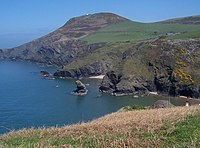
Welsh coast: Llangranog, Ceredigion, by Jayne Toyne, geograph.org.uk (Creative Commons)
Llangranog, Ceredigion (Jayne Toyne, geograph.org.uk)
I first became aware of family history as a child, when my father drove us around his native West Wales talking about who used to live in this place, or how we’re related to that distant aunt. It sounded like storytelling, wonderful tales about semi-legendary characters. I wish I’d asked him to write it all down. Still, a spark had been lit.

In 1994, my mother came back from a visit to her relatives in Australia with the thrilling news that we were descended from an Irish rebel and transported convict. Zap! That spark turned into a blazing flame and I was hooked on genealogy. She and I went to Ireland to do more research and started swapping emails with helpful Aussie rellies. Eventually we had so much family information that we published it as a book, A Rebel Hand: Nicholas Delaney of 1798.

Most of my research until late in 2011 was into Australian and Irish genealogy, history and local history. Then I found out that one Aussie 3x great grandmother was supposed to be a famous New South Wales ghost. Well, I had to know more. She and her husband/partner were both convicts, too, and I was inspired to look at other branches of my family tree.

Another convict ancestor came from Deptford, on the Thames, and my research broadened into London history and genealogy. And now I’m starting to look at the Welsh side of my family. Dad would have been pleased.

A side effect of my genealogy sleuthing has been learning about the history of the late eighteenth and early nineteenth centuries in the UK, Ireland and Australia, and of the places my ancestors came from. I’m fascinated by the social history, the day-to-day lives of people, the conventions of those times.

It was in November 2010 that I started blogging as a way to share my family history interests and discoveries. I soon found that there was a big world of geneabloggers out there, commenting, helping, sharing joys and sorrows and joining in challenges and memes. It was a wonderful discovery. There’s so much collaboration in the history, local history and genealogy and this new blog is a great example. If you’re not taking part already, why not join in? Here’s how.

I’ll finish by sharing some of my favourite blogs and websites for research, all free to view:
  • Claire Santry’s Irish Genealogy News is just what it says, all the latest information about genealogy for Ireland north and south.
  • Old Bailey Online, a collaboration between historians, has not only digitised the proceedings of London’s Central Criminal Court but gives lots of information about London life from 1674 to 1913.
  • Trove, where you can search Australian newspapers, books, manuscripts, images and much more dating from 1803. A lot of people using the digitised newspapers also collaborate by correcting the optical character recognition (OCR) transcriptions.
  • Welsh Newspapers Online, a new project from the National Library of Wales (Llyfrgell Genedlaethol Cymru).

Working together is so rewarding. Please join us in this new worldwide adventure by commenting, asking questions or even writing a post!