Showing posts with label social history. Show all posts

Tuesday, 14 October 2014

Rear view mirror

Flickr: photo Big Grey Mare, Icky Pic
A light-hearted post this month. I’ve been reading an article about ‘mirror years’ on the History Today website. "To put your lifespan into historical perspective," it says, "start with the year you were born, then subtract your age. The result is your 'mirror year'." Or just double your age and take it away from 2014, if you like.

For instance, if you’re 40 years old now, your mirror year is 1934. That means the start of your life – 1974 – is as close to the middle of the 30s as it is to today. Your birth is as near to the US dust bowl drought, the shooting of Bonnie and Clyde, Hitler declaring himself Fuhrer, the Flying Scotsman reaching a record-breaking 100 miles an hour, the first-ever photo of Nessie and Donald Duck’s first film as it is to what you had for breakfast today. Eek. As the article says, your date of birth is "often closer to events that seem in the distant past than to the present day."

Baby's behaving herself today
What’s this got to do with genealogy? Well, for me, one of the pleasures of researching my ancestors is finding out how they lived – family social history, if you like. And looking though my own rear-view mirror makes me think how much life has changed since I first gave my parents a sleepless night.

Not everyone had a telephone (and I mean a round-dialled, wall-connected one, kids, not a smartphone). You could park in the centre of town. Washing was done by hand or sent to a laundry. The only pasta dish most people knew was macaroni cheese. TVs were black and white. And playing on the street was normal, not dangerous, for us children. How much more would be different in my mirror year?

And of course the older we get the further back our mirror year stretches. If you’re 50 this year, it’s 1914, the start of the First World War. 60? Welcome to 1894, when The Jungle Book was published, the Manchester Ship Canal opened, Coca-Cola was sold in bottles, Nicholas II became Tsar of Russia, women in South Australia gained the vote and Coxey's Army, the first significant US protest march, arrived in Washington, DC.

A (very) small part of the spreadsheet...
If I could go back through time the other way, to my mirror year, I’d love to meet my ancestors and ask them a few questions. Well, I’d like to ask a lot of questions, but I’m thinking about battering at those brick walls. I’d like to ask my paternal great-grandfather just exactly which of the 13 or so Griffith Owens born on Anglesey around 1847 was him. Then I could delete the spreadsheet I’m using to try and track him down. (Argh!)

I’d like to sit down with my maternal great-grandmother Mary Maude and tease out of her everything she knew about her father, Thomas Robert Sandon Wilson. We don’t know when or where he was born, or died, or even where he disappeared to when she was a girl.

Then I’d like to move on to the social history. Ask another paternal grandfather, Rhys Lloyd, what life was like as a saddler in rural Wales. Find out how Minnie Richards and Thomas Winter, who lived in the Rocks, a notorious area of Sydney, got by and what it was like to be so poor they sent their daughter, my gran, to live with another family. Get Griffith to tell me yarns about his life as a mariner. Those questions might be answered by research, but... how much better it would be to hear their stories in their own words.

If you could go back to your mirror year, who would you like to meet? What would you ask them?

Wednesday, 14 May 2014

Hunting ancestors using old maps

I love old maps! Do you? They're such a good genealogy tool. They can help make sense of the census, correct wonky transcriptions and show how a great-grandparent's village became a suburb of a big city. If you're lucky, they may lead you to a place your ancestors lived.

And they can guide us in our travels into another dimension - back in time. Old maps can help put flesh on the genealogy skeleton of names and dates. They can confirm or challenge our ideas about how our ancestors lived. They can make our forefathers and mothers come to life. And for me that's one of the most fascinating parts of my genealogy journey.


I’ve used an old map before to try to make sense of the movements of one of my convict ancestors, James Thomas Richards, on the evening in 1835 when he stole a pub till and earned himself a free one-way ticket to Australia.

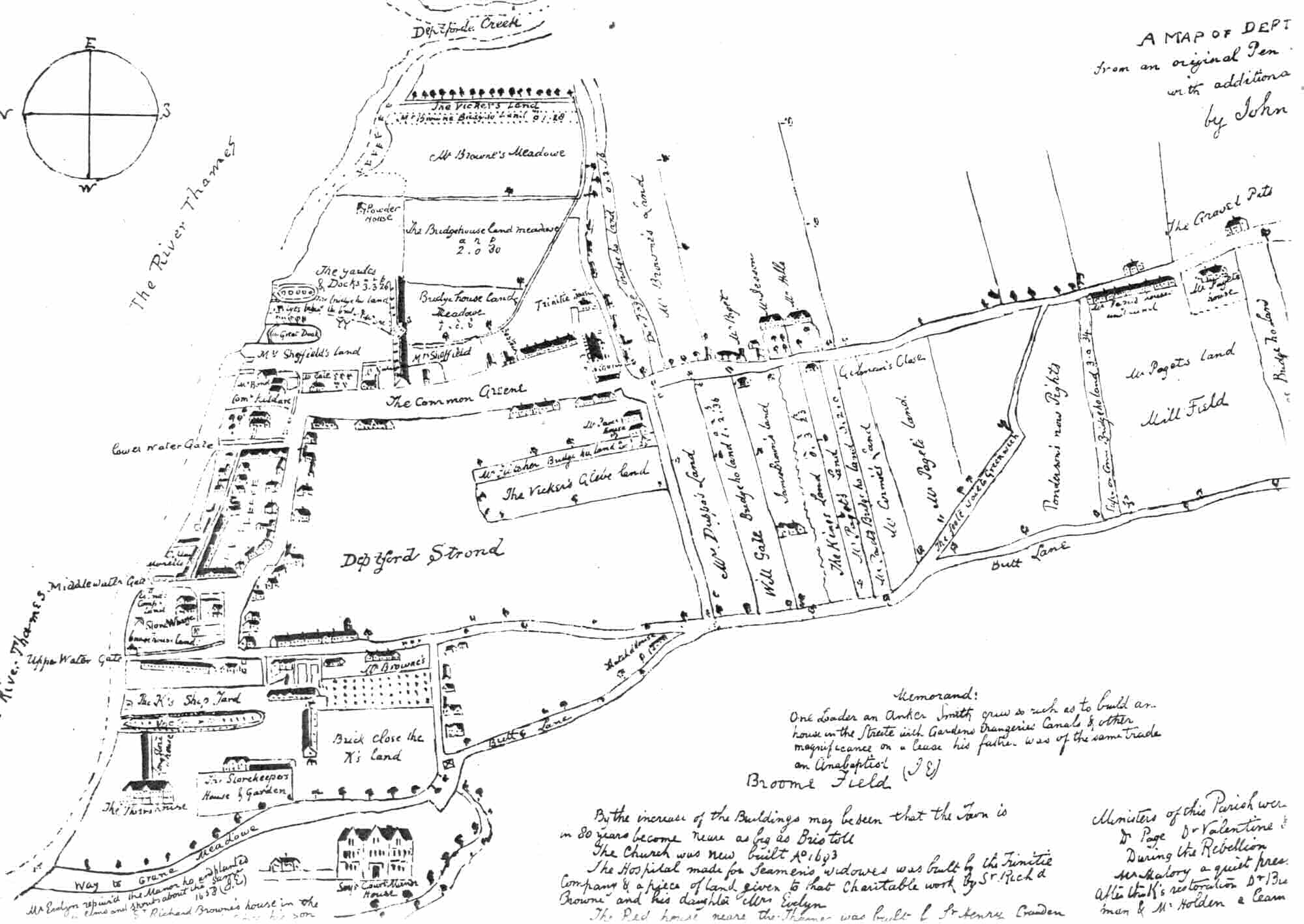
Hand-drawn map of Deptford. Creative Commons via http://www.ideal-homes.org.uk/lewisham/deptford/1623-map-01.htm
Map of Deptford, 1623, with John Evelyn's notes, late C17th
James was a Thames waterman, and lived in Grove Street, Deptford – then part of Kent, but now definitely in London. His father and he had both been born in that street, perhaps in the same house. So I thought it might be interesting to look at this small part of Deptford through maps.

Deptford is an interesting place from a worldwide perspective, too. In the Deptford dockyards ships were built and fitted up to sail to North America, Australia and many other far-off places.

It was from the wet dock in Deptford that Captain Cook set off in 1768 on board the Endeavour to ‘discover’ Australia. Convict hulks (prison ships) were moored in the Thames off Deptford. It was at Deptford that the prison reformer, Elizabeth Fry, waved goodbye to the Maria, a ship full of women convicts who she had helped. And two of Australia’s earliest convicts of African descent, Billy Blue and John Caesar, lived in Deptford before they, too, were transported to New South Wales.

Grove St, Deptford http://www.openstreetmap.org/copyright
I started my time-travelling with a map of modern London, because it’s easier to search. Of course, some streets have been re-named and others no longer exist, but I was lucky with Grove St. There it was, a longish street going almost north to south, close to the Thames. I wondered where James and his family might have lived. Had it always been this shape and length? Were there any old houses left?

A quick virtual trip via Google Street View squashed my dreams. Two Victorian pubs, a car breaker’s yard and a lot of post-war housing.

I wasn't really surprised. I hadn’t expected much to be there, thanks to the Blitz, which targeted London’s docks with great dedication . To give you some idea, have a look at this map, from the excellent Bomb Sight project. Some 650 people were killed in crowded Deptford during the Second World War, including 168 in Britain’s worst single V2 rocket attack on 25 December, 1944. Also killed that year were 13 US naval officers and ratings at an amphibious base supporting the D-Day landings. Such was the war in London’s East End.

It was time to look at old maps. My great-great grandfather, James the till-nicking waterman, was born in 1815 and convicted 20 years later. I wanted to find Grove St as it was in his lifetime.

Grove St in 1827. Website © Mark Annand
Now I'm not asking for much, am I? Only a 200-year-old map with enough detail to be able to make sense. And which reaches beyond the edges of what was then London.

Luckily, there is one. Greenwood's 1827 map, which can be seen online at the brilliant Motco and also at Bath Spa University's site.

So here it is - Grove St when my 2x great grandfather lived there. It looks very different. In fact I only recognised it because it starts at a T-junction just south of the larger dockyards.

It's much shorter, too. Only the northern part is called Grove St. To the south it's Victualling Office Row and skirts the huge warehouses where ships' stores were stocked, ready for the voyage.

Deptford in Mogg's map, http://www.geographicus.com/mm5/cartographers/
1806. Image via http://www.geographicus.com
What thrilled me was seeing that there are only a few houses in the 1820s Grove St, right at the top end. So my Richards ancestors will have lived in one of those. Now that's a bit better than the long snaky road in the modern map!
And there are open fields to the east side of the street. 

It's surprising to see just how much it was still in the countryside. I went to another favourite map to get a better idea of how rural Upper Deptford was. 

Mogg's Pocket Map of London was published in 1806. Here's a view of the area just before James was born. It's hard to square that country  with the overcrowded slums of 1944.

It doesn't look as if it had changed much even in the years since the 'Evelyn' map, right at the top, was drawn. Incidentally, if you'd like a proper look at that one,try here. And yes, it does look upside down.


http://www.mernick.org.uk/elhs/mapgallery.htm
1861. Thanks to the The East London History Society
In fact not a lot happened to the Grove St area for a while. Cross's New Plan of London, published in 1861, shows the new railway line terminating in Mr Dudman's Yard, just to the right of the street.

The dockyard closed in 1869. Sailing ships were superceded by steam, the same steam which drove the other new, fast form of transport - the train.

And with the docks no longer employing people, Deptford lost its purpose and began to slide into
poverty, and the grand shipbuilders' houses became overcrowded. There were hard times on the way.

Irritatingly, I haven't found any maps from the middle of the century which are detailed enough to show buildings apart from Cross's.


Charles Booth Online Archive http://booth.lse.ac.uk
So I'll have to shift my time machine up a gear and zoom forwards to 1889 and Charles Booth's famous 'poverty maps'. The Descriptive Map of London Poverty concentrated on the East End - the poorest part of London, it was generally agreed.

Booth based his classification of Londoners' economic status on visiting each area and talking to local people as well as looking around.

This snippet of his map shows how Upper Deptford was then, with better-off streets (in red or pink) to the south-west, poverty (dark blue) in the south-east and Grove St (a muddy-looking purple) described as 'Mixed. Some comfortable, others poor.'

You'll see that Grove St is now the same length as it is today, stretching all the way from the Wet Dock down to Evelyn St, where the red shading begins. It's built up along its entire length. And there are terraces of houses where the fields had been.

I've learned a lot writing this blog post, and I've enjoyed it, too. I'd add a lot of links, but this post is long enough anyway. So I'll be coming back to old maps on my own genealogy blog, A Rebel Hand, before too long.

And I'd love to hear what old maps you like, and if they've helped you in your genealogy journeys.

Unfortunately I am unable to respond to comments at the moment. I have attempted to credit all illustrations correctly and to use only images which are out of copyright when possible. If you would like to make any amendments, please email me and I will correct them.

Saturday, 15 March 2014

A maid's work is never done

If you’ve got ancestors from England, Scotland, Wales or Ireland, the chances are at least one of your foremothers was a domestic servant.

Even after the Industrial Revolution, in fact until the First World War, more women worked in domestic service than in any other job. It was often the only kind of employment open to poor young girls. And, as well as the obvious help with running a household, having one or more servants was a sign of social rank. They were a visible signal that you had money, like a flash car or exotic holiday might be today.

http://commons.wikimedia.org/wiki/File:Giuseppe_Maria_Crespi_-_La_cuoca,_the_kitchenmaid.jpg
La Cuoca, Guiseppe Cresci, after 1712
In the houses of the wealthy (think Downton Abbey or Upstairs, Downstairs), positions ranged from the prestigious housekeeper or lady’s maid down to the despised scullery or laundry maid. Spending your time with your hands in water seemed to be especially looked down on.

But to stop this post turning into a mini-ebook, I’m going to look at the servant any household with enough cash to hire the most basic domestic help would employ – the maid of all work – in the period between the start of the eighteenth century, when servant girls poured into London and women outnumbered men as a result, to the middle of the nineteenth century.

She was a young girl, maybe only 12 or 13 years old, away from home for probably the first time. Town employers preferred country girls as they were thought stronger and more moral. This wasn’t necessarily so. My own 3xgreat grandmother, Sarah Marshall, was a country ‘family servant’, and she was transported to Australia for theft.

In her 16-hour working day the maid-of-all-work did all the jobs needed to run a house, with some help from her mistress or the daughters of the house if she was lucky. When she got up at six o’clock the first thing she did was rake out last night’s cinders and ashes and light the kitchen fire or stove. No fire? No warmth, no hot water, no cooking. (Thank goodness for electricity and gas!)

She put a kettle on to boil. This wasn’t only for tea or coffee, but warm water for washing, too. Then she cleaned the grate and hearth and lit the fire in the room the family was going to have breakfast in. After sweeping the carpet and dusting the furniture, she laid the table. Before the family came down, she swept and dusted the staircase and hall. She scrubbed the soot from her hands and face and put on a clean apron, ready to cook and serve the meal.

While they were eating she grabbed a bite to eat for herself in the kitchen, then rushed upstairs to strip and air the beds, empty the chamber pots into the slop bucket and give the rooms a quick dust and tidy. Then it was time to clear the breakfast things and wash up, clean the kitchen and wait for her mistress to give her instructions for the day. Are you tired yet, just reading this? The work’s hardly begun.

Jean-Baptiste Siméon Chardin, The Scullery Maid http://commons.wikimedia.org/wiki/File:Jean-Baptiste_Sim%C3%A9on_Chardin_020.jpg
The Scullery Maid, Jean-Baptiste Chardin, c1736
If the family had dinner (the main meal) in the early afternoon, our skivvy spent the morning shopping, preparing the food and cooking it. If they ate fashionably late, in the early evening, she did her other household jobs before preparing lunch.

Every room needed to be swept and dusted daily, but thoroughly cleaned once a week. This involved taking rugs and carpets outside to beat them, changing the bedlinen and scrubbing, rinsing and drying the floors. A good mistress lent a hand with the cooking on very busy days, and usually dusted the precious knick-knacks in the drawing room herself.

And then there was washday. I’ve written about this most hated of days here, but to give you an idea, it would take the whole day to wash, rinse, wring and hang up the household linens and clothes by hand and it was probably more than one overworked teenager could manage by herself. The mistress might hire help for the day, or send the laundry out to a washerwoman or laundry.

You’ll have noticed how much dusting, sweeping and washing the maid of all work did. There was one main reason for this – the ash, and even more the greasy soot, from the coal fires. So the thing which the skivvy needed to do so much of her work was the thing which caused a lot of her work, too. And if the house was in a city or large town, more dust and smut would fly in every time she opened the door or windows – also given a weekly once-over.

Sleeping Kitchen Maid http://commons.wikimedia.org/wiki/File:Peeters,_Clara_-_Schlafendes_K%C3%BCchenm%C3%A4dchen_-_1765.jpg
Sleeping [drunk?] Kitchen Maid, Clara Peeters, 1765
In quieter moments or in the evening she cleaned the silver or plate and the lamps, polished shoes, mended the linen and perhaps even did a little sewing for herself after the last meal of the day had been cooked, served, cleared away and washed up after. Then, once the family had gone to bed, she made sure the fires were safe, checked the windows were shut, locked the door and at last headed to the attic or, more likely, kitchen, where she had a bedroll or, if she was lucky, a small bed. It was 10 or 11 o’clock. First up, last to bed and precious little rest in between; that was the life of a maid of all work.

Of course, there were perks. She got the tea leaves after the family had used them, to make her own brew or to sell. She had bed and board and often clothes (these were the days before maids wore those black and white uniforms). She got a half day off a week, and perhaps a whole day once a month. No walking out with the handsome baker’s boy or butcher’s son, though; she wasn’t allowed sweethearts. Though that didn’t stop many a master or his son from trying his luck with the maid.

No wonder Mrs Beeton wrote: ‘The general servant, or maid-of-all-work, is perhaps the only one of her class deserving of commiseration; her life is a solitary one, and, in some places, her work is never done.’

This post is written to mark Women's History Month, which takes place every March.

Further reading:

Inside the Smart Home, Richard Harper (2003, and online). Page 65 is especially interesting
The Book of Household Management, Isabella Beeton (1969, and online). From page 1001 on

All images via Wikimedia Commons - click on the captions for full details.