Showing posts with label Scotland. Show all posts

Friday, 30 March 2018

Genealogy Research Identifies Easter Traditions from Relatives and Ancestors Worldwide

Genealogy Research Identifies Easter Traditions from Relatives and Ancestors Worldwide

In my genealogical research, I have learned that my family is a typical American melting pot of ethnic origins! My ancestors hail from Denmark, England, France, Germany, Ireland, Italy, Netherlands, Norway, Scotland, Sweden, and Switzerland—at least. As we are preparing for our own Easter celebration, I was wondering how similar or how different some of my ancestor’s traditions might have been.   
Our own traditions include attending church as we were raised Protestant and believe that Easter represents the death and the rising of Jesus Christ, Son of God, to save us all from our sins and to give us eternal life.  It is basically, the basis of our Faith, and, is such an important time in the life of Christians.  We celebrate Easter with a long season of Lent.  However, the highlights of Holy Week include  Maundy Thursday Communion in church on the Thursday before Easter Sunday.  This communion celebrates the Lord’s last supper with his disciples. On Good Friday, we gather at the church to mourn the death of Christ upon the cross. Our own church holds a “Tenebrae service of Shadows”.  One of our daughters will sing special music with the choir, “One Sacrifice”.   The service itself begins with 14 lighted candles in the sanctuary, and as Christ walks his final passion, each candle is extinguished to signify his abandonment.  Easter Sunday, we gather to celebrate the joy of Christ’s resurrection and His salvation for each of us individually throughout the whole world. This is an astounding day for many of us faith wise!  
Part of the joy of Easter at our house is gathering with family and friends for dinner.  Many in the United States serve ham for this dinner with other spring vegetables especially like asparagus and carrots for the Easter bunny. Surely you see turkey and beef as well. My own sister, however, serves a Crown Roast of Lamb every Easter without fail!  Bunny rabbit salads made of half pears are a treat for our family.  
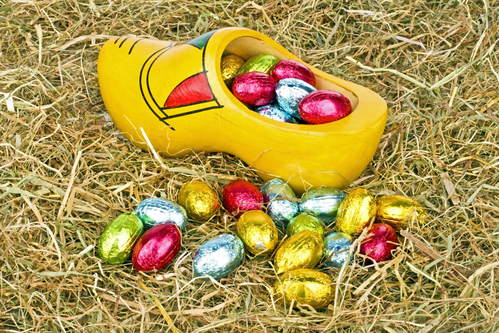
 Since our family includes young grandchildren, an Easter egg hunt is in order for the day!  Of course, we give the children Easter baskets full of trinkets, chocolate, and other candy.  We hard boil and decorate Easter eggs as well.  In our own family, we often hide the baskets and the children have to follow clues to find them!  
Easter 2015, hunting eggs with Katy and Evie
This is one way to hunt eggs! -grandchildren of author, personal library, HY Holshouser. 
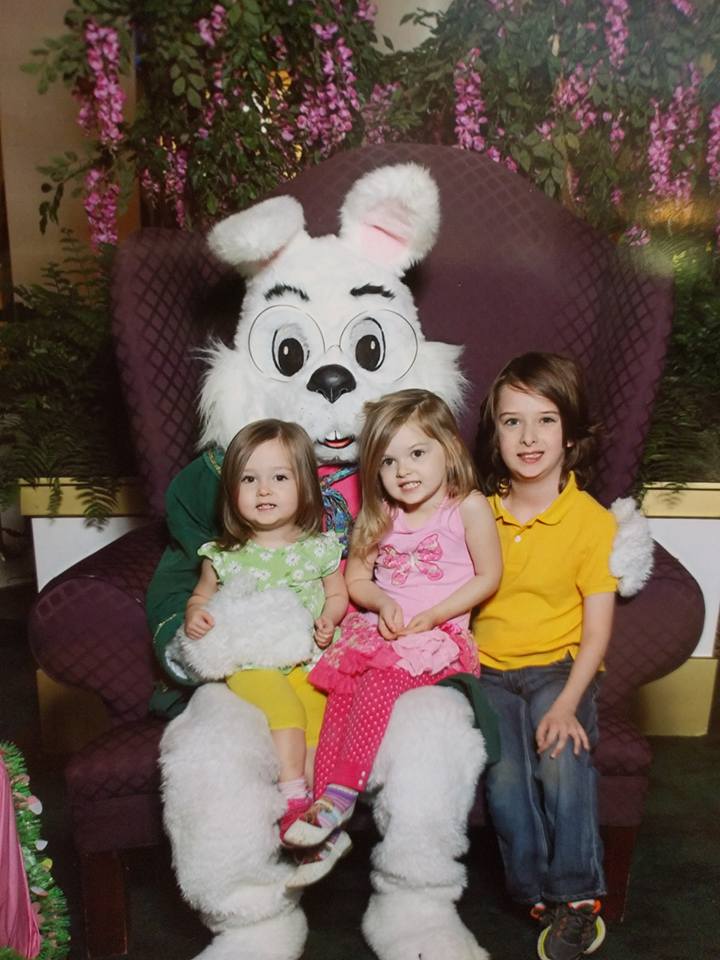
Evie, Katy, and Liam with Easter Bunny, 2016
Grandchildren visiting the Easter Bunny—from the personal library of this author, H Y Holshouser.
What about our Hogue ancestors from Scotland?  I understand that they especially were sheepherders and that their and most Scottish Easter dinners include roasted lamb!  As with us in America, chocolate is the taste of the day!  Dessert might be chocolate cake and coffee! Chocolate eggs and bunnies are ever present for both! Easter egg hunts, horse displays, and battle reenactments make for fun and festive occasions. Of course, churches throughout Scotland hold special Easter services like ours, to celebrate Christ’s rising from death and giving us the grace of salvation. We had many ministers, mainly Presbyterian, in our Hogue family.  In fact, we are told that our first immigrant from Scotland was a Covenanter.  A covenanter was one of the many Scottish people who fought against the Catholics for the right to have their own personal covenant with God. In fact, his persecution by the Catholics apparently led to his flight to America.  
 Our Kearse family from Ireland and the same ancient family, the Des Cearsais of France, how did they celebrate Easter?  The French word for Easter is Pâques. To say Happy Easter, you can say “Joyeuses Pâques or “Bonnes Pâques.”  According to my general research, Easter is an important holiday in France also. It is a religious one, and a lively, fun time with Easter egg hunts to honor the coming of Spring. Like Ireland, roast lamb is the choice for a large family meal. In Ireland, it is also an important religious holiday as well, with many traditions. Confession on Good Friday, silence on the Saturday before Easter lends to a meditative state. Eggs take center stage on Easter as they are given up for the forty days of lent by many.  Chocolate eggs, decorated eggs—all symbolizing Spring, new beginnings, renewal, and joy! 
 What about the Langhornes and others from England? Among many lovely and fun Easter traditions, Easter parades are one of the greatest. Children and adults don new clothes for good luck, and often children make elaborate paper hats to wear as they march in their local town parades!  Fun! Egg rolling, hot cross buns, Simnel cake, Morris dancing, and so much more contradicts the vision of the staid Englishmen and women!  

Our marvelous Italian ancestors and relatives add so much spirit to our family. The BottosRaffosRivaros, Costas, DeSantos,  and more, mostly originate in the coastal area of northwestern Italy, near Genoa. Italy of course, is home to the Vatican, and the place for the pilgrimage of so many Catholics on Easter.  My mother’s Italian ancestors were Catholic as well.  Mass on Good Friday in St. Peter’s Basilica is followed by the Pope leading a candlelight procession on a walk symbolizing Christ’s walk to the cross.  Our own church reenacts this walk to the cross, and we are Protestants.  
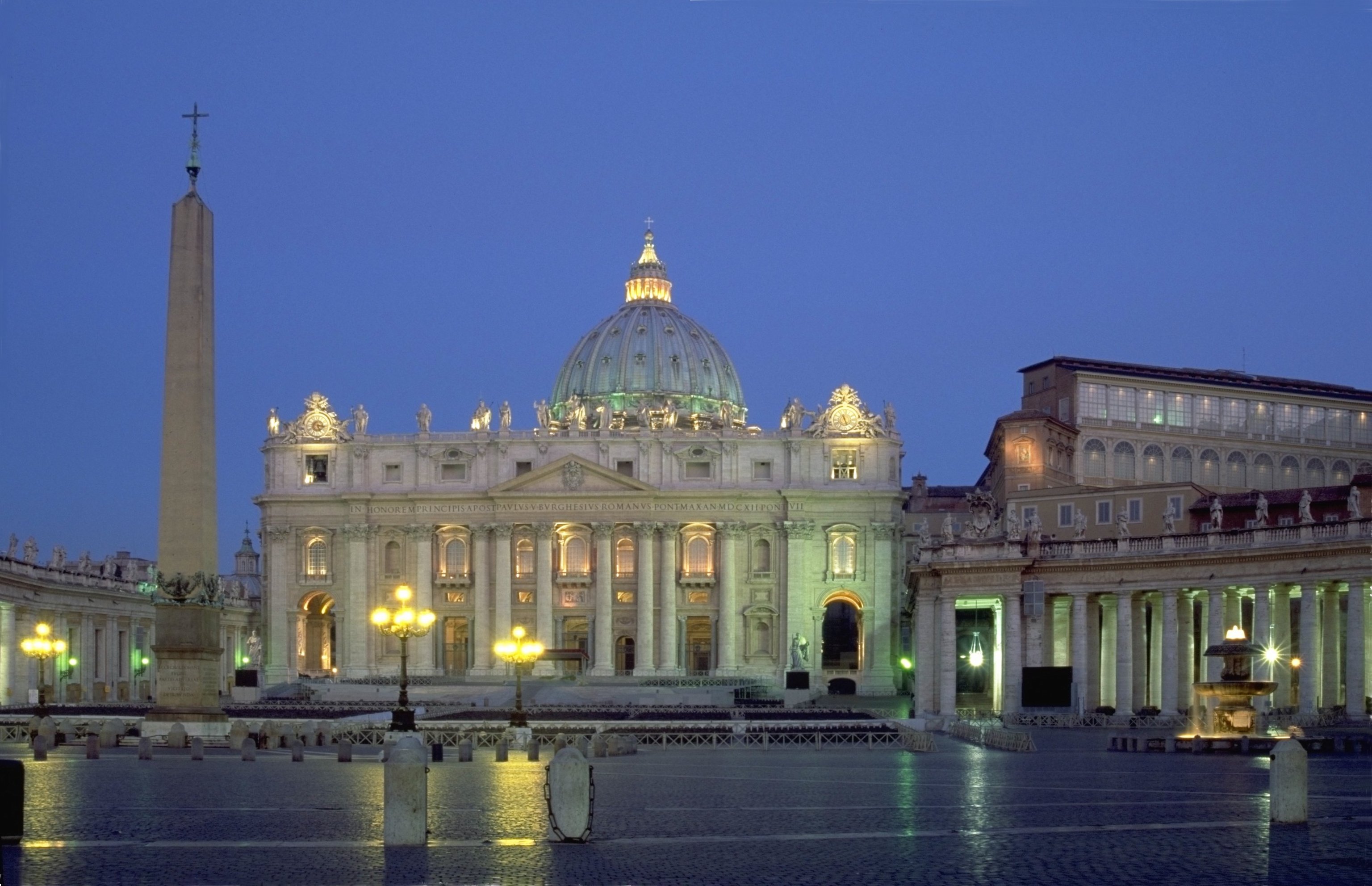
St. Peter’s Square, Vatican City, Andreas Tille – Own work, Permission details Quote of http://fam-tille.de/italien/rom/2004_030.html – Permission is granted to copy, distribute and/or modify this images under the terms of the GNU Free Documentation License, Version 1.1 or any later version published

As I understand it from relatives, northern Italian Easter feasts often feature ham, like us!  Interesting. Of course, salami is a big choice as well.  Colomba, a dove-shaped cake, made of almonds, egg whites, and sugar, is probably the most famous cake and available worldwide these days.
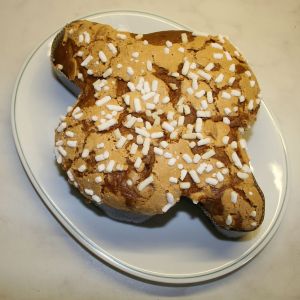
Italian bread with almonds and sugar,Colomba-Pasquale
Colomba Pasquale, An Italian Sweet bread J.P.Lon~commonswiki
What about our German JungblutsYoungbloods? And my husband’s Haulzhausen—Holshouser family?  According to a wonderful article from DW –Deutsche Welle —  http://www.dw.com/en/german-easter-traditions/a-1520904 — the Germans of course, also celebrate a religious holiday like most Christians.  
Although mainly a Christian holiday commemorating the crucifixion and resurrection of Jesus, Easter also marks the beginning of spring. The Germans, of course, have a whole range of customs and traditions to celebrate the change of seasons in proper fashion. 
A time for eggs and bunnies 
Eggs and bunnies are two of the oldest symbols of Easter in Germany and every spring shops boom with eggs and bunnies made of chocolate, cardboard or flowers in different sizes and wrappings. 
The tradition for using eggs and bunnies for Easter originates from pagan worshipping where they were symbols of fertility and new birth and traditionally used for celebrations of the coming of the spring. 
The Germans have a number of egg games which the children play over the holidays. One tradition is to blow eggs and paint them in multiple colours and patterns on Good Friday. The eggs are then put in a basket for the Easter bunny — Osterhase— to hide around the house on the night leading up to Easter Sunday. On the morning of Easter Sunday, the children go hunting for the eggs and often find that the Easter bunny has also left chocolate eggs and Easter presents for them to find. 
It is also a custom that friends exchange the painted eggs as gifts or that young people in love paint eggs for their sweetheart.” Now that is a different tradition, which I find so special and romantic!   
For the Netherlands and our Van Vreeland, Van Swol, Voorhees, and Banta families, what was Easter like for them? According to many articles, they celebrate much the way we do…. or we celebrate much the way they do!  One of our favorite meals is a festive brunch and apparently it is theirs as well:  eggs, cheese, ham, rolls…and did I say eggs?  The Dutch also take great pride in providing the thousands of tulips to decorate St. Peter’s in Rome for the Pope’s Easter service.  Wow!  Back home, they are also known for their beautiful painted eggs.  However, they do not have the Easter bunny, but the “Paashaas, the Easter hare!   
Our ancestors represent many more countries and traditions from around the world, but as you and I can readily see, we are more alike than different.  This Easter, as I pray, and as I play, I will have a keener sense of connectedness due to my genealogical research, and our worldwide collaboration.   
Until we meet again, Helen Youngblood Holshouser 


Tuesday, 8 September 2015

Occupational Records

If our aim is to portray a rounded picture of the lives of our ancestors, then researching occupational records is a must.  

You may find records relating to an ancestor's working life in your local archive centre, though a lot does depend on the particular type of employment.  Here are some examples from England and Scotland  that I have come across in the course of my research. :

ARCHITECTS - A Dictionary of Scottish Architects is  a database providing detailed biographical information and job lists for all architects known to have worked in Scotland during the period 1840-1980, whether as principals, assistants or apprentices.  A "must consult" item if this is your ancestor's background.

Being a COUNCILLOR   might seem rather dull,  but Scottish Burgh and County Council  Minute Books, which go back to the mid 17th century,  give a full description of local affairs and council discussions and can reveal interesting sidelines,  such as the councillor in the 1880's who was petitioning in support of woman's suffrage, long before it was close to becoming a reality. 
 
FARMING
Most  of us can count farmers, shepherds, hinds (farm servant or ploughman), carters and  ag. labs amongst our ancestors, but how to find out more about their lives?  Realistically records on individuals  are likely to focus on  landed gentry and tenant farmers, rather than their workers.  I live in a rural region and my archive centre has a wealth of information that can provide background on estates,  and life in agricultural communities.  For example:
  • Advertisements of sale of stock 
  • Auction Mart records
  • Drawings of farm machinery
  • Field name surveys
  • Farmers' Club & Pastoral Societies - members lists and minute books
  • Individual farm records - day books, account books etc. 
  • Postcards of farms and farm workers - with an image below of "bondagers"  from my local community heritage group Auld Earlston 
  • Valuation Roll showing owners, tenants & occupiers of property - very useful in indicating the size of farms & estate, and the type of workers employed. 

Bondagers were female farm workers in south east Scotland and Northumberland.   As part of their husband's contract (or bond) with the farmer, he would undertake to  provide another worker (usually his wife) to help as and when  required. They wore a distinctive dress with bonnet, described as the last remaining peasant costume in Britain.
One of the most significant farming collections held at my local Archive Centre. the Heritage Hub, Hawick,   belongs to the Border Union Agricultural Society, with material dating from 1813,  when the Society was formed.   Included are minute books,  subscription books,  letter books, financial paper and lists of prize winners at the annual show which remains a major event in the local calendar today.  

Here is a record showing that A. S Pringle won prizes in 1876 in the class of "Implements of Husbandry"  for "a self acting horse rake" and "a turnip topping and tailing machine".


MARINERS -   I used the enquiry service of Tyne and Wear Archives who provided me  information on the life of my husband's ancestor, Robert Donaldson   (1801-1876),  a master mariner of South Shields.  “A Dictionary of Tyne Sailing Ships:  a record of merchant sailing ships owned, registered and built at the Port of Tyne 1830-1930”, compiled by Richrd Key  is a complete A-Z of Ships, master mariners and owners, detailing ships, voyages, disasters and share-ownerships, and much more - an indispensable for anyone with maritime ancestors in this region.

The entries make fascinating reading, with all six ships on which Robert Donaldson sailed, having an eventful history and coming to a sad end (though not under his charge).  


Lloyds Captain's' Register provided information on the ships under the command of another mariner ancestor, Matthew Iley White.  His journeys took him to the North Sea ports of Belgium and Holland, to Spain & Portugal, the Mediterranean, Black Sea, Adriatic Sea,and north to the Baltic and the Gulf of Finland.   

[Above right - another ancestral master mariner - John Moffet of South Shields]

MINERS   - my husband's Armitage and Hibbert ancestors were miners in Yorkshire, Derbyshire and County Durham, where the  history of mines, mining and miners  is well documented on the Internet.

The website www.scottishmining.co.uk provided detailed  information when I was researching the Spowart family of Fife.   

An early insight into life in mining areas was given by Robert Franks in his report to the Children's Employment Commission in 1842 who commented  "The domestic condition of the collier population presents a deplorable picture of filth and poverty" .   

He conducted interviews with children including 15 year old Helen Spowart who  was described as  a “putter”, with the task of propelling   a loaded coal-hutch from the coal-face to the pit-bottom by means of a series of shoves or pushes.

The report noted "Began to work in mines when nine years old and has done ever since. Helen added  "It is very coarse, heavy, cloughty work, and I get enough of it, as am never able to do muckle after hours from the fatigue".

POLICEMEN & PRISONERS  -  if your ancestor was a constable or even  on the other side  of the law, police records are a great resource and include mug shot photos of criminals, lists of prisoners, plus constable registers with personal details including a description, service record,  next of kin and family etc.


A long-held family story recollected a lost photograph of a relative in a top hat serving in the River Tyne Police. A silver uniform button (left)  was still held by the family. Tyne & Wear Archives provided some answers, finding that not only Henry,  but also his older brother Matthew Iley White,  were members of the river police force – both with rather a chequered history.


The Nominal Roll of the Tyne River Police showed that Henry, a single man, joined 9th January 1882.  By the time of his promotion seven months later in July, he was married.  The Police Defaulters Book recorded his misconduct for "assaulting a seaman A. W. Hanson and other irregularities on 11th June 1889"  Henry was fined 2/6 and transferred to Walker Division at his own expense.  The Nominal Roll of 1904 noted his age as 42 and that he had 22 years of service, with a wage of 29/6. 


With three of my Danson ancestors working as POSTMEN,  I  upgraded my Ancestry subscription, so I could access their Post Office Records.   All I got was a name, date of appointment and place, so I can't really say it added anything to my family story. Also if you are looking for a popular local name, it will be difficult to confirm which is "your" entry.  Still we all consult records in hope of finding something worthwhile!

TEACHERS  -   School Records are the place to look - with Log Books recording daily  school life, and School Board Minute Books and Education Committee Minute Books recording appointments - and dismissals!   Here is an example from a school log book: 

1873 - At Glenholm, Peeblesshire, a school inspector reported "This small school was taught by Mr Grieve in an intelligent, painstaking and efficient manner". We would all love to find such a  testimonial on an ancestor.  

 Archive image courtesy of the Heritage Hub, Hawick 

Occupation Records are  a fascinating example of how family history can take you in so many diverse directions.  So many of these records are not available online, and the message is -  search the online  catalogue of the Archive Centre relevant to your research,  and use their enquiry service if you cannot visit it.

Good luck with your research! 

*************

Thursday, 7 May 2015

A Suffragette Intervention, 1908


Local history features in my post of this month.  As Britain wakes up to the results of yesterday's  General Election, it seemed appropriate to look back to 1908 and  a visit  by Liberal Prime Minister Herbert Asquith to the village of Earlston in the  Scottish Borders.    The visit  features on several postcards in the  collection of "Auld Earlston", my local  heritage group,  with past  newspapers, held  at the Heritage Hub in Hawick,  giving  a colourful account of the event.   

This is not boring politics! So do read on - the description of the suffragette incident is particularly entertaining, not least for the journalistic style. 

"The Jedburgh Advertiser" of October 3rd described the plans  for the visit.  These included  the erection of a tent, measuring 220 feet by 60 feet  with seating accommodation for about 4000 people - this when the population  of Earlston in the 1911 census was only 1677!   How many political meetings in the Borders attract that kind of number today?  

Special trains were laid on from Jedburgh, Kelso and Edinburgh;  a large number of Members of Parliament  had intimated  their intentions to be present, and it was noted that presiding over the event would be Mr H. J. Tennant, M.P. for Berwickshire.   


 Bunting out on Earlston High Street for the Prime Minister's visit. 

The visit  proved to be a notable  occasion,  disrupted by the late arrival of reporters and M.Ps on a delayed Edinburgh train which took three hours to cover the 35 miles to  Earlston; crowds spilling out of from the congested,  hot marquee, the intervention of a woman suffragette,  and noise from the "shunt, snort and whistles" of a railway engine threatening  to drown out the speakers.  


The newspaper report gave a vivid picture of the crowds and the conditions in the marquee:
 "The special train that had started at Jedburgh Railway Station seemed to provide more than ample accommodation for the passengers, but so many persons joined it at Jedfoot, Nisbet, Kirkbank and Roxburgh, it was evident miscalculations had been made.   All the passengers from Kelso joined it at Roxburgh and when it had received additions at other stations where it stopped, the carriages were full. 
The marquee could not contain all who wished to be present.  The side canvas was raised and hundreds of people had to be content with standing room beyond the lines of the tent........Many who were in places distant from the platform did not hear the speeches distinctly.   Lighted lamps were suspended from lines and were affected by pressure on the canvas and cords were bobbing most of the time and presented a somewhat fantastic appearance that was slightly distracting.  The heat was very great and the people were so densely crowded that there was some discomfort".    

The arrival of the official party at Earlston Station
Leaving the station for the marquee


"The Jedburgh Advertiser" of October 9th noted that "When the Prime Minister appeared there was nothing of the enthusiasm that was displayed when Mr Gladstone entered a great meeting....... The reception given to the chairman cannot be described as cordial and it was apparent that the rupture between Mr Tennant, MP for Berwickshire. and his constituents had not been altogether healed".   

When Mr Asquith stood to speak "He got  a warm greeting.  Mary of the people rose to their feet and waved hats and handkerchiefs and cheered with great cordiality".  

However he had only said a few words when,  at the remark  "My primary purpose in coming here this afternoon is...., a woman startled her neighbours by exclaiming " Give votes to women!".  The interrupter was a young woman of graceful figure and pleasant features.  Stewards made their way to the fair  suffragette  and quickly bore the woman out,  calm and unresisting but with her sailor hat somewhat awry". 


By his description, the newspaper reporter clearly found this incident far more interesting than Mr Asquith's speech which he described as "Unimpassioned with no striking phrases.    The Scottish Small Landholders Bill was his main theme.  He had great command of language  and discussed  the subject with much detail". 

The vote  of thanks was given by Sir John Jardine, M.P. for Roxburghshire.    "His speech was " a striking contrast to that of Mr Asquith.  He spoke with great fluency  to stir the majority of his hearers.".

The Lord Advocate Mr Shaw brought the meeting  to a close commenting "There are four great institutions in this little land of ours - public houses, the school, the workhouse and the land.  We are in favour of fewer people in the public house and more people in the school;  fewer people in the workhouse and more on the land".  This of course was very loudly cheered".     

*******

But what had prompted this meeting to be held in a small Berwickshire village in the rural Scottish Borders?   Mr Asquith was M.P. for East Fife and had Border connections.  His second wife was socialite Margot  Tennant, daughter of the prominent Tennant family  of the Glen, Innerleithen, whilst his brother-in-law  Mr H. J. Tennant was the local Berwickshire Member of Parliament.

No general election was looming.  For Mr Asquith had assumed office  only a few months before, on the resignation of Mr Campbell Bannerman due to illness.  A turbulent political situation faced him, with issues of House of Lords reform,  home rule for Ireland, industrial strife, an increasingly militant women suffragette movement and worsening international relations with Germany, culminating in the First World War.  

But on a brief Saturday afternoon in October, Earlston was on the national stage politically.


Official photograph taken by Walter Swanston, an Earlston-born photographer
 who set up a studio on Leith Walk, Edinburgh. 


**************