Showing posts with label Old Bailey. Show all posts

Thursday, 17 July 2014

Found in an old newspaper - crime and punishment

I’ve been using the British Newspaper Archive a lot for my research recently. (If you haven’t seen it and you’re looking for British or Irish ancestors, there’s a special offer on until Sunday, 20 July – a month’s subscription to the BNA for £1.)

Wondering if the Old Bailey trial of my 2x great grandfather, James Thomas Richards, had been reported in one of the digitised papers, I searched for his name and 1835, the year he was sentenced to transportation to New South Wales. Could I find him?

The Morning Chronicle, April 15, 1835
Well, yes and no. No report of the trial, but his sentence was recorded. There he was, at the bottom of a long list of others. Looking at the list, and remembering that it represented only a tiny number of the convicts who would be sailing for Australia, got me thinking.

They were all going to be thrown back in prison, or crammed into a hulk (a ship which wasn’t seaworthy, but could be used to relieve the overcrowding in prisons). There they would wait until the next ship was ready to leave on the months-long journey to the other side of the world, where they would be put to work for seven years, or 14, or the rest of their lives.

It’s true that many convicts, like James Thomas Richards, would end up having a good life in their adopted country. And most would have much better lives than they could have hoped for if they hadn’t been caught and sent to Australia. But the men and women waiting for the next ship couldn’t know that. And yes, some people did try to get transported because they believed anything would be better than the poverty and hunger they suffered in city slums or in the countryside.

But what faced them wasn’t just a dangerous sea voyage and hard work. It was exile. It was being on the other side of the world from your family, your friends, your sweetheart, and all but your youngest children. With no way to contact them – remember, it was quite normal not to be able to read or write if your work didn’t call for it and you’d had little or no education.

blackcountryhistory.org/collections/getrecord/WAGMU_W1178/
And yet many would be deeply relieved, because the alternative sentence for their crimes was worse. Although the death penalty had been removed for crimes such as stealing goods worth a shilling (5p), theft of a sheep or a rabbit or damaging Westminster Bridge by the time James was sentenced in 1835, you could be strung up in public for crimes like forgery and coining, arson, burglary, theft from a dwelling house, rape and attempted murder as well as murder and treason.

In the eighteenth and early nineteenth centuries, the British penal system wasn’t geared towards imprisonment as a punishment (except for debtors). Prison was mostly the place where you waited for trial and for your sentence to be carried out. And for 220 different crimes, the penalty was death. Many judges and juries weren’t willing to sentence men, women and children to death for stealing a pocket handkerchief (for example) and so they would find them guilty of a lesser, non-capital offence. Or a death sentence would not be carried out and the convicted person might be transported, or even reprieved. But still, that threat hanging over many criminals must have been terrifying.

As the descendant of four convicts myself, I’m very glad that they ended up in Australia.


Further reading:

Old Bailey Online: Punishments at the Old Bailey
Port Cities London: Prison hulks on the River Thames (has a good short history of transportation)
Timeline of Capital Punishment in Britain


 

Saturday, 22 February 2014

Global Reach of the Old Bailey Online, thanks to the Collaboration of Academic Historians

Academic historians have done genealogists a huge favour by making the records of London’s central criminal court, the Old Bailey, available online free of charge for non-commercial use.

The website is a product of many years of collaboration between the Universities of Hertfordshire and Sheffield and the Open University, funded by the Arts and Humanities Research Council and the Big Lottery Fund. The Proceedings of the Old Bailey, 1674-1913, published shortly after the court sessions contain accounts of trials, are the core resource. In addition to images of the Proceedings with full transcripts, there is extensive background information and useful search and statistical tools.


Transportation

Transportation of criminals is one reason that the Old Bailey Proceedings Online (OBPO) has global relevance to family history research. Are you thinking Aussie convicts?

The relevant information page on OBPO tells me that transportation to America started in 1718 and ended in 1776 at the commencement of the American War of Independence. For a while there wasn’t anywhere to send convicts sentenced to transportation, so prisons and prison ships (hulks) served as destinations. In 1787 transportation to Australia started, and in 1857 all transportation ceased.

That got me wondering how many people were sentenced to transportation to America and Australia and how it varied over time. Using the statistics tool I extracted the annual transportation sentences and present the information as a graph.

Annual number of transportation sentences at the Old Bailey
Source: Old Bailey Proceedings Online (www.oldbaileyonline.org, version 7.1, 15 February 2014), Tabulating year where punishment category is transportation, between 1718 and 1857. Counting by punishment.

The Proceedings only tells us what punishment was imposed, not whether it was actually carried out. Appeals, commutation of sentence, and death are reasons why a prisoner might not have boarded a ship.

The trail accounts include everything from highway robbery to pick-pocketing. A couple of convicts sharing my surname, but sadly probably not related to me, were Thomas Adams and Catherine Adams.


Thomas Adams, highway robbery, transported to America

Two cases, tried on 3 July 1772, involved Thomas Adams:

On the 17 May 1772, three men robbed John Grant, who gave evidence that
“one of them presented a pistol to me, and demanded my money, another took my silver buckles”. 
One of the robbers, Richard Burton gave evidence against his fellows, Thomas Adams alias Stanley and John Waters. He told the court that Waters took the money and Adams took the buckles, which were afterwards sold by one Jones. His presence was corroborated by him being able to relate a conversation between other witnesses about a nervous horse.

On the evening of 16 May 1772 Hannah Sherman accompanied her mistress, Mrs. Abigail Harper walking home from Chelsea. Three men, Thomas Adams, Edward Jones and Richard Burton, stopped the two women. Adams held a pistol to Hannah’s head and said, “Your money, your money, madam! or I will blow out your brains”. The men took Abigail’s distinctive watch, black mode cloak and linen cap. The following evening the three men dined at Elizabeth Siday’s room. She heard them talking about the robbery, and the watch chain was left in her room. On 18 May Jones pawned the watch. The pawnbroker recognized the watch from a newspaper advertisement and reported it to the magistrate Sir John Fielding.  The cloak was found in the possession of Frances Palmer who claimed a young man who she laid with gave it to her, and she was acquitted. In this case, Burton again testified against the other two robbers. Thomas’ defense was that Burton had held up the women. Six people gave evidence of Thomas Adams’ good character.

In both cases Thomas Adams was found guilty and sentenced to death, as were Edward Jones and John Waters. Richard Burton was not tried, which begs a few questions!

The 8 July 1772 issue of Ordinary of Newgate's Account, a publication for popular consumption, tells us that the King respited the death sentences for Thomas and his fellows on 1 July.

All three are named in a contract, dated 22 July 1772, between the justices and shipping merchants. The contract obliges the shipping merchant to transport the convicts
“to some of his Majesty’s colonies and plantations in America as soon as conveniently may be and do and shall procure from the Governor or Chief Custom House Officer of the place whereunto they shall be sent an authentic certificate of their landing there”. 
The term of transportation was 14 years.


Catherine Adams, larceny, transported to Australia

On 24 November 1851 Catherine Adams was convicted of pick-pocketing a watch worth £5 from John Oxenford on 10 November. The theft was witnessed by John Oxenford’s companion Alice M’Keller. Catherine’s accomplice, an unknown woman to whom she passed the watch, escaped capture. The trial account contains a fair bit of information on the victim and witness, but only records Catherine’s name, age of 21, and her sentence of 7 years transportation.

By this time, the penal system was rather keen on keeping track of prisoners, so there are a number of other records of Catherine Adams. Both the Home Office (some digital downloads available from The National Archives and indexed by Ancestry) and colonial authorities kept records. In addition to her name, the date and location of her trial, and the name of the transport ship after arrival in the penal colony, unequivocally identify her.

The Convict Transportation Register records that Catherine embarked the ship “Sir Robert Seppings” on 17 March 1852 as one of 220 female convicts bound for Van Diemen’s Land, now known as Tasmania. The ‘Indents of Female Convicts’, recorded on arrival in Tasmania on 8 July 1852, tells us Catherine was a plain laundress, but also notes “2 years on the Town”, and names her relations as Michael, parents John and Sarah, and siblings John, Eliza, Harriet, Emma and Sophia, all resident at Kentish Town (Middlesex, England). Although her marital status is given as married, the ‘on the Town’ comment often alluded to prostitution. On 18 October 1852 Catherine applied for permission to marry fellow convict John Asbury, which was recommended on 6 April 1853. The marriage took place on 2 May 1853 at St George’s church, Hobart. In contrast to the earlier indents record, Catherine’s status is given as a spinster. The Conduct Register lists the services or employment of convicts, and other events. The latest entry, dated 10 October 1854, notes a recommendation for a conditional pardon, granted by the Home Office on 23 November 1854.

Old Bailey Trails:
Old Bailey Proceedings Online (www.oldbaileyonline.org, version 7.0, 18 February 2014), June 1772, trial of THOMAS ADAMS, alias STANLEY JOHN WATERS (t17720603-17).
Old Bailey Proceedings Online (www.oldbaileyonline.org, version 7.0, 18 February 2014), June 1772, trial of THOMAS ADAMS EDWARD JONES FRANCES PALMER (t17720603-10).
Old Bailey Proceedings Online (www.oldbaileyonline.org, version 7.0, 16 February 2014), November 1851, trial of CATHERINE ADAMS (t18511124-32).


Copyright 2014 Sue Adams

Tuesday, 14 January 2014

Hello from London!

Hi, I’m Frances Owen. We might have met when I’ve been blogging, tweeting, Facebooking or Google+ing under my online name, (A) Rebel Hand.

It’s exciting to be part of this new worldwide genealogy collaboration, and I’m very honoured to have been asked by the wonderful Julie Goucher to contribute. A big thank you for organising it to Julie and everyone involved.

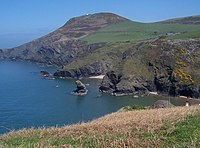
Welsh coast: Llangranog, Ceredigion, by Jayne Toyne, geograph.org.uk (Creative Commons)
Llangranog, Ceredigion (Jayne Toyne, geograph.org.uk)
I first became aware of family history as a child, when my father drove us around his native West Wales talking about who used to live in this place, or how we’re related to that distant aunt. It sounded like storytelling, wonderful tales about semi-legendary characters. I wish I’d asked him to write it all down. Still, a spark had been lit.

In 1994, my mother came back from a visit to her relatives in Australia with the thrilling news that we were descended from an Irish rebel and transported convict. Zap! That spark turned into a blazing flame and I was hooked on genealogy. She and I went to Ireland to do more research and started swapping emails with helpful Aussie rellies. Eventually we had so much family information that we published it as a book, A Rebel Hand: Nicholas Delaney of 1798.

Most of my research until late in 2011 was into Australian and Irish genealogy, history and local history. Then I found out that one Aussie 3x great grandmother was supposed to be a famous New South Wales ghost. Well, I had to know more. She and her husband/partner were both convicts, too, and I was inspired to look at other branches of my family tree.

Another convict ancestor came from Deptford, on the Thames, and my research broadened into London history and genealogy. And now I’m starting to look at the Welsh side of my family. Dad would have been pleased.

A side effect of my genealogy sleuthing has been learning about the history of the late eighteenth and early nineteenth centuries in the UK, Ireland and Australia, and of the places my ancestors came from. I’m fascinated by the social history, the day-to-day lives of people, the conventions of those times.

It was in November 2010 that I started blogging as a way to share my family history interests and discoveries. I soon found that there was a big world of geneabloggers out there, commenting, helping, sharing joys and sorrows and joining in challenges and memes. It was a wonderful discovery. There’s so much collaboration in the history, local history and genealogy and this new blog is a great example. If you’re not taking part already, why not join in? Here’s how.

I’ll finish by sharing some of my favourite blogs and websites for research, all free to view:
  • Claire Santry’s Irish Genealogy News is just what it says, all the latest information about genealogy for Ireland north and south.
  • Old Bailey Online, a collaboration between historians, has not only digitised the proceedings of London’s Central Criminal Court but gives lots of information about London life from 1674 to 1913.
  • Trove, where you can search Australian newspapers, books, manuscripts, images and much more dating from 1803. A lot of people using the digitised newspapers also collaborate by correcting the optical character recognition (OCR) transcriptions.
  • Welsh Newspapers Online, a new project from the National Library of Wales (Llyfrgell Genedlaethol Cymru).

Working together is so rewarding. Please join us in this new worldwide adventure by commenting, asking questions or even writing a post!