Showing posts with label Family HIstory. Show all posts

Sunday, 12 February 2017

Rootstech 2017 from across the pond

This year I am writing my review from the perspective of a UK family historian watching from afar and wishing she had made the journey across the pond.

When I first started to write this post I started to discuss what was happening in Salt Lake City. But I am not in Salt Lake City this year I am at home in Wales.
How can I write about a conference when I am not one of the attendees.
The Rootstech conference did not get underway until the Thursday but for me the excitement builds from the Monday.
In keeping with the tradition at 10am MST (SLC time) 5pm GMT the Rootstech week starts with Mondays with Myrt from the Family History Library in Salt Lake City. The usual panel (including me) has little to say as Pat Richley-Erickson aka DearMYRTLE interviews a variety of folks from across the globe who have made the journey to Utah arriving early enough to get some research time in the Family History Library. 
Later on Monday early attendees from the Commonwealth countries enjoyed another tradition the Commonwealth dinner. This year they went to the Blue Lemon and afterwards photographs appeared on the Geniaus blog. I must say that when I went in 2015 this was a great way to meet others prior to the conference.

Going to an event like a genealogy conference is a great way to network with other genealogists/family historians. I know that for many attending classes is low priority. We all love to find connections with others (especially someone who may have photographs) and with such a large group many do find a link. This year a cousin of someone I met in 2015 made a connection with Judy G Russell The Legal Genealogist after watching her talk on the live stream. I knew about this via facebook before she wrote her post but she illustrates my point so well (better than I could).

I managed to catch all the RootsTech General Sessions on the live streaming and some of the classes that were streamed. Now that the recordings are up, those I missed I can catch up with later, there are more than those that livestreamed. Some are US centric but may hold useful suggestions most are general and the keynotes, in particular, inspirational and passionate.

If watching or attending RootsTech does nothing more than provide inspiration to feed your passion for your family then it has done its job. But we need innovators to provide us with the means to record, communicate and preserve. 
Some of the technology advances have brought about the success of this conference in getting to folks across the world. In the early years you could lose the video if anyone else was online. This year those at home could vote using the RootsTech app on their phone. 

We need new ideas rather than more of the same. I wonder what the innovators in the industry will bring us next year.

Before I go here courtesy of Lilian Magill (in the lilac sweater) is a photograph of many of the Geneabloggers at RootsTech 2017, noticeably absent were Russ Worthington (aka Cousin Russ) and Thomas MacEntee (Geneabloggers).


The final event for many of those in the photograph was an evening to wind down with friends courtesy of DearMyrtle who has some of her friends visit her house for an after party.

I love seeing the photographs from the other get togethers which are not part of the main RootsTech event. These are as much about why we should attend as the conference and you cannot get what I call "the buzz" unless you are actually there. 
There will be lots of tired, enthusiastic people headed home today or in the coming week (some stay on to do research) but for many it is so good you want to come back again.
Maybe next year I can write a first hand report. (fingers crossed)

Monday, 12 December 2016

Sharing your research process


How do you share your  research?


I have recently joined my local (Gwynedd) family history society. I have no ancestor research in the area but it gives me a chance to share with others.

I already use ways of sharing my research online as a blogger and a participant in groups on Google+ and Facebook.

Tonight we have a members evening and I am sharing something from my research.

I have converted my post from July in to a presentation and will take it with me to the meeting.

Face to face discussions can help both the person sharing the research and the audience.
The audience may help with suggestions for further research. The methods used by the presenter may help others to use them for their research.

On line discussion with Hangouts on Air such as Mondays with Myrt are a new way of creating discussion amongst researchers across the globe.
With all the emigration over the years this international discussion is proving to be extremely helpful.

We discussed what I am presenting in the hangout today so if you want to see what I mean go to the link above and view the video.

Just because you do not have research in your local area does not mean you cannot benefit from joining the local group.

Genealogy research can be a lonely process but we all need to learn how to do it if we want to do it right.

Thursday, 19 May 2016

Headstones Are Not Always Right

Many genealogists before me have sounded the warning to only use Find a Grave memorials as a tool and not always as pure fact. Those that have headstones are considered by many as valid evidence of the death and burial of the subject of the memorial. Those with a tombstone are more valid than those memorials posted without headstones and no source pinpointing burial in that cemetery.  Another problem for the researcher is the headstone that has been recently created and added to a cemetery for someone who died more than a century ago. Where did the creator get the information?
You can tell the focus of my post will be why you need to be cautious about adding the information you find on Find a grave to your tree and creating Find a Grave page as your source for the dates you put in your tree.

I will use as an example of my words of caution a memorial I found while I was helping a family with the War of 1812 Pension Files for Josiah Mead. I went to Find a Grave website to look to see if there were any headstones for the soldier or his two wives, . There was a memorial for his first wife Sally Wood Mead and connected was a memorial for him. At first I thought it was strange there was a headstone for him in Lexington, Kentucky since he died in Will, Illinois. Then I looked a little closer and, well, let me put up the headstones for Josiah and Sally and then I will discuss.
Memorial for Josiah Mead 
 m
headstone on Sally Wood Mead memorial, wife of Josiah.


The "headstone" for Josiah on his memorial, correct me if I am wrong, appears to be the bottom part of Sally's headstone where it identifies her as wife of Josiah Mead Born...; Died...
You notice they have the exact same birth and death dates. Odder things have happened, but in this case I have a pension file to show the inaccuracy. 
Information of first wife Sally Wood 
 T
Portion of a letter in the file, stating death of Josiah. He was living in Will, Illinois

With this information, I know that the "headstone" on Find a Grave was not Josiah, because a year after Sally died he was writing a family member about her death. Another point to be made is he married his second wife in the year 1856 and then died in 1866.
I contacted the man who maintains the memorial site with the above information suggesting a change for Josiah's memorial was in order.  No response, and it has not been changed as of this time. 

You get my point, that headstones  are awesome to help with identifying birth, death, and place, It is not, however, a primary proof, and should not be treated as such. If you are sure the information is correct, then back up that information with researched sources if at all possible. 

I leave these thoughts with you to mull over and consider.
See you again, same place, same time next month.
FranE

Sunday, 15 May 2016

Genealogy centenaries

Isn't it always the way? You wait years for a significant genealogy anniversary and then three come along at once. That's how it is in 2016 for my ancestors - three significant bicentenaries for three of my convict forbears, Nicholas Delaney, Sarah Marshall and John Simpson.

So I thought I'd share a bit of information about them. A lot of Australians are descended from this trio of law-breakers and maybe one of them will find this post and get in touch. We genealogists love hearing from cousins...

The first genealogy centenary is 13 June, 2016, the 200th anniversary of the official founding of the Royal Botanic Garden in Sydney.

Drawing of the Domain and Mrs Macquarie's Point, Sydney, Australia1830
The Domain and Mrs Macquarie's Point, 1830, Creative Commons by Paul K

On 13 June, 1816, Nicholas Delaney, my 3x great grandfather, and his gang of convict workers finished building Mrs Macquarie's Drive, the road that runs round what was then the Government Domain. It's now part of the Botanic Garden.

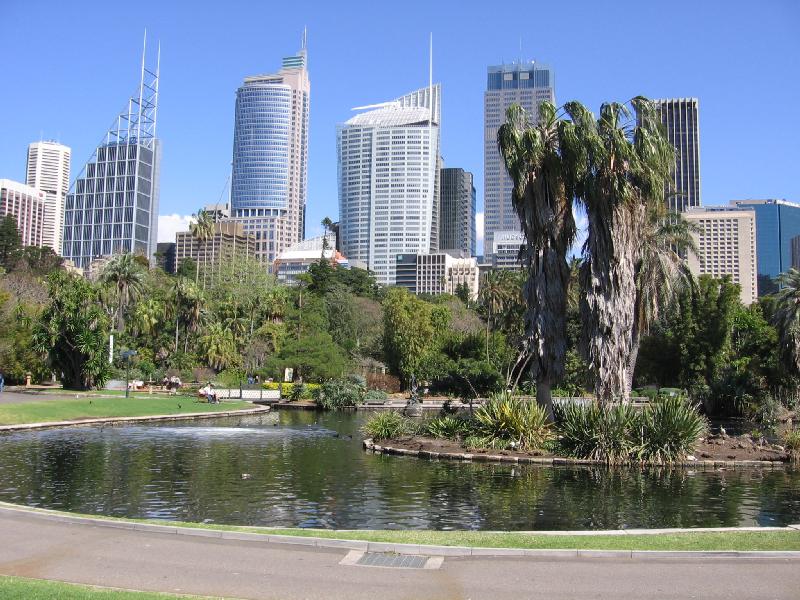
Photo of the Botanic Gardens, Sydney, with skyscrapers in the distance
The Botanic Gardens in the 21st century CC via Wikipedia

Cleverly, Nicholas arranged to finish the work on the birthday of Governor Lachlan Macquarie's wife, Elizabeth. The delighted Governor awarded Nicholas and his 10-man gang five gallons of spirits as a reward. There would have been sore heads as well as muscles the next morning.

Inscription on Mrs Macquarie's Chair, also called Mrs Macquarie's Seat, Royal Botanic Gardens.
Inscription on Mrs Macquarie's Chair, celebrating the day Nicholas finished the road CC by Graeme Churchyard

I've already written about building Mrs Macquarie's Drive as well as the only part of the original road which now survives, the Macquarie Culvert. As the 200th anniversary comes even nearer I hope to post more over on the A Rebel Hand blog.

Update: here's the first of those posts on Nicholas Delaney, Mrs Macquarie's Drive and the Botanic Garden's 200th anniversary.

The oldest bridge in Australia, built by Nicholas Delaney: the Macquarie Culvert, Mrs Macquarie's Drive, Royal Botanic Gardens, Sydney
The Macquarie Culvert, Mrs Macquarie's Drive, Royal Botanic Gardens, Sydney CC via Wikipedia

There's going to be a big party in the Botanic Gardens on the 13th and I've heard from some fellow Delaney descendants that they'll be going. If only I weren't half the world away I'd be there celebrating my ancestor's achievement. But I can't get to Australia this year. You can bet I'll be keeping up via social media and other channels, though.

The next bicentenary of this year is of the trial and sentencing of Sarah Marshall, my 3x great grandmother, on 24 July, 1816, at the Lancaster Assizes. 

Written record of Sarah Marshall's sentence at the Lancaster Assizes, July 1816
Sarah Marshall's sentence via Ancestry

Sarah was convicted of 'stealing a petticoat valued at one penny, a bed gown valued at one penny, two caps valued at one penny, a pair of silk stockings valued at one penny and a sheet valued at one penny, being of the Goods and Chattels of John Oldham.'

And for fivepence-worth of clothes, she was to be 'transported to some part beyond the seas.' To New South Wales, in fact, like all my convict ancestors.

Australian Convict Transportation Records for Friendship II via Ancestry

Sarah's story - or what I can find out about it, because there are plenty of strong Lancashire brick walls surrounding her life before she half-inched the goods and chattels - includes two particularly dramatic episodes after her trial. She was sent out on a notorious convict ship, the Friendship, famous for the licentious behaviour on board during the voyage. Again, I'm planning to write more about that.

And she's popularly believed to be the 'Sarah's Ghost' who is said to haunt Castlereagh General Cemetery, having been murdered by a group of  lust-driven men. But the story's inaccurate. I'm glad about that. Poor Sarah, as if she hadn't suffered enough.

Sarah went on to marry, or live as if married to, John Simpson, a tailor, and his is the last of my trio of bicentenaries.

John was born in Yarm, in the North Riding of Yorkshire. On 8 November, 1816, he was charged with 'feloniously taking and carrying away two bales of goods, consisting of muslin and shawls' at Hope in the Derbyshire Peak District and committed to Derby county gaol. The Derby Mercury reported the facts on 21 November.

Derby Mercury newspaper masthead, 21 November 1816
 
John Simpson charged with theft and imprisoned in Derby County Gaol: newspaper report in the Derby Mercury
Derby Mercury report via FindMyPast

He was to stay in Derby Gaol until the Lent Assizes in March, 1817, when he was tried and sentenced to seven years' transportation.

John and Sarah's daughter Lucy Simpson married Thomas Delaney, the son of Nicholas and his wife Elizabeth Bayly, which ties up my three bicentenary ancestors neatly.

Tuesday, 19 April 2016

Past Life Styles Before the Internet

Last month, I was in a slump and missed my post. I was moving back to the house my husband and I built when we were young. We had such high hopes for it and slowly began working towards those goals while having and raising 6 children.  As you can imagine, it was S L O W. We abandoned it to live in my mother’s home when
         1. She moved into an assisted living facility because of early onset of dementia and...
           2.   My sweetheart had stage 4 col-rectal cancer. 
It is a story and a half house, so my children were concerned about long range challenges for me and my knees. 
Oh well, who know what will happen in ten years. The biggest challenge has been overcoming the pain at seeing what he had worked so lovingly to make had fallen into disrepair. Some reading this know me on social media such as Facebook. I frequently talk about comments from the tree house. My son remarked that it was an apt description as it was a cross between the Swiss Family Robinson’s and the Bernstein Bear’s home. 
Now you can understand a little of the confusion and disorientation I have been experiencing in planning ahead. Well, that coupled with family calling and asking for assistance with their personal problems. What’s a mom to do, say no? I think not. That is what life and genealogy is all about.
An experience I have had as I have been moving back home, is unpacking my genealogy files. Many times, it makes me smile as I see, notes written on scrap pieces of paper, and no reference as to where I found it. 
Today, moving in the professional world of genealogy, I hear chastisement in my head for not having a research plan sheet, or writing down my documentation. I have empathy for those who find themselves with genealogy information and not a clue as to which book it was they found it in. Let me explain.
Going back to building a house and finishing it ourselves while raising 6 children, will help you understand a little bit. I worked as a public health nurse or school nurse while my children were growing up, and helped my husband with work projects he had as well. We are member of The Church of Jesus Christ of Latter Day Saints, which as most know emphasize finding your family history. We were the only members on both sides of family, who were members. No one had a clue about their family’s history, it all fell in my lap to find it, along with all the above. To shorted this story, I will just say the way it happened was, aside from a few planned visits to major libraries, I would swing by the local library for a 30 minutes to grab some research time when I went grocery shopping or was running errands. My sweetheart would look at me when I got home (days before cell phones) and say “you sure took a long time, at the library again?”  And that is how notes were scratched on odd pieces of paper and now, random information found without documentation. It was almost a lifestyle. Grabbing moments to recreate life times, it is why I am going back and filling in the blanks now. Life before the internet was not easy, nor was it always organized. That is my personal family history finding story.

Has anyone else experience a lifestyle so random or am I the only one? 

Friday, 12 February 2016

My First Impressions of Twile - Winner of The Peoples Choice Award at Rootstech 2016

File 06-02-2016, 19 03 42

This photograph is from the Twile Blog to find out more see the link below.

What is Twile?

Twile is a website which creates a timeline of your family memories that you can share with those in your family who may not be the avid genealogist that you are. 
Only the people you allow can see what you share but it allows us to share all those moments that we forget to record in our software programs.
Here is a link to why it was created and I shall leave you to explore their blog to find out more.

How I found the site

I first found out about this website when the semi finalists for the Innovator Showdown at Rootstech 2016 were announced and decided to sign up for the trial to see what it was all about. 

The Demonstration at Rootstech 2016

Life got in the way and I saw the video of the Innovator Showdown Semi-Final and decided I needed to get my GEDCOM file uploaded to the site so that I can start adding memories and sharing with my family. I know that many others are interested in this site as it won the vote from the audience including those watching online. Here is a link to the Innovator Showdown Finals 2016 if you have not had a chance to see it.


Exploring the website

I am only just starting to use this but I am impressed by the feedback from the team who run the website. They will be inundated with people wanting to join and try out the website. They are still managing to get back to answer individual queries and provide a solution in a timely manner.
Customer service is so important if you want the users to keep coming back.

Gedcom is up and working and I am adding profile pictures to my ancestors and adding living members. You can invite your family by email, and as the website can be accessed by tablets and smartphones, I expect it to be popular with the younger generations of the family.

The comment from my son after I sent an email invite  was " I received an email saying you added me to your family tree, I thought I was already a member! ". This sparked a conversation and I showed him the family timeline I am building which currently has only my side of the family and my husband. He looked at the date his grandfather died, knowing it was the same day that his cousin was born and the date the following week when we had the cremation, these are things that he remembers. 
He also asked if it was private so I told him that only the family could see this if I invite them. 
The more of them that join, even just the free part of the site, the better it will be for everyone. 
I love the timeline as it really helps to put things together in relation to each other in a way that those in the family, not "doing genealogy", can interact with and add contributions.
I like that you can add more than just the usual things like births, marriages and deaths. 
I have uploaded a few photographs from a couple of family get togethers today as milestone events.

From what I have seen so far I am almost certain I will sign up to be a premier member. 

We should all share in the mission to get the younger generations engaged, to ensure that the stories and memories we are creating today and have created or had passed on to us are saved, in a way that our families will want to share in the future. 
Photographs and stories are what inspire us to find out more. 
We have so many ways to record and store them but the best thing we can do is to share.

Just as I finish writing this there is more good news for Twile in this announcement
I already have an ongoing subscription with find my past so hopefully this will lead to integration between the sites.

Tuesday, 15 December 2015

Twelfth night, or what they ate at Christmas

With Christmas just over a week away, I'm going to write about a custom most of my UK ancestors were familiar with – but which has died out here in Britain.

It's not about a Christmas Day custom, though, but one which occurred during the festive season. Janet Few's already written a lovely post on Worldwide Genealogy about her own family Christmas tree tradition, so I thought I'd branch (sorry!) out a bit.


Dividing the Twelfth Night Cake
These days, the Christmas season seems to start in November (and in September in the shops). But go back in time and it really started on Christmas Day, or the night before, and continued for 12 days until Epiphany, also known as Twelfth Night. For many people this day was an even bigger one for parties, feasting and present-giving.

So today I'm looking at something which started out as part of the celebrations of Epiphany, when the three Magi, or Wise Men, or Kings, arrived in Bethlehem. Twelfth Cake, also known as Twelfth Night Cake, Bean Cake or King Cake.

It was a rich fruit cake in which a dried bean and pea were baked. When the family, friends and neighbours were gathered round the table, the cake would be divided up and whoever found the bean in their slice would be king for the night, while the person who got the pea would be queen.

Misrule: The King Drinks, David Teniers the Younger

Most accounts skip over what happened if a woman got the bean, or a man the pea, but it seems that whoever got a 'wrong' legume would then choose a king or queen, as appropriate.

The monarchs for the night then ruled over all the others until midnight and were in charge of the feasting.

This seems to be a distant echo of the Roman Saturnalia, a midwinter festival which was partly assimilated by Christmas festivities, when a Lord of Misrule oversaw the upturning of social norms and a wild time was had by all.

By the end of the 18th century the King and Queen were joined by others, such as Sir Tunbelly Clumsy and Miss Fanny Fanciful, caricature characters picked out of a hat or bag. They acted as the merry monarchs' courtiers.

Plain Twelfth Cake (plum cake)

Twelfth Cake probably started out as a delicious fruit, nut and spice cake, but, as sugar became more available, would be dusted with icing sugar or covered in white icing. A paper crown, or one or two made of sugar paste, was often put on top.

During the 18th century decorations increased until the cake ended up covered in paste mouldings as elaborate as a Robert Adam ceiling, while usually keeping the crown or crowns. Sometimes the other Twelfth Night characters were also added to the decorations.


And with the cake, and the feasting, and the fun, and present-giving, Twelfth Night was 'probably the most popular day throughout the [sic] Christmas' when William Sandys published his book Christmastide in 1852.

So why don't we eat Twelfth Cake these days? What happened to it?

The Victorians did. In particular, Victoria herself. As Christmas Day became more of a family celebration, thanks to Dickens, Prince Albert and all the rest - because many of our 'traditional' Christmas customs are fairly recent in historical terms - it began to rival Twelfth Night.

Then in the 1870s Victoria banned Twelfth Night. Boo! Hiss!

To be more specific, she thought it was too pagan, too un-Christian, with its boozy celebrations and dangerous misrule, and too disruptive to hard work, so she had it removed as an official holiday. No day off work; no feasting or upsetting the social order.

The cake, with its decorations modified, and without its pea and bean, moved to Christmas Day.
Well, my ancestors weren't going to lose a delicious treat as well as a holiday, were they?
Black Bun

And it seems that Twelfth Cake was also the ancestor of a Scottish cake/pie called Black Bun, which I've eaten on Hogmanay.

Another Twelfth Night tradition was drinking a wassail - spiced cider, or wine or ale. With the flesh of baked apples floating in it, it was known as Lamb's Wool. It would go very well with a slice of cake or Black Bun.

The inspiration for this post came from my friend Lesley, who asked me if I knew anything about Twelfth Cake. I said I did, a bit, and dashed off to do some research. Any excuse! It was so interesting I wanted to share it with you.

So thanks to her, and to you for being a wonderful Worldwide Genealogy community. I'll end by wishing you a very Merry Christmas, if you celebrate it, and a happy holiday season to all. In the words of a favourite of mine, the Wassail Song:

Love and joy come to you,
And to you your wassail too!
Twelfth Night Feast by Jan Steen


All illustrations are in the public domain

Wednesday, 21 October 2015

Homebodies: Benjamin, Edith and Thomas Herbert Victor of Mousehole

Mousehole Harbour, Cornwall, England
On my own blog starryblackness I’ve recently written about the Victor branch of the Rowe family.

Born in the small fishing port of Mousehole, Cornwall, England, sister and brother Mary and John moved at different times to Devonport (Plymouth) for work and their brother Edwin ended up in Glamorganshire, South Wales. However their brother Benjamin happily stayed behind in Mousehole, which is just 6 miles from Land’s End in the western tip of Cornwall.

Benjamin was the son of a fisherman called Bernard Victor and his wife Alice (nee Rowe). He was born around Christmas 1860/New year 1861 as he was 3 months old by the 7 April 1861 census.  He was baptised on 28 April that year, one of eight babies baptised that day – Paul Parish Church must have been so noisy!  However, scrolling down the list of baptisms that year in Paul Church, 13 October 1861 must have been wilder as an astounding 17 babies were baptised.

Looking down Fore Street, Mousehole
The family were living on Quay Street at that time, but by 1871 they had moved to 2 Mill Place – this picture of Fore Street is the view Benjamin would have got as he came out the house and turned down to head to the harbour.  He was still at school at that point.

By 1881 he was working as a boot and shoe maker, living on Church Street in Mousehole with his parents and two of his brothers, widowed Gamaliel and younger brother Edwin.

His father Bernard died in summer 1891. His father had been a quiet man, interested in the Cornish language and history, and perhaps the love he had for his home village was passed on to Benjamin.

St Mary's Church, Penzance, Cornwall
Although there was hostility between neighbouring Newlyn and Penzance (the latter was the far side of Newlyn from Mousehole), Benjamin met and fell for a Penzance girl called Edith Wilkins. They married in her parish, Penzance St Mary’s, on 3 November 1890. Her father was an engineer called Thomas Wilkins and witnessed the wedding; by that time Benjamin had become a boot maker like his grandfather William Rowe.

They settled down in Mousehole, where their son Thomas Herbert was born on 6 September 1894. Their daughter Annie Olive was born on 5 August 1898.  I know they also had a third child who’d been born and died young before 1911, according to that census.

Benjamin continued to work as a boot and shoe maker and they lived in Mousehole at various addresses over the years.

Benjamin’s mother Alice Victor (nee Rowe) died in 1903.

Penzance Public Library (L) and School of Art (R)
In 1911 Benjamin and Edith were living at home in Mousehole with Thomas and Annie. They also had a widowed aunt staying, a lady called Ann Curnow who had been senile for two years. At this time Thomas was an art student, which I found intriguing as this is the time when the Newlyn School of Art was flourishing and there was an art college in Penzance next to the Library, built in 1880.

So I googled Thomas Herbert Victor and – yes! A ‘famous ancestor’ at last! I found him on the Cornwall Artists Index and he indeed did go to to the Penzance School of Art where he had a scholarship from the start.  He was offered a scholarship at the Slade School of Fine Art in London but chose not to leave Mousehole and indeed lived there all his life, never travelling further than Truro, 32 miles away.

Bernard died in 1914 and was buried in Paul Cemetery.  Edith outlived him and the first world war by many years, dying on 15 January 1941 in Mousehole; her son was her executor.

Their children lived into their 80s, Thomas dying on 10 March 1980 in Mousehole, and Annie two years later, also close by in the same registration area.

© Lynne Black, 21 October 2015

Friday, 16 October 2015

October in the USA, Halloween and Family History Month

.
October is Family History Month in the USA

Family history month.  Not genealogy month.

What does that mean to you?

To me, it means adding to my genealogy with "history" and other "fun things" I find along the way.

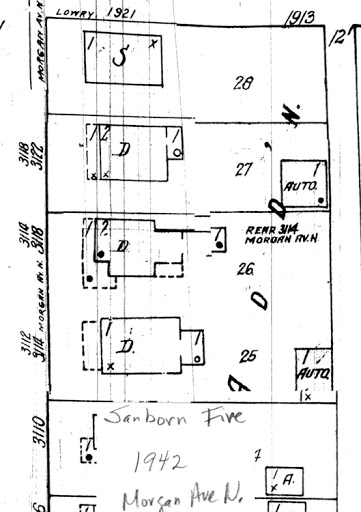
Like Maps.  Here are two Sanborn Fire Maps, of the same street, same addresses in Minneapolis, Minnesota, one from 1912, the second from 1942.  These two maps answered many questions we had on Man's great-grandparents.  Their address changed, but, so did the street addresses on the homes during this time period.  See 3114 and 3118.

1912:  
And, in 1942:  

Bibles.  Family bibles, sometimes the only record we can find for birth, marriage and death dates, if our ancestors lived in a locale that did not require civil registrations.  Sometimes those Bibles differ from the civil registrations.  No matter.  What great family history.


There are always newspaper articles to be found, obituaries and other wise.  

In 1940 Joseph and Minnie made a trip back to Georgia to visit relatives they had not seen in over 25 years.  A news article was found in the effects of Donald Eugene Bowen (Joseph and Minnie's only grandson) after his death in 1991 stating that Joseph and Minnie were celebrating their 50th. wedding anniversary.  The newspaper is not known:
     "Wed 50 Years
     Mr. and Mrs. Bowen Celebrating Here Today
     Mr. and Mrs. J. E. Bowen, who are visiting Mrs. Lela Akins at 342 Whitaker street, are celebrating their fiftieth wedding anniversary in Savannah today.
     Residents of Berkeley, Va., they are visiting Mrs. Akins, who is the sister of Mr. Bowen.   Mr. Bowen lived in this city several years before 1900 and has many relatives in Wayne County.
     Today Mr. and Mrs. Bowen went to Savannah Beach, stopping on the way at Fort Screven where Mr. Bowen's nephew, Rufus. L. Bowen, is stationed as a sergeant in the artillery.  They were driven to Tybee by Mrs. C. L. Dean, a niece.
     Mr. and Mrs. Bowen are renewing old friendships among Savannahians and are seeing relatives they have not seen in 25 years, they said today.  Mrs. Bowen is 68 and Mr. Bowen is 70."

Sometimes even the obituaries can be a bit controversial and maybe even a wee bit humorous.  We submit two obituaries for Joseph:


The first obituary was found in the Tuesday, August 31, 1948 issue of the Savannah Morning News, Savannah, Chatham County, Georgia:
    "Joseph Eugene Bowen
     Funeral services will be held tomorrow afternoon in Darien for Joseph Eugene Bowen, 81, who died in a local hospital Sunday after a long illness.
     Services will be conducted at 2 o'clock at the Darien Baptist Church by the Rev. William G. Studer.   Burial will be in St. Francis Cemetery, near Darien.  The body will be at Fox and Weeks Funeral Home until leaving for the service.
      Mr. Bowen is survived by one son, Hayden E. Bowen, Norfolk, Va.; a brother, Ashley Bowen, Jacksonville, Fla.; a grandson, Donald Bowen, Norfolk; and a great-grandson, Carol Bowen, Norfolk."
     
From the Norfolk Virginia-Pilot, published on August 31, 1948:
     "Joseph E. Bowen, 81, father of Hayden E. Bowen, of Norfolk, died Sunday in a hospital at Savannah, Ga., after a long illness.
     In addition to his son, he is survived by a brother, Ashley Bowen, of Jacksonville; a grandson, Donald Bowen, of Norfolk, and a great-granddaughter, Carol Bowen, of Norfolk.
     Funeral services will be conducted Wednesday at 2 p.m. at the Darien Baptist Church, Darien, Ga., by the Rev. William G. Studer.  Burial will be in St. Francis Cemetery.
     The body is at the Fox and Weeks Funeral Home, Savannah."

That Carol Bowen, once a great grandson and once a great granddaughter just happens to be yours truly.

How about artwork, a child's hand or your grandmother's last art project?


Notes on the history of towns, counties, even cemeteries can provide some interesting fodder for your family history:

For example, Great Bridge, Norfolk County, Virginia is now known as Chesapeake Virginia.  Just a small but mighty important fact in my research.  With the help of Uncle Google, I found the Wikipedia page on Great Bridge, which page led me to information on the Great Bridge High School, which my father attended.

One frustrating search ended up with me making the following notes:

Grindstone City was near Port Austin, Huron County, Michigan.  It is no longer found on many map programs.

Sometimes the "history" is a photo of a historical marker on the side of the road:


Your pets are part of your family history story too, for example this photo of our Bimbo, taken in Morocco, shows the kitty, but, it also shows so much about our living conditions while we lived there for about 16 months, courtesy of our Uncle Sam.  I wrote this caption to accompany the photo:

1971. Stove is Navy issue.  See bottom right of photo:  2 water jugs were filled at base for cooking and drinking. Kerosene was used for heating. Behind the bag of garbage, between the stove and cabinets is the propane bottle for the stove.  Why no garbage can?  Have no idea!


Then, we have 2 yorkie clowns and a kitten.  The kitten ended up being a "treat" for a very sweet little girl that Halloween. Yes, we adopted out the kitten.(This is my reference to Halloween in the title.  I know, I really stretched it this time!  LOL  Apologies for the quality of the image, if I ever find that photo again, I will re-scan it.  Another part of family history, learning new skills, adapting to newer technology, scanning photos.)


I have been known to include boats, cars, trucks, rv's in my family history. They are an important part of our family history.  

Yes, there is a story, and yes, Man survived, with not even one scratch.  It could have been much worse:


Houses and how they relate to our family history is another favorite of mine.  

One of our homes when we lived in Kenitra Morocoo.  There were glass shards on the top of that wall surrounding the yard.  To discourage "visitors".


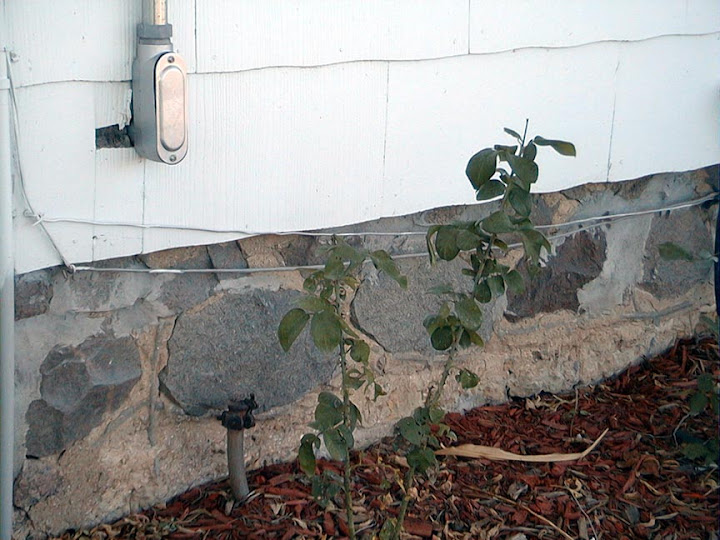
This house, may be, maybe not, the home of Man's g-g-g grandfather in McHenry County Illinois.  It was in the same place as the home was shown on old plat maps.  I felt the foundation in the middle section looked kept up, but, old.  This story still could unfold:


The foundation of what I felt was the oldest part of the home.  Even though I was able to track down the current owner of the property, they were uncertain of the history of the home.  Boy, wouldn't I have loved to get into the house.  No such luck.


I also love to add unusual documents or resources to my family history, one such document was the Certificate of Special Rights of Citizenship I wrote about recently over at Reflections.  


October, a great month to expand and expound on your family history.  It's not just the census anymore.


*  All the images above will be found in my data base attached to the appropriate family or individual.  I currently have over 10.000 such images attached in my data base.  It's all about telling the story, the family history.

**  Happy Halloween, take photos, they are part of your family history as well.  Yes, even the pumpkins no matter how you decorate them.

BOO!


.

Monday, 14 September 2015

UK National Archives webinars - a new genealogy resource

The UK’s National Archives (TNA) at Kew has started a new initiative for genealogists – interactive webinars. I took part in one last week and thought I’d pass on my experiences to the Worldwide Genealogy community.

The National Archives, Kew, © Copyright Chris Reynolds and licensed for reuse under this Creative Commons Licence
The National Archives © Chris Reynolds  Creative Commons
If you’ve got ancestors from the UK or its former colonies you may have already used TNA’s catalogue, Discovery, its online collections or its podcasts. You may even have visited the archives at Kew. Now these webinars may be another way to learn more about genealogy and how to research different aspects of your own family history.

I found out about the webinar I took part in because I’m signed up to TNA’s enewsletter, but you can also see upcoming events on their home page.
You have to book your place on a webinar via Eventbrite, and you’ll get a confirmation email and, nearer the date, a link and instructions. They suggest using a PC or laptop rather than your phone as the sound quality will be better. If you’ve got headphones, better still.

It’s a good idea to go to the webinar a little early to get used to the layout and to iron out any possible glitches as well as to sign in. You’ll see an e-curtain where slides will display once the webinar gets under way, and on the right hand side a small dialogue box where you interact with the TNA mods and other participants. This is also where you post questions for the speaker to answer at the end – you can ask questions at any time and some people’s queries were answered by other participants during the webinar I attended. Above this is a video feed of the speaker.

TNA says:

This webinar will identify relevant record series at The National Archives and help you trace individuals from this period.
We will also show you some key primary sources available to help you with research around this topic.
Webinars are interactive, online seminars designed to support and develop research skills. You access this event from the comfort of your own home, by logging in on your pc, tablet, smartphone or other device. Being online, you will be able to take advantage of the expertise of The National Archives' staff from your own computer or tablet, without having to travel to Kew. During the session (which will last no more than an hour), you can interact with staff members and fellow researchers taking part in the webinar, as well as listening to, and viewing, the presentation on screen.

How was my first TNA webinar? Instructive and enjoyable, with only a few minus points. There were some glitches with the sound. At first there was none, then it was too low, and later on I and another participant heard a very distracting echo which made it almost impossible to follow what the speaker was saying. This wasn’t too bad while there were slides on the screen, but made the Q&A at the end impossible to follow.

In addition, the dialogue box was supposed to stay on screen after the session ended so that attenders could go on talking for a while, but it disappeared.

I’m sure these were just teething troubles. I found the TNA staff very helpful and keen to sort out the problems. They generously offered to send us the slides and a link to the audio so we could catch up with the bits we missed.

Apart from these small problems, it was a very positive experience. The slides were clear and left on the screen for long enough to take notes from (though I did take a few photos as well), and the speaker, Dr Katy Mair, used several documents from TNA’s collection to illustrate points, which was an added bonus.

She was excellent at explaining the sources available from the National Archives and how to search them. And it’s always a joy to hear an expert speak.

I’d definitely recommend taking part in a TNA webinar if you can. Some older ones are also available on their website.

Finally, a few notes about the session I attended. With this being the 300th anniversary of the Jacobite Rising of 1715, TNA is marking the event with some commemorative events, including a small display in their Keeper’s Gallery. This talk was about tracing Jacobites (supporters of the exiled King James) in the National Archives.

There are no sources online (apart from State Papers Online, a subscription site only available to institutions), so it’s necessary to go to TNA or get someone to do the research. Discovery, their online catalogue, has descriptions of the relevant series. They are:
  • State Papers (SP) – the key series
  • Various legal series – Treasury Solicitor (TS), Kings Bench (KB)
  • Forfeited Estates Commission (FEC), Patent Rolls (C66)
The State papers fall into two categories, State Papers Scotland (SP 54), letters to the Secretary of State from Scotland, and State Papers Domestic George I and II (SP 35 and 36), letters to the Secretary of State from England.

Flora MacDonald, captured in 1746 (Wikimedia)
In addition, SP 41 (State Papers Military) covers the risings of 1715 and 1745, with letters and papers directed to the Secretaries of State in their military capacity; SP 42 (State Papers Naval) holds correspondence from the Board of Admiralty; and SP 44, which covers letters sent dealing with warrants, pardons, petitions, licences and reports.

Katy also talked about women prisoners taken after the Jacobite Risings and about what happened to the people captured and convicted – if not execution, then banishment, pardon on enlistment or transportation.

She showed us lists in CO 1 (State Papers Colonial) of Jacobites transported to British colonies in America and the West Indies, where they were sold as ‘indentured servants’ to plantation owners.

Britain used its American colonies for transportation until the independence of the United States, after which it turned to New South Wales... but that’s another story.