Monday, 18 April 2016

Finding ancestors in the 'wrong' year in records

If you're fortunate (or dedicated) enough to trace any ancestors back to before the 1750s, and they were from Britain or its colonies, you may come across some odd-looking dates in documents from the early months of each year. They might be in letters, books, newspapers or parish records.

Here's an example, from the parish records for Merioneth/Meirionnedd in north-west Wales:


It looks as if nobody was baptised, married or buried between March 21, 1748, and March 25, 1749 - which isn't very likely. But not understanding this record could cause problems.

Suppose you're looking for Hugh Ellis and all the evidence points to him being born in Cae Gwernog in 1749 - and you found this record. You might think your other information was wrong, because it looks as if he was baptised on 21 April, 1748.

You might find a parish record which is even more puzzling (but gives a clue to the solution), like this one for the baptism of Mary Roberts of Tarporley, from the Diocese of Chester parish records:


She was baptised on 1 January, 1744. But wait a minute - just above her in the baptism of Thomas Garnett, on 30 December... 1744. Couldn't these people keep their records in order?

And yes, of course, they could. It's just that the calendar was organised in a slightly different way until 1752 in Britain and its colonies.

Old Style

From the late 12th century until 1751, the legal year began on Lady Day, the Feast of the Annunciation, celebrated on 25 March (exactly nine months before Christmas Day). So the year changed on that day: 24 March, 1750, would be followed by 25 March, 1751, and the year's length was calculated according to the Julian calendar. It seems odd to us, but since it was the way things had been for centuries, it was easy to understand.

Except...

New Style

Except that in October 1582, Pope Gregory XIII introduced a new calendar. By then, because the length of a year under the Julian calendar had been slightly over-calculated as being 365 days and six hours, with the six hours being added together every fourth year to make a leap year, the date of Easter had drifted too far away from the Spring equinox.

This also resulted in 'removing' 10 days from the calendar to make up for the drift. The new calendar, known as the Gregorian, was adopted by Catholic countries. But the English-speaking world was officially Protestant, and Protestant states weren't having anything to do with a change decided by the Pope. They stayed with the Julian calendar.

This caused confusion in dating letters, reports and documents which crossed the time zone between Protestant and Catholic countries.

To avoid this confusion, people often dated their papers using OS (Old Style) and NS (New Style), or gave two alternative years for those awkward days from 1 January to 24 March, like 1700-01, or 1700/1.

Here's how one newspaper, the Newcastle Courant, coped with the date problem:


You'll notice that in the latest edition the paper is dated 1744, but the first article mentions a date as being in OS - it's a report from (Gregorian, NS) France.

Just to add a little more confusion, the legal year in Scotland was changed to begin on 1 January in 1600, and after the Union of Parliaments in 1707, this caused more legislative problems.

Parliament wasn't happy. In 1750, it stated that the use of the Julian calendar was 'attended with divers inconveniences, not only as it differs from the usage of neighbouring nations, but also from the legal method of computation in Scotland, and from the common usage throughout the whole kingdom, and thereby frequent mistakes are occasioned in the dates of deeds and other writings, and disputes arise therefrom.'

And so the Calendar (New Style) Act 1750 was passed. It ruled that the English-speaking world would make two changes in 1752: that year would start on 1 January everywhere; and there would be 11 days removed from the calendar, since the drift had widened another year since 1582, when the Gregorian calendar came into force.


Still with me? Phew! I think we both deserve a picture to help explain the effect this had on record-keeping.


These are burials from the parish records of St Stephen's Church in Norwich. You'll see that 1750 burials go from 31 March to 14 March; 1751 burials are from 25 March to 24 December; and 1752 burial start on 2 January.

The other part of the changes brought about by the Calendar (New Style) Act 1750 was the removal of 11 days. Here's the law:


So you went to bed in the evening of September 2 and woke up on the morning of September 14. Which was not much fun if your birthday or other special day fell into the 'lost' time.


The Whitehall and General Evening Posts tried to explain the whole muddle on the morning of 14 September, NS:


Until recently I believed the story that the loss of 11 days caused widespread riots, with people furiously demanding: 'Give us back our eleven days!'

Unfortunately, it seems that this is an urban, and rural, myth, though the phrase was well enough known at the time. It appears, as 'give us our Eleven Days', on a placard at the bottom of William Hogarth's satirical painting An Election Entertainment:


But the missing 11 days isn't just a story about how daft the uneducated people were. A very recent blog post has pointed out that, though poorer people's wages, which were often paid by the day, fell by a third in September 1752, their rents did not. A good reason to be angry.

The taxes still had to be brought in, and so (rather than lose 11 days' tax) the government ruled that the new fiscal year should start 11 days later than Lady Day. And an extra day was added in 1800. That's why the UK tax year begins on 6 April - it's the old Lady Day, plus the (now) 12 days' drift.

Finally, as everyone's going Shakespeare mad, with the 400th anniversary of his death on 23 April, here's a brain teaser:
Shakespeare and Miguel de Cervantes died on the same date - but not on the same day. How can that be?

Notes:

Believe it or not, I've simplified things a lot here. The original Calendar (New Style) Act 1750 can be read online, if you really want to
All images are from FindMyPast, except for the Hogarth painting, An Election Entertainment, which is CC via Wikimedia, and the extract from the Calendar Act
If working out OS/NS dates is too much of a time-waster, there's a handy online date converter to do the work for you

Tuesday, 12 April 2016

Conferences and Genealogy Shows What's the Difference?


Photograph from the conference of Guild of One Name Studies held in Birmingham, England 
1st - 3rd April 2016

Conference or Show what do you get for your money?
Are they the same?
Does it depend where in the world you are?

Last year I wrote about going to Rootstech / FGS 2015 in Salt Lake City, my first impressions and compared it with WDYTYA Live which had just moved to Birmingham.

This year I was only able to catch the livestream and videos at Rootstech. However I did attend my first Guild of One Name Studies Conference held the weekend before Who Do You Think You Are Live. Both were in Birmingham the first at the Hilton Birmingham Metropole and the latter at the National Exhibition Centre the same as last year.

I have not attended anything in Australia and I know there are other conferences in the US. Pauleen Cass wrote a post on this blog last April about conferencing and she has quite a few references in this post to help give a more balanced view.

I did enjoy my Guild conference and have every intention of going to next year's conference which is being held on the outskirts my home city of Southampton. I am hoping to make the most of it by incorporating a research trip to the local archives in Southampton and the Hampshire Record Office in Winchester.

I decided to go to Birmingham on the train and managed to get a direct train both ways with a table seat for most of the journey. Both trains were crowded as it was the Easter holidays. Before I arrived at the hotel I could tell we were going to have an interesting and possibly noisy weekend see this tweet from Janet Few.

Chris Braund pointed me in the right direction and after registering, up to my room with the luggage, then back for a much needed drink before the first talk about DNA. 
Our first meal was followed by the quiz which I soon learnt was quite a challenge.

Unlike the likes of Rootstech the conference had 2 full days. The first part of the first morning was the AGM and the business side of things being swiftly dealt with we arrived early for the morning break. 

Next up was an interesting presentation about life on the canals. This guest was surprised when he actually sold out of the books he had brought with him. 

The session after lunch can be a real challenge and there was a lot of information to take on board. If you have anyone who lived and worked in British India the wealth of information available is incredible. Families in British India Society (FIBIS) has a lot on their website. They also had a big presence at WDYTYA Live this year and the celebrity I saw on the Saturday had gone to India to find out more about her family.

Anita Rani talking about her experience on WDYTYA at the Live show on Saturday 9th April 2016

The next speaker was from Twile but I will not expand further here as I plan to do a post on my own blog later this week.

Our final session for the day had to be changed at extremely short notice Paul Howes Chairman of the Guild did an admirable job and we heard some interesting stories from him and several other members.

Unlike Rootstech the Guild has a Reception and Dinner on the Saturday night a chance to chat and get to know other attendees a bit better.

A short church service first thing on Sunday was followed by 2 presentations. The first looked at presentation of your study using that member's own study. The second was looking at key sources outside the UK for finding your surname across the world.
Lots of information here and "food for thought" as to how to get the information and then how to put it into a useful format.

The session after lunch on Sunday was another change looking at how we might find living people. As one namers we often find the best information comes from members of families especially if you need individuals for DNA studies. Finding clues in the records and knowing where to look is crucial. The techniques shown were those I had used in doing my own family research and have reaped dividends in terms of family photographs.

The final session of the conference looked at example sources for emigration and immigration. This rounded off an interesting weekend. 

I had three days before the WDYTYA Live show and I will write about these on my own blog if you are interested.

For the first 2 days of WDYTYA Live I offered to help out on the GUILD stand. Here are some photographs that I took.


This was just across the aisle from the replica Spitfire that was on display at the Forces War Records stand


Ancestry, Family Search, Find My Past, My Heritage and The Genealogist all had their own stands. There were relatively few commercial vendors and several non-genealogical charities had their own stands. Much of the Society of Genealogists area was taken by Family History Societies although many local societies did not attend. A full list of exhibitors can be found here.
There was much more in the way of workshop sessions that could be attended and the interest in, and availability of, DNA testing appears to be growing.
Family Tree DNA sponsored a raft of free lectures in their theatre.

Having everything in one large hall with sections partitioned off for sessions can be a disadvantage but with well set up sound systems and microphones the only problems seem to be when technology failed.

As regards costs the ticket prices for Who Do You Think You Are Live can be found here. The website of The Guild of One Name Studies can be found here if you want to know more about who they are and the benefits of becoming a member. Rootstech has a different pricing structure to WDYTYA Live and details can be found on the FAQ page. Pricing for this year's FGS Conference is not yet online you can find their website here. The FGS Conference has more in common with WDYTYA Live than Rootstech in regards to the topics for the presentations. This is not surprising given that The Society of Genealogists and The Federation of Family History Societies are similar organizations to FGS in the US.

Comparisons between events in different countries are difficult as the audience and how they interact can be affected by the numbers that attend for just a single day. In the US conference attendees are more likely to stay overnight in the area rather than travel on the day. Up until this year I travelled on the day, this was cheaper than finding overnight accomodation, this makes for a long day which means that a single day is all that most would feel up to attending.
Whether more would be willing to stay if evening activities were included it is difficult to know. It can be a problem organising events and then not getting sufficient uptake for them to take place. Having cancelled a day of the WDYTYA Live event in Glasgow the organisers are unlikely to want to take on any additional evening entertainment.

If you have attended other genealogical conferences or shows elsewhere in the world I would be interested in your comments.
If genealogists don't tell the organisers what we like or don't like or how we think they could improve the experience for us then we risk falling attendances. 
Many societies are seeing falling membership numbers. 
What do those researching want from them and what can we as members contribute? 
Why do you belong to a society? 
Have you allowed your membership to lapse? 
If so, why did this happen?

Why are some societies not attending national events?


Saturday, 9 April 2016

Does History Matter?

Last year a popular British TV quiz programme revealed that a third of those questioned did not know who was on the British throne in 1859, more worryingly, a similar number couldn’t name the monarch in 1979! Admittedly the question was not straightforwardly phrased but even so…… Does this matter? Well, at the most basic level maybe not but it is symptomatic of our frenetic clawing towards the future and lust for something new, at the expense of our heritage. In England at least, history is continually being squeezed from the school curriculum and what is taught is often disjointed and lacking in context. Yes there really is a whole load of history between the Tudors and the Victorians, of which many school children are blissfully unaware, even supposing they have grasped that the Tudors come first! And yes, history does extend beyond the twentieth century political history, so beloved of the examination syllabus.

At the same time the news featured an eighteen year old American scientist who had discovered a diagnostic test for pancreatic cancer. His mantra was, ‘Science is using your curiosity to change the world.’ Undoubtedly this is true in his case and he deserves every credit. When I explain what I study, I often feel that others think it is self-indulgent and that it does not contribute to the greater good. I am not suggesting history is more important than medical research but I maintain that, in some ways, it is as important. More and more studies are suggesting that an understanding of the past is crucial to our well-being in the present. American research, by Dr Marshall Duke, investigating childrens resiliency and ability to deal with stress, discovered that children who knew more about their families:-
  • Tended to do better than other children when they faced challenges.
  • Proved to be more resilient and able to moderate the effects of stress.
  • Had a stronger sense of control over their lives.
  • Had higher self-esteem.
  • Believed that their family functioned successfully.
  • Felt that they belonged to something larger than themselves.
Studies by The Heritage Lottery Fund found that there are positive benefits to an awareness of heritage that relate to quality of life, community cohesion and creating better places to live. Can historians use their curiosity to change the world? I am an idealist, if we each change our little bit of the world, perhaps they can.

History is about using the past to inform the present and the future. It can hone analytical skills and teach people to question but it can also engender a sense of belonging, to a family or a to community. An awareness of a shared past creates unity in the present. In the dim and distant past (well ten years ago), when I had a history classroom, I had history related quotations depicted in coloured speech bubbles around the wall and these now head and foot pages on my website. Perhaps the most telling of these is George Santayana’s on the home page ‘Those who cannot remember the past are condemned to fullfil it’. Sadly many are not learning from the past and many never will but I for one have the vision to think we could try and encourage people not to repeat so many past mistakes.

So yes, it matters but how do we spread the word? As my passion (far to far gone to call this merely a hobby) and what passes for my job overlap, I either work 150 hours a week, or I do nothing but enjoy myself! We can introduce others to history in a more moderate way. A bit like faith, we can take history out with us and introduce it to those with whom we come into contact. Not, I hasten to add, in a pushy overbearing way (that doesn’t work for religion either!) but gently, without people even realising that what they are doing is engaging in history. I wrote about this for the British Association for Local History’s newsletter. This blog post is already long enough, so I won’t repeat it all here now but there are many inventive ways in which this can be done; if you watch this space I may be inspired to feature some here. I am particularly focussed on engaging young people with history and heritage. Some of my descendants are on their way to visit (excited face) so I have the opportunity to put this into practice. Yes, I am talking about two year olds and yes it is possible. 

I know you will say ‘I don’t have the time’ or ‘My friends and neighbours don’t have the time’. Originally this post was entitled ‘Making Time for History and why this Matters’ but I have spent so long on why it matters that I haven’t made time to address how to make time in our busy lives. Another day, another blog post - I promise.

Janet Few

Wednesday, 6 April 2016

Because of You~Moving Forward


Passey Family Reunion
June 2015


It has been a year since "Saying Goodby Too Soon" was posted on this blog.
 Reading back through it's hard to believe that a year has gone by and in some ways, it feels like a lifetime ago.
 The journey has been tough, the lessons life changing but through it all support came pouring in.
 The Genealogy Community being one of our families biggest supporters both emotionally and financially.
  From generously giving to Reagan's Go Fund Me account, sending messages of love and support as we spent weeks at a time out of town for surgeries, radiation and chemo to understanding my need to continue my genealogy pursuits to have an outlet, you all have been such help in our journey.

After first surgery at Duke
April 2015

  This past year has been full of pain, fear, stress, exhaustion, and grief as well as fun, joy, and faith. While we watched our sweet 13-year-old, slowly lose his ability to walk, talk and care for himself we were blessed to make forever memories and enjoy our last 7 months together.

Disney Make A Wish Trip
August 2015


 We did say goodbye too soon; Reagan passed away on 4 November 2015. It hasn't been an easy last 5 months. He donated his body to science so without a body to bury we had a memorial service.
 A cremation burial still lies ahead.

My question in my post last year was "How did they go on?"
 Now I know.They had their family, church and community support. We have the same.

Thank you, dear Genealogy Community. Because of all you have done and continue to do, moving forward is hard but doable.

Reagan Blake Passey
25 June 2002-4 November 2015

Cheri

Saturday, 2 April 2016

April Alphabets

Yesterday I made the rash decision to join the 2016 A-Z Blogging Challenge. Now I am wondering when I will get time to eat and sleep as I follow some of the close to 2000 blogs that are on the list of participants.

I am hoping to give my CurryAus Surname Study a boost by blogging stories about Australian Currys (people not food) on my CurryAus blog. It's barely day two and the blog statistics have  already spiked.


One of the reasons I joined the activity was because many of my friends were taking part and secondly I wanted to meet and learn from some new bloggers - I've hooked up with a couple.

If you haven't time to join as a blogger please consider taking a a look at the list of participants and visiting and commenting (an important part of the event)  on their blogs.

Some of the newtome blogs I have discovered so far are:

Genwest UK  http://www.genwestuk.blogspot.com
The Curry Apple Orchard https://argonautsite.wordpress.com
My Genealogy Challenges http://genealogychallenges.blogspot.com
Southern Graves  http://blog.southerngraves.net/
Springhill History  http://www.springhillhistory.org.uk/blog-3/index.html
treetrack'n  http://treetrackn.blogspot.com

Monday, 28 March 2016

Understanding personal loss


How did our ancestors do it?
Without the Internet.
Without "cheerful" memes or tweets from sympathetic friends?
Without advice from numerous websites about overcoming grief and "getting on with your life" ?

How did our ancestors cope with the loss of loved ones? A parent, a child, a grandchild?

Did they have the means to erect a tombstone - of stone, to withstand the weather for generations?
Or was the memorial, of necessity, a few initials scratched on a rudimentary wooden cross?

Most certainly there were private memorials, etched in the heart.

To this I can relate.

Were there annual trips to the family cemetery with flowers lovingly placed?

We do this as a matter of course each Memorial Day. On Veterans Day, we decorate our servicemen and women's graves honoring their service.

Having experienced the loss of a child years ago, my parents in 2006 and 2007, and then this year the passing of a grandson and a month later a grandfather in our extended family - I know it is TOUGH. And I have all the modern conveniences, all the access to modern tutorials on grief management.

As a mother, I didn't lose three to typhoid or one to scarlet fever. We have modern medicine to thank for this. But how did our ancestors handle the grief?

One thing I share with my ancestors is the remembrance of simple times shared with beloved family members now gone. I understand the grief.

Of times not shared.

Of voices no longer heard.

No more hugs, silly storytelling or trips to Orcas Island.

Taking the younger generation to the old haunts is bittersweet.

We think of the things that might have been.

We think of things we wish we'd said.

Image: Licensed by Adobe Stock.

Were my ancestors comforted by family and friends?

Did the minister come to call?

My father could hardly speak of his beloved mother, without choking back tears. How they loved playing checkers...


IMAGE: Siblings Jack Player, Glen S. Player and Beverly (Player) Muir
at the graves of their parents Shirl Player and Myrtle (Weiser) Player Severinson,
Mount Pleasant Cemetery, Seattle, Washington, June 2007,
from the author's private collection.

In the case of the death of my maternal grandmother's father, I know nothing more than what I gleaned from on site research in Emporia, Kansas. We followed directions to the Ivy Cemetery in Admire, Kansas, along a paved 2-lane road, to a gravel road, and finally to a deeply rutted dirt road. Wish I'd had a ladder and some black paint to freshen up the sign at the entrance.

IMAGE: The Ivy Cemetery, Admire, Kansas, 2012,
from the author's private collection.
There was no church or cemetery office offering a map of graves, so Mr. Myrt and I walked the cemetery. He went to the left, I went to the right, and very shortly reached my goal. 

IMAGE: Charles H. Goering tombstone, Ivy Cemetery,
Admire, Kansas, 2012, from the author's personal collection.
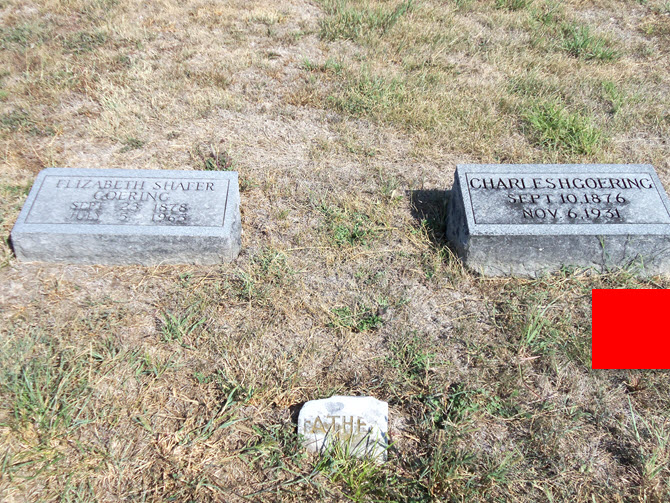
It was hot, so I sat down in the parched grass, and gently traced the letters of Charles H[enry] Goering's stone. His known birth and death dates were clearly visible. I looked across and saw the stone of his second wife, Elizabeth Shafer Goering. Shafer was her maiden name, and many other Shafers were buried there. This was her family's cemetery. This is why she didn't bury him in the cemeteries in Emporia, Kansas where they lived. She buried him where she planned to be buried, though even now, the road isn't paved. (Her tombstone didn't reflect her first marriage.

I mentioned I sat down near Charles' grave stone, about where the red box is in this photo: 


IMAGE: Elizabeth Shafer Goering and Charles H. Goering tombstones,
Ivy Cemetery, Admire, Kansas, from the author's personal collection.

My feet noticed a lump in the grass, and when I straightened it up, and removed some weeds, I found a broken stone with the letters "FATHER" still visible. Apparently this foot stone is my grandmother's expression of personal loss at the death of her father. (Although the stone seems off center, it wasn't when sitting there.)

That reminded me that my grandmother, an only child, said she loved her father dearly, particularly after the loss of her mother Estelle Mae Phillips. There was resentment when Charles later married again, and it was said my grandmother never got along with her step-mother Elizabeth.


Sitting, I wondered how my grandmother managed to pay for this stone. I know her daughter, my mother, was a mere toddler of about 3 years of age at the time Charles passed away. My grandmother and her husband and child are found up in Washington state in the 1930 US federal population schedule the year before.

I remember how hard it was for me when my father passed away. The memorial service was very difficult.

Was my grandmother financially able to attend her father's funeral?

Did she travel by train with a cranky, inquisitive, bouncy 3-year old in tow, while her husband held down the fort at home? The concept of "family leave" wasn't around until late in the 20th century.

Or was my grandmother only able to order the "FATHER" stone, now the tangible evidence of her feelings for her beloved Poppa?


With two close family funerals within a month of each other, I've found life is in sort of a muddle.

We leave the grave site, thankful for the life, perhaps cut all too short. We are thankful the elderly are no longer suffering. And then we pick up the little strands that make up our life.

Initially just going through the motions.

First we do what needs to be done with travel and laundry.

Though we have a calendar, we seem to move from each "must do" appointment to the next, almost thoughtlessly.

Was this how my grandmother felt when her mother died? Was this how she felt when her father died?

Or was she comforted by the cute things my mother as a young child might say and do each day? Was my grandmother going through the motions, caring for my mother then, until the pain subsided? Until she could almost get through a sentence without choking up, like my father? Like me?

Earlier today, I found myself looking out the window at the spring snow's lacy pattern in the blossoms of my apricot tree. I was lost in thought recalling my grandmother's admonition - "This is apricot preserves, not apricot jam." I think of traditions handed down.

I think of questions I never thought to ask.

I remember the good times.

It's the circle of life, but it's sometimes hard to understand personal loss.


Sunday, 27 March 2016

Easter Traditions and Family Memories


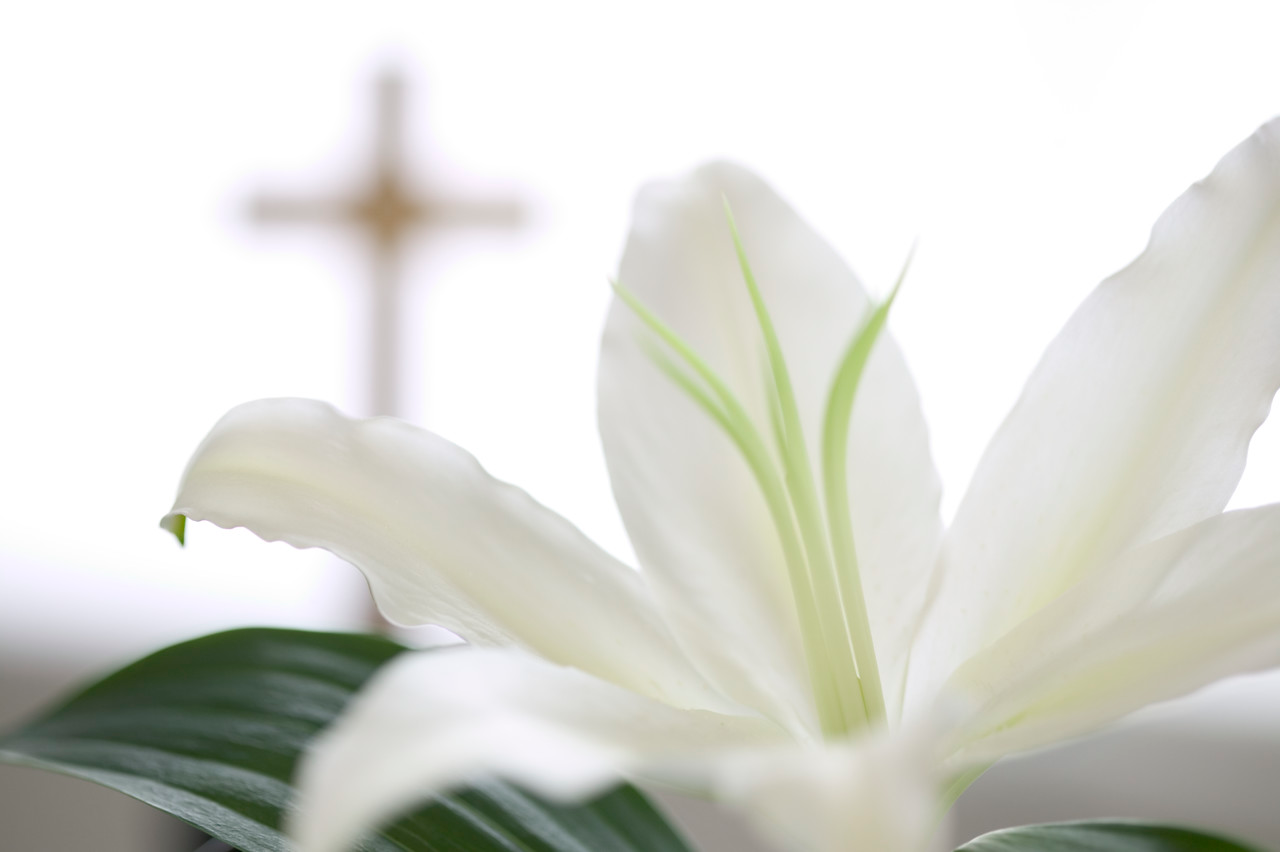
Easter Lily with Cross   mentoringmoments.org    easter lily with cros


Growing up in America, a descendant of Irish and Italian Catholics, and Scottish, German, English and French Protestants, I was taught that Easter was one of the holiest days of the year. Easter celebrated Jesus rising from the dead to save us from our sins. We were thus given, by God’s Grace,  eternal life with God.

It is actually pretty amazing to me that my Catholic and Protestant families joined their celebrations and traditions and were kind, loving, and respectful enough to each other that we children of 1950’s America didn’t realize the differences! That certainly hadn’t happened in the home/ancestral countries of Ireland, Scotland, Germany and Italy!

My mother left her Irish Catholic Church upon marrying my Methodist father at his promise to attend church faithfully and to raise his children there. (He was more strongly willed than she was--the Catholic Church taught her to follow.) So we were raised in the Methodist traditions with a touch of Catholicism thrown in.

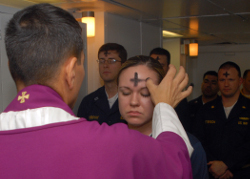
Starting with Lent, Ash Wednesday, we visited my Mother’s family’s church,  St. Patrick’s Catholic Church in Richmond, Virginia and got the sign of the cross made on our foreheads.
From http://www.catholic.org/clife/lent/ashwed.php


According to an article featured in “Catholic Online” at
http://www.catholic.org/clife/lent/ashwed.php

“Ash Wednesday is one of the most popular and important holy days in the liturgical calendar. Ash Wednesday opens Lent, a season of fasting and prayer.
Ash Wednesday takes place 46 days before Easter Sunday, and is chiefly observed by Catholics, although many other Christians observe it too.
Ash Wednesday comes from the ancient Jewish tradition of penance and fasting. The practice includes the wearing of ashes on the head. The ashes symbolize the dust from which God made us. As the priest applies the ashes to a person's forehead, he speaks the words: "Remember that you are dust, and to dust you shall return." ‘

We always “gave something up” for Lent--something we loved, like chocolate for instance. We also got little boxes from our Methodist Church into which we put pennies or more everyday, returning them to Church on Easter to help feed the hungry.


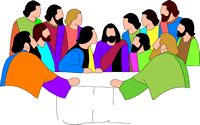
The week before Easter, called Holy Week by Catholics and Protestants, was treated that way by my parents and our Church. Everyday was something special, but on “Maundy Thursday” night we always attended the somber, special communion at church where we came forward and sat around a table of twelve in the chancel of the sanctuary. An author by the name of James Cooper explains this tradition in his online article which can be found at: http://www.whyeaster.com/customs/maundythursday.shtml


“Maundy Thursday is the Thursday of Holy Week. It represents the day that the Jewish Passover was celebrated in the Bible Story of Easter.
On that day, Jesus had his last meal with his friends and followers before he was killed. This meal is now know as 'The Last Supper'. At the meal, Jesus and his friends would have followed the Jewish Passover custom of eating roast lamb and bread and drinking red wine. However, Jesus gave the bread and wine a special meaning. When they got to the part of meal when the Bread was eaten and the wine drunk, Jesus said that these would be a symbol of his body and blood to his followers to help them remember that through his death, our sins are forgiven.
Maundy comes from Latin and is the word for 'Command', this is because Jesus commanded his followers to think of him when they ate bread and drank wine. This is very important to Christians and is now remembered in the Christian service known as Communion, Mass or Eucharist.”
As a child growing up, I loved the Maundy Thursday Service and always found it extremely meaningful. Attending with us were extended members of our family like my Paternal Grandmother, and Aunts, Uncles and cousins from my mother and my father’s side.
www.youtube.com--Three Crosses --pictures

On “Good Friday” the Friday of Holy Week, we mourned the death of Jesus upon the cross. I truly could not understand this as a child--how could they have put to death such a loving man! It bothered me as a child, made me think, and I dare say, increased my conscience and beliefs in right and wrong!

Arlington Church’s Easter Play
Jacksonville.com  John Fullop portrays Jesus as he rises from the tomb on Easter morning during Harvest Baptist's, story by David Crumpler


Finally came Easter Sunday! It was truly an enjoyable celebration! In the Methodist Church I always looked forward to singing “Christ the Lord Has Risen Again- Hallelujah!” You could tell by the joy in the music and the smiles on people’s faces, just how different this day was from say Maundy Thursday and Good Friday services. Before church however, we always went to an Easter Sunday sunrise service. Bundled against the Spring cold morning, we usually attended a beautiful Easter pageant in Richmond, Virginia, USA, where we watched the Easter story unfold. We saw the capturing of Jesus, judgement by Pontius Pilate, his death upon the cross and the dawning on Easter where an angel rolled away the stone from Jesus’s tomb, and found Jesus gone, informing Mary Magdalene and all of us that Jesus had risen from the dead! “ (from the Holy Bible, Matthew, Chaps 26-28.)

The pageant was so beautiful, dramatic and inspiring to the viewers, who were also being bathed in the sunrise of a new day, we could not help but have our faith strengthened.

Back at home after Church, we had Easter Baskets from the Easter Bunny like my own grandchildren pictured below do as well today. This was followed by a large Easter dinner--a gathering of relatives and stories of the generations before us.

Author's Personal Library--grandchildren


When I realize that I have personally known five generations spanning over 100 years of family who celebrated these Easter traditions with me, it moves me greatly. (With my grandmother Hogue-Youngblood born in 1881, to my youngest grandchild born in 2014!) Having been involved in genealogical research for several years now, I more deeply understand the centuries of believers from whom I descend-- from many different countries-- and how their Easter culture and traditions coalesced into mine. It is simply awesome. Happy Easter all!


Friday, 25 March 2016

12-Step Program for New Online Collections

I recently learned that FamilySearch had a collection of Ohio death certificates for 1908 through 1953. This was news to me so I wanted to take maximum advantage of the collection. To do so, I have a workflow I use when I discover new online collections that may be relevant to my genealogy research.

My 12-step process for taking maximum advantage of new online document collections;
created using Microsoft Powerpoint

Preparation Steps

These are important steps for saving time and creating efficiency. They let me target specific individual, eliminate duplicate entries, and improve my knowledge of the availability of online sources.

Searching and Recording Steps

These are the actual "meat" of the process. The order of Steps 6 through 11 is just my personal preference. I find I get in a rhythm of search, discover, switch browser windows or tabs, record findings, etc. If I add too many different steps, I lose my rhythm and make mistakes. (I'm a terrible dancer, too!)

Wrapping-up Steps

These steps enable me to easily pick up where I left off if I have to end my research for the day. By updating my custom report of people with new findings, I can easily record where I stopped if I run out of time. I prefer to create source citation creations for many documents from one repository all at once (as it has its own unique rhythm). But it's totally up to you!

The Steps in Detail
  1. Run a custom report from my family tree software filtering in whatever parameters will capture the names and vital dates of people in my tree who should be included in the new collection of documents. Do I have enough relevant people to follow my workflow? If so, I usually export this custom report to Excel and add a Y/N column to the spreadsheet in which to record my findings.
  2. Add the bibliographic information about the general collection to my family tree software. At a minimum, I create a title for the collection; the author (what organization created the records); date or range of dates; the URL for the home page of the collection, and notes about the collection, for example, why were the records created. A personal preference is to prepend a unique identifier to the title of the repository. All of the specific source citations I create later in the process will be attached, or associated with this repository information.
  3. Add the website address, or URL, of the new collection to my spreadsheet of online document sources. I include the unique identifier on this spreadsheet. This prevents me from creating a duplicate repositories when working with the collection months or years later.
  4. Search the collection for each name on the report. As I find a document, I save it to my computer, using a standard filename.
  5. Add Y=Yes or N=No to my spreadsheet of names. Yes, obviously denotes I found the document and No means even though the document should have existed, I didn't find it.
  6. Upload the document from my computer to the person in my family tree software and enter the date I added the record and the URL where I found it. Unlike, many I do not create the source citation or analyze the record at this time. I'm simply in collection mode and I'll explain why I do it this way later.
  7. Upload the newly discovered record to my Google Drive genealogy area. (How that is organized is another post. Maybe I'll write it one day.)
  8. Continue working through the list until I looked up every name.
  9. Search collection again for people I could find no documents, using as many different search permutations as possible. If no document is found, I may have an error in my tree that needs to be investigated in more depth sometime in the future.
  10. Look up the person/people in my family tree software for which I should have found a document but did not. Add an explanation of my activities and that I didn't find anything to my Research Notes about that specific person. By doing so, I'll know that I may need to re-examine the data I have recorded about that person's death (if I was searching a new collection of death certificates, for example.)
  11. Look up each person for which I found a document in my family tree software. Create the necessary source citation for the new document and attach it to the document. Don't forget to also associate the new source citation to the collection repository created in Step #1.
  12. Upload the Excel spreadsheet of the people for which I searched for a document in the new collection, using a standard filename format, which is R-OH Death Cert 1908-53 200160325.xlsx. The file name tells me that it is a report of Ohio death certificates between 1908 and 1953 which I conducted today. If I run this search at some point in the future, perhaps after finding a new branch of my tree in Ohio during the relevant time period, I can use this report to eliminate searching for the same people over again.
I have found creating this process has saved much time, added consistency to my work, and reduced the errors I make in my tree. Do you have a workflow process for taking maximum advantage of new or newly discovered online document repositories? If so, I'd love to hear about it.