Showing posts with label 1939 Register. Show all posts

Friday, 22 April 2016

Lost in 1939 - The Misleading Map

When Findmypast launched the 1939 Register, Infographic maps which pin-point the place of residence were heralded as a valuable extra.  My grandparent's household at 30 Manor Road, Birmingham is pinned like this:
1939 Regsiter location map for 30 Manor Road, Birmingham

See the problem? The pin is in Sutton Coldfield, not Birmingham.

Mapping locations is a revealing technique for family and local history when the source contains spatial information.  The 1939 Register contains 3 pieces of location information for each household:
  1. Borough or district.  Counties were divided into four  types of units, County borough (C.B), Municipal Borough (M.B.), Urban district (U.D.) and Rural district (R.D.).  These units are listed in Understanding 1939 Registration Districts.
  2. Enumeration district.  Boroughs and districts were divided into manageable areas for an enumerator to cover.  They are denoted by the E.D. letter code.  The One Place Studies blog published a helpful explanation of the 1939 enumeration districts and provide a list of these administrative units.
  3. Street address. No explanation needed.
Extract of 1939 Register with location information highlighted

My grandparents lived in Stechford which was in the Birmingham County Borough.  A Vision of Britain through Time is a comprehensive resource for jurisdictions in the UK.  Sutton Coldfield was a Municipal Borough until it was merged with Birmingham in the 1974 re-organisation of local government.  In 1939 the boundary of Birmingham County Borough was:
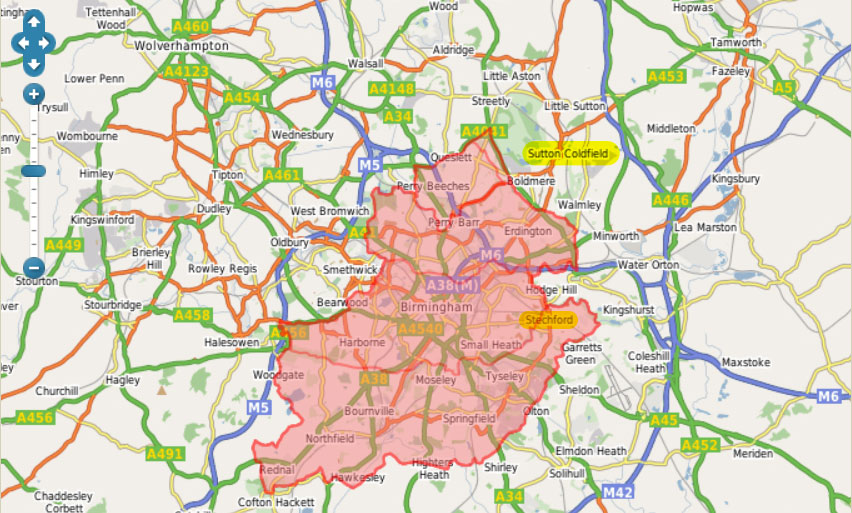
Birmingham County Borough, with Sutton Coldfield and Stechford highlighted.  Source: A Vision of Britain.

Sadly smaller units like enumeration district QBEZ are not mapped in A Vision of Britain.  Census enumerators books included a place to enter as description of the area covered, but I don't know if 1939 Register booklets did.  Browsing the 23 images in the district reveals that only pages with personal entries have been published, so the context of the enumerator's work is missing.  From the street addresses, it is possible to gain an insight of the area covered.  Seven roads are named: Lyndon Road, Manor Road, Church Road, Station Road, Rosemary Road, and Yardley Fields Road.

All of the roads in enumeration district QBEZ are incorrectly scattered around Sutton Coldfield on Findmypast's maps.  Here is a Google maps comparison of the real locations and Findmypast's locations:
Enumeration district QBEZ.  Roads denoted by lines are actual locations, those denoted by pins are the 1939 Regsiter locations
 
A road is a linear feature, so is better represented by a line than a point.  Road names like Manor, Station, and Church are common. There are even several Lyndon Roads. These roads have been matched with other roads of the same name.  Matching locations using a gazetteer, a geographical index of place names with co-ordinates or grid references, is fraught with difficulty.  Red House, Rosemary and Yardley Fields roads were all pinned to the same spot as the incorrect Manor Road pin.  It is likely that the more uncommon road names could not be matched, so were assigned to a pin thought to be in the enumeration district. 

Findmypast's pins mislead even when correctly placed.  A point or pin suggests accuracy, so one might expect it to identify a house.  An jurisdictional area like an enumeration district or borough is best represented by a polygon, a shape which denotes the boundary of the feature.

Mapping technology is now widely and freely available.  Findmypast used open source mapping software, Leaflet, to present the maps, delivering a smooth user experience.  That was a smart move.  Using the digitised historical maps from the National Library of Scotland and modern OpenStreetMap was another smart move.  All of that came free.

It is clear that the jurisdictional boundaries from A Vision of Britain weren't used.  Adding that data layer could have unleashed the power of spatial queries, eliminating the type of errors discussed here.  The data seems to be available only for academic use, but the website was built over a decade ago, so would greatly benefit from serious investment.  Investing in the development and expansion of A Vision of Britain would be, well visionary.

Thursday, 12 November 2015

How useful have you found the 1939 Register ?

It's finally online!


Find My Past in association with The National Archives finally launched the long awaited 1939 Register on Monday 2nd November 2015. 
Probably the biggest announcement and dataset launch this year.

I am not going to explain what it is or how to use it as you can find everything you need in the links.

You can also out find how they brought the register online.

Find My Past also have a blog dedicated to the 1939 Register.

Audrey Collins of The National Archives explains more in this video.


Peter Calver of the Lost Cousins website has also put together a page with information.

So with all the information available how have the genealogy community responded.
On the launch day Chris Paton of the British GENES blog posted an initial review. With a further follow up on the following day.
Sunday saw some changes made to the search facility and another post. Yesterday he posted a link to a webpage with a tool you may find useful.

There has been much discussion about the price of accessing the scanned images and the Who Do You Think You Are Magazine website published a blog post  about this on the day of the launch.

So how have I found the register. I made a few comments on the day of the launch on Mondays with Myrt which were very much my initial reaction with barely 30 minutes of searching.


Even now I have not found those members of the family who I wanted to find. Is it poor transcription or were they missing for some other reason? I have searched with the exact date of birth but still not found them in the index.

So whilst there may be complaints about the cost I have as yet to make a purchase. I know that I will eventually decide to buy the household records for my direct family but it is not them who intrigue me, it is those who appeared as children on the 1911 census and were siblings of my ancestors. 
Those with common names can be difficult to find. I have found some WARDs in the town where I have been looking for some, without any forenames. In the same town I have found a couple who I believe to be my husband's gt grandmother and her husband but the surname was presumably unreadable as it is transcribed as ~???.

I am not sure that many individuals will be prepared to supply evidence of death to open a record as this is what Find My Past say about the proof needed "You will be required to scan and send a copy of a fully certified death certificate from General Register Office (GRO) or the equivalent Governing body if the death occurred in a country other than the UK. By certified copy, we mean the original certificate as registered and provided when the death occurred. This can be a copy as opposed to an original however it must contain the full registered details. If the criteria are not met, you may be requested to either re-submit or provide further evidence, such as a birth certificate."
How many researchers who already have a copy of a death certificate issued since 1991 are going to go to the trouble of asking for a record to be opened? 
Is it going to provide any great evidence for that individual given that they are likely to have known that person?

I'll carry on hunting for my missing relatives.
If anyone finds Ruth Ellen Gadsby born 1901 or Charles Reuben Gadsby born 1910, Please let me know. 

If you had family living in England or Wales in 1939 please give some feedback on any searches you have done.
Are you prepared to wait up to 24 years until all the entries will become available?