Showing posts with label Ireland. Show all posts

Friday, 30 March 2018

Genealogy Research Identifies Easter Traditions from Relatives and Ancestors Worldwide

Genealogy Research Identifies Easter Traditions from Relatives and Ancestors Worldwide

In my genealogical research, I have learned that my family is a typical American melting pot of ethnic origins! My ancestors hail from Denmark, England, France, Germany, Ireland, Italy, Netherlands, Norway, Scotland, Sweden, and Switzerland—at least. As we are preparing for our own Easter celebration, I was wondering how similar or how different some of my ancestor’s traditions might have been.   
Our own traditions include attending church as we were raised Protestant and believe that Easter represents the death and the rising of Jesus Christ, Son of God, to save us all from our sins and to give us eternal life.  It is basically, the basis of our Faith, and, is such an important time in the life of Christians.  We celebrate Easter with a long season of Lent.  However, the highlights of Holy Week include  Maundy Thursday Communion in church on the Thursday before Easter Sunday.  This communion celebrates the Lord’s last supper with his disciples. On Good Friday, we gather at the church to mourn the death of Christ upon the cross. Our own church holds a “Tenebrae service of Shadows”.  One of our daughters will sing special music with the choir, “One Sacrifice”.   The service itself begins with 14 lighted candles in the sanctuary, and as Christ walks his final passion, each candle is extinguished to signify his abandonment.  Easter Sunday, we gather to celebrate the joy of Christ’s resurrection and His salvation for each of us individually throughout the whole world. This is an astounding day for many of us faith wise!  
Part of the joy of Easter at our house is gathering with family and friends for dinner.  Many in the United States serve ham for this dinner with other spring vegetables especially like asparagus and carrots for the Easter bunny. Surely you see turkey and beef as well. My own sister, however, serves a Crown Roast of Lamb every Easter without fail!  Bunny rabbit salads made of half pears are a treat for our family.  
 Since our family includes young grandchildren, an Easter egg hunt is in order for the day!  Of course, we give the children Easter baskets full of trinkets, chocolate, and other candy.  We hard boil and decorate Easter eggs as well.  In our own family, we often hide the baskets and the children have to follow clues to find them!  
Easter 2015, hunting eggs with Katy and Evie
This is one way to hunt eggs! -grandchildren of author, personal library, HY Holshouser. 
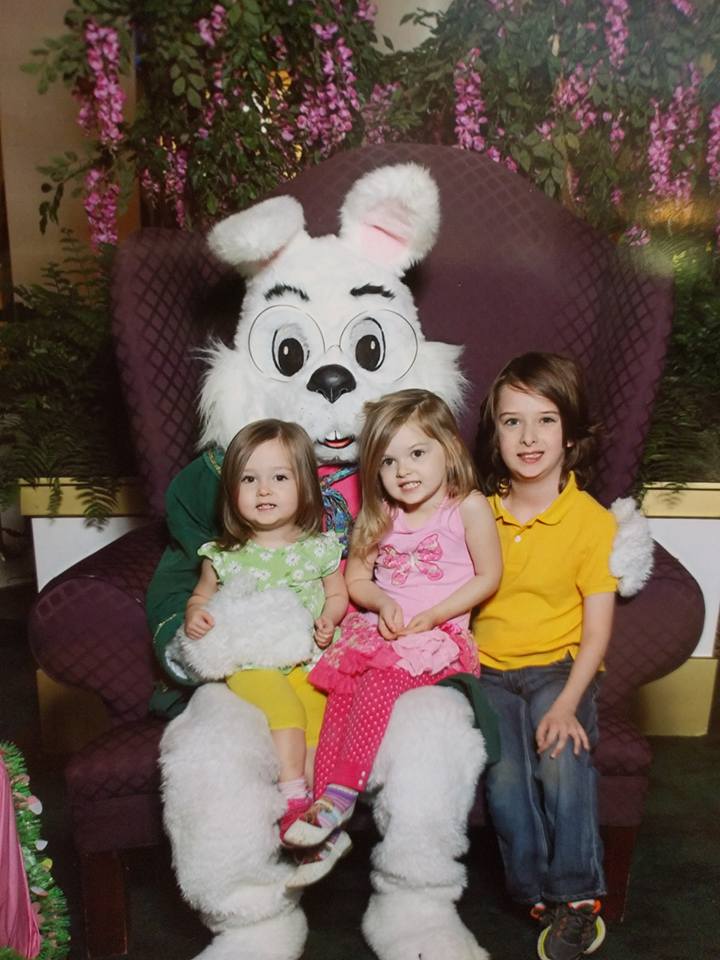
Evie, Katy, and Liam with Easter Bunny, 2016
Grandchildren visiting the Easter Bunny—from the personal library of this author, H Y Holshouser.
What about our Hogue ancestors from Scotland?  I understand that they especially were sheepherders and that their and most Scottish Easter dinners include roasted lamb!  As with us in America, chocolate is the taste of the day!  Dessert might be chocolate cake and coffee! Chocolate eggs and bunnies are ever present for both! Easter egg hunts, horse displays, and battle reenactments make for fun and festive occasions. Of course, churches throughout Scotland hold special Easter services like ours, to celebrate Christ’s rising from death and giving us the grace of salvation. We had many ministers, mainly Presbyterian, in our Hogue family.  In fact, we are told that our first immigrant from Scotland was a Covenanter.  A covenanter was one of the many Scottish people who fought against the Catholics for the right to have their own personal covenant with God. In fact, his persecution by the Catholics apparently led to his flight to America.  
 Our Kearse family from Ireland and the same ancient family, the Des Cearsais of France, how did they celebrate Easter?  The French word for Easter is Pâques. To say Happy Easter, you can say “Joyeuses Pâques or “Bonnes Pâques.”  According to my general research, Easter is an important holiday in France also. It is a religious one, and a lively, fun time with Easter egg hunts to honor the coming of Spring. Like Ireland, roast lamb is the choice for a large family meal. In Ireland, it is also an important religious holiday as well, with many traditions. Confession on Good Friday, silence on the Saturday before Easter lends to a meditative state. Eggs take center stage on Easter as they are given up for the forty days of lent by many.  Chocolate eggs, decorated eggs—all symbolizing Spring, new beginnings, renewal, and joy! 
 What about the Langhornes and others from England? Among many lovely and fun Easter traditions, Easter parades are one of the greatest. Children and adults don new clothes for good luck, and often children make elaborate paper hats to wear as they march in their local town parades!  Fun! Egg rolling, hot cross buns, Simnel cake, Morris dancing, and so much more contradicts the vision of the staid Englishmen and women!  

Our marvelous Italian ancestors and relatives add so much spirit to our family. The BottosRaffosRivaros, Costas, DeSantos,  and more, mostly originate in the coastal area of northwestern Italy, near Genoa. Italy of course, is home to the Vatican, and the place for the pilgrimage of so many Catholics on Easter.  My mother’s Italian ancestors were Catholic as well.  Mass on Good Friday in St. Peter’s Basilica is followed by the Pope leading a candlelight procession on a walk symbolizing Christ’s walk to the cross.  Our own church reenacts this walk to the cross, and we are Protestants.  
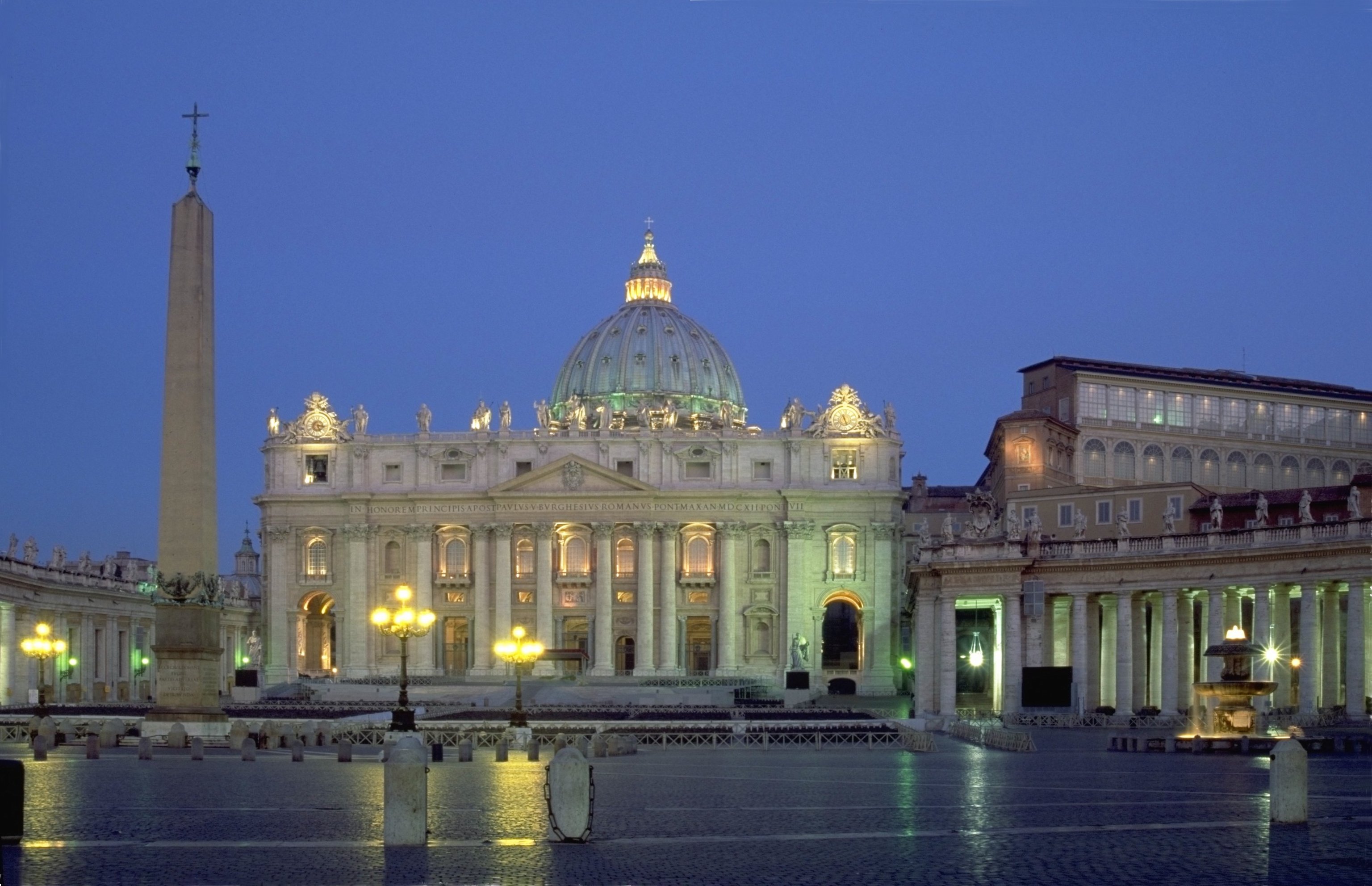
St. Peter’s Square, Vatican City, Andreas Tille – Own work, Permission details Quote of http://fam-tille.de/italien/rom/2004_030.html – Permission is granted to copy, distribute and/or modify this images under the terms of the GNU Free Documentation License, Version 1.1 or any later version published

As I understand it from relatives, northern Italian Easter feasts often feature ham, like us!  Interesting. Of course, salami is a big choice as well.  Colomba, a dove-shaped cake, made of almonds, egg whites, and sugar, is probably the most famous cake and available worldwide these days.
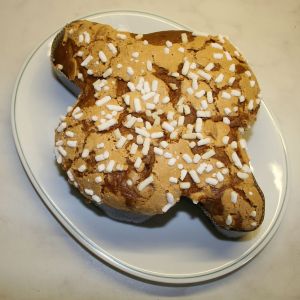
Italian bread with almonds and sugar,Colomba-Pasquale
Colomba Pasquale, An Italian Sweet bread J.P.Lon~commonswiki
What about our German JungblutsYoungbloods? And my husband’s Haulzhausen—Holshouser family?  According to a wonderful article from DW –Deutsche Welle —  http://www.dw.com/en/german-easter-traditions/a-1520904 — the Germans of course, also celebrate a religious holiday like most Christians.  
Although mainly a Christian holiday commemorating the crucifixion and resurrection of Jesus, Easter also marks the beginning of spring. The Germans, of course, have a whole range of customs and traditions to celebrate the change of seasons in proper fashion. 
A time for eggs and bunnies 
Eggs and bunnies are two of the oldest symbols of Easter in Germany and every spring shops boom with eggs and bunnies made of chocolate, cardboard or flowers in different sizes and wrappings. 
The tradition for using eggs and bunnies for Easter originates from pagan worshipping where they were symbols of fertility and new birth and traditionally used for celebrations of the coming of the spring. 
The Germans have a number of egg games which the children play over the holidays. One tradition is to blow eggs and paint them in multiple colours and patterns on Good Friday. The eggs are then put in a basket for the Easter bunny — Osterhase— to hide around the house on the night leading up to Easter Sunday. On the morning of Easter Sunday, the children go hunting for the eggs and often find that the Easter bunny has also left chocolate eggs and Easter presents for them to find. 
It is also a custom that friends exchange the painted eggs as gifts or that young people in love paint eggs for their sweetheart.” Now that is a different tradition, which I find so special and romantic!   
For the Netherlands and our Van Vreeland, Van Swol, Voorhees, and Banta families, what was Easter like for them? According to many articles, they celebrate much the way we do…. or we celebrate much the way they do!  One of our favorite meals is a festive brunch and apparently it is theirs as well:  eggs, cheese, ham, rolls…and did I say eggs?  The Dutch also take great pride in providing the thousands of tulips to decorate St. Peter’s in Rome for the Pope’s Easter service.  Wow!  Back home, they are also known for their beautiful painted eggs.  However, they do not have the Easter bunny, but the “Paashaas, the Easter hare!   
Our ancestors represent many more countries and traditions from around the world, but as you and I can readily see, we are more alike than different.  This Easter, as I pray, and as I play, I will have a keener sense of connectedness due to my genealogical research, and our worldwide collaboration.   
Until we meet again, Helen Youngblood Holshouser 


Sunday, 19 March 2017

Ireland Research Hopes Revisited

My turn to blog is a wee bit after St Patrick's Day but the thought of researching the Irish ancestors is not bound by time.

My Irish quest has been begging to start for years. Recently due to a DNA find, I have been sent on a new Irish quest when an O'Toole turned up as an ancient DNA match for our Langley DNA project.
I have felt intimidated by the challenge of delving into the films on FamilySearch or Ireland, and just trying to sort out all the Michaels, Williams, and Margrets that I see when I go to FindMyPast or other Irish sites...words escape me. One thing I do know and follow is...the obvious search for our ancestors begins with a name, and, if you have it, a place. On the Hero's and my mom's side of the family there are many Irish names to look for.
There are some blogs and websites that specialize in Ireland research
Smallest Leaf is one of those. She has so much Irish information and many books listed on her blog. It is wonderful to stop by and browse. Click here to see her blog.
Another site I really like it Irish Genealogy Tool Kit.
I like these because I need someone to give me direction. I am so ingrained in United States research it will take some shift in my paradigms to hopefully finds some success in venturing into Ireland research.
What I have done so far...
I started making a note of all the names I was looking for, variants of the names, and places the names were found.  An example for the is : A Rootsweb site for Researching Irish Names. I searched for Magill from my mom's ancestors. They were adamant in the 1830's per a letter written by John Magill that their family was the only ones who spelled it that way.
"...I have been particular so that you may know if you meet with any person of the name of Magill you can tell whether they are your relation. I have seen several from Ireland that are no kin of mine. They spell their name McGill. They are generally native Irish and Roman Catholic. I recollect to have seen my grandfather's certificate from Ireland dated 1725. It was spelled Magill and all his descendants spell their names the same way. Any who do not are not of our kindred..."  Click here to read the rest of the transcribed letter.
My finding:
MacGiolla ancient of Magill,
Gill,
McGill
Turning to my Hero's Irish ancestors, I was able to glean the following for his known surnames.
Death certificates helped with clues as to where the places were correct.

O'Shaughnessy      
Sandys
FURLONG              Wexford
FURLONG              Wicklow
O'AHERN,               Cork
O'Echtighearn  
Ahern
O'DWYER              Tipperary
Dwyer                      Lemerick
Dyer                         Sligo
O'Breen  
O'Brien

I have toyed with learning Gaelic, but I haven't gotten that far yet.
Besides knowing the surname, I discovered that the old Irish had a naming pattern. Most but not all used it. The Irish Tool Kit website points out that in the 1700s and 1800s those that immigrated to America did use this...making it hard to sort out the descendants when 5 brother, in the same area named their sons in the same pattern (true experience). I have posted on the naming patterns before click here to read the post then click back to return.

I have ascribed to the method of looking to others who have already done research reading how to find records in Ireland, talking to people who have UK experience in searching, and utilizing the free course on FamilySearch.org. I take the time to watch videos by those who have done the walk such as David Rencher's videos Tips for Researching your Irish Ancestors. I HAVE to mention the FamilySearch.org's Irish Collection which includes images... Ireland Historical Records.

There is something so exciting in searching for families that have been apart for years and reuniting them. I love genealogy research and have been excited to share how to research and source with the upcoming generation to get them involved in their history to know their ancestors. So Far, it has been a positive experience for both generations. 😉

Monday, 14 March 2016

Irish Catholic parish registers - which is the best site to search?

It's St Patrick's Day on the 17th, so it's probably not surprising that FindMyPast Ireland chose this month to release its collection of Irish Catholic parish registers. With the same records available on Ancestry, that brings the number of sites - and ways - to search these records to three, which is a giant bonus to those of us researching Catholic ancestors from Ireland.

Free Irish records

In July last year, the National Library of Ireland first released these records, which were warmly welcomed by genealogists all round the world. It's not just that they help us trace our Irish ancestors, a notoriously tricky thing to do (but not as hard as I thought when I started out). The other wonderful thing is that they're free to access.

At the time, I posted on Worldwide Genealogy about my first impressions of using this wonderful resource, which the NLI provided without an index. I wasn't going to look such a ground-breaking gift horse in the gob. But now, with FMP and Ancestry both providing access to the parish registers, it's possible to search them using the methods that many genealogists are used to on these two sites.

So this month I'm going to conduct a genexperiment and try all three out, looking for the same person, and see if any of them will become my favourite for Irish Catholic parish register research. I also want to know if I can search all three for free.

Catholic parish register search

I'll start with the first publishers of the Irish Catholic parish registers, the NLI's own website. Because you need to know which parish you want to search, I'm going to look for Daniel Delaney of the parish of Tomacork (Carnew). He may be related to my ancestor Nicholas Delaney, who was from the same parish. It's a fairly unusual surname in the area.

Shane Wilson has a useful tool on his excellent website for finding RC parishes.

NLI

Going to the home page, I entered the parish name (Tomacork, in this case). This took me to a page offering three microfilms. I needed the earliest:


Selecting any of the categories or the image all took me to the same page, the first image in this collection:


And from then on it was a case of scrolling through the records, looking out for the name Carnew (usually at the right-hand side of the page).

This took a while, and I found Daniel only as a father, here with his wife Mary as parents to Anne in February 1794:


The display's fairly small and I recommend switching to full screen view using the button on the top right. You can also adjust brightness using the buttons, but here I'm just giving you the image as is, for comparison.

Daniel's baptism and marriage must have taken place before these records were compiled, or else he moved to Carnew from another parish.

Ancestry

Next I searched for Daniel in the Catholic parish registers on Ancestry. I've got a subscription, but I wanted to see whether I could find Daniel without logging in. From the Birth, Marriage & Death, including Parish screen I selected Ireland as my collection focus and opened the card catalogue. Ireland, Catholic Parish Registers 1655-1915 is the last collection on the second page, so I hope I've saved you some time!


If you want to just browse, you'll need to know which diocese you're searching for to use Ancestry. I'm looking for Ferns. You then have the option to enter the parish name and year range - for me, it's Tomacork and 1785-1845. However if you just hit the year range it takes you to a page asking you to sign up for a free trial, which I don't need. I still wanted to see how far I could go in searching records which are available free elsewhere. So don't browse if you haven't got an Ancestry sub, you need to actively search.

So going back to the screen above I entered my search. I found that entering the exact diocese brought up a few results but not the one I wanted - but if I didn't enter the diocese I got 240 results and none of them were the one I wanted. That told me that I couldn't search baptisms by parents. So if I hadn't known that I was looking for the father of Anne, I'd have had to browse, just as with the NLI records. So I searched for Anne, and...


The first record! But to check, I hovered over View Record, and...


The right record (though Mary's name in the original is Costolough, not Cossolough). And that's as far as you can go without signing in. I don't know if you can go further by opening a free account because I don't need one. But I wanted to check the quality of the image, so I signed in, and here it is:
It's a slightly lighter image that the NLI's, but (peering at the screen) I think it's not quite such good quality. While using Ancestry, I found it fairly easy to navigate around the record set, so that will save me time researching these records in the future. If I hadn't got an Ancestry sub, I could use it as an index and get the images from the NLI. Or is there an easier way?

FindMyPast

FMP offers its Irish Catholic parish registers for free. Again without signing in, I went to the Ireland Birth, Marriage, Death & Parish Records screen. But when selecting the record set, I found that FMP has separated the baptisms, marriages and deaths into three different record sets, so unlike with the other two sites, I had to choose.
Luckily, I knew I was looking for a baptism. But this time I got zero results. Once again, it was lucky I knew Daniel and Mary's daughter's name. Searching for Anne, I got zero results again. Was this because I'd gone straight to the record set, which is a method of searching FMP recommended by several genealogists with much more experience than me?
Back to the Search screen, and selecting only Births & Baptisms as a subcategory, no record set:


And there was Anne, the first record.


Clicking on the image icon brought me to a register/sign in dialogue box. I know that FMP Ireland has promised that the registers will be 'free to search, forever', but there's no mention of whether the images are free to view. Again, I don't want to open a new account just to check this because I already have a subscription to FMP. (How do I afford these subs, you may ask? I grab the special offers.) So I signed in, and here's the image:


It looks very similar to the NLI one. You can navigate using the < and > arrows, but there's no jumping to a page as there is with Ancestry.

So there you have it - three ways of accessing the NLI's Irish Catholic parish registers. Which will I use in the future? Obviously, it's a huge help to be able to search, though you need to know who you're looking for first (eg the daughter's name, not the mother's or father's, in this case).

I think I prefer the NLI site for scrolling through the images, though, as I said, I'll be using full screen. But for jumping around the records, Ancestry's the easiest. I suppose, in the end, it's a very personal choice.

And I'm hugely grateful to all three providers for making these superb records accessible.

It's a long post, so thanks for staying with me. There's so much more to say about these records! 


I'd love to know your thoughts if you've used the Irish Catholic parish registers via any of these sites. Have you got any favourites, or tips? Is there a clever shortcut I've missed?


Irish genealogy webinars

PS: There are some free Irish genealogy webinars taking place this week:

Family Search is hosting two sessions a day on Thursday 17th and Friday 18th. Full details over at Claire Santry's unmissable Irish Genealogy News blog.

FMP is holding its webinar tomorrow (Tuesday 15th) at 1600 GMT and the link is available here (this works for the UK; please check for your own area).
Thursday 17 March: Where is That? Finding and Understanding Places in Ireland. Starts 11am MST; 6pm GMT.

Thursday 17 March:
Ireland & Census and Census Substitutes. Starts 1pm MST; 8pm GMT.


Friday 18 March: Ireland Catholic Church Records. Starts 11am MST; 6pm GMT.

Friday 18 March: Irish Protestant Records. Starts 1pm MST; 8pm GMT. - See more at: http://www.irishgenealogynews.com/2016/03/family-search-four-irish-genealogy.html#sthash.f3itwe7R.dpuf
Thursday 17 March: Where is That? Finding and Understanding Places in Ireland. Starts 11am MST; 6pm GMT.

Thursday 17 March:
Ireland & Census and Census Substitutes. Starts 1pm MST; 8pm GMT.


Friday 18 March: Ireland Catholic Church Records. Starts 11am MST; 6pm GMT.

Friday 18 March: Irish Protestant Records. Starts 1pm MST; 8pm GMT. - See more at: http://www.irishgenealogynews.com/2016/03/family-search-four-irish-genealogy.html#sthash.f3itwe7R.dpuf

Saturday, 15 August 2015

My earliest Australian ancestors

We’re halfway through National Family History Month for genealogists researching in Australia and New Zealand. I’m based in the UK, so the only way I can join in is online. But that’s OK – we’re Worldwide Genealogists here!

Tree growing over an old brick wall, Arminghall, © Copyright Evelyn Simak and licensed for reuse under the Creative Commons Licence.
© Evelyn Simak and licensed for reuse under this Creative Commons Licence.
So I decided to do something I haven’t yet done. It's about time! 

I’m going to mark NFHM by putting together a list of the first of each branch of my ancestors who arrived in Australia. They all came from the British Isles. Well, as far as I know – there are brick walls in my tree, of course. In fact sometimes I think my family tree grows out of an old brick wall, like the one in this photo.

I’m going to do this by starting with the earliest, first on my grandfather’s side, then on my grandmother’s.

Grandfather’s side:

Nicholas DELANEY (Ahnentafel no 48), arrived 30.10.1802 on Atlas II. Convict and Irish rebel, from Carnew, Co Wicklow in Ireland. Married to:
Elizabeth BAYLY (A49), arrived 3.4.1807 on Brothers. Came free. May have been from Kent. A brick wall. Their son Thomas married Lucy, the daughter of:
John SIMPSON (A50), arrived 10.1.1818 on Ocean II. Convict, born in Yarm, Yorkshire, arrested in Derbyshire. A tailor. Married/lived as married with:
Sarah MARSHALL (A51), arrived 14.1.1818 on Friendship II. Convict, from Salford or Manchester.

(Thomas) Robert Sandon WILSON (A26), called ‘the Man of Mystery’ because we know nothing much about him. English, possibly a bigamist. Certainly a brick wall. Married to:
Sarah Emma HENLEY (or DICKS?) (A27). Arrived before 1854. From Sussex. Their daughter Mary Maude married Lucy and Thomas’s son Tom.

Grandmother’s side:

James Thomas RICHARDS (A30), arrived 12.12.1835 on Royal Sovereign. Convict, from Deptford, Kent. A Thames waterman. Married to:
Rebecca HARRINGTON (A31), arrived between 1857 and 1873. Probably assisted immigrant (meaning that she didn’t pay for her own voyage). May have come with her father, Thomas Harrington (A62), a dock labourer, or he may’ve joined her later with his wife Julia (A63), nee Gamin, or Cannell, or even Gemmell, from somewhere in Ireland. Yes, Julia’s a brick wall. Rebecca and Thomas were from Hackney in East London.
James and Rebecca’s daughter Eleanor Ann Edith (Minnie) married Thomas Henry, the son of:

John WINTER (A28), arrived 9.2.1857 on Parsee. Assisted immigrant from Tebay, Westmorland (Tebay’s now best known as a service station on the M6 motorway). Married to:
Ann GRAHAM (A29), arrived 23.7.1857 on Alfred. Assisted immigrant from Butterknowle, Co Durham. She came with her parents:
Thomas Rume, Rumneys or Ramneys GRAHAM (A58), a quarryman born in Gaitsgill, Cumberland, and his wife:
Elizabeth BELL (A59), from Bishop Middleham, Co Durham.

Convicts


Looking back over my earliest Australians, I can see three big brick walls. Interestingly, none of them are convicts. OK, so three of my naughty ancestors have so far resisted my attempts to track down their parents, but at least because the legal system kept tracks on them they’re fairly well documented. That’s one reason I like having convict ancestors – they leave traces. And they’re cool.

Two of my branches are from Ireland and the rest are from what’s now London or from the north of England. A nice mixed bag. No Scots yet – but who knows where those Grahams came from before they turned up in Cumberland? All my Welsh ancestors are on the other side of my family.

As far as I know. And that’s one of the reasons I love genealogy. There’s always something new to discover. It’s a bit like being a time-travelling sleuth. I’ve got quite fond of some of them. Others I could spank for being so secretive. But in the end, they give me hours of fun, days of frustration, and a lifetime’s work. 

If you recognise any of the names or other information - places, ships and so on - that I've mentioned, please get in touch. I'd love to hear from you.

NFHM 2015 logo
Thanks to everyone involved in NFHM, get well soon Shauna Hicks, and a big G'day to my Aussie geniemates!