Showing posts with label Geneablogging. Show all posts

Friday, 22 January 2016

Get Blogging!

As Worldwide Genealogy has just turned two, it is time to take stock.  Thanks to my co-authors this blog is still going strong.  The total number of page views currently stands at 170,000, which attests to a real audience.  At the end of 2014, the blog had attracted 38,000 page views.  Posts published in 2015 have attracted 41,000 views. Posts published in 2014 were also viewed a further 91,000 times during 2015.

The original objective was a daily post achieved by each of the 31 authors committing to post on a particular day of the month.  In 2015 most authors followed a bi-monthly posting schedule, with a few sticking with the original monthly schedule.  This change allowed 41 authors to contribute from the UK, USA, Canada, The Netherlands, Germany and Australia.  216 posts were published in 2014, but the number of posts dropped to 159 in 2015.  I wonder if the less frequent schedule is harder to keep to.  

Collaboration has certainly helped Worldwide Genealogy build an audience, but now is not the time to be complacent.  Reasons commonly given for bloggers giving up include lack of:
  • commitment - making time 
  • patience - not expecting instant results like a large audience or profit 
  • persistence - most bloggers give up too soon 
  • writing skills - requires practice
  • passion for the blog topic - motivation

Passion for genealogy certainly is not lacking for this blog's authors.  Posts cover a variety of genealogy-related topics.  The most popular posts include discussions of technology, tools, resources, research methods and telling of family tales:
Digital preservation, or why I worry about Evernote
Using Time Lines as a Family History Writing Tool
My three Rs of Genealogy
Criteria for Assessing the Quality of Genealogy Websites and Online Data
Use FreeBMD postems to find new relatives
A Transcription Toolbox
Why the Genealogy Do-Over is not for me
Al Capone’s bullet proof car and my great-uncle
Saying Goodbye Too Soon

For anyone who would like to join in, the resource links in Want To Be A Geneablogger? are a good starting point.

Get Blogging!

Monday, 2 March 2015

There's more than one way to skin a cat....

... and there is more than one way to "do genealogy".

Many family historians are hung up on "doing the right thing" but, just as there is more one way to skin a cat, there is no one right way to do genealogy. This applies to all stages of whichever research process we use and the tools we use to facilitate and record our research. It depends on why we are doing the research in the first place, is it just for fun, is it as part of a collaborative exercise with family or society members or is it to prepare a detailed report to fulfil a client contract? Constantly in my thoughts is the statistic shared by Curt Witcher at Rootstech 2015 that between 82%-90% of people who do family history do not belong to a Society but go it alone. While some of these folk will devour online genealogical educational opportunities and purchase many geneabooks and guides many of them will probably work happily in isolation. They will be doing family history research their way.

As for the Research Process I stick with the Australian one I have used for years, it can be applied to all things from making a peanut butter sandwich, to learning to ride a bicycle to genealogy research. I notice that Michael John Neill also advocates another oldie: Polya's Four Step Process which also appeals to me. I would suspect that most family historians don't follow a particular published process while others may follow one specifically developed for genealogical research.

I see at least one query each week in the online forums I inhabit that asks for suggestions on which is the best genealogy program to use. Most of the answers are suggestions on which particular program to use or avoid but do not address the issue of what unique features the programs suggested offer to fit the requester's individual needs. Of course beginners often don't know what they want out of a program, in this case I think they should avoid the software evengelists' suggestions and turn to a few trusted friends or members of their family history society for advice. Another excellent resource is Gensoftreviews, one could probably choose with confidence any of the programs that appear in this site's Annual Gold Award List. The pruned down free packages or 30 day trials from various vendors  also give one an opportunity to try before you buy.

Keeping track of one's research is another question that pops up regularly. The evangelists come out in force to answer these questions by suggesting their way as the only way but there are many ways. I would suggest that if you are confident with a means of recording (be it pencil and paper or on a computer) then use that or if you are up to a challenge then select and learn a piece of software that will do the job for you.

My genealogy software program is rather sophisticated so I am able to keep my research notes, research log and to-do items within the program. Before I switched to this program I used Excel or Google Sheets (if sharing with others) for these tasks, as I love spreadsheets I still use them for all sorts of geneatasks.

I am an Evernote junkie and use this tool for many personal tasks and a few geneajobs like managing my blogs and details of my genimates. It is an excellent tool for keeping track of your research and making it available on any device you may use but it takes a  while to become a comfortable and confident user. There are groups on Facebook and Google+ that can assist you with this.

If you find that you can organise efficiently and effectively with pencil and paper and are happy with that method then keep doing it your way. My advice is to find a method that works for you and use it consistently.Whatever works for you should be the bottom line.

Taming the paper and digital mountains of files we have created while researching is another hot issue. Do you have a huge Piling System that is crying out to be organised? If you can find whatever it is you need within a couple of minutes then that system works for you but what about those that take over once you turn up your toes? Will they be able to negotiate and make sense of your folders and files?

If you keep digital copies of your photos and documents in your genealogy software program and have them linked to appropriate individuals then others should be able to find and retrieve them. I haven't done this yet but my program copes admirably with this. I use a very simple system of Surname (and other) Folders for both my digital and physical files. This works for me but may not be sophisticated enough for other users (note to self - update four year old post - my filing system is dynamic). I ascribe to the KISS Principle (Keep it Simple Sweetheart - I prefer Sweetheart to Stupid ). I would suggest that whatever system you use is easy to adapt as your needs and experience grow.

Storing those valuable original documents safely should be a priority. Make sure they are digitised and that your digital files are backed up in several places.

And then there is sharing. I am an advocate of Geneablogging for sharing ancestor stories and putting out Cousin Bait. To this end I also have a personal website where I share the details of my ancestors, both of these have brought me valuable cousin connections. I have concerns with printed family histories because they are not dynamic like online publications. Recently Mr GeniAus used my research to compile a written history for his brother's significant birthday. The delight and interest of my brother-in-law and family as they perused the publication demonstrated the value of providing  family members with a printed version of their family history. However you do it please record your family stories in a format that will survive and be accessible for future generations.

So what I have been banging on about for the past few paragraphs is that there is no one correct way to "do family history". I hope that, as members of a collaborative and supportive community, we respect the efforts of our fellow researchers no matter which way they approach their research.

As individuals we should approach our study of family history in a way that suits our personalities and purposes.

Monday, 14 April 2014

Ancestral April Fool


Laughing fool, c 1500 (via Wikimedia)
This April, I've been fooled by a name.

I've started researching my father's grandmother's family, who lived in the same area of West Wales for - well, if you believe old family stories, many centuries. I've been looking for great-grandmother Sarah Davies, born in Llandyssilio[gogo], Cardiganshire, between 1853 - 56. And I thought I'd found her in the 1861, 1871 and 1881 Wales censuses. In 1881 this Sarah was living in an old farmhouse that's been in the family for generations. Right name, right age, right birthplace, right-looking address.

Wrong Sarah. I found her in the same house in 1891, but with the married surname James. 'My' Sarah had married Rhys Lloyd of Llandyssil/Llandysul before then.

We can all follow false trails. It's so easy to be fooled by the 'right' details. The fact that my ancestors were unadventurous in their naming doesn't help. Half my foremothers were called Sarah or Elizabeth, and a lot of the men were Thomases. And of course finding a married woman's maiden name can just complicate things even more. Poor Sarah has gone back into my 'to do' file, and I'm picking myself up, dusting my research off, and starting all over again.

There's an up-side, though, with names and false trails. I'm guessing that if you've looked at online family trees which have your own ancestors in them, you'll have found some cuckoos in the nest. A John Jones married 10 years after he was buried, perhaps, or a Jane Smith who emigrated in 1865 when records show she never moved from her Scottish birthplace. They're in your family's tree, but they don't belong there - and you have the documentary proof.

I've got my own cuckoos in the family nests. For instance, my 3xgreat-grandfather, Nicholas Delaney - the one who got me interested in genealogy - was transported from Ireland to Australia in 1802, and married Elizabeth Bayly (Bayley, Bailey) in 1808.

Reed warbler feeding cuckoo (Wikimedia)
A look at some family trees have him married before, in Ireland, to a woman with a very 'modern' looking name. Now fair enough, a name could be spelled in plenty of different ways, like Elizabeth's surname in the last paragraph. But when it looks extremely 20th century, like Kathryn, Debra or Barbra, you have to go 'hmm'. And if her second name is also not what you'd expect in rural Ireland in the 18th century - Jay, Kay or Dee, for instance - well, it's time for a pinch of salt.

It turns out that this cuckoo wife was born in the US (and would have had to cross the Atlantic as a young woman to live in deepest County Wicklow in order to meet and marry Nicholas). Digging a little deeper into her history, I find she was born in the mid-20th century. How she ended up in Nicholas's tree in the 1790s, I do not know.

So in this case the name is a hint that you need to look very closely at the proof for this claimed 'relative' - which Worldwide Genealogists would do anyway, of course!

When I start searching for great-grandmother Sarah Davies again, I plan to use names as clues. I've said that my lot were all very traditional in the forenames they chose, so maybe they followed traditional naming patterns, at least for the first few children (many of them had traditional large families, too).

In many parts of the UK, couples would use this pattern, strictly or loosely, until the later 19th century:

1st son - named after the father's father
2nd son - mother's father
3rd son - father
4th son - father's eldest brother


1st daughter -
named after the mother's mother
2nd daughter - father's mother
3rd daughter - mother
4th daughter - mother's eldest sister


Of course, it's never that simple in real life. Some people used variations on this pattern. Some only followed it for the first few children. Some didn't use it at all. Parents who were firstborns could choose another sibling's name for baby number four. Children could be named after other relatives, a powerful local family, royals, role models or political figures. And if someone had fallen out with a parent or sibling they might well not want to name their baby after its spiteful granny or criminal uncle.

Still, I'm glad of any clues which might help me track down those elusive ancestors hiding away in the records.

I'm looking at you, Sarah.


Apologies to all my fellow Worldwide Genealogy bloggers - in its wisdom Blogger/Blogspot has decided not to let me make comments once again. I thought I'd sorted out the glitches! (Sigh...) So I just wanted to let you know that I'm enjoying your writing and all the inspiring ideas and information. And please do comment on this post. I'd love to hear from you - I just won't be able to chat!

Friday, 28 February 2014

A Special Gift.

I’d been trying to come up with a topic all month but wasn’t having any luck until a couple of days ago. I was catching up on a TV show when inspiration struck – My Great Great Grandmother Novie.

In January, my family and I went on holidays to Hawaii for two weeks. My Maternal Grandparents – Mum’s Dad & Step-Mother – managed to fly over from Texas and spend a week with us in Hawaii. Grandad is now 83 and my Grandmother is in her early 70’s. They’ve both had some health issues the past few years so we were very lucky they were able to make the trip. Before the holidays, we knew that they were looking to move out of their house and into a retirement village. Their house is quite big and was getting hard to manage with just the two of them living there…and 3 very active little dogs as well. They also wanted to make the decision about moving into a retirement village while they still could, and not have someone else make the decision for them. A couple of weeks after our holiday, they actually found a house in the retirement village they want to live in and are signing the papers today.

Anyway, the night my Grandparents arrived in Honolulu, my Grandad gave me something very special. His Grandmother, my Great Great Grandmother Novie’s sugar bowl and butter dish. I had never seen these before, nor was I expecting anything at all, so I was very surprised and very honoured to be given them. He actually said “out of all the grandchildren, you’ll probably appreciate them the most” and I sure will!

Butter Dish

Sugar Bowl

So, who was my Great Great Grandmother Novie?

Novie Leona Swindell
Approx. 1901, Texas, USA.
Novie Leona Swindell was born in 1874, in Morgan County, Alabama to parents James Webb Swindell & Elizabeth Roberts. Currently I only know of one sibling that she had; a brother, Erbie Milton Swindell born in 1880. In 1894, Novie married Charles Rufus Thompson. They had six children together – Ethel, Pearl, Roy, Claude, Velma & Robert. Ethel was my Great Grandmother. Between 1897 and 1901, after having two children they moved to Texas. 

Thompson's: Charles, Ethel, Roy, Novie & Pearl.
Approx. 1901, Texas, USA.
Something that I hadn’t known about Novie & Charles until my Grandad told me that week was that at some point they separated. My Grandad doesn’t remember having much to do with Charles who moved to New Mexico. Novie lived with Ethel & her family when my Grandad was little to help with the cooking and cleaning. Novie died on the 19th of March, 1949 in Corsicana, Texas.

I wonder what Novie would think if she knew her butter dish and sugar bowl had made it all the way to Brisbane, Australia? I will treasure them with all my heart, and when I have children, I hope they will too.

Until next time genea-friends.

Tuesday, 28 January 2014

G'day Y'all!

Hi there. I’m Caitie & I reside in Brisbane, Queensland, Australia. I’m 23, so if I’m not mistaken, that makes me the youngest author on Worldwide Genealogy. I’ve lived in Brisbane my whole life (minus a year), and in my line of ancestors I was the first person born in Queensland. You might have been able to tell by the title of this post, that I’m half Australian (G’day) and half American (Y’all). My Dad grew up in Sydney, while my Mum is from Texas. I have lived in America before – Virginia, for a year when I was a baby. I remember nothing.

I caught the genealogy bug – that’s what we call it in our family – on the 8th of July, 2009, when I was 18. Needless to say, I’ve been obsessed with genealogy ever since. I’m not the first person to research our family history. My paternal Grandfather, Poppa, was first generation Australian born. His parents were from Scotland and arrived in Sydney in the 1880’s. My Poppa was an only child, but he connected with many cousins that we have around the world including in Canada & New Zealand. 

My Poppa (middle) with his cousins in Scotland.

On my mother’s side, my Grandma loved genealogy. If you’re from Texas, you’re considered to be a Southerner, and there’s generally one thing that a Southerner always knows – the family tree. My Grandma was adopted and researched her adoptive and biological ancestors. My Mum, Aunt and Uncle always tell the story of while they were growing up; their friends would be at the beach during summer vacation. Not them. They would be at court houses, churches and civil war battlegrounds with my Grandparents. My Grandma drilled the family tree into them. My Aunt & Uncle caught the genealogy bug, but it completely skipped my Mum and came to me. My Grandma died in 1980, ten years before I was born, so I never knew her. However, I feel like I am getting to know her through my genealogy. I also know that she would have loved this concept of Worldwide Genealogy. 

My Grandma, Nancy Robinson.
1932 - 1980

Anyway, where else can you find me?

I live over at Genealogically Speaking. I co-run the blog Young and Savvy Genealogists. I’m actually yet to do my first post over there – that’s something for tonight after work. Last year in August, coinciding with National Family History Month in Australia, I took the plunge and started a YouTube Channel. I love writing and blogging about my family history, but I wanted to TALK about it. I love love love talking to people about it. I’m definitely going to mention Worldwide Genealogy in my next video.

When I’m not doing genealogy, I’m a full time University student studying Criminology. I graduate this year. That’s a scary thought. The second half of the semester is usually when I begin to drown in assignments and exams, so I’m hoping I can keep up with one post a month here. :) I'm very excited to a part of Worldwide Genealogy. Thank you Julie!

Until next time genea-friends...


Saturday, 25 January 2014

Hello from the Old Dominion

I first heard about Worldwide Genealogy -- A Genealogical Collaboration from Fran Ellsworth, author of the Branching Out Through the Years blog. She sent me to Julie Goucher, of Anglers Rest, who told me there was one spot still available -- the 25th. Today is my day; but, after reading all of the previous posts, I feel seriously outclassed as a genealogist. I am a rank amateur. I am obsessed, though.

I hang out at my blog, Tangled Roots and Trees, Facebook, Twitter and now here. My social media goal for 2014 is to become active on Google+. I got my love of family history and genealogy from my father. He was the genealogist in our family for years, starting before the Internet made it so much easier than it was then. He wasn’t the best typist in the world so he would save up all his data entry tasks for my next visit. We spent hours together in his home office as I entered his latest research into the computer – all the while Dad would tell stories about our ancestors. He was a natural born teacher and storyteller.


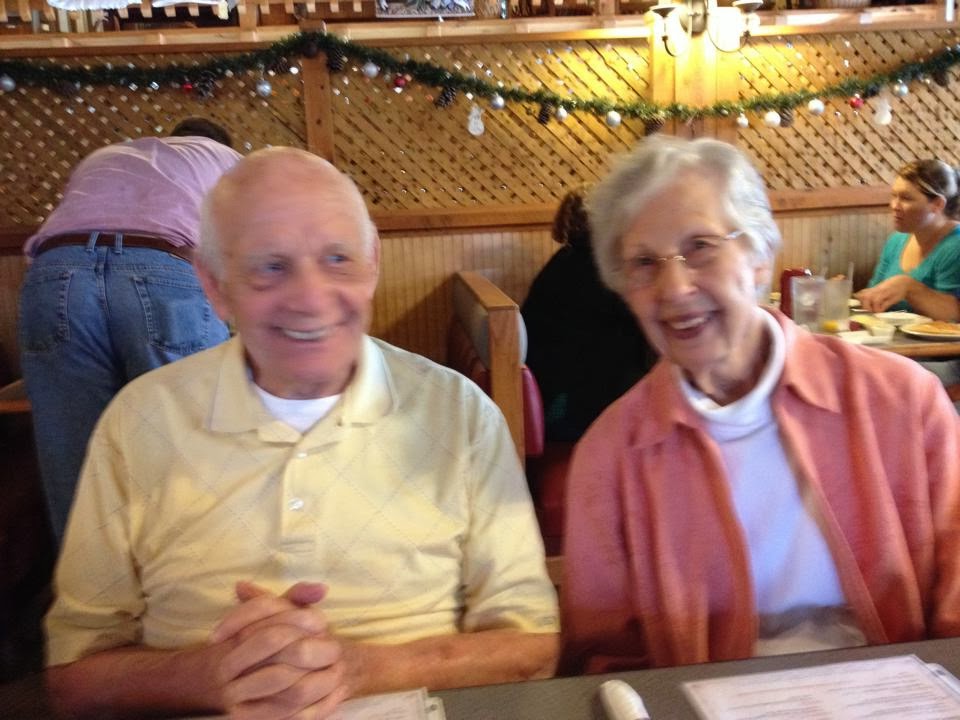
My octogenarian parents 

When I got a personal computer in 1994, the first software application I bought was for family trees. Since Dad was working on our family, I started on my husband’s. I didn’t get very far.  His parents were first-generation Americans whose parents came from Lithuania (Russia at the time), Austria, and Serbia (though they considered themselves German). My first big discovery was on the Ellis Island website when I found my husband’s paternal grandfather on a passenger list.

I would put down my research for months and years at a time and then pick it back up again. I’d find some new bits and pieces of information before hitting another brick wall. And so it continued until last year.

Dad suffered a massive cerebral hemorrhage and could no longer research our family. After seven months of brutal physical, occupational and speech therapy, he is again able to walk and understand what we are talking about, but he is not able to speak. I’m a Daddy’s girl so I was suffering. When Mom decided it was time to move into an assisted living facility with Dad, I brought all Dad’s genealogy files home when we emptied out their house.

Dad's genealogy files and old photo albums

And so began my obsession. I’ve connected with several genea-cousins online, and a couple of them have become friends and research collaborators. I purchased more old, musty books than is reasonable and haven taken a few genealogy vacations (thankfully I have a very understanding husband who goes with me). My biggest find that caused a happy dance, lasting for days, was connecting with a woman who owned two unpublished manuscripts written by my aunt’s brothers. Their father was a Church of God missionary, who took the family to British East Africa (now Kenya) in 1920. The family lived there for nine years. The stories of that time from the memoirs are wonderful and I’ve written about them on my blog in an ongoing “Out of Africa series.” Dad and I now have plenty to talk about, and we’ve discovered that while he can no longer speak, he can read. (The brain is a mysterious thing!) So I print out my posts and take them me when we go to visit. I also tell him about new genea-cousin connections I’ve made and how we are related.

Showing Dad how I was related to a recently discovered 4th cousin from New Zealand

Google Play has become a favorite app for my research. So many old county histories, written for the country's centennial anniversary, which contain biographical sketches, and old genealogy books are available. I also spend a lot of my research time on newspaper archive sites. Many require a subscription but others located at county historical societies or on Google are free. I do this because I enjoy learning more about an ancestor than just dates and places. I have discovered my ancestors did two things well: marry into interesting families and die in very creative ways!


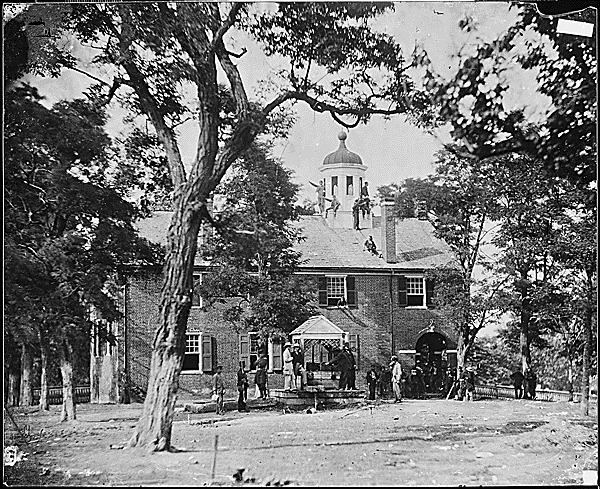
I live in Fairfax County, Virginia, and am more than willing to photograph headstones in the northern Virginia, Washington, DC, and southern Maryland area. I keep an up-to-date bibliography on my blog of books I own (digital and old fashioned). If I can look anything up in one of those books for you, I am happy to do so.


Union soldiers at the Fairfax County Courthouse in 1863 during the Civil War.
Photograph by Timothy H. O'Sullivan and courtesy of Wikimedia Commons

I work full-time and that seriously cuts into my research obsession, but it won’t last forever. When I retire I would like to start writing books. I consider my blog and this collaboration project good practice! Tangled Roots and Trees is not a typical genealogy blog; I leave the documents and the source citations on my tree. I tell stories instead about incidents in the lives of my ancestors and places in which they lived. I enjoy being able to marry my life-long love of history with my genealogy obsession.

Wednesday, 22 January 2014

A Blogging Collaboration Leads to the Answer

Introductions are the order of the month, but I will keep it brief.  I am Sue Adams and I live in Thetford, Norfolk, England.  I am coming up to the first anniversary of my launch as a professional genealogist.  My business name is Family Folk.  Rather than bang on about myself here, I direct you to the Geneabloggers series that featured yours truly at May I Introduce You To…Sue Adams

I blog at Family Folklore Blog on a variety of genealogy and family history topics.  Blogging is about communicating and communication leads to collaboration.  The following story begins with a post published in September 2012.


The Question

Stamps on a selection of certificates with dates

The post, Stamp duty and authenticity of legal documents, examined a marriage certificate and lead me to do some homework on why stamps appear on original birth, death and marriage certificates.  Stamps were an effective and convenient method of paying the tax levied in legal documents, which includes vital certificates.  The revenue stamps used evolved over time, but use of the penny postage stamp for taxation was introduced in 1853 and the Stamp Duties Management Act 1870 included a penny tax on ‘copies of registers of births & c’.

Amy, of Amy: Finding My Past wrote a post Stamp duty on birth, marriage and death certificates and posed the question:
"What I have yet to establish is when the practice of attaching a stamp to certificates died out. The latest example I have in my possession is from 1948. I’d be interested to hear from anyone who has a later example or knows the date this practice stopped."

The Collaboration

Ever skipped comments left on blogs?  You could be missing some gems.  Comments on both my post and Amy’s narrowed down the date range:

ContributorDatetypeStamp or no stamp?
Amy1948stamp
cjJan 1949deathstamp
SoamesFeb 1949birthstamp
SoamesNov 1949birthno stamp
cjFeb 1950birthno stamp, 'Exempt from stamp duty' printed over stamp box
Amy1954no stamp
Sue1956birthno stamp

Soames nailed the time period down to between February and November 1949.  CJ’s observation suggests the duty was abolished.  My hunch was that the duty abolition is probably in one of the annual Finance Bills passed after the budget.


The Answer

The Finance Act 1949 was enacted on 30 July 1949.  It abolished stamp duty on a long list of legal documents, but only gave the headings specifying the type of document in the Stamp Act 1891.  It included headings relating to Copies or Extracts, which in the 1891 Act turns out to be:
"The duty upon a certified copy or extract of or from any register of births, baptisms, marriages, deaths, or burials is to be paid by the person requiring the copy or extract, and may be denoted by an adhesive stamp, which is to be cancelled by the person by whom the copy or extract is signed before he delivers the same out of his hands, custody, or power."

I would likely have never have navigated tax law without the clues from the certificates. Thank you to Amy, CJ, and Soames for their help in answering this question.

Thursday, 2 January 2014

G'Day from Downunder

GeniAus
Thanks to the wonders of Social Media I have dear friends in many places up over the Equator. One of these whom I have yet to meet is Julie Goucher who came up with the idea of this "Worldwide Genealogy" collaborative project. Apparently she is blaming me for giving her the idea for this activity!

I am thrilled to be involved in this venture and look forward to sharing genealogy news from our great southern land. I am going to put modestly aside in my first post and tell you a little about myself.

My name is Jill Ball but I am also known as GeniAus in social media circles.

I spend a lot of time searching for my ancestors

I am a procrastinator

I am a lifelong learner

My favourite social media tool is Google+ and I love hosting Google Hangouts on Air.

This year I was voted as Australia's Gold Rockstar Genealogist

I am a member of The Hawkesbury Family History Group, The Ku-ring-gai Historical Society, The Society of Australian Genealogists and the Society of Genealogists.

But that's enough about me!

You may be interested in some of my favourite free sites for Australian research, here are a few:

National Archives of Australia
NSW Registry of Births, Deaths and Marriages - Family History BDM indexes
Ryerson Index
State Records NSW
Trove

If you have any questions about genealogy in Australia I would be happy to answer them but, as I am an amateur, I may need to direct you to someone who is more equipped with answers than I.

Wednesday, 1 January 2014

Happy New Year!

Image from Globe Photo
One of the things that I love about social media is that sheer fact that it shrinks the world to the size of a matchbox.

I love the options it gives us, to embrace our hobbies, obsessions from where ever we are in the world using whatever social media tools that appeal to us as individuals.

By embracing the different forms of social media we can integrate with others, sharing ideas, knowledge and friendship with people that we have never met.

Social media, in whatever form it takes has revolutionised the way we interact with others, the way we conduct our genealogical and historical research and more importantly it has revolutionised Society in general, in pretty much all areas - banking, learning and shopping to name a few.  Is this how our ancestors felt when the concept of rail travel was first introduced I wonder?

I like various social media tools for different reasons. I can typically be found either by my own name or Anglers Rest

Twitter is always a challenge. I struggle to share details in 140 characters or less, but I can be found at @juliegoucher

Facebook - I like the fact that I share share the incidentals of peoples lives, especially my family who live down under. I have a personal page and I have a page that is linked to my blog and Twitter and I plan to share more general genealogical material to that page. I rarely share genealogy to my personal page.

Google+ - This was a big learning curve for 2013 and I love it! Once I got my head around the point of circles and the interaction is by topic rather than individual I was hooked and I love the way that Google+ enables hangouts and links to YouTube

  • Do you have a favourite social media tool or tip you can share? 
  • Does your Society use social media really well, spreading the word to the genealogy community and members far and wide?
  • Do you want to learn to use a social media tool that you perhaps do not use, or want to expand your use of particular one?

If you want to respond and share please get interactive and leave a comment!