Showing posts with label DNA. Show all posts

Thursday, 27 July 2017


Worldwide Genealogical Collaboration
Cousins Find Each Other Around the World


Today’s technology and DNA testing provide all kinds of exciting opportunities in genealogical research.  Many of us, and I am surely one, believe that each individual has the right to know exactly who she/he is and to know her or his ancestors. As my own genealogical research progressed, it helped strengthen my identity-- as I learned about the ancestors whose DNA coursed through my own veins as well as theirs, hundreds of years ago.  Lately, I’ve learned that nowhere is this “need to know” stronger than for adoptees. Many, probably most adoptees feel the need to know their own individual identities and heritage.

I have a cousin named Bradley who was adopted. We didn’t know each other until we both did our DNA tests on Ancestry, and discovered our match.  Bradley and I have worked together a lot over the last year or so.  We have used Ancestry, FTDNA-Family Tree DNA, 23 and Me, and Gedmatch.com as well as other genealogical research sites and have learned amazing things. 

Before Bradley contacted me about our DNA match, he had met another cousin named Courtney--DNA proved she was my cousin also!  I have to tell you, one of us is from California, one from North Carolina, and one from New York--we cover the whole of America, and we are cousins -- united by DNA and ancestors/genealogy.


Bradley is a force of nature, who makes things happen. He found two other cousins, Stella and Zoe, both of whom were also adopted, and who are also related to him, and to Courtney and to me by DNA! That is truly incredible!  In my experience, finding five people, unknown to each other, from all over the world, all of whom are related by DNA to each other--well, I would wager that it would be a zero probability that we would find each other!  However, the miracle continues, even more amazing to me is that Stella had met another DNA- matched cousin  named Eva and she was related by DNA to the rest of us as well!  That made six of us, three from across the United States, and three from Central Europe -- the Netherlands, Germany, France, and Switzerland.  We are three adoptees and three who know their parents, all 4th, 5th, or 6th cousins! 
Bradley then organized us into a group on Facebook, so that we could communicate more easily.  He invited one other DNA match of his to join the group hoping she might also match some of us. Laura did indeed match another one of us, another cherished cousin.  I asked my daughter Ali to join our group, as she speaks and reads German and French fluently, and was also a cousin of course! Eight of us, what a wonderful group of people, all dynamic and interesting to know!  Typically, the Europeans all speak and read English with different levels of experience, while we Americans only speak English, except for my daughter Ali, whose linguistic abilities did not come from her mother, but from other ancestors.

Eight people, eight cousins, three adoptees from all around the world-- united by a desire to know our common heritage -- awesome!  We truly engage in “Worldwide Genealogical Collaboration”!

We have been working together for a few months, but we may have just discovered our common line of ancestors, one of Netherlander origin.  We still have research to do to be sure.  As we identify our most recent common ancestor--possibly 4th, 5th, and 6th great grandparents depending on our cousinship and as the ancestral lines fall in place, birth parents are often-- usually identified.  It is a fact of research.  What happens next is a choice that adoptees and their birth parents, if living, have to make. Reunions can be fulfilling and joyful, or full of rejection. With DNA, technology, and our heritage research, identities can no longer be secret -- instead they can be stronger than ever.

There is one more phenomenal situation that we have discovered with our genealogical work together.  Our common ancestors, the Vreeland family, came to America in the mid 1600’s from the Netherlands to New Amsterdam (New York) in Colonial America. They helped found New Jersey, buying land from the Indians, and fighting in the Revolutionary War. Now, 350 years later, eight of us are getting to know each other and one completes this circle of migration.  Zoe was born in America, in New Jersey.  After her adoption, as a very young child of 2, she was taken to the Netherlands to be raised by her adoptive family. She brings OUR family full circle--from the Netherlands to New Jersey and from New Jersey back to Europe!  Isn’t that amazing!

Worldwide Genealogical Collaboration-- aren’t we blessed to be a part of it! Enjoy finding your cousins all over the world. 

Until next time, Helen Holshouser
 
Map depicting migration of colonial settlers from Europe to America and back to Europe. --From DNA Genetic Communities, Ancestry.com.

Wednesday, 7 December 2016

One is the Loneliest Number

 When it comes to Family Trees, Backups, DNA and Research we need to take a "more is better" approach.


Trees~
 Where do you keep your family tree? Are you an online tree, computer database or a file cabinet/binder person?
Personally, I use all 3 methods. I have my family tree on ancestry.com, findmypast.com, myheritage.com, FamilySearch.com and wikitree.com.
 My tree is also in a database on my computer. I use Legacy Family Tree to store my ancestor's information, pictures, and documents.
Each family has a file in my cabinets to store original documents and other important information.
 Binders for each surname contain copies of pertinent information and are put together so that others can pick them up and look through them to discover their family's story.
 Why not just one online tree? Having my family included in the   databases available will help me connect with more people.  Perhaps the person who has the information on my Great Great Grandmother has uploaded their tree to one and not the other.
 By not spreading my tree around, I am limiting my cousin connections.
  Why have other storage methods if I have my tree on so many places on the web?  Simply to ensure I can always access it.
 Have you ever tried to pull up one of your trees and the site is down, or your internet is having issues and isn't working?
 My Legacy program functions as my working database as I research and find evidence about my ancestors. I can write as I go in the notes section and make sure I have followed the correct steps in finding the answers to my questions before I attach someone to an online tree. It also is a backup in case my internet goes out.
Filing cabinets serve as storage for originals and information that I haven't processed yet and the binders put it all together for those who would rather have a book to flip through.


Backups~
 While my files and binders and online trees serve as a type of backup, they are not always up to date. They are not a substitute for making sure everything - pictures, documents, and data downloaded to my computer files or added to my Legacy Family Tree program- is protected from a computer crash.
 Trying to cover all my bases, I use Dropbox.com, and Backblaze.com to send all my genealogy and other data to the cloud. If I experience a crash or loss of information, it can easily be restored. When buying a new computer everything can be reinstalled while I am busy doing something else.
 An external hard drive is updated on the first of the month, Genealogy Back Up Day, and kept in a safe place. Thumb drives, while not as stable, store my important files too. I keep one on my keychain. Just in case.
These fulfill the advice of having the information in at least 3 different places to avoid data loss.


DNA~
Have you taken a DNA test? Again, this is another area where one is not the best solution to connecting with family members.
There is no way of knowing where others have tested and if the if the matches you need can be found on one particular site. Each company has a different database of testers.
 Spreading your DNA around to other places will put your information out there for a better chance of finding those matches.
Gedmatch.com is a free way to upload your raw DNA from any of the testing companies and add your results to a greater variety of people.


One can also be a lonely number when it comes to our research. Often we tend to work by ourselves and not take advantage of networking with other genealogists. From Genealogy Societies to Social Media, there are those who can help us with our brick walls, transcription of a hard to read document or use as a sounding board as we work through the research process.
 The best is having someone to share those 'happy dance' moments when we need those who understand to celebrate with us.

When it comes to protecting our information and reaching the greatest potential of connections, one is the loneliest number.
Get out there and spread it around!

Cheri


Sunday, 25 September 2016

AncestryDNA for Newbies (Including Me)

So you have DNA tested with Ancestry. Now what?

My husband and I first had our DNA testing done in 2012 using an autosomal test offered by Ancestry. My two brothers and my 83-year-old mother tested the next year, which turned out to be the year before she died. Dad's dementia did not enable him to understand spitting into a vial. But earlier this year his 89-year-old brother tested. Currently, I administer the results of 11 DNA tests and another 6 are at the lab being processed. I still consider myself a DNA research rookie.

Several of the tests are first cousins on my maternal side. None of us know much about our grandfather, the family Gustav Lange (1888-1963), and more than half of my 11 Lange cousins are helping me in my research by agreeing to DNA test. I have uploaded Mom's raw DNA test results and a gedcom version of her tree to GEDMATCH.com because there is a group of Society of German Genealogy in Eastern Europe (SGGEE) members who share DNA with Mom who understand chromosome matching. I do not. Therefore, this post is about how someone with a limited understanding of DNA can use Ancestry DNA-related tools to further their research.

And I will attest to the success I've had using DNA even with a limited understanding of the science. Some successes:
  1. Confirming my 4X great grandfather Samuel Beard, (1750-1814) was the brother of Capt. David Beard and the son of Adam Beard (1725-1777), which proved my previous research and enabled me to have him re-instated as a Daughters of the American Revolution (DAR) patriot.
  2. Identifying a new Beard cousin (descended through Capt. David Beard), whose uncle had written a book which described the family's wagon trip from Iowa to Colorado and California in the late 1890s.
  3. Learning about my previously unknown great great grandmother Barbara Ann Mitchell, who descended from Robert Mitchell "the Immigrant," who was alive and living in Londonderry, Northern Ireland during the Seige of Derry in 1688-1689.
  4. Having the opportunity to interview my first cousin once removed who was the son of Grandpa Lange's youngest brother about the family's experience during and between World War I and World War II
  5. Proving that I had correctly identified the siblings of my great grandmother, Caroline (Ludwig) Lange.
  6. Discovering a five times great grandfather was Robert Mitchell "the Elder" (1714-1799) and finding a book about one of his sons which included a personality profile about Robert Mitchell.
And more...

In order to take full advantage of what little I do understand about DNA, I needed to develop a process to follow when viewing, identifying, and managing the results of the tests as well as how I communicate with the people who have so graciously spit into the tube for me! I thought for my bi-monthly Worldwide Genealogy -- A Genealogical Collaboration, I would detail my DNA process. 

I maintain a master DNA spreadsheet in which I record matches, common shared ancestors, pedigree charts and ethnicity information. 

On the ethnicity worksheet, I have the people who have taken the test arrayed on rows and the global regions Ancestry uses to categorize ethnicity are arrayed in columns.

Column A = Name of person who DNA tested (not shown)
Column B = Relationship to me
Columns C through AB = Ancestry's 26 global regions (some are not shown)

Ethnicity worksheet in my Master DNA spreadsheet; created using
Microsoft Excel

I find that the people who have tested for me are most interested in their ethnicity. I can make their eyes glaze over when I talk genealogy. So I usually send them a copy of the information Ancestry includes about each region when I send them their ethnicity results.

The pedigree charts look like the example below. I include them as I know many of my relatives will be unfamiliar with the names of some of their direct ancestors.

Example of a pedigree chart I create for each person whose DNA test I
administer; created using Microsoft Excel

I annotate the chart to include whether the information was new to me based on DNA testing and which lines have been proven using DNA testing. My relatives enjoy seeing how their DNA tests have helped further my research into our shared family history.

The "meat" of my spreadsheet is the worksheet where I capture information about DNA matches. I organize the information in the following manner:
  • Column A = the name of the DNA match (not shown): Sometimes I cannot determine their name, but note them as Daughter [Surname] for example. Frequently, if one of their parents are deceased I can locate an obituary online and determine the name of the DNA match.
  • Column B = M/F (not shown): This is the sex of the person who took the DNA test
  • Column C = the name of the DNA test (not shown): This will be an Ancestry username unless it is a test of a third person administered by an Ancestry member. In that case, I enter the initials in this column.
  • Column D = the username of the test administrator (not shown): If the test was taken by an Ancestry member, it will be the Ancestry user name. In my case "sdagutis." Using my mother's test as an example, the name of which is D. J. (administered by sdagutis), I enter DJ in Column C and sdagutis in this column.
  • Column E = the surname of the common shared ancestor (not shown). This column was added for sorting purposes.
  • Column F = name of the common shared ancestor. This is the person from which the DNA match and the test I administer descend. I use the name of the male as frequently we descend from children of different wives. I've learned wives are complicated! ;)
  • Column G = birth year of common shared ancestor. I use red font if it is an estimate.
  • Column H = death year of common shared ancestor. I use red font if it is an estimate.
  • Column I = relationship of common shared ancestor to me. If this column is blank the row is related to a DNA test to a by-marriage relative who is not related to me by genetics or blood and this information is included in a different column for only those non-relatives.
  • Columns J through whatever = the names of the people whose DNA test I administer and their relationship to me. I have tested some by marriage ancestors who were curious about their family history so their columns are organized at the far right and are not shown.
A snippet from my DNA matches worksheet; created using Microsoft Excel

When I'm working with new DNA matches I usually sort the spreadsheet by the Test Administrator column. This enables me to insert a new row alphabetically by the Ancestry username. When I am analyzing the DNA matches I sort by the common shared ancestor columns. I have observed that while my brothers and I share many DNA matches there a few that unique to one sibling and those seem to fall into particular surnames. One brother has more matches where the common shared ancestor's surname was Beard for example.

I always research the ancestry of the DNA match. Occasionally, I find, especially when dealing with U.S. Colonial-era ancestors that the research can be incorrect. Often, I can make what I believe to be the correct amendments and I will note that on the DNA match itself. I also use this field to indicate who the person is and a link to their facts page in my tree.

An example of how I use the Note field on the DNA match page; courtesy
of Ancestry

As I complete my process for each match, I click the star to the left of the image so I know I have worked on this match and know who the common shared ancestor was even if Ancestry did not identify one. I also note the DNA match on the two relevant fact pages in my tree using the DNA Markers fact option.

The fact about Uncle Marvin's DNA match on my facts page; courtesy of
Ancestry.com
Corresponding fact about our match on Uncle Marvin's fact page;
courtesy of Ancestry.com

I will mention that I am not generally a fan of using icons on my tree but have found it extraordinarily helpful when working with DNA. I create an icon for each person who has tested and as I resolve each match, I associate that person to the icon in my relative's gallery.

When I solve a match, especially one without a known shared common ancestor, I will click the Shared Matches button to see which other matches are shared between the person who took the DNA test for me and the match on which I am working. Usually, I can figure those out as well, using the research I just completed on the current match.

Buttons that appear on every DNA match detail pages; courtesy of
Ancestry.com

I'll talk about DNA Circles another day!

Wednesday, 31 December 2014

Genealogy 2014 - 2015: Successes and Goals

Mary Peacock nee Hugill
Mary Peacock (nee Hugill)
After today, someone else is taking over my '31st-of-the-month' time-slot. My previous posts were about sources and strategies for family history worldwide. Today I want to reflect upon the highlights of 2014 and my goals for 2015.

In 2014, unforeseen events (ranging from a back injury to moving house) meant that there were many disruptions to my usual genealogical activities. A health scare reminded me that spending quality time with family and friends is more important than being an educator, a genealogy professional or a blogger!

Genealogical highlights of 2014:   (links open in a new window)
  1. Collaboration via CuriousFox.  I have been swapping information with a distant relative who contacted me via CuriousFox. She sent me certificates and other information for our PEACOCK and HUGILL ancestors from Yorkshire, and confirmed that my Mary PEACOCK (nee HUGILL) died 17 Feb 1900 at Stockton-on-Tees, Durham, England.

  2. New data via National Probate Calendar.  I found many relevant entries in the National Probate Calendar (Index of Wills and Administrations, England and Wales 1858-1966). For some, I've already ordered copies of the wills. Others are on my wish list, but in the meantime they gave me locations, death dates, occupations and relationship details that helped with research in other sources.

  3. New data via FindMyPast.  Many record sets released on FindMyPast during 2014 revealed new information for my family history. For example:
    • 'British in India' collection has 5 pension fund documents for Mary PORTER (a widow in England) with names and exact birth dates (between 1811 and 1821) for her five children.

    • Yorkshire collection has records such as parish registers and Bishop's Transcripts for my many family lines in that county.

    • Trade Union records refer to my John William CORDUEX in registers of two different railway unions.

    • New South Wales will books 1800-1952 in which I have already found 13 records for my family (including some people who lived outside NSW). I expect to find more when I do a systematic search for all names in my family tree.

  4. Newspaper notices.  In the York Herald, Yorkshire Gazette and Sheffield Daily Telegraph (digitised and available via FindMyPast and the British Newspaper Archive) I found obituaries and other items for some of my families including HUDSON of Barton-le-Willows and BATTY of Bolton-upon-Dearne.

  5. HUDSON family at Crows Nest.  I added another generation to the family tree after finding clues in Queensland funeral records and cemetery burial registers.

My genealogy goals for 2015:

  • Change my priorities.  Spend more time on my own research and less time on answering emails from people who expect everything to be free!

  • Share my knowledge more efficiently.  (1) Write more mini-guides.  (2) Use my Twitter page more often (because it is a quick way to share genealogy tips and links).

  • Organise my records.  Before scanning or taking digital photos of all my family history material, I need to write down a 'style guide' for naming and filing the images. I will use a modification of the system described by Nancy Loe (a.k.a. 'Sassy Jane') in Cataloging Digital Family Photographs and Records and Organizing Genealogy Research Using Archival Principles. My paper filing system has always been source-based, so Louis Kessler's idea of a source-based incremental fix will suit me perfectly.

  • Use DNA for genealogy.  I need to become more familiar with various tools for analysing DNA results, and to persuade more of my distant cousins to do the FamilyTreeDNA Family Finder test for autosomal DNA and the X-chromosome.

  • Plan my genealogy cruise presentations.  Prepare my talks well in advance of Unlock the Past's 'Barrier Reef' cruise in March 2016. (You can get AUD$40 discount by quoting the code UTPC-WEB06 when you book any Unlock the Past cruise.)

  • Research the HUGILL family.  My top priority is to find parents' names for Mary HUGILL (born c.1813, Hull, Yorkshire) and confirm that George HUGILL (born Hull, later of Stockton-on-Tees) was her brother. (Perhaps the wills and probate documents that I've ordered will help.)

  • Write about my ancestors.  Many of those posts (which I will put in Jottings, Journeys and Genealogy) will be quite brief initially, but I'll update them as my research progresses. Hopefully people who read them will contact me and help fill the gaps in my knowledge.

Someone else is now taking over my '31st-of-the-month' time-slot, but watch for additions to my own blogs, which include UK / Australia GenealogyGenealogy LeftoversQueensland Genealogy;  and Jottings, Journeys and Genealogy.
~ ~
You might also like:
(This post first appeared on http://worldwidegenealogy.blogspot.com/2014/12/genealogy-2014-2015-successes-and-goals.html.)

Saturday, 4 October 2014

A Baker's Dozen of Genealogy/Family History Books

A few from my list - you can find many of these at your local library!

Last month at this time I shared ten books (well I cheated a bit with some series books but hey, what is a bibliophile to do) that have had an impact on my life. I promised that I would be back this month and share ten books that have had an impact on my genealogy life (could not fit all that in the title - too long!). That might seem like a tall order, but I think I can handle it. So let's get sharing (if you have a book that has impacted you, please share it so we can all benefit!).

(1)  Evidence Explained: Citing History Sources from Artifacts to Cyberspace by Elizabeth Shown Mills - this book is simply the best! If you want to understand how citations work and why they are important, look no further than Evidence Explained. Ms. Mills not only explains the reasoning behind various citations, she also shares examples of most every type of source citation. And if you read the beginning chapters and pay attention, you will be able to craft you own source citation for any work for which she did not provide an example. I am a huge fan of "watching/reading and learning" and Ms. Mills' writing is clear, concise, and gently nudges genealogists and family historians to reach for the next level. Every genealogist needs to own this book.


(2)  Professional Genealogy: A Manual for Researchers, Writers, Editors, Lecturers, and Librarians edited by Elizabeth Shown Mills - what can I say, this woman is on a roll! Whether you want to take your hobby, passion, or profession seriously and understand all the important business, financial, and ethical requirements or you simply want to understand how to make the best use of a genealogy professional, this is the book for you (put it right next to Evidence Explained). Professional Genealogy serves as the textbook for ProGen Study Groups. You will definitely wring everything out of this book if you join a ProGen group. Whether you join a ProGen group or go it alone, you need Professional Genealogy.

(3)  Destination America: The People and Cultures That Created a Nation by Chuck Wills - do you want to understand how all of the people who came to America shaped and added to our nation's rich tapestry of multiculturalism? This gorgeous book (spoiler alert - maps and lots of photos - you won't be able to put it down) was the basis of a PBS series by the same name put together by David Grubin. Destination America contains amazing stories of where immigrants came from and why they left their native lands, lovely photos and maps (oh yes maps!) and the chance to gain a better understanding of how our freedoms (freedom to worship, freedom from oppression, freedom from want, freedom from fear, and freedom to create) have been strengthened due to the efforts of all our people. Destination America introduces us to the original native Americans as well as most religious or ethnic groups that joined them here. As a country, we don't always get it right (and sometimes we get it very wrong) but we do aspire to be better. Destination America will remind you of what your own group(s) went through and help you appreciate the stories of other groups of your fellow Americans.

(4)  Our America: A Hispanic History of the United States by Felipe Fernandez-Armesto - American history is often taught through a prism of British history, but that is only a part of our story (think about the Native American population, as well as French, Russian, and Spanish interests). Our America serves as a reminder that the United States' history is just as much the story of Spanish colonization as any other group's colonization. Our America reminds us of the Southwest and West regions' rich history. Our Hispanic past is just as important as any discussion of the Pilgrims and the 13 colonies.

(5)  Geography and Genealogy: Locating Personal Pasts edited by Timothy Dallen and Jeanne Kay Guelke - this one is a bit hard to find (go to your college and university libraries) but is worth the trouble. Geography is such an important aspect in genealogy and it usually gets short shrift. I recently took several courses in cultural and physical geography and they opened my eyes to all the factors that affect people, culture, and place. Whether you want to understand the questions of why people settled where they did, how they lived, how natural and man-made barriers affected their lives, what migration patterns were and how they have changed over time, the push-pull factors of migration, and a host of other topics - the study of geography provides the answers. This book provides an introduction to the field of geography as it relates to genealogy. Combine Geography and Genealogy with a few classics like Longitude: The True Story of a Lone Genius Who Solved the Greatest Scientific Problem of His Time by Dava Sorbel and Geography: Realms, Regions and Concepts by Harm J. De Blij and Peter O. Muller (the newest edition is available as a rental eBook!), as well as the very readable newer entries that combine history and just plain fun, including The Discoverers: A History of Man's Search to Know His World and Himself  by Daniel J. Boorstin and Maphead: Charting the Wide, Weird World of Geography Wonks by Ken Jennings - and you will see our world in a whole new light.

(6)  Tracing Your Irish Ancestors: the Complete Guide by John Grenham - this book is an excellent primer on Irish family history research. It is important to understand the history of a place, its physical layout and system of record-keeping and, of course, what is available (offline and online). For anyone serious about researching their Irish ancestors this is the book. Mr. Grenham has a number of other publications (in both book and CD-ROM format) that are also especially helpful - Clans and Families of Ireland, Grenham's Irish Surnames and Grenham's Irish Recordfinder. Combine Tracing Your Irish Ancestors with A New Genealogical Atlas of Ireland by Brian Mitchell and Irish Records: Sources for Family and Local History by James G. Ryan, and you will have your Irish research resources covered.

(7)  Finding a Place Called Home: A Guide to African-American Genealogy and Historical Identity by Dee Parmer Woodtor - for African-Americans researching their genealogy and family history and for all those wanting to understand the family history of African-Americans in our county, this is the book. An excellent resource to find out about how slavery (and the concept of people as property) affects our research from as early as 1790. Finding a Place Called Home is not only a genealogy resource but a fascinating history of a people through time - slavery, the Civil War, Reconstruction, WWI, WWII, the Civil Rights movement, and migration resulting from these events. African-American history is American history and African-American genealogy is American genealogy - it touches all of us and this book is an excellent introduction.

(8)  The Source: A Guidebook of American Genealogy by Loretto Dennis Szucs and The Red Book: American State County & Town Sources edited by Alice Eichholz are essential genealogy reference books, so much so that Ancestry.com puts them front and center on their learning page (in front of their pay-wall - run don't walk there - okay use the magic of the internet!). If you want to figure out what records are available - whether on the Federal or local level, where those records are located in various State and County repositories, and how to get your hands (real or virtual) on them, these two books are the place to start. A note: researchers need to take the contact information and update it as more information becomes available online and datasets and office information change - but these books provide the history, the guideposts, and those all important breadcrumbs for further research. These books are at many libraries and sit happily alongside my copies of Evidence Explained and Professional Genealogy - they are that good and that useful.

(9)  Albion's Seed: Four British Folkways in America by David Hackett Fischer - a look at four waves of immigration to America: the Cavaliers to the Atlantic Southeast (Virginia), the Puritans to New England, the Quakers to Pennsylvania, and the Scots-Irish or Borderers to the Appalachians. This is an interesting book that speaks to English culture and its impact on populating the colonies in the 1629-1775 time-frame. I would encourage readers and researchers to take Mr. Fischer's conclusions and generalizations with a grain of salt - I don't think everything is so neat and tidy, but Albion's Seed does provide lots of information on the cultural and social history of these groups, together with references and suggestions for additional reading.

(10)  Organizing Your Family History Search: Efficient & Effective Ways to Gather and Protect Your Genealogical Research by Sharon DeBartolo Carmack - if you are anything like me you would like to know that you are on the right track and that you are approaching your genealogy and record-keeping in an efficient and effective manner. Simply put, genealogists want to know how to put all the information we gather together. Well Ms. Carmack does a fine job of helping us out in an easy to read and incorporate way. Sometimes you will nod your head (done that) and other times you will have an "aha moment." The best method of organizing our research and results is the method that we will actually use day in and day out. Check out Ms. Carmack's suggestions and get organized!

(11)  The Surnames Handbook: A Guide to Family Name Research in the 21st Century and DNA and Social Networking: A Guide to Genealogy in the Twenty-First Century both by Debbie Kennett - these areas of research are relatively new to most of us. Both DNA and Social Networking and The Surnames Handbook are well-written and contain a wealth of website links and resources to assist us in our studies. Ms. Kennett's clear and concise explanations of DNA studies (so much has changed since my university biology classes!) and social networking (how to best use all the tools at our disposal and not be overwhelmed by them) help genealogists and family historians understand how to make the best use of both. Ms. Kennett's guide to surname research is thorough and quite readable. Surname research, as a facet of family history, is expanding on a worldwide basis and Ms. Kennett's guide is an especially helpful introduction.

(12)  Seven Pillars of Wisdom - The Art of One-Name Studies edited by the Guild of One-Name Studies and Putting Your Ancestors in their Place: A Guide to One Place Studies by Janet Few - those of you who know me, know that I am working on a one-name (surname) study and a one-place (location) study. At some point I hope to encourage enough Keoughs to join the existing Keough-DNA study (but that is still a future thought). While our own family history and genealogy is interesting, I do think that putting those who share our surname or our place in context is a fascinating area of specialized family history research. The methodology and projects suggested in Seven Pillars and Putting Your Ancestors in Their Place are incredibly helpful to the family historian who wants to take her/his research further and connect it to the bigger picture or puzzle out possible connections.

(13)  A People's History of the United States: 1492-Present by Howard Zinn - what can I say - a history of the United States told from the viewpoint and in the words of the people who have made this country and who are not often heard from - the women, the Native Americans, the immigrants, the factory workers, the farmers, the laborers, and the working poor. This is not the history you learned in your unwieldy and cursory high school or college textbooks. This is not the history told by the establishment. Be sure to take Mr. Zinn's A People's History with a grain of salt, but also realize that history is written by the winners. It is important to understand our past and look at all sides of the story. Wear your critical thinking eyeglasses with this one, but it is just as important to not wear our rose-colored glasses while we read either.

(14)  And because I am a bit of a cheat (I am sure you have counted more than my baker's dozen here) EVERYTHING by Ken Burns & Company is, in my humble opinion, brilliant and shines a light on our American family history. We and our extended families exist in a time and place and our experiences affect other people and other countries as well as our own. Be sure to check out these books which serve as companions to the Ken Burns for PBS documentary films. Although the films are wonderful, these books include much more detail (no time constraints, unlike film productions), provide additional resources, and explore the American experience from a variety of events or topics, large and small. My choices include the following:
    • The Civil War: An Illustrated History by Geoffrey C. Ward, Ric Burns and Ken Burns
    • Lewis & Clark: The Journey of the Corps of Discovery by Dayton Duncan and Ken Burns
    • The National Parks: America's Best Idea by Dayton Duncan and Ken Burns
    • Jazz: A History of America's Music by Geoffrey C. Ward and Ken Burns
    • The War: An Intimate History, 1941-1945 by Geoffrey C. Ward and Ken Burns
    • Mark Twain: An Illustrated Biography by Geoffrey C. Ward, Ken Burns and Dayton Duncan
    • Not for Ourselves Alone: the Story of Elizabeth Cady Stanton and Susan B. Anthony by Geoffrey C. Ward and Kenneth Burns
    • The Shakers: Hands to Work, Hearts to God by Amy Stechler Burns and ken Burns
    • Horatio's Drive: America's First Road Trip by Dayton Duncan and Ken Burns
    • The Roosevelts: An Intimate History by Geoffrey C. Ward and Ken Burns
Books - Glorious Books! (image made with wordle.net)
Okay - there you have it! Did I miss anything that you think is a must read? You will notice that I have a bit of an American bent (hey I'm American), but I hope I have included enough varied topics and types of genealogy and family history books so that there is something you know and agree with and something that is new to you. Please share your choices of genealogy or family history books that have had an affect of you in the comments section. 

Cheers and Enjoy!
Tessa 

Wednesday, 11 June 2014

My Cleage Family's Disappearing Ydna

Frank and Juda had 5 sons. I do not know if those other than my great grandfather, Lewis Cleage, had any children as I cannot find them after 1870.  My grandfather had 1 daughter and 4 sons.  Three of those sons had sons.  None of them had sons.  Unfortunately, I was not able to collect any DNA from them so I don't know what the YDna was.  I would have liked to know if the YDna went back to Angola because I have read that Samuel Cleage prefered slaves from Angola.

My grandfather and his siblings. Front left my grandfather, Albert B. Cleage Sr. Behind him is Henry, in the middle is their sister Josie. Front right is Edward.  Behind him is Jacob.

Cousins - Children of the Cleage brothers + spouse.
My grandparents and their 7 children. 1930.


L>R Hugh, Albert Jr, Albert Sr, Henry, Louis Cleage.   Of the 4 sons, only my father had children, both girls.

My sister, my father and me.  1953.


Tuesday, 27 May 2014

DNA Projects -- What Genealogical Help Can We Expect?

During the past few weeks, I have been trying to understand what genealogical information we can ascertain from DNA testing.  We have had over thirty family members tested so far using Family Tree DNA.  The company provides us with exciting charts and lists of "matches" and it is easy to get carried away and jump to conclusions.  So far, we have found new cousins whose family trees match with ours and we have confirmed other cousin relationships.  But, we have not filled in ANY of the holes in our family tree.  I want to formulate questions that the DNA tests can help us answer.

I have decided to focus on three DNA missions:

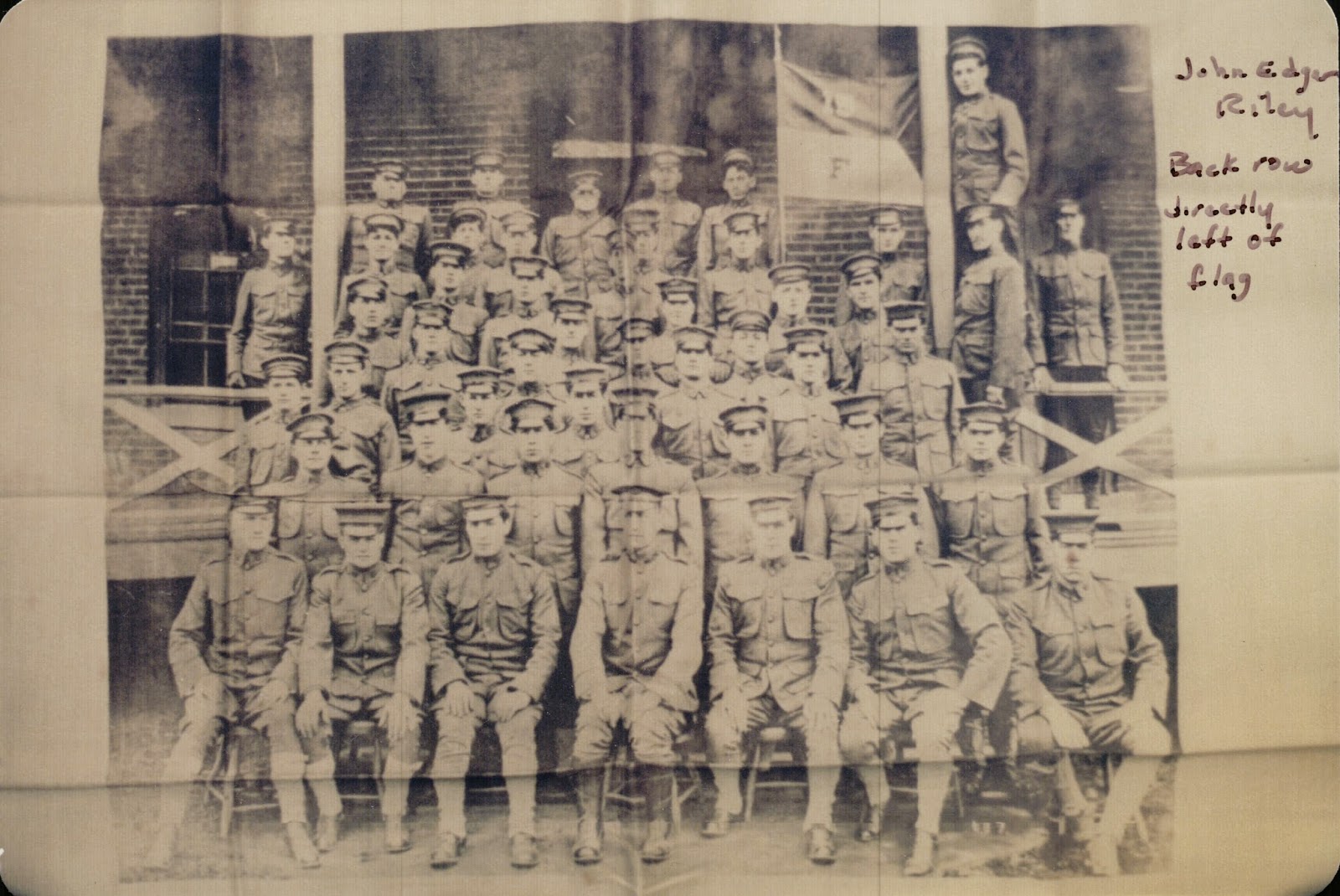
1. Find information about the ancestry of my great-grandfather, John Edgar Riley.

2. Try to find the name of my missing great- great-grandmother, Atinahona (Austin's woman).

3. "Map" my parents' chromosomes as much as possible to help categorize their autosomal DNA matches into ancestry lines.

Mission #1: John Edgar Riley, why can't we find you?

One of the most stubborn lines in my family tree is that of my great-grandfather, John Edgar Riley.  He supplied his third wife with detailed facts from his early life:

He was born in Broad Brook, Connecticut on April 21, 1892.
His parents were Timothy O'Riley and Elizabeth Brennan.
He had three older sisters, Rose, Julia and Maude, who were born in Ireland before the family immigrated to the USA.
The family spent time living in Manhattan at 350 E. 88th Street.
His father owned a pub in Manhattan.
His father worked for the railroad.
He was Catholic and served as an altar boy and one of his sisters was a nun.
Before he turned 20, his whole family was dead.  His father and two sisters died in two separate railroad accidents.  His mother fell down the back steps and hit her head.  His other sister drowned.
He had a paternal uncle, Michael O'Riley, who moved to Texas, but returned to Ireland.

John Edgar Riley - Union Pacific Railroad
My mother spent years on this line (it's my dad's side) and so have I, but we have not been able to verify even one of these clues.  There are no records on John Edgar Riley until his army files in Kansas when he was about 20.  We have found nothing on his family of origin.

So, I hope that eventually, my father's Y-DNA will show a match with another man who shares the same male lineage.  For this, I depend on some unknown relative doing a DNA test.  I hold out hope.

My father, his aunt (John Edgar Riley's youngest daughter) and cousin have also had the autosomal DNA test.  So there is a possibility that we may be able to tease out a member of that line through those matches.  So far, though, the people who match do not mention Rileys or O'Rileys in their ancestral surnames or in recent generations of family trees.

So my John Edgar Riley DNA strategy is to wait and hope for Y-DNA matches while recruiting some of my dad's second cousins and second cousins once removed to get the autosomal DNA test done.  The more second cousins we can get, the better we can group his close matches into family lines.


John Edgar Riley in his later years with his wife, Frances

Mission #2: Atinahona, who are you?


Another very frustrating stumbling block we have is on my mother's side.  My great- great- great-grandmother is listed with her husband, Samuel Austin, as "Atinahona".  This is seems to be a transliteration of the Choctaw words for "Austin's woman."  We would like to find out Atinahona's real name. 

Through DNA testing, we have found that our male Austin line goes back to a Choctaw man.  Originally, we thought a man of European ancestry might have married into the line, but apparently Samuel Austin or his ancestor adopted the name.   

My strategy to find Mrs. Austin, or at least narrow down the possibilities, is to analyze DNA results and family trees of cousins known to share common ancestors as well as Choctaw tribal members who come from the same community and are likely to be distant cousins.  We have started to do this. The community members (2) who have been tested match my mother and her relatives.  The problem is that matches could be from other than the Austin line, and the matches could be from multiple lines.  This DNA analysis is to be done along with studying historical documents and rolls which is mostly done by my mom.  She is an expert on Choctaw genealogies from the time of removal to the Dawes rolls.  

Mission #3: Mom and Dad, what genes were you dealt?

My mother and grandmother

My dad's parents and relatives

I have started to read about DNA genealogists who map their chromosomes so that when they get a new match, they can make a good guess about which line it is on.  Also, it may be possible to identify missing surnames from branches.  One website I've used as a reference is: Chromosome Mapping.

I am just getting started with this process.  It looks like a lot of work, but I hope it will be useful, especially for my other two missions!  To fill in the chromosome map well (it will never be totally filled in), I need to have more cousin data.  I will update in a future post.


Wednesday, 7 May 2014

Hello from New Hampshire, USA

Hello!  My name is Heather Wilkinson Rojo.  I've lived for 30 years in New Hampshire, and  I grew up in Beverly, Massachusetts where many of my ancestors lived since the 1630s. I also spent my school years in central Massachusetts in the adorably quintessential New England town of Holden.   I had one set of 5th great grandparents who were married there in Holden, in the same church where my husband and were married.  Centuries of my ancestors were baptized in the Congregational church in Beverly, where I was baptized, too.

Four years ago I started a blog called Nutfield Genealogy, named for the original grant of land where the first Ulster Presbyterians first settled in 1719.  They renamed it Londonderry in honor of the county in Northern Ireland where they came from.  Their pastor, Reverend James MacGregor of Aghadowey, brought his flock of Scots Irish settlers to Nutfield, and I've learned a lot about them over the past 30 years.  I even learned that I had two Scots Irish minister ancestors, too, but they were in Massachusetts.

I started doing genealogy as a young teen in Holden.  I didn't know any of my ancestors, nor did my parents.  The lucky thing about starting my genealogy young was that I was able to interview my grandparents and their siblings.  My grandmother remembered her grandfather, who was in the Civil War!  I took a few genealogy classes, but I was already hooked on family history. 

In the past 35 years or so I have found a dozen Mayflower ancestors,  several ancestors hung as witches in Salem in 1692, traveled to Europe, Nova Scotia and Hawaii for research, read tons of books, and squinted at miles of microfilm.  I have pages and pages of notes, and many terabits of information and images saved.  It’s now time to take all that information and write up the stories.

Blogging is the perfect platform for a beginning writer.  You need only post a few paragraphs each day.  You can skip days and no one will care, but your followers will care enough to bug you if you take too much time off.  Cousin connections and collaborations with other researchers happen automatically, often by pure serendipity as soon as your blog posts appear in search engines.  All this has happened by luck, even without any planned “cousin bait” blog posts.   

As I write about my New England ancestors, I find deep connections to the area where I live.  It is impossible to drive far without seeing an ancestor’s surname on a street sign or in a cemetery.  Weddings and funerals of friends and relatives are often at churches where my ancestors were married, or in burial grounds where they are interred, too.  After nearly 400 years in just a few counties of Massachusetts, New Hampshire and Maine I feel rooted in time and history.  But I often think about those voyages across the Atlantic from Europe in the 1600s, and of connecting to my roots abroad.

On the other hand, I married a first generation American.  When I visit his parents’ villages in Spain I feel a deeper connection.  My father-in-law was baptized in a church built over 1200 years ago, and  generations of his family lived in that same spot.  My mother-in-law came from a military family on the border with Portugal where for hundreds, maybe thousands of years the political borders moved back and forth but the people stayed in place as the names of the villages changed.  It truly gives me a feeling that all our family histories go back millenniums as we all get our DNA results and find we are connected.  Even my very British New England Yankee family shares haplogroup H with my Spanish mother-in-law.  Perhaps many millenniums ago we were cousins?

And so according to our Ancestry.com DNA results, my husband has more British ancestry than me, and I have more Iberian ancestry than him.  He has more Irish ancestry than I do, and where did I get Viking DNA? 

That is worldwide genealogy!


Friday, 31 January 2014

A Genealogy Indexing Addict in Australia

Hello. My name is Judy Webster, I live in south-east Queensland (Australia), and I am an indexing addict!

I grew up on a sheep and cattle grazing property in outback Queensland, and I have been doing family history since the 1970s. My mother's grandparents came to Queensland from Germany and Prussia, but at the moment I am concentrating on my father's ancestors and their siblings in England and Scotland, plus a recently discovered Irish ancestor.

Headstone of Mary Agar, 1794, Gillamoor, Yorkshire
Agar headstone, 1794, Yorkshire
Most of my Scottish ancestors were in Argyllshire, and I suspect that siblings may have gone from Tiree to Canada. My English research mainly involves Yorkshire and the Greater London area (Surrey/Middlesex), but a few families were in Somerset, Durham, Lancashire, Kent and elsewhere. Others emigrated to Australia and settled in Queensland, New South Wales and Victoria. One of my ancestors may have been a Lancashire convict who was sent to Tasmania, but as yet that is only a theory.

I have started using DNA testing for genealogy, and I have already contacted one 'new' relative whose relationship we can confirm by traditional research. I hope my success rate will increase as more British family historians are tested.

After graduating from university in Brisbane, I worked for thirty-four years as a medical scientist in a hospital's Haematology and Transfusion Medicine departments. In the 1980s I switched from full-time to part-time work, did a Graduate Diploma in Local and Applied History by external study (University of New England, Armidale NSW), and established my own part-time business as a professional genealogical researcher and indexer.
Brisbane Prison Hospital register
Prison hospital register
I love working with unusual sources that overcome dead ends in family history. My Web site, www.judywebster.com.au, has about 130 pages with advice on sources and techniques for family history, and more than 53,000 names from my indexes to local, interstate and overseas folk mentioned in archival records. I also allowed FindMyPast to publish three of those indexes. As I said, I am an indexing addict!

Apart from my main Web site, I also write about my family and share research tips in... (links open in a new window)
I am the founder and coordinator of the Genealogists for Families Project, which is a magnificent example of international teamwork. In 2011 we received an award for 'Best New Community Project'. After only two years we have more than 270 members in 13 countries (Australia, Canada, Czech Republic, Denmark, England, Germany, Netherlands, NZ, Northern Ireland, Scotland, Spain, USA and Wales). Many contributors to this blog are already part of the team, and I hope more of you will join us. Please take a moment to read about 'Genealogists for Families'. Together we can make a difference!

In my next post here I will talk about ways in which (perhaps unexpectedly) Australian records can help family historians in other countries. In the meantime you will find many research tips in my genealogy blogs.

I look forward to learning from you all as the year unfolds. It will be interesting to see what thirty-one people can accomplish by contributing to an international collaborative blog.
~ ~ ~
You might also like: