Showing posts with label England. Show all posts

Friday, 30 March 2018

Genealogy Research Identifies Easter Traditions from Relatives and Ancestors Worldwide

Genealogy Research Identifies Easter Traditions from Relatives and Ancestors Worldwide

In my genealogical research, I have learned that my family is a typical American melting pot of ethnic origins! My ancestors hail from Denmark, England, France, Germany, Ireland, Italy, Netherlands, Norway, Scotland, Sweden, and Switzerland—at least. As we are preparing for our own Easter celebration, I was wondering how similar or how different some of my ancestor’s traditions might have been.   
Our own traditions include attending church as we were raised Protestant and believe that Easter represents the death and the rising of Jesus Christ, Son of God, to save us all from our sins and to give us eternal life.  It is basically, the basis of our Faith, and, is such an important time in the life of Christians.  We celebrate Easter with a long season of Lent.  However, the highlights of Holy Week include  Maundy Thursday Communion in church on the Thursday before Easter Sunday.  This communion celebrates the Lord’s last supper with his disciples. On Good Friday, we gather at the church to mourn the death of Christ upon the cross. Our own church holds a “Tenebrae service of Shadows”.  One of our daughters will sing special music with the choir, “One Sacrifice”.   The service itself begins with 14 lighted candles in the sanctuary, and as Christ walks his final passion, each candle is extinguished to signify his abandonment.  Easter Sunday, we gather to celebrate the joy of Christ’s resurrection and His salvation for each of us individually throughout the whole world. This is an astounding day for many of us faith wise!  
Part of the joy of Easter at our house is gathering with family and friends for dinner.  Many in the United States serve ham for this dinner with other spring vegetables especially like asparagus and carrots for the Easter bunny. Surely you see turkey and beef as well. My own sister, however, serves a Crown Roast of Lamb every Easter without fail!  Bunny rabbit salads made of half pears are a treat for our family.  
 Since our family includes young grandchildren, an Easter egg hunt is in order for the day!  Of course, we give the children Easter baskets full of trinkets, chocolate, and other candy.  We hard boil and decorate Easter eggs as well.  In our own family, we often hide the baskets and the children have to follow clues to find them!  
Easter 2015, hunting eggs with Katy and Evie
This is one way to hunt eggs! -grandchildren of author, personal library, HY Holshouser. 
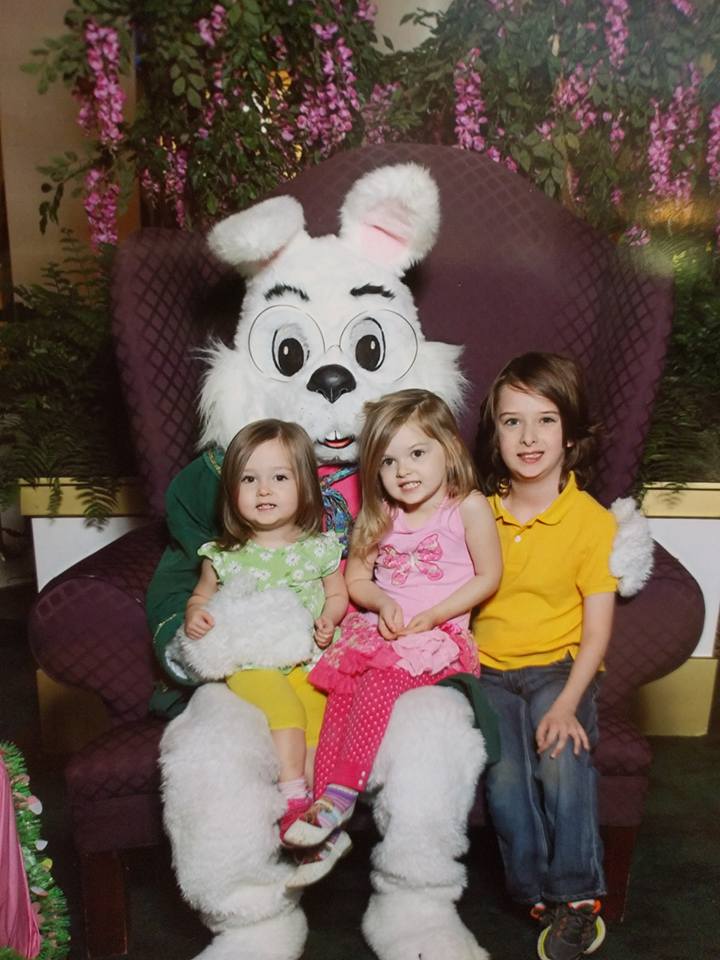
Evie, Katy, and Liam with Easter Bunny, 2016
Grandchildren visiting the Easter Bunny—from the personal library of this author, H Y Holshouser.
What about our Hogue ancestors from Scotland?  I understand that they especially were sheepherders and that their and most Scottish Easter dinners include roasted lamb!  As with us in America, chocolate is the taste of the day!  Dessert might be chocolate cake and coffee! Chocolate eggs and bunnies are ever present for both! Easter egg hunts, horse displays, and battle reenactments make for fun and festive occasions. Of course, churches throughout Scotland hold special Easter services like ours, to celebrate Christ’s rising from death and giving us the grace of salvation. We had many ministers, mainly Presbyterian, in our Hogue family.  In fact, we are told that our first immigrant from Scotland was a Covenanter.  A covenanter was one of the many Scottish people who fought against the Catholics for the right to have their own personal covenant with God. In fact, his persecution by the Catholics apparently led to his flight to America.  
 Our Kearse family from Ireland and the same ancient family, the Des Cearsais of France, how did they celebrate Easter?  The French word for Easter is Pâques. To say Happy Easter, you can say “Joyeuses Pâques or “Bonnes Pâques.”  According to my general research, Easter is an important holiday in France also. It is a religious one, and a lively, fun time with Easter egg hunts to honor the coming of Spring. Like Ireland, roast lamb is the choice for a large family meal. In Ireland, it is also an important religious holiday as well, with many traditions. Confession on Good Friday, silence on the Saturday before Easter lends to a meditative state. Eggs take center stage on Easter as they are given up for the forty days of lent by many.  Chocolate eggs, decorated eggs—all symbolizing Spring, new beginnings, renewal, and joy! 
 What about the Langhornes and others from England? Among many lovely and fun Easter traditions, Easter parades are one of the greatest. Children and adults don new clothes for good luck, and often children make elaborate paper hats to wear as they march in their local town parades!  Fun! Egg rolling, hot cross buns, Simnel cake, Morris dancing, and so much more contradicts the vision of the staid Englishmen and women!  

Our marvelous Italian ancestors and relatives add so much spirit to our family. The BottosRaffosRivaros, Costas, DeSantos,  and more, mostly originate in the coastal area of northwestern Italy, near Genoa. Italy of course, is home to the Vatican, and the place for the pilgrimage of so many Catholics on Easter.  My mother’s Italian ancestors were Catholic as well.  Mass on Good Friday in St. Peter’s Basilica is followed by the Pope leading a candlelight procession on a walk symbolizing Christ’s walk to the cross.  Our own church reenacts this walk to the cross, and we are Protestants.  
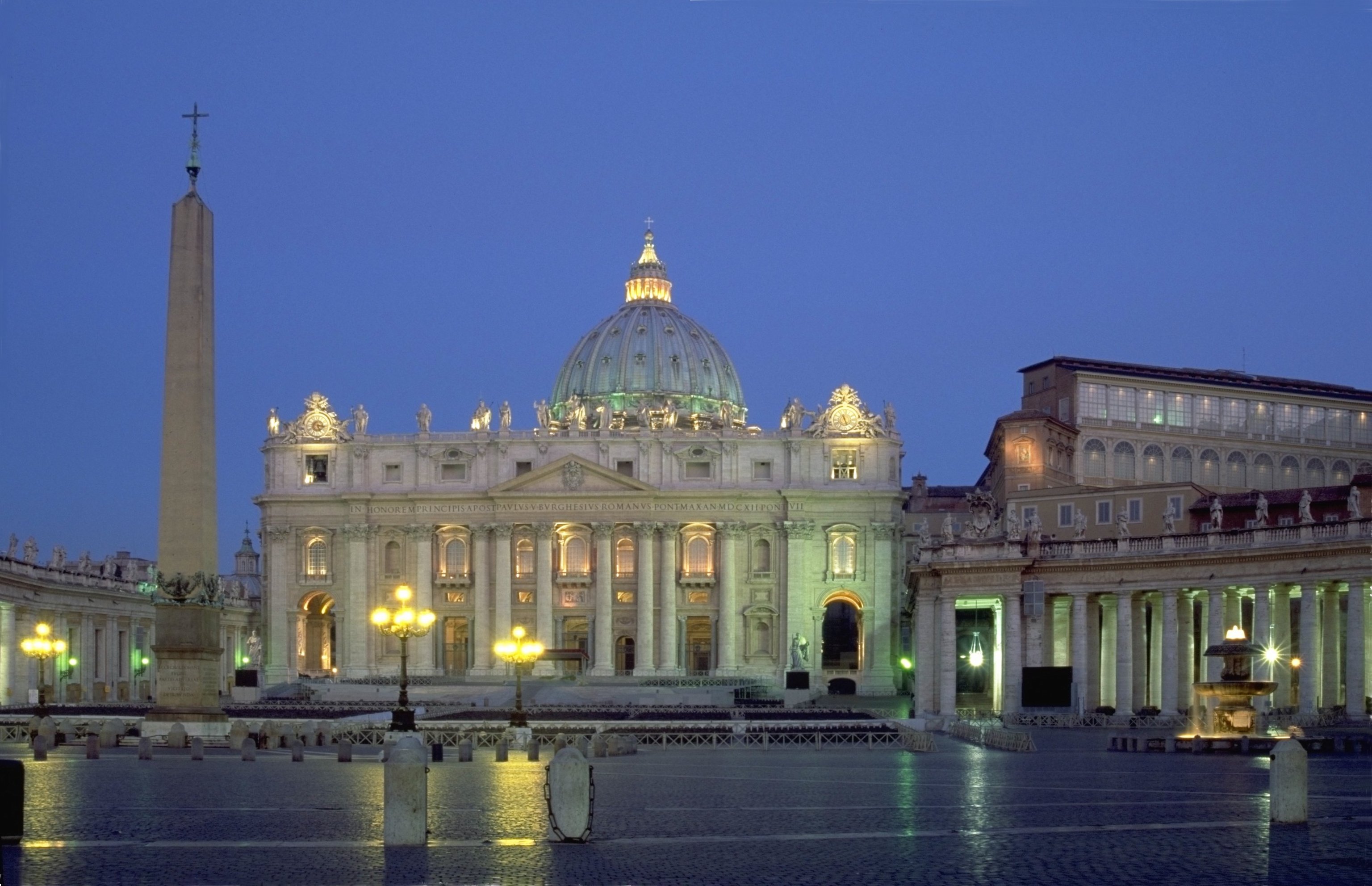
St. Peter’s Square, Vatican City, Andreas Tille – Own work, Permission details Quote of http://fam-tille.de/italien/rom/2004_030.html – Permission is granted to copy, distribute and/or modify this images under the terms of the GNU Free Documentation License, Version 1.1 or any later version published

As I understand it from relatives, northern Italian Easter feasts often feature ham, like us!  Interesting. Of course, salami is a big choice as well.  Colomba, a dove-shaped cake, made of almonds, egg whites, and sugar, is probably the most famous cake and available worldwide these days.
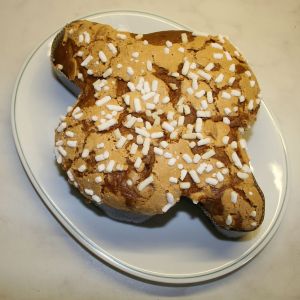
Italian bread with almonds and sugar,Colomba-Pasquale
Colomba Pasquale, An Italian Sweet bread J.P.Lon~commonswiki
What about our German JungblutsYoungbloods? And my husband’s Haulzhausen—Holshouser family?  According to a wonderful article from DW –Deutsche Welle —  http://www.dw.com/en/german-easter-traditions/a-1520904 — the Germans of course, also celebrate a religious holiday like most Christians.  
Although mainly a Christian holiday commemorating the crucifixion and resurrection of Jesus, Easter also marks the beginning of spring. The Germans, of course, have a whole range of customs and traditions to celebrate the change of seasons in proper fashion. 
A time for eggs and bunnies 
Eggs and bunnies are two of the oldest symbols of Easter in Germany and every spring shops boom with eggs and bunnies made of chocolate, cardboard or flowers in different sizes and wrappings. 
The tradition for using eggs and bunnies for Easter originates from pagan worshipping where they were symbols of fertility and new birth and traditionally used for celebrations of the coming of the spring. 
The Germans have a number of egg games which the children play over the holidays. One tradition is to blow eggs and paint them in multiple colours and patterns on Good Friday. The eggs are then put in a basket for the Easter bunny — Osterhase— to hide around the house on the night leading up to Easter Sunday. On the morning of Easter Sunday, the children go hunting for the eggs and often find that the Easter bunny has also left chocolate eggs and Easter presents for them to find. 
It is also a custom that friends exchange the painted eggs as gifts or that young people in love paint eggs for their sweetheart.” Now that is a different tradition, which I find so special and romantic!   
For the Netherlands and our Van Vreeland, Van Swol, Voorhees, and Banta families, what was Easter like for them? According to many articles, they celebrate much the way we do…. or we celebrate much the way they do!  One of our favorite meals is a festive brunch and apparently it is theirs as well:  eggs, cheese, ham, rolls…and did I say eggs?  The Dutch also take great pride in providing the thousands of tulips to decorate St. Peter’s in Rome for the Pope’s Easter service.  Wow!  Back home, they are also known for their beautiful painted eggs.  However, they do not have the Easter bunny, but the “Paashaas, the Easter hare!   
Our ancestors represent many more countries and traditions from around the world, but as you and I can readily see, we are more alike than different.  This Easter, as I pray, and as I play, I will have a keener sense of connectedness due to my genealogical research, and our worldwide collaboration.   
Until we meet again, Helen Youngblood Holshouser 


Saturday, 15 August 2015

My earliest Australian ancestors

We’re halfway through National Family History Month for genealogists researching in Australia and New Zealand. I’m based in the UK, so the only way I can join in is online. But that’s OK – we’re Worldwide Genealogists here!

Tree growing over an old brick wall, Arminghall, © Copyright Evelyn Simak and licensed for reuse under the Creative Commons Licence.
© Evelyn Simak and licensed for reuse under this Creative Commons Licence.
So I decided to do something I haven’t yet done. It's about time! 

I’m going to mark NFHM by putting together a list of the first of each branch of my ancestors who arrived in Australia. They all came from the British Isles. Well, as far as I know – there are brick walls in my tree, of course. In fact sometimes I think my family tree grows out of an old brick wall, like the one in this photo.

I’m going to do this by starting with the earliest, first on my grandfather’s side, then on my grandmother’s.

Grandfather’s side:

Nicholas DELANEY (Ahnentafel no 48), arrived 30.10.1802 on Atlas II. Convict and Irish rebel, from Carnew, Co Wicklow in Ireland. Married to:
Elizabeth BAYLY (A49), arrived 3.4.1807 on Brothers. Came free. May have been from Kent. A brick wall. Their son Thomas married Lucy, the daughter of:
John SIMPSON (A50), arrived 10.1.1818 on Ocean II. Convict, born in Yarm, Yorkshire, arrested in Derbyshire. A tailor. Married/lived as married with:
Sarah MARSHALL (A51), arrived 14.1.1818 on Friendship II. Convict, from Salford or Manchester.

(Thomas) Robert Sandon WILSON (A26), called ‘the Man of Mystery’ because we know nothing much about him. English, possibly a bigamist. Certainly a brick wall. Married to:
Sarah Emma HENLEY (or DICKS?) (A27). Arrived before 1854. From Sussex. Their daughter Mary Maude married Lucy and Thomas’s son Tom.

Grandmother’s side:

James Thomas RICHARDS (A30), arrived 12.12.1835 on Royal Sovereign. Convict, from Deptford, Kent. A Thames waterman. Married to:
Rebecca HARRINGTON (A31), arrived between 1857 and 1873. Probably assisted immigrant (meaning that she didn’t pay for her own voyage). May have come with her father, Thomas Harrington (A62), a dock labourer, or he may’ve joined her later with his wife Julia (A63), nee Gamin, or Cannell, or even Gemmell, from somewhere in Ireland. Yes, Julia’s a brick wall. Rebecca and Thomas were from Hackney in East London.
James and Rebecca’s daughter Eleanor Ann Edith (Minnie) married Thomas Henry, the son of:

John WINTER (A28), arrived 9.2.1857 on Parsee. Assisted immigrant from Tebay, Westmorland (Tebay’s now best known as a service station on the M6 motorway). Married to:
Ann GRAHAM (A29), arrived 23.7.1857 on Alfred. Assisted immigrant from Butterknowle, Co Durham. She came with her parents:
Thomas Rume, Rumneys or Ramneys GRAHAM (A58), a quarryman born in Gaitsgill, Cumberland, and his wife:
Elizabeth BELL (A59), from Bishop Middleham, Co Durham.

Convicts


Looking back over my earliest Australians, I can see three big brick walls. Interestingly, none of them are convicts. OK, so three of my naughty ancestors have so far resisted my attempts to track down their parents, but at least because the legal system kept tracks on them they’re fairly well documented. That’s one reason I like having convict ancestors – they leave traces. And they’re cool.

Two of my branches are from Ireland and the rest are from what’s now London or from the north of England. A nice mixed bag. No Scots yet – but who knows where those Grahams came from before they turned up in Cumberland? All my Welsh ancestors are on the other side of my family.

As far as I know. And that’s one of the reasons I love genealogy. There’s always something new to discover. It’s a bit like being a time-travelling sleuth. I’ve got quite fond of some of them. Others I could spank for being so secretive. But in the end, they give me hours of fun, days of frustration, and a lifetime’s work. 

If you recognise any of the names or other information - places, ships and so on - that I've mentioned, please get in touch. I'd love to hear from you.

NFHM 2015 logo
Thanks to everyone involved in NFHM, get well soon Shauna Hicks, and a big G'day to my Aussie geniemates!


Saturday, 7 March 2015

Exploring British Records from America


John Peter Bawden Roberts and his wife,
Emma Frances Warren, and children, Hilda,
Horace and Bertha (the baby) circa 1898
Leeds, Yorkshire, England
(My great grandparents, and my grandmother (Bertha) )

A few weeks ago in the US Ancestry.com offered a weekend of free access to the UK record collection.  The last time I noticed one of these offers we were on vacation, so I couldn't take advantage.  This time we were snowed in for a long duration blizzard, so I had lots of time to peruse the collection.

Note: If it weren't for social media, I wouldn't have been notified about this sale.  Many of my genealogist friends were sharing the post about free access to the UK records on Facebook and Twitter or on their blogs.  There was probably an email from Ancestry, but I have a tendency to clear out my e-mail box of advertising without reading any of the unsolicited offers.  I almost lost out on this deal!

My grandmother was born on 30 September 1897 in Leeds, Yorkshire, England.  She, her parents and siblings came to America in 1915 via Ellis Island, traveling in steerage on board the SS Orduna from Liverpool.  My cousin and I had already found the passenger lists, which listed the entire family, and my grandmother as a 21 years old.  I remember her stories, and her brother and sister’s stories (my great Auntie Hilda and great Uncle Horace).  

And so I began my search for my grandmother’s family roots via the vital records and UK census records on Ancestry.  I had used this collection a few years back and had a copy my grandmother’s family listed in the 1901 British Census.   Now I could look for them in the 1911 census, and perhaps work backwards in time to previous generations. .    The British census is conducted on years ending in “one”, and online the records are available from 1841 – 1911.  This would be the last British census for the Roberts family before leaving for America in 1915.

The Ancestry collection was very easy to use, and even though I was working with very commonplace surnames I was able to pinpoint the records easily.  


Above is the 1911 census of the Robert Family in Leeds, Yorkshire.  I was excited to see that it was the original census form with my great grandfather's signature.  I was not excited to see that my 13 year old grandmother, Bertha, was missing.  However, I remembered that she had been "in service" as a undernurse in a vicarage since she was age 12, so by searching for her own name (I had previously searched under her father's name) I found her enumerated in the vicar's household.  See below, Bertha is listed on line 11 as a servant:


Previous to this weekend, my only copy of my great grandparent's marriage record was a photocopy given to me by an uncle.  He only had access to an 8" x 12" photo copying machine, so I had never seen the entire certificate before, just a partial view. This was a terrific find for me!


This image has two marriage records, my great grand parents are on the top:

"1890 Marriage solemnized at Sheepscar in the Parish of St. Clements in the County of Leeds
No. 401  
When married:  May 24th, 1890
Name and Surname:  John Peter Bawden Roberts  and Emma Frances Warren
Age:  25 and 25
Condition:  Bachelor and Spinster
Rank or Profession:  Engine Tender
Residence at the time of marriage:  1 Henbury Terrace Bistol Street and 45 Benson Street
Father's Name and Surname:   Samuel Roberts and Oben Warren
Rank or Profession of Father:   Engine Tender and Miller
Married in the Parish Church according to the Rites and Ceremonies of the Established Church
by --------- or after Banns by me, Henry A. Prem
This Marriage was solemnized between us:
John P. B. Roberts and Emma F. Warren  
in the Presence of us
Arthur Roberts and Ellen Roberts"  [John's siblings]

Again, I was thrilled to see that these were my great grandparent's signatures! 

Here is the 1853 marriage of Samuel Roberts and Mary Anne Stott, parents of John Peter Bawden Roberts and my 2nd great grandparents.  This image is slightly cut off, but you can see the dates, information and signatures, including the names of my 3rd great grandfathers:


I was not able to trace the Roberts family further back in time, nor the Warren family, but I had very good luck with the Stott family.  I found the marriage records for Mary Anne Stott's parents, grand parents and great grandparents.  This is the 1796 marriage of Jonathan Stott and Mary Brunyet, my 4th great grandparents, married in Leeds, Yorkshire. 


"No. 386   Jonathan Stott sawyer of this parish and Mary Brunyet of this parish spinster were married in this church by Banns this twenty ninth Day of September in the Year One Thousand Seven Hundred and ninety six by me Edward Watson, clerk.  
This marriage was solemnized between us Jonathan Stott and Marey Brunyet
in the presence of John Hardaker and Tho. Atkinsone"

With all the information I gleaned from the UK collection (mainly census and marriage records) I was able to start a pedigree chart for my grandmother Bertha Roberts. These are my roots in Yorkshire, England.  See below:


This was very exciting to me.  I have an audio tape made in the 1970s of my uncle interviewing my grandmother about her family in England.  Grammy Bertha had forgotten a lot of names, and also had the names of some of her grandparents incorrect.  These documents fill in the holes and extend her family back to the late 1700s!

After learning these new ancestor's names I joined a few Facebook groups on UK and Yorkshire genealogy.  I immediately had some help from genealogists living in some of the towns in Yorkshire where my grandmothers ancestors lived - Leeds, Dewsbury and Pontefract.  I also learned about a website called Curious Fox.  If you have UK ancestry, it is worth checking out with a free registration http://www.curiousfox.com/    If you like it, subscriptions are available.  

Wednesday, 31 December 2014

Genealogy 2014 - 2015: Successes and Goals

Mary Peacock nee Hugill
Mary Peacock (nee Hugill)
After today, someone else is taking over my '31st-of-the-month' time-slot. My previous posts were about sources and strategies for family history worldwide. Today I want to reflect upon the highlights of 2014 and my goals for 2015.

In 2014, unforeseen events (ranging from a back injury to moving house) meant that there were many disruptions to my usual genealogical activities. A health scare reminded me that spending quality time with family and friends is more important than being an educator, a genealogy professional or a blogger!

Genealogical highlights of 2014:   (links open in a new window)
  1. Collaboration via CuriousFox.  I have been swapping information with a distant relative who contacted me via CuriousFox. She sent me certificates and other information for our PEACOCK and HUGILL ancestors from Yorkshire, and confirmed that my Mary PEACOCK (nee HUGILL) died 17 Feb 1900 at Stockton-on-Tees, Durham, England.

  2. New data via National Probate Calendar.  I found many relevant entries in the National Probate Calendar (Index of Wills and Administrations, England and Wales 1858-1966). For some, I've already ordered copies of the wills. Others are on my wish list, but in the meantime they gave me locations, death dates, occupations and relationship details that helped with research in other sources.

  3. New data via FindMyPast.  Many record sets released on FindMyPast during 2014 revealed new information for my family history. For example:
    • 'British in India' collection has 5 pension fund documents for Mary PORTER (a widow in England) with names and exact birth dates (between 1811 and 1821) for her five children.

    • Yorkshire collection has records such as parish registers and Bishop's Transcripts for my many family lines in that county.

    • Trade Union records refer to my John William CORDUEX in registers of two different railway unions.

    • New South Wales will books 1800-1952 in which I have already found 13 records for my family (including some people who lived outside NSW). I expect to find more when I do a systematic search for all names in my family tree.

  4. Newspaper notices.  In the York Herald, Yorkshire Gazette and Sheffield Daily Telegraph (digitised and available via FindMyPast and the British Newspaper Archive) I found obituaries and other items for some of my families including HUDSON of Barton-le-Willows and BATTY of Bolton-upon-Dearne.

  5. HUDSON family at Crows Nest.  I added another generation to the family tree after finding clues in Queensland funeral records and cemetery burial registers.

My genealogy goals for 2015:

  • Change my priorities.  Spend more time on my own research and less time on answering emails from people who expect everything to be free!

  • Share my knowledge more efficiently.  (1) Write more mini-guides.  (2) Use my Twitter page more often (because it is a quick way to share genealogy tips and links).

  • Organise my records.  Before scanning or taking digital photos of all my family history material, I need to write down a 'style guide' for naming and filing the images. I will use a modification of the system described by Nancy Loe (a.k.a. 'Sassy Jane') in Cataloging Digital Family Photographs and Records and Organizing Genealogy Research Using Archival Principles. My paper filing system has always been source-based, so Louis Kessler's idea of a source-based incremental fix will suit me perfectly.

  • Use DNA for genealogy.  I need to become more familiar with various tools for analysing DNA results, and to persuade more of my distant cousins to do the FamilyTreeDNA Family Finder test for autosomal DNA and the X-chromosome.

  • Plan my genealogy cruise presentations.  Prepare my talks well in advance of Unlock the Past's 'Barrier Reef' cruise in March 2016. (You can get AUD$40 discount by quoting the code UTPC-WEB06 when you book any Unlock the Past cruise.)

  • Research the HUGILL family.  My top priority is to find parents' names for Mary HUGILL (born c.1813, Hull, Yorkshire) and confirm that George HUGILL (born Hull, later of Stockton-on-Tees) was her brother. (Perhaps the wills and probate documents that I've ordered will help.)

  • Write about my ancestors.  Many of those posts (which I will put in Jottings, Journeys and Genealogy) will be quite brief initially, but I'll update them as my research progresses. Hopefully people who read them will contact me and help fill the gaps in my knowledge.

Someone else is now taking over my '31st-of-the-month' time-slot, but watch for additions to my own blogs, which include UK / Australia GenealogyGenealogy LeftoversQueensland Genealogy;  and Jottings, Journeys and Genealogy.
~ ~
You might also like:
(This post first appeared on http://worldwidegenealogy.blogspot.com/2014/12/genealogy-2014-2015-successes-and-goals.html.)

Tuesday, 7 October 2014

Bringing Betty out of the Shadows - A Research Review

The further we go back in family history, the more shadowy  our ancestors can appear - especially on the female side, where we don't usually have the benefit of a photograph or portrait,  or knowledge of an occupation to define the person. 

I have three fellow WG bloggers to thank for the inspiration for this post  - Kate's recent  article  about female ancestors Hidden from History.  Cassmob (Pauleen's) Three Rs of Genealogy Research (Revisit, Record,  Revise)  and Tina's  post on Finding Family Stories  

They prompted me to look afresh  at my research  on  my great, great, great grandmother  Elizabeth Danson, nee Brown,  who was little more than a name to me  as the wife of Henry Danson, yeoman farmer.

I had never written a profile on Elizabeth, so I set out to see how I could bring her more to the fore of my family history  by  revisiting  the records. 

ELIZABETH AS A DAUGHTER  
My first information on Elizabeth came in her Marriage Bond [below]  which gave her age - 20, so born c.1766 and her father's name as William. 
 
The English Christening Records on Ancestry include an Elizabeth Brown at Poulton-le-Fylde, Lancashire born 27th June 1766 - father Wiliam, but no mother's name cited.  A search for a William Brown marriage in Poulton c.1760 traced  only one possible entry - a union with Ellen Clegg 17th November  1751 - this could be Elizabeth's mother, given that the witness to her marriage was a Nelly Clegg - Nelly being the diminutive of Ellen. 


ELIZABETH AS A WIFE   

Elizabeth and Henry  married 29th October 1786 at St.Chad's Church, Poulton-le-Fykde Lancashire, as recorded in the Poulton Parish Register, with one of the  witnesses Nelly Brown - Elizabeth's sister perhaps?

I was  lucky enough to trace a marriage bond at Lancashire Record Office
This was a promise between two people, normally the groom and a friend or relative (in this case Henry's brother-in-law John Bryning) that,  if the marriage proved invalid in the eye of the law,  they would pay a penalty to the church of a substantial sum of money - in this case £200.

The marriage bond reads: 

Know all men by these present that we, Henry Danson and John Brining of the parish of Poulton, County of Lancashire, are held and firmly bound by….two hundred pounds of good and lawful money of Great Britain, sealed with our seals, dated twenty eighth day of October in the year of our Lord one thousand seven hundred and eighty six….there shall not hereafter appear any lawful let of impediment by reason of precontract, consanguinity, affinity or any just cause but that Henry Danson, husbandman aged 19 years and Elizabeth Brown….aged 20 years, with the consent of John Danson and William Brown, their fathers…….” 
    

So the marriage bond was dated a day before the actual wedding.  Marriage licences could be obtained as an alternative to having the banns read.  They enabled marriages to take place at any time and were useful  if the marriage had to take place quickly or be kept quiet for some reason.   

Henry and Elizabet's first born child, daughter Margaret was born 7 months after the wedding - was that the reason for a hasty ceremony? 

Obtaining the marriage licence was always a more expensive way of ensuring the legality of a marriage and never as popular as Banns.  That Henry could afford this form   seems to suggest that the family was relatively well off.  
 
ELIZABETH AS A MOTHER
The young Elizabeth went on to have  seven children between 1787 and 1811 - Margaret, John, William, George, Peter, Nelly, Henry, and James - with her two youngest sons born  when  she was in her 40's.  Their Christian names had family significance, with Margaret, John and William named after grandparents, Peter after Henry' (senior)'s   grandfather and Nelly (Ellen)  a name in both the Danson and Brown families. 

A sideline on family life was revealed in the Family Bible  where a page headed "Be Good to the Poor" had been scribbled on by various member of the fmaily, criss crossed on the page in what  can only be described as scribbles.   Elizabeth's contribution can just be made out  in the middle of the section here, with Henry's above it left. 


The entries cite the family living at Trap Farm, Carleton and signatures include that of "Ellie Simpson, Carleton, Trap, Servant, 1830".  The fact that servant Ellie   was included in the activity  somehow casts  a lovely light on the household informality - though the fact they used the Bible for these scribbles  does raise other issues!   

But family life was not without tragedy.  In the space of 12 years (1827-1839), Elizabeth saw the loss of her husband and three children.
  • Eldest child Margaret married before her 17th birthday on 28 April 1804  (and before the birth of her two youngest brothers);   her husband  Roger Ryding, a bricksetter,    Margaret was dead by the time of her father's will (1833)  and death in 1839, with her five children receiving legacies. 
     
  •  First born son John died aged 46 in 1836, with no marriage traced.  However at the age of 21 he was served with an affiliation order ordering him to contribute  to the upkeep of his "said bastard child" (a forerunner of the current Child Support Ageny!)   The order, traced at  Lancashire Record Office, notes: 
    “Ann Butler, single woman, was upon the 27th day of August last, delivered of a female bastard child in the said township of Marton…and that John Danson, husbandman of Carleton did begot the said bastard on her body and is the father of the same....... Thereupon, we order… for the better relief of the said township…and the sustenance and relief of the said bastard child…John Danson pay unto the churchwardens and Overseers of the Poor…the sum of One Pound Eighteen Shillings for and towards the charges and expenses incident to the birth…further sum of four shillings towards the cost of apprehending and securing the said John Danson….the sum of Two Shillings weekly…towards the keeping, sustenance and maintenance of the said bastard child”.
  • James, the youngest son, died at the age of 15, with an inquest held into his death on 11th January 1827.  Unfortunately the only record traced on this tragedy was in the  Quarter Session Records at Lancashire Record Office, which noted that the coroner claimed £1 expenses and 16s.6d travelling costs for the post mortem.
  • Henry - second youngest son (and my great great grandfather), was born 20 years after his parent's marriage and was to continue the Danson name down the generations.
     
  • Peter never married,  making his home with his brother Henry's household until his death in 1866. 
     
  • Second son William died at the age of 41 in 1833. as recorded in Poulton Parish Register.
     
  • No further information has been traced on George and Nelly. 

ELIZABETH AS A WIDOW 
Elizabeth was left a widow on  21 October 1839 and a copy of Henry's  will dated 26 August 1833 was obtained from Lancashire Record Office.It noted:

" I give and bequeath unto my dear wife Betty all my household goods, plate, china, linen and household furniture for and during her natural life….I also bequeath during her natural life one clear annuity of thirty pounds".

ELIZABETH AS A FRIEND 
I came across this short but  beautiful testimony to Elizabeth  almost by chance during a  quite casual browslng of  British Newspapers Online 1710-1953 on the website Find My Past. -
"Blackburn Standard Wednesday 20 May 1840 
Betty, widow of the late Mr. Henry Danson, yeoman, Trap Estate, Carleton, near Poulton-le-Fylde. She was much esteemed, and will be greatly regretted by a large circle of acquaintances".
The Blackburn Standard is not a newspaper I would have every thought of looking at for events in Poulton, so it was also a lesson to widen  a search beyond the obvious.  

But that little piece somehow brought Elizabeth (or the more familiar Betty)  alive for me, as no other record had done. 

Postscript:  Elizabeth (Betty) Danson, nee Brown died  seven months after her husband Henry. buried  on 13th May 1840 at the age of 73, predeceased by at least four of her seven children - Margaret, John, William and James. 


Trap Farm, Carleton - Elizabeth's married home c.1827 at the time of the scribbles in the family bible [see above]. Her sons Henry and Peter were living there with Henry's large family in the 1841 and 1851 censuses.  I took this photograph c.1998 and the property has undergone major refurbishment since them.


St. Chad's Church, Poulton-le-Fylde, Lancashire where Elizabeth was baptized,    married and buried.  Many gravestones, including the Danson ones,  were unfortunately   removed many years ago. 


By bringing together all the information on Elizabeth in this way, I felt I had a much clearer picture of my great, great, great, grandmother - Elizabeth.  
She has emerged from the shadows. 


Copyright © 2014 · Susan Donaldson.  All Rights Reserved