Showing posts with label Historical information.. Show all posts

Thursday, 29 May 2014

Bankruptcy in England in the early nineteenth century

Shrewsbury Prison main entrance
It seems that my fourth great grandfather, William Pulteney Dana (1776-1861), went bankrupt and was gaoled for it. Notices in the London Gazette include insolvency and I found some concerning William Dana that give some of the story of his financial experience. The Gazette commenced in 1665 and is now digitised and searchable. 

(On their own Petitions.)
Recorded in The Gazette (London Gazette), Publication date: 18 August 1840 Issue: 19885 Pages: 1921-2 retrieved from https://www.thegazette.co.uk/London/issue/19885/page/1922
A few months later he was out of gaol and living in lodgings. We learn that as well as being on half-pay from the army, Dana was running a printing business.


Recorded in The Gazette (London Gazette), Publication date: 13 November 1840 Issue: 19913 Pages: 2558-9 retrieved from https://www.thegazette.co.uk/London/issue/19913/page/2558
Some months later his case was adjourned.


Recorded in The Gazette (London Gazette), Publication date: 5 March 1841 Issue: 19958 Pages: 627-8retrieved from https://www.thegazette.co.uk/London/issue/19958/page/628
I have found no further mentions of the case. I assume Dana settled his debts. At the time of the 1851 and 1861 censuses he was living with his married daughter and her husband in a terrace house in Shrewsbury. It would seem his finances did not recover.  It was quite different to living in Roughton Hall.

Bankruptcy featured a lot in Victorian literature. Charles Dickens's character of Mr Micawber springs to mind. In 1824 Charles Dickens's father, John Dickens, was imprisoned for debt under the Insolvent Debtors Act of 1813. It wasn't until 1869 that debtors no longer went to prison. For a brief history of insolvency law in England the Wikipedia article at http://en.wikipedia.org/wiki/United_Kingdom_insolvency_law#History is useful. However I found the chapter on the subject of Bankruptcy, Debt and Money lending in What Jane Austen ate and Charles Dickens knew : fascinating facts of daily life in the nineteenth century by Daniel Poole very readable and informative.

Pool, Daniel What Jane Austen ate and Charles Dickens knew : fascinating facts of daily life in the nineteenth century. Robinson, London, 1998.

Earlier this month, Susan Donaldson wrote about a book on Victorian life and this is another but containing many references to novels of the era. Bankruptcy and debt featured in many novels and this presumably was based on the experiences of living in the era. My forebear was one of those who experienced this misery.

Anne Young blogging at http://ayfamilyhistory.blogspot.com.au

Thursday, 8 May 2014

Everyday Llife of our Victorian Ancestors

I've been trying to catch up after the mammoth daily April A-Z Challenge - so just a short piece from me this month on a book that is well worth reading as background material for writing your family history narratives.

Do you want to find out what life was really like for your ancestors living  in Victorian Britain?    

17321139 I recommend "How to be a Victorian" by Ruth Goodman, published by the Penguin Group in 2013.

It is  a fascinating read that gives us an insight  into how Victorians lived their daily lives, whether they be rich of poor, town or country based.  

Material has been gathered from contemporary accounts,  letters, diaries, newspapers and magazines.   

The author takes an innovative approach by following a typical routine  day in all its detail  for both men and women;  from the point of waking up - by a servant in a grand house or a"knocker upper" poking a stick at the window of a miner or mill worker's home.

Of added interest are the descriptions by the  author of her attempts to experience some aspects  of Victorian life  - such as doing the laundry, trying out Victorian recipes, heating the home or  struggling into the multi layers of dress.

We often can gather information quite easily on the life of the upper classes. but the emphasis here is very much on the day to day lives  of ordinary people.  

Chapters look at 
  • Waking Up
  • Getting Dressed 
  • A Trip to the Privy
  • Personal Grooming
  • Breakfast and Midday Meal
  • A typical  working day -  for both men & women 
  • School
  • Leisure Time
  • The Evening Meal 
  • Before Bed
  • Behind the Bedroom Door 
Just one slight niggle - there is hardly anything on the the part church played in people's lives,    which I found surprising, given our perception of the Victorian preoccupation with religions observances.

This is no dry historical textbook, but an engrossing read, (or a book to dip into), to experience what life was really like for our ancestors.   

RECOMMENDED! 

Monday, 17 March 2014

My Favorite Media "Old Newspapers"

If I were to say where some of my most exciting discoveries have come from, I would have to say Old Newspapers.  
This last year, I made the discovery of the death of my Hero's great great grandmother that I had almost given up on.  A sweet lady had put her obit up on FindaGrave when she discovered there wasn't a memorial for her. She gave me the paper it was in, but there is only a transcription on Nebraska USGenWeb for the Columbia, Nebraska newspaper.  When searching to read the transcription, I found there was also a small obit for a child that the Heimbach family had lost when it was 18 months old. We would never have known this baby existed if it had not been for the small newspaper article.  

I also was trying to find what happened to my great great grandfather's first child. In an old newspaper article that told of him leaving Georgia, there was a mention of his wife dying and that he still had a new boy that he was very fond of.  


When he arrived in Texas, he met a lovely lady, and they were married. All the children I found on the censuses were her's.  I ask my dad about his great grandfather, and he said all he knew was that his great grandfather Gildon had lost his family when he crossed the Mississippi. His thought had been, that they had drowned or were killed.  It was a time when many were dying of Yellow Fever in Georgia, and this was apparently the cause of Frances Massey Gildon's death.  Other family members said the child was left with one of  Charles's sisters.  I could not find any evidence of this.  I turned to old newspapers again.  I found the article of Frances's death, but kept searching.  I found what I thought was another repeat of her death, but on closer study, found it was the son's death at 9 months of age. He was also named Francis and thus that was how I almost missed finding the truth.  

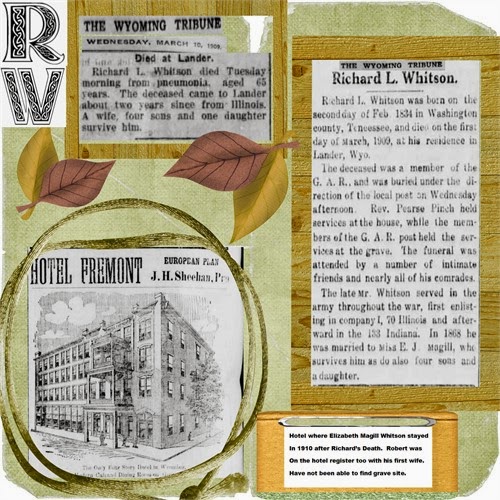
Another great great grandfather was said to have died in a gun fight. I searched books and gun fights to no avail.  Then, Wyoming opened up their old newspapers online in the Wyoming Newspaper Project. There I found in two different newspapers his obit and who handled his death. He died of pneumonia in his home. Nothing exciting there, except the evidence of truth. 

 These are wonderful finds, but I have also been able to trace the epidemics that took the lives of half of the Hero's great great grandparent's families in Chicago in the 1910s.  The Yellow Fever Epidemics of Georgia that had high reports of deaths in newspapers up as far as New York. The coverage of the fire in Savannah in 1820 that was documented all the way to Connecticut newspapers, and my ancestor's losses in the fire. I found and followed my mother's father's travels to and from the Philippines in the Philippines War. There was the discovered brother of one of the Hero's ancestors, who had died in the Mexican War, with not a clue as to who his parents were. Now I have a the day  that they both were the first volunteers in their town to step up to go fight in the Mexican War in blazing detail.

This is just a smidgen of the excitement of the browsing through old newspapers I have had the fun of doing. Chronicling America has a great sampling of old Newspapers. GenealogyBank.com has helped a lot. This is just two sites I have used. and I have also ordered old films, and gone to the libraries to search the films.  Ancestor Hunt offers information on many resources for old newspapers, and many State Archives have old newspapers online. I have only tried one in Great Britain, but I am sure there are serendipitous information to be had there too, just not quite over there yet.

Hope you have enjoyed this and if you haven't played a lot with old newspapers in your research, give it a try.