Showing posts with label Diane Hewson. Show all posts

Sunday, 20 March 2016

What is Oral History?

Firstly, I must apologise for the tardiness of my post this month.  We have moved house recently and unfortunately have just been reconnected to the internet.  Amazing how we come to rely on that constant connection with the outside digital world.  

Continuing on from my last blog "Family Oral History Project - A Kick in the Butt, today's post looks at "What is Oral History?"

Our culture, traditions and history have been passed down through generation after generation by the spoken word or "oral history".  The expression "oral history" covers a wide span of information and formal story collecting, for example: stories carried down through family generations, history of cultural groups that is learned by culturally appointed "story tellers", projects designed by oral historians to enable us to have an understanding of significant people within our community, cultural groups and the stories of everyday people and their experiences.

The evolution of oral history has seen a significant acceleration over the past 70 years and is now recognised by most, as an integral part of recording and collecting the history and stories of our past. The last couple of decades have seen many changes.  These include: innovative improvements in recording technology and legislative changes that have been initiated as a result of deeper consideration of the ethical issues and accountability of the interviewer and the rights of the person being interviewed. 

Put simply, "oral history" is the formal collection of unique personal memories and stories through the recording of a conversation between two people.  These stories are then preserved for current and future generations.  Originally formal oral history recording was used to obtain an insight from influential people, such as politicians, prominent community leaders and famous artist.  However, it is now recognised that we can learn and gain a clear understanding about past historical events and periods from ordinary people as well.  Their stories add colour, and a realistic and more in depth understanding of past times.

Traditional researchers questioned the value of oral history and the reliability of memor. However we can now see an evolution in their approach to research with a recognition that oral history gives voice to the status and history of the common people and brings history to the community.  It provides an understanding and awareness between generations and social classes.  In short, it provides a more descriptive and vivid picture of those who went before us.  Oral history supplements traditional historical research, by widening and opening up leads to new historical information and understanding.

Recording of oral history is a two-way process, between the person/persons being interviewed and the interviewer.  The "recorded session" will provide the interviewer/researcher with an insight into that person or group's past experiences and how they remember them in the present.  In in order for this to be a valuable exercise careful planning and consideration must be taken.

It is important to note that two people will have different recollections about past events, and that all these memories are a valid and integral part of piecing together the history of an event. It should also be noted that over time a person's recollections or "memories" evolve as they mature and that their life experiences give different meaning and understanding of past events.   

It is with this exploration and a better understanding of "oral history" I move on to the next stage of preparing for the interview. Stay posted for the next installment. 

Saturday, 9 January 2016

Family Oral History Project - Kick in the Butt

Happy New Year to All! Yes it is time to reflect on the year past and plan for the coming year!

Reflection:


It is hard to believe that it is two years since my first post on the Worldwide Genealogy - A Genealogy Collaboration Blog. My involvement with this project has encouraged me to broaden my horizons, to look at my research from a different perspective and to delve into areas that were once foreign to me.


Each blog has pushed me to find something new and interesting to share with our members and readers.  I must admit sometimes this has been a little stressful due to other commitments, however, I always feel a sense of accomplishment once the blog is posted. Of course the bonus is the supportive and informative feedback that I have received from the group and readers. Last year, due to moving house, a family reunion and family illness I missed a couple of blogs, so this year I would like to plan ahead and develop a theme for my 2016 blogs.  

Plan: Development of an Oral History Plan for our Family History

We have all wished we had taken more time to sit and talk to our elders, to capture their stories, experiences and perspectives on their lives and the times they lived in.  Often, we leave this until it is to late and the memories are lost for ever.

Over recent months when I spending time with my mother, I have noticed that she is starting to lose and confuse her memories.  Unfortunately, she had a fall on New Year's Eve while visiting me and has been in hospital for a week.  Each time I visit her, I find she is spending a lot of time recalling memories from her childhood and teenage years.  I am taking this as a sign, or a kick in the "butt" to put a concerted effort into starting to record an oral history for our family.

With this in mind, I started to do a little research on Oral History Collection.  Another Reality Check!

I realised if I was going to do this properly, it wasn't just a matter of sitting down with family members, sticking a microphone in front of them and asking a few questions.  There are so many things to consider.

For example:
can of worms
  • What equipment will I use?
  • Recording of interviews? - should they be audio, by video or both?
  • How will I store/archive the digital files
  • How do I approach the family members I wish to interview?
  • How do I make them feel comfortable with being interviewed?
  • What questions should I ask?
  • What are my ethical responsibilities?
  • What new and exciting apps/programs are now available for recording and storage of oral histories?
You would have to agree I have opened a "can of worms" and that these questions cannot be covered adequately in the space of one blog, so I have decided to follow a theme for my 2016 blogs on Worldwide Genealogy - A Genealogy Collaboration Blog, with each post for this year looking at different aspects of putting together our family "Oral History Project".  

Watch this space! I am looking forward to sharing my learning experience with you all and look forward to your feedback and advice 

Tuesday, 10 November 2015

Family Reunion - a reflection

Display of Memorabilia
In one of my early posts for 2015, I wrote about our plans to organise a "Family Gathering" on the long weekend in October.  In this post "Sharing and Building Memories through a Family Reunion" I outlined some of the points we would have to consider if our family reunion was going to be successful.  We were "newbies" and I really appreciated the feedback, suggestions and comments that readers gave us on organising a family tree reunion 

Our "family gathering" was born following a discussion among cousins at the wake of one of our elderly relatives.  We thought it would be great to organise a family reunion that would give our families, children and grandchildren the opportunity to meet and spend a "fun" day together. It was decided an ideal venue would be one of the pavilions at the Show Ground at Milton, a small diary town on the south coast of NSW.  Milton was our grandparents home town and they were enthusiastic supporters of the local  show.  Nanna, with her flower arrangements, jams and cooking, and Pop was quite an accomplished axeman in his younger days, competing on a national level and winning a number of Wood-chopping events at the Sydney Royal Easter Show.  In their later years they continue their involvement as members of the show committee.

It was our aim to keep the "gathering" as simple and low key as possible, providing the opportunity for anyone connected with our family to come along and share stories, photos and memorabilia.  My cousins and I set up a small working group and assigned different tasks to each member to spread the load.  We kept in touch on a regular basis and as the big day approached our emails and phone calls almost became daily events.   The organisation of the event, was a new learning experience, however, I am happy to report that from all accounts the day went well and a great time was had by all.   I thought I would share with you some of the lessons learned and ideas that helped contribute to everyone's enjoyment.

Pre-Family Gathering
One of the most important aspects of the planning was our communications plan, we approached this in a number of ways. This included:


- Set up a "Family Links" site on Facebook - we posted details of the "family gathering" along with regular updates, family photos, stories and newspaper clippings.  This page was quite successful in engaging with younger members of the family, and allowed us to link with other members of the family, including a couple from overseas.
Displays of Family Photos
- Provided regular updates by email, snail mail and telephone.  Some family members, especially some of the older relatives, are not as familiar with email and social media, so it was important to take the time to call them to give them an update on details for the day, and also to encourage them to rummage through their photos to share on the day.  I found the phone calls particularly rewarding and had a number of quite long conversations with very enthusiastic elders of our family who enjoyed the opportunity to share their stories.
Contacted local newspapers, historical societies and information centres with details of the reunion for publishing in their local notices.  The local Milton and Ulladulla Information Centre, were very supportive, posting the details of the reunion on their web page and providing us with some suggestions for external activities such as ghost tour of Milton on the Saturday night and the option of a guided tour of the local indigenous burial ground.

Day of the Gathering

 Registration: The registration desk  was set up with three desks, where we collected small entry fee that went towards covering the cost of the hall hire, and sign on sheets where family members were asked to provide their contact details and family connection.  These were later entered into a contact spreadsheet for later use.

Catering:  To keep it simple, everyone was invited to provide a plate of goodies for morning tea, and the committee organised tea, coffee and cordial.  The morning tea was set up outside the hall on tables, providing the chance for all attendees to meet, greet and catch up over a cuppa before moving into the pavilion to view the displays. Lunch was organised as a giant picnic, with everyone bringing in their eski's and picnic baskets into the pavilion where they mingled over lunch renewing acquaintances, meeting new family members and sharing family stories and memories.

Welcome:  The formal part of the day brief, with a short welcome by the oldest cousin prior to lunch.

Family Tree - displayed on wall of pavilion
Family Tree: The venue provided us with some large vacant walls, so a large family tree was set up, using name cards and photos (where available).  These were arranged on the wall, and lines connecting  the family relationships drawn in with chalk.  This worked extremely well, and meant that any family members attending who were not on the tree, could write their name on spare name cards and position themselves in the correct position on the tree.  At the end of the day, photos were taken of the family trees so that all the new additions and connections could be entered into our family tree.

Photos:  The organising committee set up a number of photo displays on freestanding notice boards, using the following themes:

  • Military - displaying pictures and short bio's on family members who had found in conflicts from the Napoleonic War, Boer War, WWI and WWII.
  • School Photos
  • Wedding Photos - This was a great way to engage the younger members of the family as they all shared their wedding pictures and were delighted to see them up on the display board with all the wedding photos of past generations.
  • Surnames - photos relating to a specific surname or branch of the family tree.  This was a good way to display the photos that family members brought on the day.  They could place their photos on the board corresponding with their branch of the family.

Display - from Aunty Glad's Suitcase
Displays of Memorabilia - Family members were invited to bring along their collection of family memorabilia.  We were lucky enough to be able to use the Show Committee's glass display cabinets for these collections.  One of the most interesting was the display of the contents of  "Treasures from Aunty Glad's suitcase" (I have written a number of blogs about the contents of this suitcase's contents). This amazing collection of postcards, maps, letters and memorabilia from WWI was one of the favorite talking points of the day.

Activities for the youngest generations - a large number of children attended the day, so in the morning a number of outdoor games were set up to cater for the different ages groups, these included mini tennis, cricket, treasure hunt, hula hoops, bubble wands, balloons and bocce.

Cousins - playing in Nanna's Dress up Box
Nanna's dress up Box. - This was a great hit!! We recalled when we were young and visited our Nanna at Christmas time, we would delight in dressing up in the box of clothes that Nanna had stored in her spare room.  It was decided to replicate this delight for the family gathering.  Word was sent out, and we collected and made a number of "olden day" costumes. Family members scoured secondhand shops and gathered hats, shoes, stoles, gloves and jewelry.These were displayed on racks in one corner of the room with the open invitation for young and old to dress up and have their photos taken.  This became a very busy corner of the hall and out photographers were kept very busy snapping shots of all generations having fun and dressing up int he different outfits of times past.

History Book Table - Everyone was invited to bring along local history and family history books. The books were displayed on a table and were a popular resource for the day, triggering many a conversation and family memories.

Post Event

Cook Book - Everyone was invited to contribute one or more family recipes that were put in a book with photos from the day with copies sent out to all families attending on the day.

Thank you letter and copy of group picture was sent out to all family members attending the Family Gathering.

Reflection:  Looking back on the day, I think the stand out lessons were to have a good communication plan, that used a variety of ways to contact family members and engaged with the different generations. Secondly, ensure that there were displays and amusements to cater for all ages, especially the younger children. Finally, follow up with family members after the "gathering" to keep the communication and family links open.
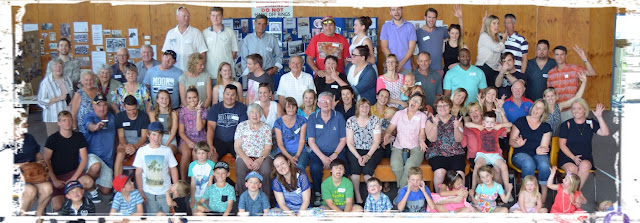
The Family Gathering

Friday, 2 October 2015

Going Wayback

In a recent post on my GenAus blog I lamented that I had not kept files of all the websites I had developed over my 20 years on the World Wide Web. Quick as a flash one of my readers, Kylie Willison, reminded me of The Wayback Machine from The Internet Archive. Why didn't I think of that?

Wikipedia describes the Wayback machine thus "The Wayback Machine is a digital archive of the World Wide Web and other information on the Internet created by the Internet Archive, a nonprofit organization, based in San Francisco, California. It was set up by Brewster Kahle and Bruce Gilliat, and is maintained with content from Alexa Internet. The service enables users to see archived versions of web pages across time, which the archive calls a "three dimensional index.".

So taking on Kylie's suggestion I tried to fins some of my old sites in the Archive but didn't have much luck as the search requires a URL and I couldn't remember the exact URLs of my sites. I'll have to go through some old emails and files and see if I can find them.

What I did remember was the URL for my GeniAus blog. Entering that in the Wayback Machine I discovered that it had first been captured by The Wayback Machine in January 2011 and had been "Saved 53 times between January 27, 2011 and September 5, 2015".  I often play around wiht the design and layout of my blog but forget to take a screenshot before I make changes. I intend going through all of those 53 captures and creating a personal archive of my blog changes. My blog is also captured by The Pandora Archive from The National Library of Australia so it should be accessible via one of these platforms for a long time to come.

First capture of the GeniAus blog by The Wayback Machine.

I wondered about my family site and found that "http://www.geniaus.net  has been "Saved 72 times between July 20, 2009 and October 2, 2015". Ain't that grand.

Of course, when I started writing this post my mind turned to the Worldwide Genealogy Blog and I thought I'd see what I could find in The Wayback Machine. I discovered that it has been "Saved 13 times between February 9, 2014 and September 6, 2015.

Here is the very first screenshot.

First capture of Worldside Genealogy Blog to The Wayback Machine
The post from February 9th about using Evernote for family history was from Diane Hewson in Australia.

Have you checked The Wayback Machine to see if your sites or blogs are being archived?

Sunday, 10 May 2015

Mother's Day - A celebration


Firstly I have to apologise for being a little tardy with my scheduled post! We are at present driving home, after spending the weekend with family, and celebrating Mother's Day with my mother. This morning, we braved a very chilly morning to take Mum out for Mothers's Day brunch. As she is quite elderly now it is a wonderful to have some time with her and see her delight when the huge plate of apple and cinnamon pancakes was popped in front of her. 

This morning's celebration got me thinking! remembering past mother days and wondering how long we had been celebrating Mother's Day in Australia.  

It you go back in history there are numerous references of different festivals that celebrated Mothers.  Many historians proposed that the first Mother's Day celebrations were the ancient spring festivals dedicated to mother goddesses. In Rome, around 250 BC there was the celebration to Cybele, or  Magna Mater (Great Mother). This festival was celebrated for three days in March and was called Hilaria.  The Greek's had a similar celebration in spring in which they honoured Rhea the mother of gods and goddesses. 
Anna Jarvis

A similar celebration, called Mothering Sunday, has been practiced in England since the 1600's. This celebration is also called Mid-Lent Sunday. However, the celebration of the modern Mothers day is accredited to Anna Jarvis. In 1908 Anna sought to honour her mother by holding a memorial church service in Grafton, West Virginia. It was her desire to have a day put aside especially to remember and pay respect to mothers. Following this service Anna and her fellow supporters lobbied officials throughout America to have Mother's Day endorsed as an official holiday.

I hope and pray that someone, sometime will found a memorial mothers day commemorating her for the matchless service she renders to humanity in every field of life.  She is entitled to it.  
- Ann Reeves Jarvis.

By 1911 Mother's Day was celebrated widely throughout the United States, and in 1914 the second Sunday in May was officially declared as "Mother's Day".  Her wishes were realised.  Interestingly, in later years, after the commercialisation of "Mother's Day" by florists, chocolate manufacturers, and greeting card companies, Anna regretted the move away from the true meaning of Mother's Day.

It seems Australia followed quickly in the steps of the United States and "Mother's Day" is reported to be celebrated in 1909, only a year after Anna's celebrated memorial service in West Virgina.

A number of reports can be found in TROVE, outlining the celebration of the new "Mother's Day" holiday.  The report here from 10 May 1909 points out that "the second Sunday in May is now generally set apart in the United States as a period for extolling of the virtues of mothers" it goes on to point out "The mothers of Australia are no less deserving of praise and gratitude than are those of the great Republic".

How did you celebrate mothers day, has your celebration changed over time?  I remember as a small child my sisters and I making cards and saving up for a small gift for Mum. Often this gift would be some talc and soap or a new cup, saucer and plate set for her tea set collection.  Mothers Day would start with four sisters bouncing on Mum and Dad's bed, bringing in our gifts and settling in for a cuddle and wrestle.

As we grew older, we took on the task of preparing a special Sunday lunch to celebrate mother's day.  The kitchen would be turned into something a little short of a war zone, as we put together a three course lunch and our Dad would be assigned to the kitchen sink, up to his elbows in soapy suds, washing the piles of discarded saucepans and pots. My mother must have observed these operations with great amusement and possibly a little trepidation. 

A few years passed and it became my turn to be the recipient of Mother's Day attention.  I recall a number of occasions, lying in bed, and listening to my eldest son, in our kitchen giving directions as my two boys prepared my Mother's Day breakfast.  After a short while, two smiling teenage boys would appear at our bedroom door, one bearing a cup of steaming hot tea and the other balancing a large tray of breakfast goodies.  The tray would be laden with an enormous bowl of rice bubbles, milk lapping the rim of the bowl and a large orange on a side dish.  My husband would smile, wink and whisper,  "Make sure you eat all that cereal".  

Today we celebrate Mothers Day with family gatherings, special lunches, flowers, cards and gifts. Yes, it has become highly commercialised, however it has also become a special time for family to reconnect and pay respects to mothers, grandmothers and aunts. 

I would like to dedicate this Mother's Day post to my special Mum and my grandmothers as these wonderful women have had such an incredible influence on who I am today. 
My Nannas - Happy Mother's Day

Monday, 9 March 2015

Family stories - Living in the times of Bushrangers

Crossing the Clyde River on Punt at Nelligen - circa 1962
As a small child I loved to hear the stories that were passed down through the generations and one that fascinated me most was the "Capture of the Clarke Brothers".  When we caught the punt across the Clyde River at Nelligen, we would all jump out of the car as we crossed the river and peer over the edge of the punt at the conglomeration of jelly fish as they blobbed past and under the punt.

My dad would lean over with us, and reminisce on time's past when as a small child he lived a little further up the Clyde river with his Grandmother on "The Farm". As we crossed the river, he would point out an old tree on the opposite side of the river and tell us " Back in the olden days, that is where the bushrangers  - the Clarke Brothers, were tied before they were taken by boat to Sydney for their trial". 

He would then relate the stories from his childhood, told to him by his grandparent. They were young children in the times of the gold-rush and lived with the ever present threat of bushrangers.  My great great grandparents Thomas and Emma Lee (nee Weston) lived and ran the local store in Nelligen, at the time of the Clarke Brothers capture and shipment to Sydney. They would have experienced first hand, the sigh of relief from the community, knowing they would be a little safer when travelling between the colony settlements. 

Clarke Brothers - Thomas and John 
The Clarke Brother's were among the most notorious of the bushrangers that held the goldmining communities to ransom during the late 1850's through to the 1870's.  They became known as the "most bloodiest" of all the bushrangers, even considering, Ben Hall, Frank Gardner and Ned Kelly. They were part of a gang that included their uncles and other relatives and friends and were well practised in the art of cattle duffing and horse stealing.  As the areas of Araluen, Braidwood and Majors Creek boomed with the discovery of gold the Clarke gang moved into holding up stage coaches, inns, banks, storekeepers, local farmers and travelers.  It was reported that they were responsible for over 36 hold ups and the murder of five policemen.

Following their capture Thomas and John Clarke were shipped from Nelligen to Sydney where they faced trial and were hanged on the 25 June 1967.  Their deaths marked the end of Bushranging in Australia. 

Anyone who follows my blogs Family Stories, Photographs and Memories, would know that my fathers side of the family were settlers in the gold mining district of Araluen and Braidwood, as farmers, gold miners and overland transporters. All branches of this family would have lived through the time when the Clarke brothers and other bushrangers ran rife in the district.  Another branch of my family who worked the goldmines in the district were the McGregor's. Last year when I was looking through some research notes made by another family researcher, I was fascinated by a letter by one of my great great Aunt Jessie McGregor that talked about her father James McGregor having a run in with the Clarke Gang! Fascinating!

Then after little searching on Trove.  I found what I was looking for!  A small article in The Tumut and Adelong Times, which gives details of the Araluen coach being held up by the Clarke Brothers, "One of the passengers, McGregor, had about 40 pounds; (quite a bit of money for then, I would think), he gave Tommy (Clarke) one coat containing 14 pound, and stated that was all he had, whereupon the knight of the road very liberally returned him 7 pounds". 

So my great great grandfather James McGregor seemed to have escaped this incident with out losing a large sum.  I did however, find the journalist's comment at the end of the article quite amusing, "It serves people right if they will carry money about them, where for the sake of a few shillings they could easily secure the safety of it by procuring a draft".

I often wonder if any other of my relatives who lived in this district during this era knew or meet up with the bushrangers?  Would it be great to hear their stories! No wonder my dad loved to relate the tales that were passed down to him as a young child.  Did any of your ancestors brush shoulders with the other side of the law?

Bushrangers holding up Coach 
 ___________
Resources.
1. The Clarke Gang, Our Town Our People,  http://ourtownourpeople.com/www.ourtownourpeople.com/32._The_Clarke_Gang.html, viewed 9.3.2015. 
2. The Bushragers of Araluen, http://www.goldrushcolony.com.au/australian-gold-history-culture-info/bushrangers-araluen, viewed on 9.3.2015.
3. O'Sullivan, J. (1973), The Bloodiest Bushrangers, Rigby, Adelaide.
4. Colonial Summary." The Tumut and Adelong Times (NSW : 1864 - 1867; 1899 - 1950) 4 Feb 1867: 3. Web. 9 Mar 2015 <http://nla.gov.au/nla.news-article144774022>.


Friday, 9 January 2015

Sharing and Building Family Memories through a Family Reunion

Christina (nee Lee) an Lionel
Carriage
Sharing family memories is one of the themes on my blog “Family Stories Photographs and Memories” that I enjoy writing about the most.  We spend a lot of time researching our ancestors and sometimes forget to record our own history. I think it is important to take the time to record your own memories and assist in building your families memories.

At the wake of a recent family funeral, a number of relatives commented that “it was nice for the family to get together, even though it was a sad occasion” and “we should make an effort to get together for an occasion other than a funeral”.  These sentiments fuelled a discussion with one of my Aunts and a cousin, and we agreed to put our heads together and organise a family reunion for all our relatives linked to my Nanna (Christina Lee) and Pop (Lionel Carriage) and Nanna’s first husband (Malcolm Michael Shepherd).

A family reunion provides us with the opportunity to share and build family memories as well as discover new links.  As this blog is such a great form for sharing and discussing new ideas I thought I would post my initial thoughts and outline for our family reunion.

The aim of this post is twofold:

     1. To assist other who are contemplating a similar event and more importantly
     2. To seek the wisdom and feedback from others who have organised or attend a family reunion

So here are my initial thoughts on items that we will need to consider for the organisation of the upcoming reunion which we have scheduled for the long weekend in June.

1.  As this is our first attempt at organising a Family Reunion it is important to keep it as simple as possible! (Yep!! the KISS method). 

2.  Organising Committeedecide on the core group of family members who will be involved in organising the reunion, and select one person to coordinate, and keep the communication flowing and follow up on all action items.

3.  Allocate tasks to family memberstaking the time to select areas that they have skills in, e.g., someone with IT skills to set up scanner and copier to make copies of photos on the day, someone who is keen on photography to take charge of taking photos and someone who likes cooking  to organise morning tea.

4.  Select a date and book a venue.We have organised to use the pavilion at the Milton Show Ground, this will provide us with plenty of space, toilet facilities, a kitchen and a large covered space if the weather is inclement. Take time to visit the venue prior to the event to check out the layout and assess requirements, e.g.  Seating, heating, crockery, suitable areas for displays etc.

5.  Decide on the type of reunion you are going to have.  To keep it simple we are going to provide morning tea on arrival and then a picnic lunch, where everyone can bring along their own picnic. 

6.  Family Contacts: Set up master spreadsheet with Family member’s name’s, contact details, connection to the family and details on areas they can assist with. Seek assistance from willing family members to source as many family members contact details as possible.

7.  Reunion Flyer and Letter:
  • Develop a Reunion flyer outlining the main details of the Reunion in both hard and soft copy.
  • Compose a letter of invitation that can be sent by mail or email.  The letter should give detailed information on the reunion, contact details for RSVP or queries, details of accommodation and other attractions in the area and an invitation to assist on the day, or bring along family memorabilia, photos etc.
8.  Budget and Fundraising:
  • Draw up a list of costs for the day, e.g. Cost of Venue hire, morning tea, printing and postage, displays, printing, items for children’s activities, toiletries for the bathrooms etc.
  • Decide on how costs will be covered: Donations of goods and services, small attendance fee or a donation tin on the day of the reunion.

9.  Media and Communication:
  • Distribution of Letter and Flyers, - Circulate letters and Flyers to family members, asking if they are able to forward the invitation on to other family members.
  • Put an advertisement and possible a short article in the local paper.
  • Set up a Family Tree Web site or Family Reunion Page on Facebook – family photos, articles and reunion updates can be shared on this page.
  • Consider setting up a twitter and Google+ group.
  • Closer to the date of the reunion send out reminders and updates.
10. Decide on the Schedule for the Day:
  • Have members of the committee (or other volunteers) on hand when everyone arrives to assist with introductions, name cards and a brief outline of the layout.
  • Initial Welcome – select someone to give an opening welcome and quick outline of the day (perhaps the oldest grandchild or one of the elders of the group?)
  • Presentation – have a short presentation on the history of the family members?
  • Depending on the number of people attending, a quick run around the group to introduce family members.
  • Plan entertainment for the day, plan activities for the children that covers a range of age groups.
  • Consider having a short movie or PowerPoint of photos running, so that people can watch at their pleasure.
11. Photography:
  • Assign one or two people to be responsible for taking as many photos as possible.
  • Organise for a large group photo for all attendees.
  • Provide the opportunity for family groups to have their photo taken (with someone taking down the names of the people in the photos).
12.  Collection of Memorabilia and compiling of Family Tree:
  • Seek assistance from family members to put together the family history.
  • Set up a display of family tree – encourage attendees to make corrections and additions.
  • Collect photos and memorabilia for display at the reunion and encourage families to bring photos and memorabilia on the day.
  • Set up a display of family photos and memorabilia.
  •  Encourage families to bring photos and memorabilia on the day
  • Have a scanner and photocopier set up on the day to collect copies of photo's and to make copies of photos for family members.
13.  Post Reunion:
  • Ask family members to provide feedback and suggestions on the day.
  • Put together Memento of the day, this could include collection of photos and family documents from the day to be sent out to those attending.  This could be in the form of a booklet, CD or usb stick.  Family members could indicate if they would like this memento and pay a small fee to cover costs for this on the day.
I am quite excited and a little daunted by the prospect of organising this reunion in six months, however I am sure we will be able to put our heads together and pull off and enjoyable day for all family who are interested.

Have any of you planned or attended a family reunion recently?  Your feedback and advice on my initial summary of actions would be greatly appreciated. 


Christina and Lionel Carriage with family (hopefully some of these will be attending the Reunion) 
_______________________
If you are interested, a little more information can be found on Christina, Lionel and Malcolm (Christina's first husband) on these blogs.

Tuesday, 9 December 2014

Four Generations of our Family through the Eyes of the Street Photographer

Recently I read an article in the July edition of Australian Family Tree Connections Written by Mrs Leonie Punch.  In this article, she shares some of the wonderful family photos she has of her family taken in the 1930's and 1940's by street photographers, along with a little of the history of the street photographers in Australia.  
It seems that the street photographers were not always popular, upsetting pedestrians, the local council and the more established photographic studios. 

Numerous articles can be found in TROVE relating stories of proposed changes in laws, prosecution and complaints about the street photographers who made their living snapping photos of couples, families out shopping or going about their daily business. 


Street photography was a way that many men earned money in tough times, and even though we are so thankful for the glimpses of the past that they have provided us with, they weren't always popular. Following WWI through to the early 1950', they were the subject of many court convictions, complaints and changes law. 


However, I am very thankful for the intrusion of these photographers into the everyday lives of my ancestors as they went about their shopping.  Their pictures provide us with wonderful glimpses of our grandparents, great uncles and aunts dressed up in their best as they go out shopping. I love the pictures that capture the family groups striding out in their hat, gloves and bags.

I thought I would share some of the family picture's that I wouldn't have if there had not been the street photographers. In some cases they provide us glimpses of our family through the generations as is shown in the pictures below of my husbands great grandmother, grandmother, mother and uncle and then his sister!!


Jessie Smith (Taylor) and daughter Joyce


Jessie Taylor with her Mother Marion Taylor (nee McNair)

The first picture shows my husbands great grandmother Marion Millar Taylor (nee McNair) and his grandmother Jessie Taylor.  The second picture shows his grandmother Jessie Smith (nee Taylor) and his mother Joyce as a young girl.
Jessie Smith and her Grand daughter Sue-Ellen

Jessie Smith and twins Colin and Joyce


The next two photos show Jessie with her twins Colin and Joyce (from previous photo) and finally another generation!!  Jessie with her granddaughter Sue-Ellen.  

So our family really has to thank a number of street photographers from the 1930's through to the 1950's, for providing us with a short time line of family photos through the generations.

Finally, this is my last blog for this year.  I would like to take this opportunity to thank everyone for the wonderful posts they have shared this year and the sense of community this blog has provided.  I have enjoyed reading them all, and learnt so much.  I would like to wish you all the best for the festive season, however you celebrate it and look forward to more collaboration in 2015.

Monday, 10 November 2014

Researching the Forgotten Side of Your Family Tree

My Grandmothers Edna Palin and Christina Lee
Firstly, please let me apologise for not posting last month.  Family commitments fully occupied my time last month and my blogging was unfortunately, put on the back burner.

As some of you may know, one of my blogging sites, “The other half of my tree – stories of my female ancestors” is an attempt to record the stories of the women in my family.  I thought I would share how I approach gathering all the little tit bits that can be pieced together to build an understanding of your grandmother, great grandmothers or great aunt’s story. As we all know, due to many social and financial circumstances, piecing together their history is much more difficult to that of their male counterparts. Often our family tree is traced back through the male branches and the female branches are neglected or put aside as being too difficult.

How do you unravel the history of the females in your family tree?  I think the key to discovering the stories related to your female ancestors is to rethink your approach to researching, using clues in different ways.  It helps to expand your area of research by looking outside her immediate family and start to develop a knowledge of her community. This month, I plan to follow on from my previous post on using Excel Time line as a tool, and expand some of the research methods that can be useful to fill in the gaps on your female ancestors time line. 

1. Birth, Death and Marraige Records - The first and most important place to start with are birth, marriage and death records.  Examine these thoroughly for all details.  These can provide, information on her parents, where they lived, and their occupation. Carefully check the witnesses signatures, as these can also provide clues to close relations or friends, and by researching these names you can come across more information about your female ancestor.  An example of this is: my great great grandmother Emma Weston.  One of the witnesses on her marriage certificate was Mary Ann Weston, after a little research I found that Mary Ann was Emma's sister.  Then after obtaining Mary Ann's wedding certificate I found that one of the signatures was Alfred Weston, this clue led me to discover that Alfred Weston was Emma and Mary Ann's uncle and that he had sponsored their trip from London on the "Kate" in 1856.

2. Immigration Records - These can provide details of parents, where they lived before immigrating, and their age.  In the case of Mary Ann and Emma Weston their immigration record also provides information about their occupation, their religion and that their passage of ten shillings was paid by their Uncle Alfred Weston.


3. Census Record - These will give provide details of their address, other family members, occupation, if she attended school and parent's occupation. If your female ancestor has a name that is difficult to search for eg Mary or Anne, you can search for one of her siblings with a more unusual name to  trace family movements and events. Also when searching census records, it is a good idea to check the pages before and after your ancestors record, as quite often you will find the records of other members of the family who live nearby. The census record will also give you an indication of the your ancestors social circumstances, ie, parents and neighbour's occupations, if there are servants listed on the record, and sometimes there is an indication of land ownership and if there any workers under their employ.

4.  Naming patterns - The names of children often will provide clues to parents names. It is common for the first child is names after one of her grandmothers and often a child’s middle name is the mother’s maiden name. I often wondered why my Nanna was called Christina Sterland Lee, as I couldn't find any link to the name Sterland.  Then when I was researching her mothers branch of the family tree I discovered that her aunt Christina Sterland (nee McGregor) passed away a couple of months before she was born, and obviously she had been named after her Aunt.

Headstones can be a valuable source of information
5. Cemeteries - These can provide proof of burial, and often also provide the date of birth.  Family members buried nearby may provide details of her maiden name, names of children and links to other members of her family. It is quite likely that if she was buried in a church yard or denominational section of the cemetery that she was a member of that church's congregation.  Further searching of the church records may provide you with more information on her marriage and baptism. For example in the picture of the gravestone here, the maiden names for David McNair's wife Marion Taylor and his mother Annie Simpson are listed on the tombstone, as well as information about other members of the family.

6. Wills and Probate Records - can provide information on widows, daughters and grandchildren, including names, addresses and inherited property.

7. Newspapers - can be a valuable source of information when researching women, especially articles in smaller local papers.  Looking for obituaries or your ancestor, or her husband, parents and children can also provide more information about the person you are researching.  By searching the names of the ships that your ancestor immigrated on in the newpapers, can also be rewarding.  In the case of Emma and Mary Ann Weston, I searched for the ship on their immigration record, the "Kate"  in Trove and was able to find a couple of references to the arrival of the "Kate" into Sydney Harbour just before Christmas in 1856.

8.  Stories from family members - Take the time to listen and take notes of family stories, these can often provide a valuable clue that can link you to more information. If you have old photos, consult with older family members, often a picture can trigger a memory.  A few years ago I met my great Aunt in Adelaide, and took down a couple of pages of notes detailing some of the stories that she had told me.  Earlier this year, when reading through my notes again I noticed I had written down that my great grandmother  Caroline Hornhardt had downed.  Using this clue, I searched for a drowning in Adelaide around the time of her death, and was rewarded with a number of articles outlining the circumstances of her death.

Family Bible and Letters
9. Family Bibles,Diaries, Postcards and Letters -  If you are lucky enough to be able to source family bibles, diaries/journals and or letters, they can be a valuable source of social and genealogical history. Families often recorded important family dates in their bibles.  Diaries and letters can provide an insight into the feelings, emotions, and relationships of your female family members. They can provide you with important information on dates, places visited, addresses, how they feel about events and an insight into their culture and social history.  Postcards, and letters can give you a sense of how your ancestors feel at the time of deaths, births or war, perhaps they may provide you with a clue to an admirer or close family friend.

10. Military Service - if you female ancestor served as a nurse you can search the military records for information on where she served.  Also, by searching the military records of your ancestors husband or son you can find in their record details of mother or widow, with copies of telegrams/letters notifying of death and pension records.

Family picture taken after a funeral
11. Photos - These not only give us a visual image of our ancestor, but can also tell us so much more.By carefully examining the picture, you can read the body language between those in the picture. How are your ancestors are dressed can indicate the importance of the occasion, their economic circumstances, their occupation etc. Buildings in the picture can provide clues to where they lived, worshipped, worked or their leisure activities. Always remember to check anything written on the back of the photo as well.

Putting together the story of your female ancestor's provides an interesting challenge and involves using combination of the traditional genealogical records such as birth, death and marriage records along with their social history which can be sourced from a myriad of resources such as those outlined in this blog.  By collecting all this data into a timeline, you will be able to put together a clearer picture of your grandmother, great grandmother or great aunt's life.

Tuesday, 9 September 2014

Using Time Lines as a Family History Writing Tool

The thing I enjoy most about writing family stories for my two blogs, Family Stories: Photographs and Memories, and The Other Half of my Tree - Stories of my female ancestors, is putting together all the different snippets of information that I have gathered.  I love piecing together dates of birth, death and marriages with newspaper clippings and events of the day into a short story that reveals a little about a particular ancestor.

This is often a difficult task, especially when of writing about female family members.  So today I thought I would share with you the tool I find the most helpful.    A time line of events in their life! 

There are many different programs and apps designed to assist you with this task, for example: Easy Timeline Maker, Timeline Builder, Capzles, Tiki-Toki and Timeglider to name a few. However, I have found the most useful form  is to create a simple time line in Excel. 

To show how I use this format, I will share with you a section of the time line I developed when researching Elizabeth Taylor (nee Rushworth). I wrote a series of blogs on Elizabeth's life, and it is my hope in "time to come" to will be able to write a short book on her fascinating story.

Part of Time Line for Elizabeth Taylor (nee Rushworth)
Using an Excel Sheet I enter every little bit of information that I can find. It is important to remember, in the case of women, to record all the dates and events of the male members of her family as these are often more easily found and will add background to her story:

  • birth, death and marriage dates (bdm) for the person with details of place etc 
  • bdm dates for their children, parents, siblings, grandparents, Aunts and Uncles, if they occur during the person's life time line.
  • census dates, with details of where they lived
  • dates they started and finished school
  • dates of illnesses, or other life events that you know about
  • details from any newspaper articles that you have been able to find on them, i.e.winning prizes in the local show for flower arrangement, being involved in an accident, receiving an award
  • military service of the person or a family member
  • immigration, travel
  • land or business ownership
  • courtcases
and the list goes on.  

Then, on the same excel spreadsheet, I build another timeline of events that could have impacted on Elizabeth Taylor's life. This is, I think the key to putting your ancestor's story together and places it in context.


Examples of events that should be included into the supporting time line are:

  • Start and finish dates of Wars, eg WWI, Crimean War
  • Times of economic depression, eg start of the Potato Famine, cotton famine
  • Launch of post office savings scheme, first postal service
  • Establishment of Trade Unions
  • Workers strikes
  • Events in the town, ie Establishment of local Borough, or council, building of schools, starting of hospital or ambulance service, opening of Town Hall
  • Women given the right to own property
  • Laws passed to make it compulsory for children to attend school
  • Visits from dignitaries, major sporting events, opening of local cinema, Circus comes to town
  • Natural disasters such as  disease outbreaks, storms, floods and droughts
Searching for this information can take time, however today with access to so many online newspapers, and historical sites there is a lot of information available to plump out the details of your ancestors life.  I have even found it possible to go search the local newspaper on the date of an important event, ie wedding and found the weather forecast for the day.

Often, a small piece of information entered into the second part of the time line will give meaning to an event in your ancestors life.  For example an outbreak of typhoid and the death of a number of family members at the same time, or trade union strikes or closing down of a local factory could explain why your ancestor decides to move to another village or district or even immigrate.


The development of a time line is vital to gain an understanding of the setting of your ancestors life and helps put life events into a clear frame of reference with the lives of their families, events in their community and outside influences.  Do you use timelines when researching your ancestors?  Do you have any other suggestions for the composing these stories?