Tuesday, 16 December 2014

The Dreaded Christmas Letter - - Turn it Into A Treasured Genealogical Blessing

.

(Coming to you this month from Tuscon Arizona where Man and I are spending the holiday month.)

Tis the holiday season.  And, the season for the "dreaded" Christmas/Holiday letter.  I know, I know, many of you just cannot stand them, you moan, you groan, you may even toss it in the garbage unread.  I understand.

I have been doing holiday letters for many years.  Like over 20, ok, maybe over 30.  A long time!

I actually have many of them saved as word documents, once I started using computers.  Yea, really.

Have you given any thoughts to turning those "dreaded" letters into genealogical artifacts?? Or, at least saving them, somehow in your genie collections??  Maybe you just want to save them as hard copies with your other documents.  Maybe you want to scan and have the digital files along with your digital data base.

My mother-in-law saved everything, even Man's hospital bill when she delivered him.  I have been sorting through the masses of papers since she passed 4 years ago.  She saved EVERY Christmas/Holiday letter I wrote.  She had a few I did not have copies of.  It was a great genie find.

Here is an example of one of my letters, 1998.  In it I relive and remember, 2 new yorkie puppies (both now gone from our lives).  A new computer too, with Dragon Naturally Speaking (that never worked out for me, sadly).  Man had worked 30 years.  We took a trip to Appomattox Court House and found my great great grandfather's photo on the Wall of Honor there.  We went camping (surprise!  LOL)  We had a party, (a great party, still have fond memories of that party).  We did lawn work (and weather was discussed).  I chatted about some research (for fee) I did in our home county; and some books I was working on for said county.


And, this is just on page 1 of this years holiday greetings.  By the way, the computer is long gone, and has been replaced by several new laptops since then.  We have taken "camping" to the next level, by living months on end in our RV and we no longer have the same RV as we did in 1998. I still spend summers dragging hoses and working in the yard of the stickbuilt.  I no longer am doing research for fee and I am no longer working on books for the country.  I did about 25 or more books, and then, Man retired.

So, for me, saving the old holiday letters is a genealogical gold mind of memories.  I will leave them for the next generations.  I can imagine my great-grandchildren, asking, what was Dragon??  Where is Gun Lake??

I have scanned the letters that were not on my word processors.  I have attached them into our family history images.  They are filed chronologically with other family memory images, pets, trips, vehicles, camping rigs, boats, family events such as graduations, the list is long.  It is a reflection our lives, images and digitally.  

The holiday letters are a snap shot moment in time, once a year, preserved for the future.

Have you turned your dreaded holiday letters into genealogical treasured blessings??


FROM MAN AND I, MAY YOU HAVE A MERRY CHRISTMAS. HAPPY HOLIDAYS TO ALL.

.

Sunday, 14 December 2014

Cousins, calculations and Christmas

I've been spending the day adding people to my Lost Cousins Ancestors page. If you haven't heard of this genealogy tool, do have a look at the link. I subscribe to the newsletter, which editor and founder Peter Calver fills with useful genealogy tips and the occasional offer or competition.

This month's contest involves entering as many ancestors or blood relatives as you can, based on selected England and Wales, Scotland, Ireland, US and Canada censuses. The earliest is the 1841 England & Wales census, which is too late for most of my Aussie ancestors, and finding my early emigrants' and convicts' families is a tough job, full of brick walls.

Still, I'm a genealogist, and we're a stubborn persistent lot, so I keep chipping at those ancient walls. No-one ever said family history was easy, did they? Or if they did... well, don't listen.

And fossicking out direct ancestors' brothers and sisters often gives surprisingly useful clues, as well as filling up my Lost Cousins list and increasing my chances of contacting my living rellies. It hasn't happened yet, but I'm hopeful (another genealogists' characteristic).

I was pleased to find my 4xgreat grandmother, Margaret Richardson (born around 1789 in Hamsterley, Co Durham), in the 1841 census. Off I hurried to add her to my ancestors' list, when I came up  against a problem. I had to enter her Ahnentafel number. You know, those numbers you see on family tree charts and other genea-tools.

When I've needed an Ahnentafel number before, I've gone to my trusty battered paper family tree chart, which goes back to my 3xgreats. I know, not very tech, but it weighs nothing and I can slip in my bag when there's even a slight chance of fitting in some genealogy action that day.

But Margaret's off the scale. She's a 4xgreat. And I know it's a shocking thing to say, but I had no idea how to calculate the numbers, short of counting all the way up from 63 (my Irish 3xg, Julia Harrington).

A quick search came up with the answer, which is so simple that I had to share it, in case there are any other Ahnen-newbies in the Worldwide Genealogy community.

Here's how: to find out the number for someone's parents, take their number and multiply it by 2. That gives the father. Add 1 and you have their mother.

It really works! Though if you're going back a few centuries you may need a calculator.

For example:my parents. I'm the person I'm calculating from on my family tree, so my number's 1. 1x2+2. So my father's number is 2. 2+1=3. So my mother's is 3.

Oh, no! Margaret's off the chart.
Getting more complicated, to calculate 4xgreat granny Margaret, I take her daughter Elizabeth Bell (1810-1876). Elizabeth has Ahnentafel number 59, which will always mean the number 1 person's mother's mother's father's mother's mother. On any Ahnentafel you see. Clever, eh?

59x2=118. And I'm looking for the mother, so add 1. 118+1=119. And that's Margaret's number.

You can also work out Ahnentafel numbers using the binary system, but I'm going to stick to what I know.

And there's a clever site that does all the work for you, set up by Stephen P Morse.

But that's enough hard work, it's nearly Christmas! I've got two weeks off work so I'm going to get down to searching for my earliest female Australian, Elizabeth Bayly, wife of Nicholas Delaney. Anhentafel 49, in case you wondered. Ohh, but, she's hard work. And over on my A Rebel Hand blog there's a scary Christmas story to write for later in the month.

Have you got any genea-projects for the holiday season?

Wishing you a very merry Christmas, a happy Yuletide, Nadolig Llawen, Nollaig Shona dhaoibh, Nollaig Chridheil, Joyeux Noel, Feliz Navidad und Fröhliche Weihnachten!

Friday, 12 December 2014

Rootstech 2015 in 50 Words


The following can be found on Jill Ball’s blog at http://geniaus.blogspot.co.uk/2014/11/where-geniaus-gets-chance-to-play-santa.html?m=1


Where GeniAus gets a chance to play Santa.

Rootstech 2015

Rootstech Ambassador

One of the nice perks of being a Rootstech Ambassador is that I get to give some lucky person a nice Christmas present.


The kind folk at Rootstech have given me "One complimentary RootsTech 2015 3-day pass ($239 value) for one of your lucky subscribers." If you have already registered for Rootstech you can still enter this competition as I will supply a code to the winner and, if you have already registered, you will get a refund from Rootstech. If you haven't registered yet winning this competition might just change your mind about attending this premier event in Salt Lake City in February 2014.


This prize only covers your entry to the event, you will be responsible for all travel, accommodation and incidental expenses.


So what do you have to do to win this prize?


You need to tell me in 50 words or less using as much Geneajargon as you can from my Geneadictionaryhttp://geneadictionary.wordpress.com why you are or why you would like to attend Rootstech 2015. Of course you could use newly created geneajargon that can be added to the Geneadictionary. As a condition of entry you give permission for your entry to be posted in the Geneadictionary.

Jill has requested that entrants email their entries the closing date is today 12th December 2014. As it coincides with my day to post here I decided to add what would have been my entry as this month’s post.
The reason I do not have to enter can be found here.


I am going on a geneajaunt to Rootstech 2015 to get a genealogy overdose. I expect to wear blogger beads whilst meeting with other geneabloggers, doing some geneatweeting and joining a geneawebinar.
Then back across the pond to WDYTYA Live by which time I will need to join Ancestors Anonymous.

Thursday, 11 December 2014

Keeping Family History Stories Alive through Fiction - Part C - "Dr. Bill" Smith


Keeping Family History Stories Alive through Fiction
Part C
"Dr. Bill" Smith

I began this series of posts in October 2014 suggesting we each consider preserving the family stories we find as we do our family history and genealogy research, whether for ourselves, or for others, by using fiction as a tool (See Part A).

In November, in Part B, I shared my love of family saga literature and hopefully I got you to thinking about how your own stories could possibly add to this fiction literature genre, using some of my own fiction stories as examples, and recommending some to you, for your review.

Today, in December, I want to be a little more specific and recommend some types of stories you might watch for in your research that would make the basis for good fiction stories. Since this is December, let me start with the “coming home for Christmas” theme. Do you have a member of the armed services you hope will make it home to be with family to celebrate Christmas? That was one of the stories at the heart of my “Christmas at the Homeplace” novel last year. It was 1996, and Travis Inman had left, as a National Guardsman, to serve a tour in Bosnia. He had to leave the winter before prior to his youngest daughter’s birth. Her getting to meet her daddie for the first time at Christmas would be an even greater reunion. Do you have a story like this that you could incorporate into your own story?


Sometimes, I have found, story ideas come from very different sources to create a new storyline for a novel. In the years surrounding when the ideas for my first novel was created, I was doing accounting work, among many clients, for a number of artists who happened to be what today we call gay. They were not family, but I was personally very close to them because I appreciated their devotion to their craft, and wanted to help them on the business side of their lives. This group, of nearly a dozen young men, was hard-hit by the arrival of AIDS to the community. I was particularly close to one, one of my earliest clients. He flew into Washington, D.C., so many times, to get the best treatments then available. He, and most of the others, eventually died. As a tribute to them, I suppose, I included a character in my fictional family in my ongoing family saga who faced these particular challenges. He first appeared in the first novel, “Back to the Homeplace,” and has continued to be a key character. His development, based on the ravages of the HIV infection, through the years, has been a very gratifying part of my continuing stories, as a survivor.


Finally, sometimes it is just a particular “trait” that you can bring into one of your characters. How about the middle-aged aunt that is very active in your small church, but… wants to sing in the choir, but sings far too loud, and cannot carry a tune in a breadbasket? How about the uncle that always wears the same “awful” sweater to every family gathering? How about the young “romeo” who only seems to be interested in “hitting on” his young cousins? These “traits” won’t carry a story, but they can make your stories/characters more interesting, more real. Watch for them as you do your research. What useful “traits” for stories have you come across lately?

See you next month! I love to read comments, so please leave one or more, including questions. 

Dr. Bill


**********

"Dr. Bill" (Wm. L.) Smith can be found regularly at his genealogy blog, "Dr. Bill Tells Ancestor Stories" <http://drbilltellsancestorstories.blogspot.com/> or his family saga blog, "The Homeplace Saga," <http://thehomeplaceseries.blogspot.com/>. He is an original contributor, as The Heritage Tourist, to the "In-Depth Genealogy" blog with a monthly column in the "Going In-Depth" digi-mag. He also writes a monthly post for the Worldwide Genealogy Blog.

Tuesday, 9 December 2014

Four Generations of our Family through the Eyes of the Street Photographer

Recently I read an article in the July edition of Australian Family Tree Connections Written by Mrs Leonie Punch.  In this article, she shares some of the wonderful family photos she has of her family taken in the 1930's and 1940's by street photographers, along with a little of the history of the street photographers in Australia.  
It seems that the street photographers were not always popular, upsetting pedestrians, the local council and the more established photographic studios. 

Numerous articles can be found in TROVE relating stories of proposed changes in laws, prosecution and complaints about the street photographers who made their living snapping photos of couples, families out shopping or going about their daily business. 


Street photography was a way that many men earned money in tough times, and even though we are so thankful for the glimpses of the past that they have provided us with, they weren't always popular. Following WWI through to the early 1950', they were the subject of many court convictions, complaints and changes law. 


However, I am very thankful for the intrusion of these photographers into the everyday lives of my ancestors as they went about their shopping.  Their pictures provide us with wonderful glimpses of our grandparents, great uncles and aunts dressed up in their best as they go out shopping. I love the pictures that capture the family groups striding out in their hat, gloves and bags.

I thought I would share some of the family picture's that I wouldn't have if there had not been the street photographers. In some cases they provide us glimpses of our family through the generations as is shown in the pictures below of my husbands great grandmother, grandmother, mother and uncle and then his sister!!


Jessie Smith (Taylor) and daughter Joyce


Jessie Taylor with her Mother Marion Taylor (nee McNair)

The first picture shows my husbands great grandmother Marion Millar Taylor (nee McNair) and his grandmother Jessie Taylor.  The second picture shows his grandmother Jessie Smith (nee Taylor) and his mother Joyce as a young girl.
Jessie Smith and her Grand daughter Sue-Ellen

Jessie Smith and twins Colin and Joyce


The next two photos show Jessie with her twins Colin and Joyce (from previous photo) and finally another generation!!  Jessie with her granddaughter Sue-Ellen.  

So our family really has to thank a number of street photographers from the 1930's through to the 1950's, for providing us with a short time line of family photos through the generations.

Finally, this is my last blog for this year.  I would like to take this opportunity to thank everyone for the wonderful posts they have shared this year and the sense of community this blog has provided.  I have enjoyed reading them all, and learnt so much.  I would like to wish you all the best for the festive season, however you celebrate it and look forward to more collaboration in 2015.

Stagecoaches - Romance v. Reality

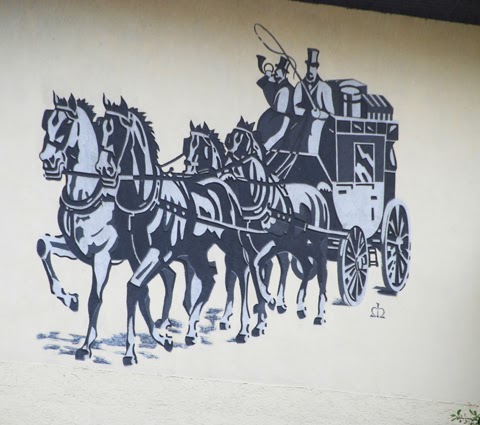
I am striking a seasonal note with this post by looking at the Images of stage coaches on Christmas cards.   They look colourful, dashing and rather romantic, but what was the reality like for our ancestors traveling 170 years ago?


Stagecoaches were public service vehicles designed specifically for passengers and running to a published schedule.  Eight passengers could be packed inside, with others sitting at the back of the coach and the poorest passengers atop along with the luggage. A newspaper report  of 1846 (below) refers to a heavy coach of 18 to 20 passengers.  

The coaches ran in stages, usually from 10-15 miles depending on the journey, the type of countryside travelled and the availability of inns and staging posts en route. 

The  driver was often the sole crew member responsible for the coach, the passengers, timekeeping and dealing with minor incidents.  Coaching inns acted as stopping points for travellers and  were where  the ostlers changed and fed  the teams of horses   On the Edinburgh  to London journey there were twenty eight changes of a team of four horses.  In 1819 in the Scottish Borders  the published time for a journey from Edinburgh to Hawick was just under six  hours for the 54 miles distance - a twisting route over rolling hills -  and  could involve three changes of horses.
   
For Mail Coaches the primary concern was the delivery of mail  although passengers were also taken.   In 1786 the first mail coach arrived in the Scottish capital from London. welcomed by the ringing of church bells,  and guns fired from the castle ramparts - even though on its inaugural run it was twelve hours late!  

The hey day of stage coach travel was the early 19th century, with  improvement in road building techniques, the development of the turnpike system (where tolls financed  road consgtruction),  and  increased comfort of the coaches themselves.  

*******  
The romantic picture  of stagecoach travel has been   perpetuated by many writers including Jane Austen and Georgette Heyer.  American author  Washington Irving (1783-1859)  described his experiences in England  in his "Old Christmas" sketches, 


"I rode a long distance in one of the public coaches on the day preceding Christmas   The coach was crowded both inside and out with passengers who by their talk seemed principally bound for the mansions of  relatives or friends to eat their Christmas dinner.  The coach was loaded with hampers  of game and baskets and boxes pf delicacies....

A stage coach carries animation along with it and puts the world in motion as it whirls along.  The horn sounds at the entrance to a village  and produces a general battle.    As we drew into the great gateway of an inn, I saw on the  one side the light of a roaring fire kitchen fire, beaming through a window.  I entered and admired the picture of convenience, neatness and broad honest enjoyment  - the kitchen of an English inn,  it was of spacious dimensions hung around with copper and tin vessels, highly polished and decorated here and there with Christmas green".
 
Charles Dickens in "David Copperfield" published in 1850 painted a rather different picture of the reality of a winter stagecoach journey. 
"How well I recollect the wintry ride! The frozen particles of ice brushed from the blades of grass by the wind and borne across the face; the hard clatter of the horses' hoofs beating a tune upon the ground;  the stiff-tilted soil,   the snowdrifts, lightly eddying in the chalk pit as the  breeze ruffled it;  the smoking team stopping to breathe on the hill top and shaking their bells musically,..........
 **************

Less poetically local newspapers are full of items on stagecoach travel:

"The Border Watch" - 19 November 1846: 

“A SLOW COACH. – The Edinburgh and Hawick coach, which left Princes Street, Edinburgh on Saturday afternoon at 4pm  did not reach the Bridge Inn, Galashiels, until about 10pm; thus accomplishing the distance of thirty-two miles in the astonishing period of six hours!   

The pace was such that an ordinary pedestrian would have found little difficulty in keeping up with the coach. The road was by no means heavy, although in some places newly laid with metal. The coachman did his duty well with whip and voice, constantly urging forward his jaded steeds, and employing the box seat passenger to assist him with a spare thong.
But it was all of no avail. The animals would not move one foot faster than another. Up hill or down hill there was little perceptible difference, and several times the vehicle came to a dead halt, almost on a level.

The coach was full from Edinburgh, but a passenger having been let down on the road, another person was taken up. In spite of the loud remonstrances of the passengers, a second was buckled on behind, and a third was allowed standing room beside him. It appears there is now no restriction as to the number a stage coach may carry, and consequently three poor miserable horses were forced to drag, throughout a weary stage of fifteen miles, a heavy coach loaded with eighteen or twenty persons.

If there is any law against cruelty to animals, surely it must apply to a case like this. Whatever grievances attend railway traveling, it will be something, at least, to get rid of this wholesome horse murder.”
Reports on accidents,  present a graphic picture of the perils facing passengers and  (and pedestrian) alike.

"The Kelso Chronicle": - 16 June 1837: 

"ACCIDENT. – On Tuesday evening when the coach from Kelso had passed Ord, the reins broke, and the driver left his seat, and went along the pole to recover them. His foot slipped, and he fell between the pole and the horses to the ground. Fortunately, the wheels passed on both sides of him, and he escaped with no other injury than a slight blow to the head.The horses set off at rapid pace, and ran through Tweedmouth. The passengers kept their seats, and the horses while running furiously along the bridge, were stopped by a young man named Robert Robertson, who, with great personal risk, seized the horses’ head.Had they not been stopped, in all probability, from the speed with which they were proceeding, the coach would have been upset at the turn of Bridge Street.  The conduct of the young man deserves great praise.”
"The Kelso Chronicle" -  4 October 1844:
“WONDERFUL ESCAPE. – As the Defiance Coach was leaving the town on Friday last, a girl, about 10 years of age, daughter of Mr. Ferguson, tailor, who was hastily crossing the High Street, and not perceiving the coach, ran in betwixt the fore and hind horses, by which she was struck down, when the horses and coach went over her, to the horror of the spectators, who could do nothing to save her. The wheels on the one side passed over one of her legs, bruising it most severely in two places, while the opposite wheels went over the top of her bonnet, close to the head, but without doing any injury. The poor girl’s thigh was also much bruised, apparently by one of the horses’ feet. We are glad to state that she is recovering from the effects of her injuries.”.
************

The development of the railways marked the end for stagecoaches  but the iconic image remains of a mode of travel that still captures our imagination. especially at Christmas time.  

Sources:
Border Highways by John James Mackay, 1998 
http://en.wikipedia.org/wiki/Stagecoach
Local newspapers of the Scottish Borders 

Sunday, 7 December 2014

Pearl Harbor Memories

Disasters can be great prompts for family history interviews. Many years ago, when my daughter was in high school, she used Pearl Harbor Day as the basis for interviewing some of the older members of our family.  After this we also did some interviews based around the Cuban Missile Crisis (October 1962), the Kennedy Assassination (22 November 1963), and the terrorist attacks of 11 September 2001.  Perhaps other infamous historical events can be used as similar interview prompts in other countries.

The USS Arizona Memorial at Pearl Harbor
The American naval base at Pearl Harbor, Hawaii, was attacked by the Japanese on 7 December 1941, a day President Franklin D. Roosevelt proclaimed “… a date that shall live in infamy.”   This was over 70 years ago, so very few relatives will be able to remember this date.  Here are the transcribed notes my daughter made:
"Where were you when you heard that Pearl Harbor had been bombed and what was your reaction?"

Phyllis (age 67 years at the time of the interview): I remember that day because I was six years old and the only thing I remember about it really is my mother crying because my brother was..., I had five brothers and the oldest one was sixteen I think at the time... and she knew that he was going to have to go to war. That really upset my mother. [Two of her five brothers ended up in the service; one in the Pacific and the other in Occupied Europe]

Shirley (age 76 years at the time at the time of the interview): I remember that. I was standing in the kitchen, ironing, I was ironing a blouse, getting ready to go to church. I heard the news, and I couldn't believe it. I couldn't absorb what it actually meant to me. It really didn't all sink in until later, but then I heard Kate Smith coming on and singing “God Bless America.” And standing there crying my eyes out as I ironed, because it was so touching. I was beginning to realize what it was going to mean to the country.

Robert (age 77 years at the time of this interview, he has since passed away): I was listening to a football game at my house on 7 Dearborn Avenue [Beverly, Massachusetts]. I was about your age, in high school. And my reaction was “Japan? Attacking us? We’ll have them wiped out by Christmas time.”

Shirley: At the time.... I’m a nurse. And I was taking care of a lady whose father was the ambassador to Japan. At the time of the war, before, and during the war. And Ambassador Grew, his name was, from Manchester (MA), and he was... She showed me lots of papers and things that he had written about what he claims in writing. And they showed me a copy of the letter, the family owns. That he had told the president, that Japan was about to do something, he didn’t know that Pearl Harbor was actually going to happen, but it was going to be Pearl Harbor. But he knew because of his position, and contacts, that there was about to be some sort of a war with Japan, and he was ignored completely. When he went and had an interview, I saw the letter that he wrote to the president, Roosevelt, and told him what was happening, and what steps he thought should be taken. Because, perhaps, president Roosevelt was old and ill at the time, he wasn’t using good judgment and he never furthered that information on. And then Pearl Harbor happened.

[See this link to a Wikipedia article about US Ambassador Joseph Grew (1880 – 1965),  who was interned by the Japanese following the Pearl Harbor attack  http://en.wikipedia.org/wiki/Joseph_Grew ]

Note: I still have the audio tapes of my daughter’s interviews. I remember she was very serious about the assignment, since September 11th, 2001 was only just two years earlier during her first week of high school.  This is especially memorable because my uncle has passed away since the interview. My aunt, uncle and Mom spoke for over an hour about the Great Depression, Pearl Harbor and the home front during World War II. By the end of the World War II, my uncle Robert was serving as a paratrooper medic in Europe.


About ten years later I was able to take my mother to Hawaii with me, and one of the places she most wanted to visit was Pearl Harbor.  It was fun taking her to see the sights, and very moving to visit the USS Arizona with her and to hear more of her memories of that time period in history.  The museum at Pearl Harbor had some wonderful exhibits of the war and of the home front.  Visiting museums like this with your parents and grandparents can lead to lots of great family history memories. 

Vincent and I at Pearl Harbor with Mom, 2012

Saturday, 29 November 2014

On the Eureka rebellion and elections

160 years ago today the Eureka flag was hoisted above Ballarat. Gold miners were unhappy with the laws that required them to pay an onerous license fee. Miners received few services for the fee. They had no vote. The miners burnt their licenses and built a stockade.The Eureka rebels adopted the language of the American revolution - there should be no taxation without representation. There were other issues: a young miner, James Scobie, had been killed by a hotel owner, Bentley. The miners felt that Bentley was acquitted inappropriately by the judge - a similar grievance to the contemporary protests at Ferguson, Missouri.

A replica of the Eureka flag flying near the site of the stockade photographed by me in 2007


On 3 December the Government forces attacked the stockade built by the miners at the Eureka lead. The miners lost the skirmish. 22 miners were killed and 5 of the Government troops. However, after the rebellion changes were introduced. The license fee was reduced. Miners could own land. Miners also got the vote.

A gold license issued in 1853 by my great great great grandfather, Philip Champion de Crespigny (1817-1889),  who was a gold warden in Victoria (image from the State Library of Victoria). He was not at Ballarat at the time of the rebellion.
160 years later the citizens of Victoria went to the polls to elect the State Government. There are debates as to how significant the riots were in progressing Australian democracy. It seems to me that the miners included lack of representation amongst their grievances and that grievance was addressed not long after the riot. The path to our present political system is not dependent on one event but in my mind certainly the protests by the miners progressed our system of democracy and thus our vote today has roots in the raising of the Eureka flag 160 years ago.

In the 1850s more than half a million immigrants arrived in Australia and 60% of these came to Victoria for Gold. At the time of the Eureka rebellion there were about 25,000 living on the Ballarat goldfields including some of my husband's forebears.  I don't know if they played any part in the rebellion, they are certainly not among those named, any part they played must have been small. I would love to know what they thought about it.


Further reading:

Tuesday, 25 November 2014

The Importance of Planning

My husband commutes to Albany, New York, a couple of times a month for work. Last month I accompanied him on one trip, and we drove instead of flying. Neither of us have any known ancestors near Albany, but his paternal ancestors lived in the Hazleton, Pennsylvania, area. We are stopped there to do some research and visit the cemetery where his grandparents and several aunts and uncle are buried.

We’ve been to Hazleton before, but I was a neophyte about genealogy trip planning and did none. We found the cemetery but not their graves; found and photographed their house; and learned a bit about what the lives of anthracite coal miners were like.

The Saints Peter and Paul Lithuanian Roman Catholic Church Cemetery in
Hazleton, Pennsylvania

 This time I followed Heather Wilkinson Rojo's advice. Before we left I did the following:
  • Called the Saints Peter and Paul Lithuanian Catholic Church only to discover the church closed in 2009 and their records are now housed at Transfiguration Church.


Saints Peter and Paul Lithuanian Roman Catholic Church
in Hazleton, Pennsylvania, which closed its doors on
8 July 2009


  • Called Transfiguration Church and learned they do not allow the public to look at their records. They were, however, willing to provide information if you knew specific ancestors’ names and birth and death dates of the events. The church secretary very thoughtfully emailed me the plot locations the day before we left.
  • Made an appointment with the Hazleton Historical Society Museum, which is open only by appointment. The appointment needed to be made at least a week before the trip.  The society has some back issues of the local newspaper and old city directories. 
  • Learned the Luzerne County Historical Society's collection of Hazleton newspapers is not available to researchers because they are being digitized (yeah!) So I struck this stop off our list.
So how how was our trip? Much more fruitful than our 2009 trip when we arrived with a map no plan. We photographed the headstones of Adam and Cecelia Dagutis, my husband's grandparents; his first cousin, who was killed in a sledding accident at the age of 4; his uncle's grave; and his by-marriage uncle, father of the little boy mentioned previously. We also made some stops along the way to photograph and transcribe war honor roll memorials for Heather's Honor Roll Project.


My husband's paternal grandparents' headstones at the Saints Peter and
Paul Lithuanian Cemetery
The host for our private tour of the Hazleton Historical
Society and Museum. He said he was Tyrolean; Pete
was Lithuanian; and I was a disappointment because
I had no ancestors from Hazleton. Quite a character!

I certainly learned the importance of planning a trip as we would have been disappointed at every turn if we thought we could just drop in and start researching! Thank you, Heather!

The church secretary later sent me copies from their "death book" of the entries for my ancestors. There is just one wee problem. The church secretary thought they were in Lithuanian and my work colleague, who emigrated from Lithuania and can read and speak the language, doesn't recognize it but thinks it Latin. 

Saturday, 22 November 2014

Napoleon’s Legacy – The Civil Code

Napoleon crossing the Alps
Last month's post on Dutch civil registration brought the influence of the French Empire under Napoleon Bonaparte to my attention. The Civil Code or Napoleonic Code established new, reformed legal principles and procedures that had widespread and profound effects on legal history far beyond the borders of France. A part of the Civil Code of interest to genealogists is the secular administration of birth, marriage and death registration, and the definition of the procedures and documentation of these events.

Laws

The Civil Code was published in 1804 and came into force in France and its territories thereafter. Civil registration in France commenced in 1792, which pre-dates both the Civil Code and Napoleon's rise to power in 1799. Many of the principles espoused by the Code, such as personal freedoms (including religious freedom) and equality, came to prominence during the French Revolution of 1789. The Décret du 20 septembre 1792 qui détermine le mode de constater l'état civil des citoyens was a decree of the French Revolutionary government that set up a secular civil registration system and made marriage a civil contract. This replaced the role of religious organisations had previously played in recording life events for governments. The Civil Code was a comprehensive codification of civil law, which governed interaction between citizens covering a broad scope including property, trade, as well as individual rights and obligations. It largely confirmed the civil registration system that was enacted in 1792.

Wars

The Republic of France was at war almost from its creation in 1789. The French Revolutionary Wars and Napoleonic Wars spanned the period 1792 to 1815. Mass conscription into the French army, which commenced in 1793, was supported by the information gathered by the civil registration system. During these wars much of Europe came under French rule. The extent of the French Empire reached its peak in 1810.
The French Empire in Europe in 1812, near its peak extent.  Alexander Altenhof, Wikipedia CC 

Territories that came under French rule might be expected to adopt the Code during Napoleon's time. The Wikipedia article Napoleonic Code suggests it was adopted in regions that now comprise Italy, The Netherlands, Belgium, Spain, Portugal, Poland and parts of Germany. Does that mean these countries implemented Napoleonic civil registration?

It depends.

The bureaucracy needed to run such a system requires a degree of military and political control, and co-operation from the population. It takes time to establish local officials in a new bureaucratic system or to adapt existing systems.

Guerilla warfare and political upheaval in Spain and Portugal meant that the military and political situation fluctuated throughout the period of French occupation. Civil registration was not implemented in these countries during Napoleonic times, but much later. In Spain, nationwide civil registration commenced in 1871, and in Portugal it started in 1910.

Places where civil registration was implemented by the French Empire were:
Modern Country Historic Place French rule start Civil registration start Civil registration end
Belgium Austrian Netherlands 1795 1795-1796 continued
The Netherlands Batvian Republic (Limburg & Zeeuws-Vlaanderen) 1795 1795-1796 continued
Batvian Republic (the rest) 1795 1811 continued
Italy Piemonte 1796, 1801 1804 1814
Veneto & Lombardia 1797, 1801 1806 1814 or 1815
Kingdom of Naples 1806 continued
Papal States 1809 1810 1814
Poland Duchy of Warsaw 1807 1808 continued
Germany Rhineland , Baden, Pfalz & Alsace-Lorraine 1792
Hamburg 1799
Hessen-Nassau & Hessen 1803
Westphalia 1808
Hannover 1809
Oldenburg & Lübeck 1811

After the final defeat of Napoleon at Waterloo in 1815, some places continued the French civil registration system, but others did not. Some areas re-introduced civil registration at a later date. Parts of Germany replaced the system by using duplicates of parish registers instead. Prussian provinces (later Germany) introduced civil registration in 1874. Nationwide civil registration followed unification in Italy (1860) in1866 and German unification (1871) in 1876. In Poland the system was implemented by drafting the Catholic clergy to act as civil officials. As the boundaries of Poland changed, the system was extended to former German territories in 1874 and former Russian and Austrian territories in 1918.

The last 200 years of turbulent European history resulted in many boundary changes between countries. A common feature of the French system is that records were kept locally, with a copy sent to the district court. Consequently, the trick to tracing ancestors using these records is knowing their place of origin, and tracking down where the records are now held. That is a whole topic of itself!

A Rosetta Stone for European Civil Registration Records

The rich detail and quality of the information contained in Civil Code registration records makes them a very important source for European genealogy. The content and format are remarkably consistent. The Code was very explicit in what was to be recorded, and who could report events, which contributes to the accuracy and completeness of the records.

The language of the records varies with place and time, following the language of the political administration. Languages include French, German, Dutch, Flemish, Italian, Polish, Russian, Ukranian and Latin. The Civil Code is a Rosetta Stone because it specifies what the records should say.

Go and read this English translation of the Code, or if you understand French the original. Come back here when you are ready.

You didn't skip that did you? If so, go read the Code now. Yes, really do.

Impressed by records that specify not only the primary subject's details but also both parent's and witnesses and give details all these people's full names, professions and residence? If you have read the Code you know that is just for starters.

Now take another look at the Dutch marriage I presented last month. Examine other civil registration records with the Code in mind, such as the examples of Belgian records, or explore the online Italian records such as these death records. If you need a little help with the format of records the FamilySearch wiki on Polish records gives a clear account.

Can you see the Civil Code being fulfilled?

Wednesday, 19 November 2014

New Records Coming Available Make a Difference…

…Or how finding a record in the War of 1812 Pension Files changed my tree.
This has been a confusing process for me as the change I made to the Burleson family in my tree is for a long researched brother of my ancestor. I may get some heat for this, but this is what is on FamilySearch Family Tree... Needs fixing, which is the purpose of Family Tree. 

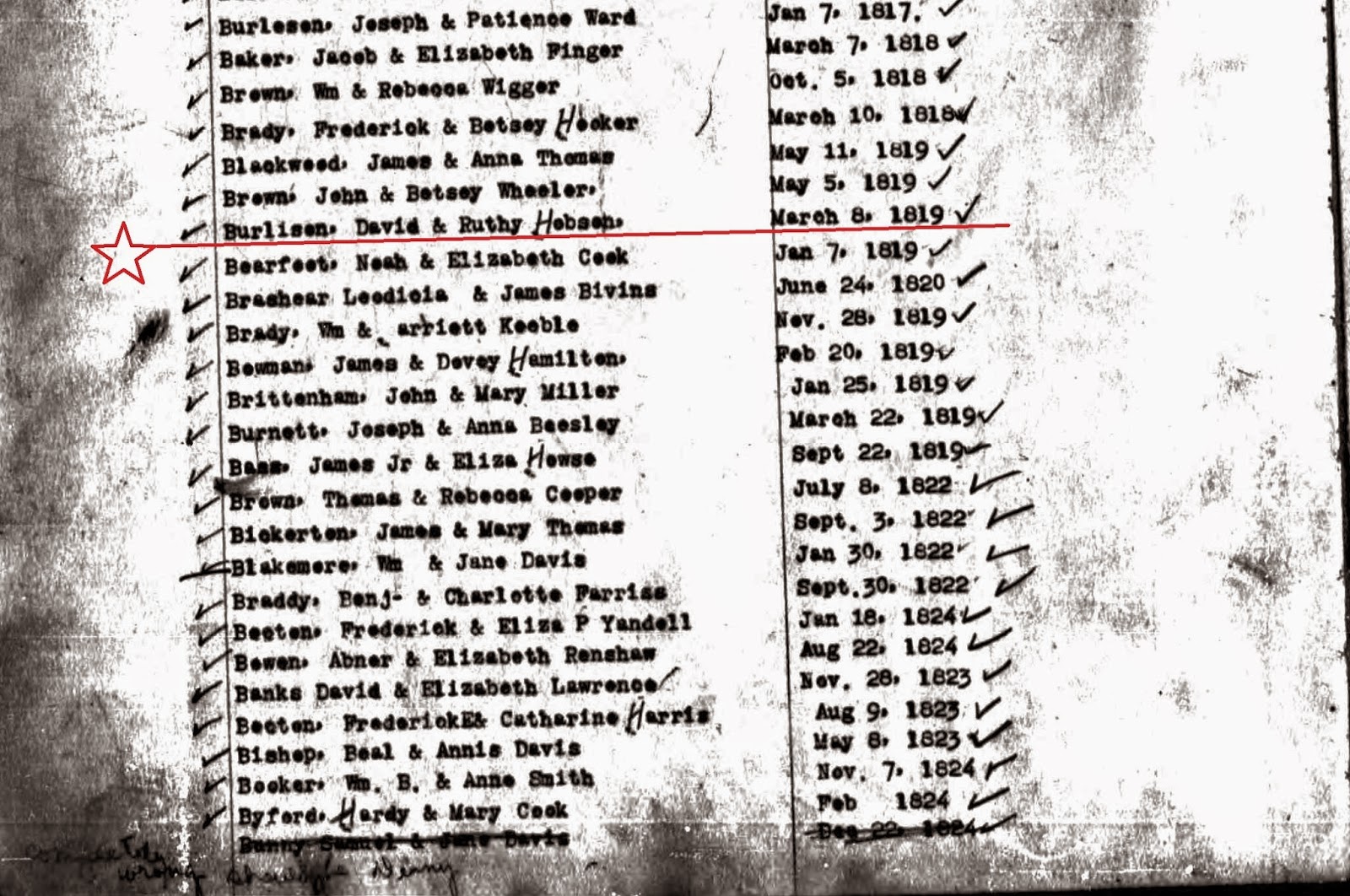
David Burleson was born on August 17, 1785, in North Carolina. His father is listed as David Burleson Sr. who was born in North Carolina and his mother as Ursula Weatherford born in North Carolina. He married his first wife, Sarah Ruth Hobson, on March 8, 1819, in Rutherford, Tennessee. 

 Most researchers and the Burleson Bulletin have him listed as dying on 8 Apr 1856 - Concord, Leon, Texas, United States.  I fell victim to this train of thought because of a David Burleson in the 1860 Census married to a Sarah, ages so close, and it was added to my tree as such.
 I checked old deeds in Tennessee, he was noted there.  His marriage to Sarah Ruth Hobson is documented in the Tennessee Marriage index.[1]

  There weren’t any death dates found for Sarah Ruth, so I was satisfied with it for a brother of my ancestor.  Then I began working on my collateral lines, this made me rethink “good enough” for it needed my attention as much as my personal lines.
My findings for this family were not directly sought out as research for David.  Rather, it was a random click on a name that was familiar as I was assisting finding records to help with the Preserve the Pensions of the War of 1812 project. 
The name was Burlason, David.  The first index card[2]. taught me the War Department/Pension Department had as much trouble with the spellings as researchers do.  There is a page in the pensions that gives one reason for the many spellings. I don’t think I have ever seen it put so plainly the challenges of a pioneer man as this.

Fold3 Pension Image Files p22 and 23 for David Burleson
The index card also gave his two wives. Yes, two, and their names, Sarah Ruth was one.  It gave Sarah’s death date and place, where and when they were married.   The second wife Mathilda,who was applying for the widow’s pension was named, her marriage to David and her death date. Unfortunately only the one child he had with Mathilda was named. People have for years thought the David Burleson married to Mathilda was a different person, and there was some contention over which one belonged to David Burleson Sr.. This is a Goldmine!
It gave his death date and place.  A little more digging through the file revealed there was a bible in the family, affidavits as to truthfulness and character of David and his wife. If I were a researcher, I would be looking for Mathilda's child's descendants for a copy of the bible... hopefully it survived.

The exciting part for guys was the description of his service.  He fought in the battle of New Orleans. 

Fold3 Pension Image Files p80 for David Burleson
  (I hear that song of  The Battle of New Orleans [3]
“In 1814 we took a little trip. Along with Colonel Jackson down the mighty Mississip.
We took a little bacon and we took a little beans and we caught the bloody British in a town in New Orleans…”
How neat to know a relative, even distant one, was there, and one who overcame the foe.

This man lived longer than anyone had originally thought.  He died on January 5, 1873, in Marion, Alabama, having lived a long life of 87 years.  

I am very glad that I found this information and have now helped point others to righting David’s Family Tree... well, a couple have now found my tree and sources and are excitedly changing theirs.  There are some that haven’t looked yet, but all in good time. 

See you next month!


[1] Ancestry.com. Tennessee State Marriages, 1780-2002 [database on-line]  http://goo.gl/9nsu2f . Provo, UT, USA: Ancestry.com Operations Inc, 2008 p2 

[2] Fold3, War of 1812 Pension Files, Digital files on-line, http://www.fold3.com/image/247/301661063/ . Tennessee, Burlason, David, p 1.

[3] The Battle of New Orleans (arr. J. Driftwood) Johnny Horton Pop Chart # 1 Apr. 27, 1959. [Lyrics online] http://goo.gl/U2w72z Columbia Legacy Records CK 69971, Transcriber: Awcantor@aol.com.