Monday, 12 January 2015

EXPECTATIONS


WHAT CAN I EXPECT IN 2015?

It is at this time of the year that we all get bombarded by new year resolutions and with the launch of the Genealogy Do-Over by Thomas MacEntee many of us are reviewing our work at setting ourselves goals for this coming year.

It is important that we give ourselves time to reflect and for those of us in the northern hemisphere the long winter evenings can be the best time of year to do this.

As I may have mentioned previously last January I attended one of The Boot Camps that Thomas and Lisa Alzo have been running. 
Next weekend they are running their Research Right Boot Camp (which sold out within a day), if you have not been able to sign up for this then it will be available from the following week. I have managed to sign up for this and hope to pick up some useful tips.

I have not managed to do much research at archives in the past two or three years and have been concentrating on getting a new organisation system in place. 
Those limited visits I have made were to look for parish registers not yet available online. 
I am hoping that next weekend's Boot Camp will help me optimise my research process so that I can make the most of my visit to Salt Lake City next month.

GOALS


  1. Complete my reorganisation process
  2. Optimise the research process
  3. Ensure that all my sources are cited as accurately as possible
  4. Make the most of visiting my cousins in the US and Salt Lake City for the Rootstech/FGS 2015 Conference

HOW WILL I ATTAIN THESE


This may sound a little "corny" but as the words of that song say "with a little help from my friends".
The genealogy community are a supportive group of people and by sharing and supporting each other we can all achieve our goals.
We must be realistic in what we aim to achieve and reassess the situation when we don't reach the endpoint we wanted.

Thomas MacEntee urged everyone who participating in the Genealogy Do-Over to slow down. Speed is not important getting it right is our aim.

The right plan with realistic goals will get more done. "More haste, less speed" is the saying that comes to mind.
I have parish register microfiche and some English counties have digital images available online, once I know what I have then I can concentrate my research objectives on those records not available in my home or via the Internet.
Some may say that goal number 4 should be number 1 and in the short term that is true. However without the other goals then I may not attain number 4. Goals 1 and 2 may not be reached before I leave the UK and 3 most certainly will not but that does not mean I cannot achieve number 4.

Preparation will be the key to my success and in my March post I will tell you if I achieved my goal and in April how I plan to make the most of my trip to Who Do You Think You Are Live.

Next month I hope to give you my impression of the first day at Rootstech 2015/FGS conference.

Sunday, 11 January 2015

Keeping Family History Stories Alive through Fiction - Part D


Keeping Family History Stories Alive through Fiction
Part D
"Dr. Bill" Smith

With the start of the new year, 2015, you may have already pledged to try writing some fiction stories based on the family research you have been doing. I’d like to take this opportunity to suggest some techniques you might want to keep in mind as you begin to write your stories.

Many of us enjoy reading about, and writing about, stories of our American pioneer families, especially in the second half of the 19th century… so let’s use that as our point of reference. I’ll focus on my favorite genre of fiction, the family saga <http://thehomeplaceseries.blogspot.com/>. I’ve recently been writing a series of short stories set in a rural, Missouri, community in the 1870s, “The Kings of Oak Springs,” <http://homeplaceseries.hubpages.com/>. It doesn’t take a lot of research on families of this period to recognize that many, perhaps most, rural families of this era had 8, 10, even 12 or more children. Are you prepared to tell stories about a family that large? Probably not. And, especially not if you want to involved some neighbors and friends in the community as well. Those relationships generate the best stories. The answer? Recognize that children came along about every two years, but, they didn’t all always survive. Infant mortality was high, accidents and disease were common, there were various reasons. For my King family in 1876-77, I used children aged 14, 12, 10 and 5… boy, girl, boy, girl. It worked well for my stories, as long as others in the neighborhood had other variations.


But, how many families can you handle in your family saga stories? Whereas most novela, including historical fiction, focus on a single protagonist, a single person, male or female, a family saga story would normally focus on one family. I did that with the King family, with their four children, plus Pa and Ma. As we move from one short story, in this case, to the next, I slowly introduced their neighboring families in one story at a time. These other families became ‘secondary characters’ although, once introduced, they could be brought into future stories in supporting roles, as well. Towns people were often introduced in occupational roles: the blacksmith, the store keeper, the telegraph operator, the school teacher, etc. Perhaps their families would be brought in, in later stories, perhaps not. This sequence soon become fairly natural, as you tell your stories and show what the family and family members are doing within their relationships in the community.

So as to demonstrate my proper understanding of the place and time about which I was writing, I used one other very important technique that I want to share with you now. I used census records of the place and time (nearby region) to choose both surnames and given names of each person in my family saga stories. I feel it is very important for my readers to really feel they are ‘living in’ that time and place. The names often provide a sense of ethnic origin and immigration issues, as well, of course. When I went back to 1833, shortly after statehood, for my recent short story collection book: “American Centennial at the Homeplace: The Founding 1833-1876,” I made sure that the four family names used as the first settlers were names that appeared in the 1840 federal census for the counties involved, as well as the given names of those first eleven people, of varying ages. This is one way to add authenticity to the stories, based on family history and genealogy research.


Finally for today, and more on this later, use the social history of the time and place of your family saga story to add context to your stories. You will almost surely, as I did, use a time and place with which you are familiar because of the research you have already done, the books you already have, and resources you don’t mind obtaining or reviewing again, especially for this purpose. I found this especially valuable when I realized that my time and place issues involved the Civil War. The towns in this area were totally devastated by competing raiding parties. What happened to my families, the town, the countryside, in this time and place? For the King family moving in, a decade or so after the war, what were the affects of the war that they still needed to face, more than ten years later? There are some good stories there, of course. Which will choose to write about? Start today.

See you next month! I love to read comments, so please leave one or more, including questions. 

Dr. Bill


**********

"Dr. Bill" (Wm. L.) Smith can be found regularly at his genealogy blog, "Dr. Bill Tells Ancestor Stories" <http://drbilltellsancestorstories.blogspot.com/> or his family saga blog, "The Homeplace Saga," <http://thehomeplaceseries.blogspot.com/>. He is an original contributor, as The Heritage Tourist, to the "In-Depth Genealogy" blog with a monthly column in the "Going In-Depth" digi-mag. He also writes a monthly post for the Worldwide Genealogy Blog.

Saturday, 10 January 2015

Thoughts On 2014 and Where I'm Going In 2015

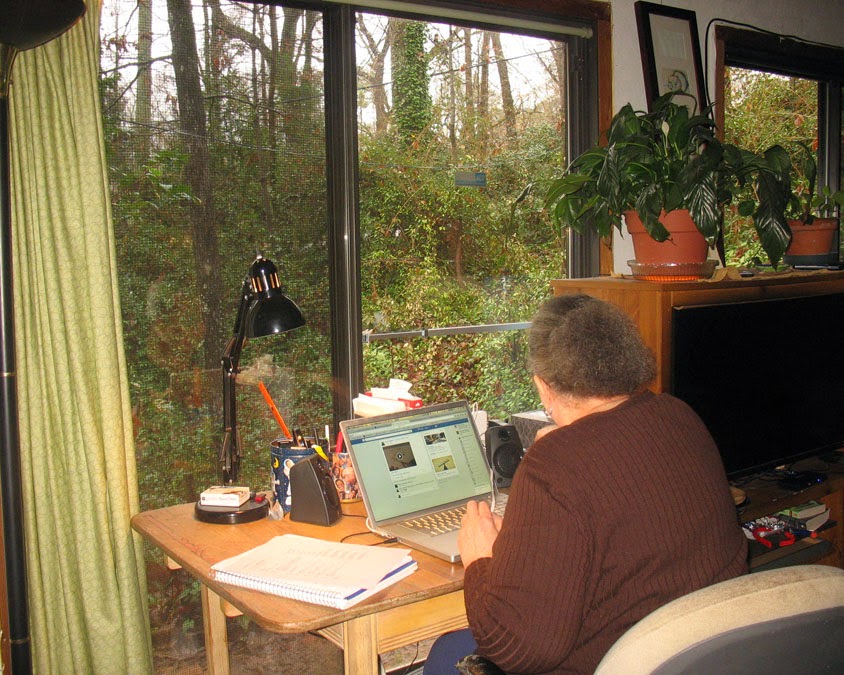
At my desk - new location, same house, new view.
I noticed that I only did 4 posts here last year. This year I have committed to 6, every other month, and plan to get those done.

Looking back over 2014 to see what I've accomplished and what I want to do this year

I participated in The Book of Me, Written by You, continued my 4th year of Sepia Saturday and did my second A to Z Challenge.  How did these challenges help my research and blogging in general?

When I can't think of anything, or have nothing ready, to blog about, Sepia Saturday's prompts very often push me to find a photograph in my collection and learn more about it or to dig deep and write about my own life.  I believe I learned the most from doing these posts about Marion Lucy Pettiford, Charles Watkins and Clifton Graham's V mail from WW2.

The Book of Me, Written by You prompts also gave me the incentive to go deeper into events in my own life and a couple of them made me look into how my ancestors lives compared to my own.  Generations of Family Signatures and Everyday Things Then and Now were the two of these.

The April A - Z Challenge works well for me. This year I used letters from my paternal grandfather, Dr. Albert B. Cleage Sr and posted parts of them with historical information to go along for the whole month.  By looking closely at the letters to see what related to the letter in question, I found information I hadn't noticed or had skimmed over on first reading the letters over a decade ago.

What new information did I find this year?  I found Wills for two owners of my enslaved ancestors - Alexander Cleage and Elijah Hurst - which mentioned my people by name and confirmed family connections.  Along with other slave era documents, these enabled me to build more complete timelines for Frank and Juda Cleage and their children. 

I found an Agricultural Census for my paternal great grandfather Louis Cleage and learned that he was a share cropper and what crops and how many animals he tended.  Most of my ancestors lived in the city or town but for the two that farmed, I've found the Agricultural Census helps round out the picture of their lives.

I found and was able to trace another sister of my great grandfather, Louis Cleage, through several generations.  This information is waiting to be written up for a blog post.  Perhaps some cousins from that line will get in touch.

Several more cousins from my paternal grandmother's side of the family found me through my blog Finding Eliza this year.  They were from the Hugh Reed branch that moved to California around 1920 and passed for white.  I am thinking about writing about how passing worked, based on several ancestors and extended family members that chose that route in the past.

Last year I started to do the 52 Ancestor Challenge, but never did. This year I am going to do it with a different twist. I'm going to  write up 52 of the slaves mentioned in various documents from the Cleage plantations in McMinn County Tennessee. I find myself researching them to find if there are any links with my elusive extended Cleage family members who disappear after the 1870 census.  I will trace them through the documents and then through other records after they gained their freedom in 1865. 


Friday, 9 January 2015

Sharing and Building Family Memories through a Family Reunion

Christina (nee Lee) an Lionel
Carriage
Sharing family memories is one of the themes on my blog “Family Stories Photographs and Memories” that I enjoy writing about the most.  We spend a lot of time researching our ancestors and sometimes forget to record our own history. I think it is important to take the time to record your own memories and assist in building your families memories.

At the wake of a recent family funeral, a number of relatives commented that “it was nice for the family to get together, even though it was a sad occasion” and “we should make an effort to get together for an occasion other than a funeral”.  These sentiments fuelled a discussion with one of my Aunts and a cousin, and we agreed to put our heads together and organise a family reunion for all our relatives linked to my Nanna (Christina Lee) and Pop (Lionel Carriage) and Nanna’s first husband (Malcolm Michael Shepherd).

A family reunion provides us with the opportunity to share and build family memories as well as discover new links.  As this blog is such a great form for sharing and discussing new ideas I thought I would post my initial thoughts and outline for our family reunion.

The aim of this post is twofold:

     1. To assist other who are contemplating a similar event and more importantly
     2. To seek the wisdom and feedback from others who have organised or attend a family reunion

So here are my initial thoughts on items that we will need to consider for the organisation of the upcoming reunion which we have scheduled for the long weekend in June.

1.  As this is our first attempt at organising a Family Reunion it is important to keep it as simple as possible! (Yep!! the KISS method). 

2.  Organising Committeedecide on the core group of family members who will be involved in organising the reunion, and select one person to coordinate, and keep the communication flowing and follow up on all action items.

3.  Allocate tasks to family memberstaking the time to select areas that they have skills in, e.g., someone with IT skills to set up scanner and copier to make copies of photos on the day, someone who is keen on photography to take charge of taking photos and someone who likes cooking  to organise morning tea.

4.  Select a date and book a venue.We have organised to use the pavilion at the Milton Show Ground, this will provide us with plenty of space, toilet facilities, a kitchen and a large covered space if the weather is inclement. Take time to visit the venue prior to the event to check out the layout and assess requirements, e.g.  Seating, heating, crockery, suitable areas for displays etc.

5.  Decide on the type of reunion you are going to have.  To keep it simple we are going to provide morning tea on arrival and then a picnic lunch, where everyone can bring along their own picnic. 

6.  Family Contacts: Set up master spreadsheet with Family member’s name’s, contact details, connection to the family and details on areas they can assist with. Seek assistance from willing family members to source as many family members contact details as possible.

7.  Reunion Flyer and Letter:
  • Develop a Reunion flyer outlining the main details of the Reunion in both hard and soft copy.
  • Compose a letter of invitation that can be sent by mail or email.  The letter should give detailed information on the reunion, contact details for RSVP or queries, details of accommodation and other attractions in the area and an invitation to assist on the day, or bring along family memorabilia, photos etc.
8.  Budget and Fundraising:
  • Draw up a list of costs for the day, e.g. Cost of Venue hire, morning tea, printing and postage, displays, printing, items for children’s activities, toiletries for the bathrooms etc.
  • Decide on how costs will be covered: Donations of goods and services, small attendance fee or a donation tin on the day of the reunion.

9.  Media and Communication:
  • Distribution of Letter and Flyers, - Circulate letters and Flyers to family members, asking if they are able to forward the invitation on to other family members.
  • Put an advertisement and possible a short article in the local paper.
  • Set up a Family Tree Web site or Family Reunion Page on Facebook – family photos, articles and reunion updates can be shared on this page.
  • Consider setting up a twitter and Google+ group.
  • Closer to the date of the reunion send out reminders and updates.
10. Decide on the Schedule for the Day:
  • Have members of the committee (or other volunteers) on hand when everyone arrives to assist with introductions, name cards and a brief outline of the layout.
  • Initial Welcome – select someone to give an opening welcome and quick outline of the day (perhaps the oldest grandchild or one of the elders of the group?)
  • Presentation – have a short presentation on the history of the family members?
  • Depending on the number of people attending, a quick run around the group to introduce family members.
  • Plan entertainment for the day, plan activities for the children that covers a range of age groups.
  • Consider having a short movie or PowerPoint of photos running, so that people can watch at their pleasure.
11. Photography:
  • Assign one or two people to be responsible for taking as many photos as possible.
  • Organise for a large group photo for all attendees.
  • Provide the opportunity for family groups to have their photo taken (with someone taking down the names of the people in the photos).
12.  Collection of Memorabilia and compiling of Family Tree:
  • Seek assistance from family members to put together the family history.
  • Set up a display of family tree – encourage attendees to make corrections and additions.
  • Collect photos and memorabilia for display at the reunion and encourage families to bring photos and memorabilia on the day.
  • Set up a display of family photos and memorabilia.
  •  Encourage families to bring photos and memorabilia on the day
  • Have a scanner and photocopier set up on the day to collect copies of photo's and to make copies of photos for family members.
13.  Post Reunion:
  • Ask family members to provide feedback and suggestions on the day.
  • Put together Memento of the day, this could include collection of photos and family documents from the day to be sent out to those attending.  This could be in the form of a booklet, CD or usb stick.  Family members could indicate if they would like this memento and pay a small fee to cover costs for this on the day.
I am quite excited and a little daunted by the prospect of organising this reunion in six months, however I am sure we will be able to put our heads together and pull off and enjoyable day for all family who are interested.

Have any of you planned or attended a family reunion recently?  Your feedback and advice on my initial summary of actions would be greatly appreciated. 


Christina and Lionel Carriage with family (hopefully some of these will be attending the Reunion) 
_______________________
If you are interested, a little more information can be found on Christina, Lionel and Malcolm (Christina's first husband) on these blogs.

Thursday, 8 January 2015

A Pauper's Life - A Look at Scottish Poor Law Records

At this time of year, my mind turned to the poem "T'was Christmas Day in the Workhouse"  and this prompted me  to take another look at Scottish Poor Law Records. 

The poem was written in 1879 by George Robert Sims (1847-1922), a campaigning journalist  concerned  with social issues.  In 21 verses it tells  the anguish of an elderly inmate, not celebrating Christmas but recalling this first anniversary of his wife's death in terrible poverty-stricken circumstances.  His bitterness and anger is directed at the patronizing visit by the local gentry dispensing food.  
It is Christmas Day in the Workhouse,and the cold bare walls are bright
With garlands of green and holly and the place is a pleasant sight:
For with clean-washed hands and faces in a long and hungry line
The paupers sit at the tables, for this is the hour they dine.
 

And the guardians and their ladies, although the wind is east,
Have come in their furs and wrappers, to watch their charges feast;
To smile and be condescending, put pudding on pauper plates,
To be hosts at the workhouse banquet they've paid for - with their rates


You will find the full twenty-one verses HERE. 

The poem had a huge impact in its day and became a popular choice for  dramatic monologue performances - but was also the subject of many a parody..  

Seeing an ancestor described as a "pauper" in a census return conjures up images of Charles Dickens' "Oliver Twist" and a time when the word "poorhouse" (or  "workhouse" in England) struck fear in people living close to destitution.  But for family historians searching for a story beyond the simple names and dates, such a discovery is an  immediate prompt to turn to poor law records - not generally available online.

They are one of the most popular types of offline tools at my local archive centre, the Heritage Hub, Hawick in the Scottish Borders,  and, although they have not been a source for my own family,  I find it fascinating to browse through them. 

Poorhouses were set up in Scotland as a result of the Poor Law (Scotland) Act of 1845 Between 1845 and 1930 over 70 poorhouses were constructed in Scotland  with an additional 90 smaller almshouses in operation. In the Scottish Borders, poorhouses were set up  in five towns serving not only the immediate town but surrounding parishes - hence their name of Combination Poorhouse or Union Poorhouse.  My own village of Earlston in Berwickshire was one of twenty-three parishes  served by Kelso Poorhouse in Roxburghshire - a lesson in research  not to get  too restricted by county boundaries. 

The Victorians  were great bureaucrats and the Heritage Hub holds a large collection of local Poor Law Registers, Poor Relief Applications and Parochial Board Minute Books, many of which can give a mini-biography of an ancestor, in often tragic circumstances, with details of name, address, aged, birthplace, marital status,  occupation, whether disabled and if so how, financial circumstances, and dependents.  Here are some examples which caught my attention:
  • Robert Leck, once a well known clockmaker of Jedburgh, admitted to the poorhouse aged 67, with a pattern of admissions and discharges until the time came when he was "wholly disabled, nearly blind and wholly destitute".  Interestingly when I did a Google search, I found  an illustration of a Robert Leck grandfather clock about to be auctioned in London.
  • The story of Janet Scott had a more positive outcome.  Her admission record in 1877 gives us a glimpse of the desperate situation in which many applicants for poor relief found themselves.  A single mother with  two children and a baby, working as an agricultural  labourer, she  was "wholly disabled by a cart falling on her".  She was on parish relief for three years.  However she also demonstrated her resilience, as  in the 1881 census she was back earning a living, as an Ag. Lab, along with her two eldest daughters.  
Janet Scott's entry in the Jedburgh Union Poorhouse Register, 1877.  
In the collection of  the Heritage Hub, Hawick
Being a "pauper" did not always mean being admitted to the poorhouse,  as those on "out relief" lived in the  community and received support such as clothing, fuel or food, as illustrated in these records from Duns, Berwickshire:

  •  15 year old James Robertson is described as "delicate and deformed by spine curvature and will never be able to do much.  He needs a suit of clothes, 2 pairs of stockings and 2 handkerchiefs.  Allowed. 
  • Mary Burns, also in need of clothing , was granted " 1 frock, 2 yards flannel, 2 yards drugget, 2 pinafores and a  pair of boots."
  • At Melrose, Rosburghshire, a mother and young children were "footsore and weary"  and given help as they made their way from Newcastle to Glasgow to rejoin family  - a distance of 114 miles.
  • Mary Phllips was admitted to the Poorhouse as "this woman's husband deserted her, having absconded to America.  She has 2 children and is about to be confined.  Her parents very poor."
  • The Inspector was not always the hard face of the law.  At Melrose two young children whose mother had run away with another man,  were given a penny to buy a roll and told to return home and send their father.   The record showed six  young children in the family aged from 13 to 3 years old.
  • Rebecca Ballantyne, however, "burdened with 2 illegitimate children" was refused poor relief on the grounds she was able bodied and earning a good wage - 15 shillings a week as a mill worker.
  • In Hawick "Robert Campbell, a weaver, almost disabled by rheumatism applied for relief and was offered admission to the Poorhouse, but declined the offer."
  • "George Wilson, a labourer, wholly disabled by bronchitis,  as certified  by Doctor McLeod, was sent to the Poorhouse on 26th March but left the same on 2nd April."


Most of these records are not available online, so my tip of the day is to contact the appropriate local archives centre, with most offering  a remote research service.  You never know what might be unearthed to throw light on your ancestors' lives.

Take a look  too, at the definitive website  http://www.workhouses.org.uk that covers  England, Wales, Ireland and Scotland - a compressive, invaluable site, full of information including  transcripts of the 1881 census of staff and inmates. 


***********

I am delighted to continue my involvement  in WorldWide Genealogy Collaboration and welcome  other bloggers joining the community, with thanks to Julie at Anglers Rest  for all her work in coordinating the project. 

My 2014 posts were: 
Bringing  Betty out of the Shadows  - A Research Review

My personal blog is at Family HIstory Fun 

Wednesday, 7 January 2015

Preserving the News from Home

I married a first generation American.  He is the only member of his family to live here in the United States, everyone else lives in Spain or Puerto Rico.  I remember years ago we used to write to family members because a long distance phone call to Spain was so expensive.  Later, the prices of the phone calls dropped and we could call more often.  In the 1990s we started emailing, and in the last few years we've used messaging and Facebook.  For the past year or two we have used Skype to make a video call to my mother-in-law.  Skype is free so we are able to do this almost every morning before my husband goes to work.  What changes I've seen in the past thirty years of our marriage!

While researching my family tree, I've seen many changes in correspondence over the centuries.  My background is almost all English, and most of my ancestors arrived in New England with the Great Migration, before 1640 with the Puritans.  I have no surviving letters, but there is evidence of correspondence in court records and town histories.  Some of these ancestors even traveled back and forth from England to Massachusetts many times.  At least one died on a voyage back to England when the ship disappeared (Reverend Thomas Mayhew (about 1620 – November 1657)).    How did the family, on both sides of the Atlantic Ocean, learn about this loss? 

I’m sure that many immigrants never heard from their families again once they arrived in America.  But we can’t be sure of that, can we?  My ancestor, Peter Hoogerzeil (1803 – 1889), stowed away on a Rotterdam, Netherlands ship to come to America in the 1820s.  He married the ship captain’s daughter.  How do I know this? Because of letters he wrote home to his family in the Netherlands.  Since he was a mariner, he traveled back and forth to the Netherlands very often, and his letters survived into the 20th century.  

My uncle served in occupied Europe after World War II.  When he was in the Netherlands he dropped in to visit his Hogerzeil cousins in Dordrect.  They welcomed him with open arms, over 100 years after Peter Hoogerzeil left Dordrect, because of the family correspondence that went on over all those years. 
2nd from left, Uncle "Buddy" Joseph Gilman Allen, 
in Dordrect, Netherlands with Hogerzeil cousins

In the 1824 in Boston, Massachusetts my 4th great grand aunt, Mary Lambert Jones (1803 – 1889) married Captain John Dominis, a ship captain.  They decided to remove from Boston and from Schenectady, New York to Honolulu, Hawaii in the 1830s.  The correspondence between Mary and her sisters and family in Boston was carefully preserved in the Hawaii State Archives.  Most of this correspondence is spread out over the last forty years of her life, after the death of her husband in 1846, at sea.

Can you imagine how long it took for letters to arrive from Hawaii to Boston in the 1840s and 1850s?  There was no formal postal system, and letters were given to ships sailing to New England on an honor system.  Even so, I’m not sure when the first news of the death of Captain Dominis reached the family.  I did find this newspaper clipping dated 24 May 1847 from the Salem Register.    The ship had disappeared four or five months earlier.  


I wonder if letters from home were accepted joyfully?  Or were they dreaded because such rare and infrequent correspondence probably carried news from home of who had died since the last letter, or who was ill, or who had disappeared at sea (it was a family of mariners).   Some of the letters to Mary Dominis were from her sisters asking her to return to Boston, but she only came home once after she was widowed, and she died in Hawaii in 1889.  Here is one from her niece in Boston written in 1848, shortly after she was widowed. 


                                          Dorchester  Aug. 13th 1848
Dear Cousin
I found looking over my letters the other day
that I am in debt to you for two.  I thought that I must
do my best to pay you by writing to you this opportunity
I am at Aunt Agnes’ visiting they have a very pleasant
place near Granite Bridge the house is old fashioned
but very good the fireplaces about two yard long wide
and a yard and a half long the panes of glass in the
windows about as large as a sheet of note paper.
I suppose that you have almost set up business for your
self.  How do you like the house  I should like to see it
very much as I understand it is the handsomest on
the Island.  Sarah Ann is in Boston visiting I suppose
she will write to you this opportunity  we miss her
and the children very much she has two very pretty
little girls  I know that you long to see them.
Aunt Lee has left Charter St. at last and gone to
Bridgewater to live they have quite a farm I believe
keep cows hens etc.  Uncle William and Aunt Agnes send
love to your mother and she will write if she has
time but she has such a family that if the vessel
sails tomorrow she will not be able to. Do you… 


Later in the 1800s letters were carried to Hawaii (the Sandwich Islands) with more frequency, and they tended to be light hearted and chatty, such as this one below from San Francisco in 1865 to Mary Dominis from her eight year old niece:


                  San Francisco, Jan. 22th, 1865

Dear Auntie,

I have got your letter,
you told me to tell you what I got on
Christmas, I got a doll, it was dressed like
redriding hood, a little wash tub and board,
a pair of gloves, a basket, and a pair of
gold sleeve buttons.  Mama has had a fire
ever since she has been here.  Mama has
a blue silk, with tails way down to the
bottom of her dress.  Mrs. Chase sent us
some pictures of our house.  On Saturday
I went to the circus.  We go to ride almost
every day.  I go to school.  I love some
friends boarding here.  Give my love
to Lydia, Jhon, Tom and Willie.

            Good bye from Annie B. Aldrich


Do you have letters from your immigrant ancestors? Or from your ancestors who removed from one city to another, perhaps moving West across the United States?

With the advent of the telephone, internet and video calling, how do we preserve these conversations now?


Monday, 5 January 2015

Why the Genealogy Do-Over is not for me

As Julie Goucher wrote in her post New Year - New Opportunity, many people have joined the Genealogy Do-Over, where you commit to starting your genealogy all over again and apply all the knowledge that you've gained over the years.

This challenge is not for me. Let me explain what my reasons are for not joining the Genealogy Do-Over.

Reason 1 - Starting over is inefficient

I think starting from scratch is very time-consuming. My biggest 'tree' is almost 60,000 people large and contains not just my own ancestors, but also my one-region-study for the area of the Achterhoek in the Netherlands, including the 6,000 emigrants from that area who emigrated to the United States of whom I've found 4,000 in US records. A conservative estimate is that I've spent over 15,000 hours of original research compiling that information. It's not something I can just 'do over.' Besides, if I had to do it all again, for the most part I would use exactly the same sources and come to the exact same conclusions.

Redoing everything is not the best use of my time, I would much rather focus on the parts that I know need work.

Reason 2 - I would end up with multiple trees

If I start over, I would end up with two trees: one with my old research and one with my 'new and improved' research. If a DNA match contacts me, I would have to consult both trees, especially if I haven't gotten far yet with the re-researching. Again, not very efficient. 

But what would I do with these two trees after I have re-researched a large part of my ancestors? Integrate them? Would that not miss the point and add a whole other layer of work? Or should I toss the old tree? But what if there are branches in there that I haven't gotten around to re-researching yet? Will I put my new, far more incomplete tree online and miss out on all the potential cousins who could have found the tree and connected with me? That seems very impractical to me. Or would I put both trees online, even though the old one may have information that I now know to be incorrect?

And what if in ten years time, after I've done more research and educated myself even more, I feel my current work is less than it could be? Would I start over again and end up with tree trees? Four? A whole forest?

Reason 3 - My tree isn't that bad

On one of my first trips to the archives, when I was 15, I met an experienced genealogist who advised me to always cite my sources, because there would come a day that I wouldn't recall where I had found everything. My early citations are far from perfect, but I have never had any problems relocating the source based on them. They may not always be understandable to an outsider though, so there is definitely room for improvement.

Almost all of the information in my database is based on original research which I've done myself. I have never just copied information from other people's trees without assessing the quality of the underlying research and verifying the underlying sources. Even as a teenager, I enjoyed doing the research myself so much that I never just accepted what someone else had written.

So although my database is far from perfect, it's not garbage either and does not deserve to be discarded. And I do not have the illusion that it would be perfect if I redid it today, my skills haven't grown *that* much :-)

My need: A process that embraces my growing skills

Instead of starting over when I arbitrarily feel that my skills have grown enough to warrant a do-over, I want to do genealogy in a way that will embrace my growing skills over time. I need a process that will allow me to revisit previous research periodically, not just once, to use my newly developed skills and experience to keep improving the quality of my conclusions.

Research reports to the rescue

The way I use my growing skills to revisit and improve previous research is by creating a research report for my ancestors, one per couple. I use the following format, which I also use for my professional clients:
  • Background information
    Here I will lay out what I know about the couple based on the research into their child(ren). For example, if I have found a birth, marriage and death record of their child that lists its parents, I will include the information about the parents that I found in these records.
  • Research questions I will state my research questions, which will include:
    • When and where were [husband] and [wife] born, baptized, married, died, buried?  
    • What children did [husband] and [wife] have? When and where were they born, baptized, married, died, buried?  Whom did they marry?
    • Who were the parents of [husband] and [wife]?
    • Did [husband] or [wife] marry more than once? If so, when and where did they marry and who was their spouse?
    Other questions might ask about the property they owned, addresses where they lived, occupations or military service of the husband, etc.
  • Limitations on research
    Any limitations on the research, such as missing records or privacy laws restricting access. Since this is my own research, there generally aren't any time limits, except in special cases where I want to share it with a relative during a family gathering. 
  • Summary
    Narrative summary of the findings of the research. 
  • List of sources
    A biography of the sources I consulted during the research.
  • Research notes
    Notes about my research, starting with an analysis of the background information. I will then create a research plan (put in the 'suggestions for further research') and start the research. For each source that I consult, I will write down any abstracts or transcripts as necessary, analyze the information and correlate it with information from other sources.
    When there is conflicting evidence, I will analyze the information and explain if and how the conflict can be resolved. If the evidence is sufficient to prove a relationship or event, I will write a proof statement or a proof argument (depending on the circumstances). 
  • Suggestions for further research
    List of other sources I intend to consult. I actually fill in this part as I'm doing the analysis of the background information and throughout the research process. Every time I think of a source I need to consult, I will add it to the list. Then when I do consult it, I will cut and paste it into the research notes and describe what I've found there.
  • Appendix
    In the appendix, I will include digital images of the original sources I consulted and longer transcripts. 
Until I've answered all of the research questions, this report is a living document where I'll add to the research notes when I work on it; updating the suggestions for further research, summary and source list as I finish each research stint.

Since my starting point for each research report is very basic, it's like a miniature do-over, for one family only. That keeps it very tidy and doable. I can often do a one-family "do-over" in one evening. See my column (Re)searcher to read how creating research reports has helped me with my research.

If I come to new conclusions or find additional information, I will then add it to my database. I will also update any source citations that weren't clear yet.

Best of both worlds

For me, creating a research report for my ancestors gives me all of the advantages of a genealogy do-over without any of the drawbacks. It allows me to analyze the information with fresh eyes, utilizing my growing skills. At any point in time, I have one database that shows my current understanding of my family, which I can share with the world.

Why do a do-over?

To the people who are doing a do-over, I would like to ask the following questions:
  • What do you hope to achieve by doing a do-over that you couldn't achieve with a less drastic and time-consuming process, like creating research reports?  
  • How do you intend to handle the multiple trees that will result from the do-over? Are you going to toss your old tree, take it offline but keep it for reference or integrate it with the new tree? 
  • Do you intend to repeat this every couple of years if your skills improve again? 
  • How will you handle the period when you've only re-researched a part of your tree? Will you not use your old tree? How will you deal with requests from (DNA) cousins?
I know that my point of view is probably not a popular one so I look forward to reading your comments and exchanging our views. In the end, I think we all want to improve the quality of our work; there are just different ways to go about it. Discussing the various ways will be interesting!

Sunday, 4 January 2015

My 2015 Goal - I Intend To Be Real

Life Lessons courtesy of one of my favorite characters!
As a child one of my favorite books was The Adventures of Pinocchio by Carlo Collodi. Originally written as a serial between 1881-1883, Pinocchio tells the story of the wood carver who wanted a son and the marionette who wanted to be a human boy. I was fascinated with the idea that a marionette could become real and I rooted for Pinocchio to get out of the various scrapes he got himself into (that underdog mentality was strong in my second generation American family). Like so many children’s stories, Pinocchio offers life lessons; sometimes we didn't even know we were learning them at the time.

In the new year and while we are all busy figuring out if we are going to do a Genealogy Do-Over or Go-Over, or if we are independently thinking about our 2015 goals, I thought it might be a good time to reflect on what we can learn from Pinocchio and apply those lessons to our genealogy and real lives. [And please find the original story rather than rely on the Disney version - although I did enjoy Disney's Jiminy Cricket.

  • Tell the truth – ah the nose that grows. Every time Pinocchio lied his nose grew. How I wish this happened in real life; we could tell who the liars were and what lies were being told. Sometimes we allow people to lie to us (we have that gut feeling, we know better, or we can’t believe the person would lie to us) and sometimes people are really good liars because they have no moral compass. In either case, when the liar is caught out trust is lost. Whether that trust can ever be regained depends on the nature and quality of the lie. The easiest thing is simply to tell the truth. 
Image courtesy of FreeDigitalPhotos.net ID-10031579
  •  Be brave, honest and generous - there is always a good fairy in these stories (that magical creature who provides the lesson and watches over the protagonist). In Pinocchio the turquoise-haired Fairy explains just what Pinocchio has to do if he wants to be a real boy. If you want to be the best person you can be, pay attention to your actions rather than just saying the words – you need to be brave, honest and generous.
Image courtesy of FreeDigitalPhotos.net ID-100260549
  • Be dependable and considerate Pinocchio got into scrapes because he was lazy, irresponsible, did not want to be told what to do, was looking for the quick and easy way, and was greedy. At any given moment that could be each of us, at least in little ways. He thought he made friends only to find out they were in it for themselves and using him (do you know any foxes, cats or donkeys?). Pinocchio survived his scrapes and found out what and who were important, and he became a responsible and considerate son. He stepped up to the plate when Geppetto was ill and took care of him. Remind yourself what and who is important in your life and act accordingly. 
Image courtesy of FreeDigitalPhotos.net ID-10029983
  •  Be the best you Pinocchio become a real boy when he was kind, unselfish and thought about others (Geppetto and the turquoise-haired Fairy). Being real (or authentic) means knowing who you are and striving to be the best person you can be. This often means putting others’ needs ahead of your own desires, showing compassion and being kind. We can all get ahead in this life, but we don’t need to do it by stepping on others or using them. Do you know who you are and is that someone you are proud of? Take those necessary steps to be the best you each and every day.
Image courtesy of FreeDigitalPhotos.net ID-100221658


Bottom line Pinocchio is all about the difficulties of growing up, accepting responsibility for our behavior, understanding the necessity of being honest, and the importance of making things right when we have been at fault or harmed someone. Since 2015 is going to be my best year ever, I intend to be real – how about you?


Friday, 2 January 2015

A Glorious GeneaYear

Over on my GeniAus blog at the end of each Geneayear I have asked my Genimates to reflect on their Geneactivities over the past year and respond to the Accentuate the Positive Geneameme


I usually post a compilation of links to the responses at the GeniAus blog but this year I will do something different. I am posting them here because the responses so far have come from all corners of the globe, they demonstrate that ours is truly a Worldwide Community


In a world where there is so much doom and gloom and in which people bellyache about not realising unreachable goals it is uplifting to read of the Geneatriumphs of our geneablogging friends. An added bonus for me is that I always get a response or two from geneabloggers who are new to me and so, with these new additions, my RSS feed becomes more bloated but my geneaworld expands.


It is not too late to add your post to this list of links so, if you have the time, please join in this activity and notify me of your post.


Here are the responses to date:


Pam Carter from the US: 
http://mymaineancestry.blogspot.com/2015/01/2014-accentuate-positive.html

Pauleen Cass from the Northern Territory: https://cassmob.wordpress.com/2015/01/03/accentuate-the-positive-2014/

Shelley from ACT: http://twigsofyore.blogspot.com.au/2015/01/2014-quality-over-quantity.html

Alex Daw from Queensland: http://familytreefrog.blogspot.com.au/2015/01/accentuate-positive-geneameme-2014.html

Sue Donaldson from Scotland: http://scotsue-familyhistoryfun.blogspot.co.uk/2015/01/accentuate-positive-geneameme-2014.html

Dara from Ireland: http://blackravengenealogy.blogspot.com.au/2014/12/2014-in-review-accentuate-positive.html


Fran Ellsworth: http://branchingoutthroughtheyears.blogspot.com/2015/01/response-to-geniaus-accentuate-positive.html

Janet Few from England:  http://thehistoryinterpreter.wordpress.com/2015/01/02/accentuate-the-positive-geneameme-2014/ 

Jo Ann Fitzgerald from Australia: http://ofmyfleshandblood.blogspot.com.au/2015/01/accentuate-positive-geneameme.html

GeniAus from Sydney: http://geniaus.blogspot.com.au/2015/01/time-for-reflection-accentuate-positive.html


Kirsty Gray from England: http://family-wise.co.uk/atp-2015/

Kirsty Gray - Part 2: http://family-wise.co.uk/atp-part2/

Victoria Green from Victoria: ; line-height: 19.6000003814697px;">http://campaspegenealogy.blogspot.com.au/2015/01/accentuate-positive-geneameme-2014.html


Rebel Hand from England : http://rebelhand.wordpress.com/2014/12/31/accentuate-the-positive-2014-2/


Shauna Hicks from Queensland: http://www.shaunahicks.com.au/accentuate-the-positive-geneameme-2014/


Iwikiwi from England: http://blog.iwikiwi.com/2015/01/my-genealogy-year-2014-accentuate-the-positive/


Tessa Keough from the US: http://keoughcorner.blogspot.com.au/2015/01/accentuate-positive-2014-edition.html

Fran Kitto from Australia: http://travelgenee.com/accentuate-positive-2014-geneameme/

Elizabeth Lapointe from Canada: http://genealogycanada.blogspot.com.au/2014/12/accentuate-positive.html


NikiMarie from the US: http://mypeopleinhistory.wordpress.com/2014/12/31/2014-in-review/


Shannon Thomas from the US: http://shannonmthomas.blogspot.com/2015/01/accentuate-positive-2014-geneameme.html

Thursday, 1 January 2015

New Year - New Opportunity?

The New Year is always full of optimism and a chance for a change. For those of you who journal it has for me that same fuzzy feeling when you start a new journal. Always in the clearest and nicest of handwriting only to become a mess within a few days.


There has been much debate and excitement in the blogging world of the Genealogy Do Over planned by Thomas McEntee.

I have spent time reflecting on will I start from scratch or simply tweak the opportunity to suit me?

I turned to my journals. My very first note about my family history was made in July 1986. Yes, almost 30 years ago. I started early, what can I say!

Do I want to really start again? I therefore spent the Christmas period reflecting and re-evaluating what material I already had. My system is not perfect, but then neither am I! but Genealogy Do-Over is an opportunity to assess your genealogical state of play.

Three out of four of my maternal Great Grandparents were born in Surrey, Sussex and Hampshire. In particular that small area where the three Counties meet. So it was probably no surprise that I eventually discovered that my maternal Grandparents were sixth cousins. My family history in these three Counties spans the best part of 300 years, with some surnames appearing twice.

My genealogical program of choice is Roots Magic, although suitably inspired by +Tessa Keough I have started to dabble with Legacy and in particular hone in on the knowledge of the Legacy Virtual Users Group on Google+. My Genealogy file is called Main File and as you might expect it starts with me, expands to include my husband and his family which is more problematic than mine for several reasons. The file then goes back through my maternal line and includes collateral lines because that can give information that on it's own appears unconnected, yet when pieced together provides other clues and angles for research. I also have a set of folders called Main File. In those folders are copies of the documents, that relate to the details in the electronic version and I have a set of electronic folders containing the same.

My Genealogy Do-Over is going to be a chance to reassess what information I have, starting with me. Checking everything is referenced and cited.  As I leave no descendants could a descendant of a collateral line take my research and follow my documentation? As I explore what I already have I will of course identify what I do not have. That is an opportunity to explore my family peers, my late Mum's Cousins and so forth. Building my Genealogical to do list.

Over the course of the last year or so I have added biographical information on various ancestors to my website and I plan to wove that into the 52 Ancestors in 52 weeks program.

This blog continues to go from strength to strength. We see a slight change in the structure with the writer's & author's from 2014 in the main moving to every other month. We say cheerio to several writer's who want to get on with various domestic things, but who may join us in the future and some of our writer's are in for the long haul and writing every month. We also have some really great writer's joining.

Would you though like to join us? The only stipulations are
  1. You write on your scheduled day (or make arrangements to swap!)
  2. The post must be related in some way to local or family history or history in general.
To see the available slots and current authors please CLICK HERE and if you are interested then please do leave a comment.

That's it from me until next month.

Happy New Year!
Julie