Tuesday, 9 September 2014

Using Time Lines as a Family History Writing Tool

The thing I enjoy most about writing family stories for my two blogs, Family Stories: Photographs and Memories, and The Other Half of my Tree - Stories of my female ancestors, is putting together all the different snippets of information that I have gathered.  I love piecing together dates of birth, death and marriages with newspaper clippings and events of the day into a short story that reveals a little about a particular ancestor.

This is often a difficult task, especially when of writing about female family members.  So today I thought I would share with you the tool I find the most helpful.    A time line of events in their life! 

There are many different programs and apps designed to assist you with this task, for example: Easy Timeline Maker, Timeline Builder, Capzles, Tiki-Toki and Timeglider to name a few. However, I have found the most useful form  is to create a simple time line in Excel. 

To show how I use this format, I will share with you a section of the time line I developed when researching Elizabeth Taylor (nee Rushworth). I wrote a series of blogs on Elizabeth's life, and it is my hope in "time to come" to will be able to write a short book on her fascinating story.

Part of Time Line for Elizabeth Taylor (nee Rushworth)
Using an Excel Sheet I enter every little bit of information that I can find. It is important to remember, in the case of women, to record all the dates and events of the male members of her family as these are often more easily found and will add background to her story:

  • birth, death and marriage dates (bdm) for the person with details of place etc 
  • bdm dates for their children, parents, siblings, grandparents, Aunts and Uncles, if they occur during the person's life time line.
  • census dates, with details of where they lived
  • dates they started and finished school
  • dates of illnesses, or other life events that you know about
  • details from any newspaper articles that you have been able to find on them, i.e.winning prizes in the local show for flower arrangement, being involved in an accident, receiving an award
  • military service of the person or a family member
  • immigration, travel
  • land or business ownership
  • courtcases
and the list goes on.  

Then, on the same excel spreadsheet, I build another timeline of events that could have impacted on Elizabeth Taylor's life. This is, I think the key to putting your ancestor's story together and places it in context.


Examples of events that should be included into the supporting time line are:

  • Start and finish dates of Wars, eg WWI, Crimean War
  • Times of economic depression, eg start of the Potato Famine, cotton famine
  • Launch of post office savings scheme, first postal service
  • Establishment of Trade Unions
  • Workers strikes
  • Events in the town, ie Establishment of local Borough, or council, building of schools, starting of hospital or ambulance service, opening of Town Hall
  • Women given the right to own property
  • Laws passed to make it compulsory for children to attend school
  • Visits from dignitaries, major sporting events, opening of local cinema, Circus comes to town
  • Natural disasters such as  disease outbreaks, storms, floods and droughts
Searching for this information can take time, however today with access to so many online newspapers, and historical sites there is a lot of information available to plump out the details of your ancestors life.  I have even found it possible to go search the local newspaper on the date of an important event, ie wedding and found the weather forecast for the day.

Often, a small piece of information entered into the second part of the time line will give meaning to an event in your ancestors life.  For example an outbreak of typhoid and the death of a number of family members at the same time, or trade union strikes or closing down of a local factory could explain why your ancestor decides to move to another village or district or even immigrate.


The development of a time line is vital to gain an understanding of the setting of your ancestors life and helps put life events into a clear frame of reference with the lives of their families, events in their community and outside influences.  Do you use timelines when researching your ancestors?  Do you have any other suggestions for the composing these stories?

Monday, 8 September 2014

The Day George Died, 16th September 1916


This date  of 16th September 1916  is  significant to me as my great uncle George Danson, a member of the Royal Army Medical Corps. was killed on the Somme, a week after his 22nd birthday, buried at the Guards' Cemetery, Les Boeufs.  Later research discovered that my husband's great uncle Frederick Donaldson died on the  same day - remembered on the Thiepval Memorial.  

I was interested to see how a serious national newspaper reflected the war and life on the home front, but also discovered another personal dimension to one of the reports, 

First impressions -  tightly packed pages with small print, no photographs, lots of classified adverts  and only a few pictorial ads - so visually not very appealing to today's general reader.

Content wise, there was no question that the war dominated the coverage from the front page announcements of men  "Killed in Action".  Two pages listed naval honours and recommendations for  promotion awarded after the Battle of Jutland.  Also featured were a Roll of Honour, reports of war on all fronts, including an excellent map showing "The Great Advance in the Albert Plateau" , plus lists of war charities.  and sad Personal Adverts requesting  any information on soldiers reported missing.


Headlines such as "Great British Advance", "Successes on a Wide Front". "Our Troops have Advanced", "Considerable Success Already Obtained - some 2000-3000 yards at various places"  present a positive picture, along, too,  with news of a new type of fighting machine  - the tank, which "proved of considerable utility".  With the benefit of hindsight, one cannot help feel this was giving an optimistic picture  of what we later came to know was the truth.  

The official casualty numbers for the day were tucked away at the end of an article - 212 officers killed and 3543 men


One story which had close personal links  told of  the Victoria Cross awarded to 15 year old John Travers Cornwell  whilst on board HMS Chester during the Battle of Jutland, with headlines - "Brave Boy's Honour After Death", Seaman's Gallant Deeds".  

The Victoria Cross (VC), born in the carnage of the Crimean War is the highest award available to the armed forces for gallantry in action in the face of  the enemy. The medal  was originally made from the bronze cannon captured during the Crimean War (1854-1856).

The citation for John Cornwell read " Mortally wounded early in the action, Boy, First Class, John Travers Cornwell remained standing alone at a most exposed post, continuing to service his gun, until the end of the action, with the gun's crew dead and wounded all round him. His age was under sixteen". 


John was a keen scout in his home town and in his honour the Boy Scout Association instituted  the Cornwell Scout Badge, awarded for outstanding acts of  courage and endurance in the face of adversity.

And the personal angle - my husband received the badge in 1948 following three years illness  in hospital.


What else caught my eye in "The Times" newspaper?

  • The  classified  adverts with households  seeking  lady housekeepers, housekeepers (what was the difference?), cooks, parlourmaids, scullery maids, between maids, laundry maids. 

  • Life was changing, though, with an advert for a "Lady Motor Driver" and a "Lady Clerk - not under 30, must be a first class typist and shorthand writer and experienced in filing and indexing".  
  • Auction Sales notices with  lengthy details of estate and their contents on the market.
  • A long listing of Shipping Adverts for travel to India, Egypt, Hong Kong,  Shanghai, Singapore, Australia, South Africa,  USA and Canada.
  • Article on "The Home Treatment of Alcoholic Excess and the Drug Habit"- with no interference with social, business or other duties". 
  • One of the few pictorial adverts was for Dunlop tyres

    •  
      Old newspapers have always fascinated me and this was no exception. For family historians, they offer an invaluable source of background information on events (local, national and international). They also enable us to experience the actual events described in the language and emotions of the time and can throw light on the smaller aspects of our ancestors' lives.  
       
      My great uncle George Danson received  a tribute in his  local newspaper "The Fleetwood Chronicle".  
      The  report noted that George was a member of St. Chad's Choir, Poulton - this was new to me and lovely to read as both my mother, father  and myself have long been involved in choirs. It also told that  prior to enlisting, George  had been manager of W. H.  Smith station bookstall at Todmorden, West Yorkshire. He joined the army in January and went out to the Front in August  - surviving  less than two months.
       
      The newspaper concludes "Captain Macleod in writing to his mother who had four other sons serving, said "He was one of my stretcher bearers and was gallantly doing his duty over open and dangerous ground which suddenly became subjected to severe shell fire.  He continued steadily bearing his burden and was only stopped by the shell that took his life. We mourn his loss and are very proud of him".  
 
George remembered on the War Memorial in Poulton-le-Fylde, Lancashire


************
Historic Newspapers provides copies from all over the world, with the bulk of their archives from the US and the UK, including many regional titles.


Sunday, 7 September 2014

Basic Nova Scotia Genealogy Research for New England Yankees


Like many other Americans with New England ancestry, I have some ancestral lines that went from New England, to Nova Scotia and back to New England with “The Planter Movement”.  This migration happened after the Acadian Expulsion of 1755, when the French Protestants were forced to leave Nova Scotia.  The area was re-populated with foreign Protestants and New Englanders.  Some New England Loyalists removed to Nova Scotia after the American War of Independence.   Other New Englanders of French extraction had their ancestors leave Nova Scotia after 1755 and arrive in the “Boston States”.   Later, some of these Planter families came back to New England after several generations.  The migrations back and forth, or from one country to the other continue until present times. 

If you look at the maps of New England and the Canadian Maritime provinces, you can see that traveling by water made these two regions very easily accessible to each other. I had ancestors from Cape Cod, Connecticut and Boston’s North Shore travel to Nova Scotia by water.  In 2007 I traveled from Bar Harbor, Maine to Yarmouth, Nova Scotia by ferry to trace my roots.  My route was the same one traveled by my ancestors, although they used coastal sailing vessels instead of a modern catamaran ferry.

If you have ancestors from Nova Scotia, or if you area resident of Nova Scotia with New England roots, it pays to become acquainted with the history of the two regions.   There are basic outlines of the Planter Movement, the Acadian Expulsions, the Revolutionary War Loyalists and Ulster Scots migrations online starting with short sketches at Wikipedia to more lengthy records at the Nova Scotia Archives website. 

You don’t have to travel to Nova Scotia to trace your roots.  Here is a list of helpful steps:

      1)       Try online searches at websites such as FamilySearch.org and Cyndislist.com to become familiar with the databases available for free and for subscription on the web
      2)      Search out genealogy societies such as the Canadian American Genealogical Society in Manchester, New Hampshire or local genealogy clubs
      3)      There are many websites and blogs available for Nova Scotia research such as Lucie LeBlanc Consentino’s “Acandia Ancestral Home” blog or check out the forums on Facebook for Nova Scotia genealogy
      4)      There are books on Loyalists, Acadians, Planters and I listed some below

If you would like to plan a "genea-jaunt" (research trip) to Nova Scotia you should try to do as much research at home ahead of time.  Map out the villages where you ancestors lived so you can plan your driving route, and research the times and hours of the local repositories of records.  Most archives will be closed on a Sunday, but we planned to be at the Baptist church in Billtown on that day, where my 2nd great grandfather, Reverend Ingraham Ebenezer Bill, had been the minister, or use that day for cemetery hunting (cemeteries don't close on Sundays).  Don't forget to photograph where your ancestors lived, worshipped, went to school,  and all the local landmarks.  

The Billtown, Nova Scotia Baptist Church
where my 2nd great grandfather was the pastor.
We drove our car and traveled by ferry to get here in 2007

Nova Scotia is accessible by air to Halifax, or by ferry from Portland, Maine to Yarmouth, Nova Scotia.  Driving is a long trip, through Maine and New Brunswick, but a worthwhile route if you also have New Brunswick ancestors.  We decided to drive one way (because Reverend Bill was buried in St. John, New Brunswick), and to take the ferry the other way because I had many ancestors in Yarmouth as well as in Billtown and Lunenburg.   We also visited Louisburg because I had many ancestors fight in the several attempts by New Englanders to overtake the French fort there.  


Sources:
Dictionnaire Genealogique des Families Acadiennes by Stephen A. White, 2 volumes, 1999

Planter Nova Scotia 1760 – 1815, by Julian Gwyn, 2010

New England Planters in Maritime Provincial Canada, by Judith Norton, 1993

Nova Scotia Archives   http://novascotia.ca/archives/   (formerly Public Archives of Nova Scotia)

The New England Planters website http://www.cyberus.ca/~bharvey/planters.shtml

The New Englanders in Nova Scotia database at the New England Historic Genealogical Society website (membership needed).  This database has 48,155 names from more than 650 families of Planters and Loyalists  http://www.americanancestors.org/search.aspx?Ca=096&Da=398

Nova Scotia GenWeb Project  http://www.rootsweb.ancestry.com/~canns/

Planters Studies Centre, Acadia University, Wolfville, Nova Scotia, Canada
Chair: Stephen Henderson Email stephen.henderson@acadiau.ca

Genealogical Association of Nova Scotia http://novascotiaancestors.ca/   and on Facebook at https://www.facebook.com/NovaScotiaAncestors


American Canadian Genealogy Society, Manchester, New Hampshire   http://www.acgs.org/ 

Lucie LeBlanc Consentino’s “Acadian Ancestral Home” blog

Gail Dever’s “Genealogy a la Carte” blog    http://genealogyalacarte.ca/

Lorine McGinnis Schulze’s “The Olive Tree Genealogy” website, Nova Scotia resources page

Nova Scotia Genealogy on Facebook   https://www.facebook.com/groups/novascotiagenealogy/

Thursday, 4 September 2014

10 Books That Have Had An Impact On My Life

2 of my choices - put them on your reading list!


Two things - As the White Rabbit said "Oh dear! Oh dear! I shall be too late!" - and for me that would be writing for the Worldwide Genealogy Blog before my midnight deadline! Oops - this has been a crazy couple of weeks and I am completely off kilter (but slowly righting myself!). However, sometimes it is a good thing to be running late because - I saw a blogpost where one person challenged another to come up a list of 10 books that have had an impact on her life. Wow - that challenge is interesting and deep (and does not require getting doused with water!). I am a huge reader and always have been - and I mean one or two books a week, except while in graduate school (lots of reading, just not much fun stuff).

So with credit to the blogger (Judy from Australia) who wrote about the challenge, as well as a link to her list found at Jottings, Journeys and Genealogy, why not make up your list and then see if you share any books in common with her (I know I did). Perhaps you share a few books in common with me.

Here is my list:

(1) Thumbelina (Hans Christian Andersen)- the first book I got to purchase. I loved the story and the artwork - it fed into my sense of adventure and possibilities. When my mother told me I could pick out a book at the school fair, I thought I was taking it home. Sadly we purchased it for the school library - and when I did not have it checked out, I hid it so others could not find it to check it out. I was a bit naughty as a first grader in Catholic school (the story of my life). This book began my lifelong love affair with books as well as strong, smart heroines.

(2) The Crystal Cave, The Hollow Hills and The Last Enchantment (trilogy by Mary Stewart) - I first read these books on our family summer vacation - we might have gone to Eastern Washington, but I went back in time and was transported.

(3) Black Like Me (John  Howard Griffin) - a must read for anyone who wants to understand what life was and sometimes still is like for a minority in the USA.

(4) To Kill a Mockingbird (Harper Lee) - I read this book in high school but did not really grasp the full importance of it until I read it (and watched the movie) for a legal ethics class. Every single one of us should aspire to live our lives with integrity and honor (when everyone is watching and more importantly, when they are not). What is not to love and admire about Atticus Finch, and didn't we all want to be friends with Scout?

(5) Gone With the Wind (Margaret Mitchell) - I immediately bonded with Scarlett in spite of all her faults and I never understood what anyone saw in Ashley. I was team Rhett from the get go. This book reminded me that so much in life is neither black nor white but various shades of grey. We need to understand an individual's background and motivations. My grandmother left me her second edition of the book (the one with all the movie photos) because I always snuck a peak whenever we visited for monthly Sunday dinner. GWTW created a bond between my grandmother and me that I will always treasure.

(6) Here Be Dragons, Falls the Shadow and The Reckoning (trilogy by Sharon Kay Penman) - I picked up this trilogy while in Glasgow and read the books while I spent a summer in the UK. Fascinating historical fiction and wonderfully written. I am throwing in The Sunne in Splendour because I picked it up with the trilogy and loved the redemption of Richard III (unfair of Shakespeare to paint him a villain).

(7) In the Garden of Beasts (Erik Larson) - one of my favorite authors, as I love how he researches and shares truth that is stranger and harsher than fiction. As the world failed to pay attention, Hitler and his bully boys rose to power. What was it about the world powers, their leaders, and foreign service personnel that they stood by while Berlin and the rest of Germany slid into such horrors? Why did the German people turn on their neighbors and turn a blind eye to what was happening to the Jews and other "minorities." Why do we not seem to learn the lesson of what happens when a people, country or political group is intolerant - why when we said "never again" do we continue to have ethnic cleansing, massacres, and religious zealots/terrorists on the world stage?

(8) The Lymond Chronicles (a six part series) and The House of Niccolo (the eight part prequel) (Dorothy Dunnett) - my all time favorite author, someone who kept me thinking throughout each book in both series and she took me on an adventure all over the world. An absolutely brilliant series of books that once you reach the end of each series, you have to go back and start all over to catch all those clues you may have missed. Her books made me delve into the history, language, literature, religion, geography, and politics of the times she wrote about - she was a wonderful author who encouraged her readers to learn more about so many subjects. When I traveled throughout Scotland, Europe and the Mediterranean, oftentimes I knew I was traveling where my favorite characters traveled.

(9) The Reason I Jump (Naoki Higashida) - if you want to understand one person's journey living with autism and rethink your response to those who are different, this book is both eye-opening and heartbreaking. Whether you know an autistic person or you simply want to be aware of what an autistic person goes through and expand your understanding of humanity, read this book.

(10) The Boys In The Boat (Daniel James Brown) - Seattle in the 1930s and 1940s, working-class American boys with a dream, the history of crew both in England and America, the hard work, dedication, and hopes of the boat builder (George Pocock), the coaches, and the crew members of the University of Washington 8-man crew, all in the context of the events that shaped history - the depression and the 1936 Berlin Olympics. I was on the edge of my seat cheering those boys on and learning life lessons from Mr. Pocock. Reading this book, you can't help but cheer for Joe Rantz (it is also a story of families - those you are born into and those you choose to join, and it made me thankful for mine).

Next month, I will share my list of 10 genealogy or family history books that have had an impact on my genealogy life.

And now - what are your selections?

Tuesday, 2 September 2014

Back to the W's

In one of my early contributions to this blog I indicated that I would be writing about the Ws in my initial posts. Well I strayed, I call that Tangential Genealogy. Back on the straight and narrow I am returning to another W word.

WHY?

Why do I spend hours hunting down dead people - at my keyboard, visiting cemeteries, libraries and archives?

  • I want to know my ancestors which in turn enables me to know who I am.
  • I want to preserve my stories and those of my ancestors for future generations.
  • I love solving problems, coming up with hypotheses and trying to solve them.
  • The thrill of the chase is energising.
  • Solving a riddle or mystery brings on a feeling of euphoria, normally a sedentary soul I find myself doing impromptu genealogy happy dances.
  • I enjoy research, after years working as a librarian I find that I can satisfy this need through genealogy. 
  • As an only child I also like working in isolation, genealogy allows me to do this.
  • I can indulge in lots of genealogy activities from the comfort of my home.
  • Genealogy gives me a focus for some of my travel (although I don't need much encouragement to hop on a 'plane).
  • Genealogy research allows me to connect with distant relatives and, when collaboration ensues, we build up richer pictures of our ancestors.
  • I have always been a bowerbird who collects what others see as ephemera or even rubbish. I am a listmaker, I love to record dates and events. These traits align well with family history activities.
  • Genealogy creates an avenue for me to connect with interesting and interested people all over the world.
  • I like writing, genealogy provides me with fresh fodder for my stories.
  • I love technology and social media, Genealogy provides me with a focus for this interest. 
  • As a social genie geneablogging gives me an outlet to share my journeys with like-minded  people. I may even snare a few cousins along the way.
  • Genealogy is an active pastime that gives the grey matter plenty of exercise.
Until I wrote this post I hadn't considered Why I do Genealogy for a long time, my reasons for 'doing' genealogy have expanded since I started out in 1988. I enjoyed the opportunity this actviity  created for me to reflect.

Why do you spend hours hunting down dead people 

Sunday, 31 August 2014

Use FreeBMD postems to find new relatives

FreeBMD is an ongoing project to transcribe civil registration indexes of births, marriages and deaths for England and Wales, and to provide free Internet access to those transcribed indexes. FreeBMD is an immensely useful site, and I like it even more since it produced the unexpected bonus of contact with new relatives via 'postems'.

An excellent feature of FreeBMD (but one that is overlooked by many genealogists) is the ability to add a short message (250 characters maximum) called a postem to any entry in the FreeBMD database.

The postem can tell people how to contact you - or (in keeping with our 'collaboration' theme) if you buy a certificate that turns out to be for the wrong person, you can help other researchers by putting details from the certificate in a postem.

Here is a step-by-step example of how I used a postem.

I searched FreeBMD for the birth registration of Bertha OAKLEY, who (according to census records) was apparently born in 1895 in County Durham. This is the search screen.


The search result looked like this.


I clicked the 'Info' icon and added a postem with my contact details.

When someone adds a postem, an envelope icon appears beside the entry, as shown below. You click the icon to read the postem.


To my delight, a distant relative contacted me as a result of my postem! She had information about Bertha OAKLEY's grandfather, Benjamin PEACOCK, who was a brother of my great-grandmother, Mary HUDSON nee PEACOCK.

This was just one of several similar successes that I've had with FreeBMD. I now always add a postem for each index entry that is (or could be) for my family.

I also use the 'search postems' feature to quickly check whether anyone else has added one that may be relevant to me. Here is an example of a search...


...and the search result, showing two postems that fit the criteria.


If you have used FreeBMD to find births, marriages and deaths for your family, I urge you to:
  1. Go back and add postems to all of those entries.
  2. Include an email address that will be valid long-term, such as a free Gmail address from Google.
  3. Check the text carefully before you click 'create', because postems cannot be changed or deleted.
  4. Before you start, read the Postems Help page.

Have you benefited from using postems on FreeBMD, or used them in different ways?
~ ~
You might also like:

Thursday, 28 August 2014

Creating your own Google Map using the Mapalist utility

Earlier this year Jill Ball wrote about where our forebears come from.  She included a map of where her forebears came from.

An excellent utility for preparing Google maps highlighting specific places is Mapalist.

I have written about Mapalist previously on my own blog (Mapping the birthplaces of the children of John Way and Sarah née Daw).

First you create a spreadsheet in Google Drive. You enter the place names you want and the utility uses those names to mark the places on a Google map.

It was very quick to enter the data and generate a map. I used a separate column to enter the Australian state to ensure correct disambiguation of the place names.

Birthplaces of children of John Way and Sarah DawState
AdelaideSouth Australia
BinalongNew south wales
Collingwood Victoria
MurrumburrahNew South Wales
GrenfellNew South Wales
ParkesNew South Wales

You then go to https://mapalist.com. You do need to register for an account if you haven't already got one. You will need to allow Mapalist access to your Google account details.

Go to the tab Maps then choose create. Choose the source type of Google spreadsheet. Choose the worksheet you entered the data into.
Creating a map in Mapalist
You get a preview of the data being used.
After clicking next you assign fields to the columns. It did this automatically - I didn't need to change anything.
stage 2 of creating your map using Mapalist

I used a separate column to enter the Australian state to ensure correct disambiguation of the place names.

I clicked apply and then next

stage 3 of creating your map using Mapalist
In my case it had no problem in working out the places I meant.  If you have trouble then you might need to tweak your spreadsheet with extra fields to help locate the place you are meaning.

At the next stage you configure your map by choosing the pin you want.
stage 4 of creating a map using Mapalist
You can play around with the settings and preview your map


options in stage 4
Finally you save your map, having configured it as to whether you want it private or public ...


stage 5 save your map
You can preview

Immediately below the map are some buttons to click. The second one, a rectangle with an arrow emerging from it, is for sharing by email but clicking that also gives you the code to embed your map on any web page including your blog.

Et voila!


Good luck with mapping your family history.

It's a...date?

It is almost August 31st. What makes me say that?

August 31st is one of those dates in my family. You know, a date that more than one person in the same family died, or was buried on. A date that when I first realized its particular significance for these people, I was kind of just like 'Wait, what? Oh my gosh, that's so trippy.'

Oh my!

My Great Uncle Adam Gow was born on August 28th, 1905. However, he was only alive for 24 hours and died on August 29th. He was buried on August 31st. Four years later, my Great Great Grandmother Christian Alves died on August 31st, 1909. 94 years later in 2003, my paternal Grandfather William D. D. Gow died on August 31st. William and Adam were brothers, and Christian was their grandmother.

Christian Croal, Great Great Grandmother.
[Source: Personal Collection]

I was only 12 when my Grandfather died, so at the time, none of us had any idea about the significance of August 31st. It was only when I started genealogy and got Christian's death certificate that I realized and proceeded to have my 'Oh my gosh' moment.

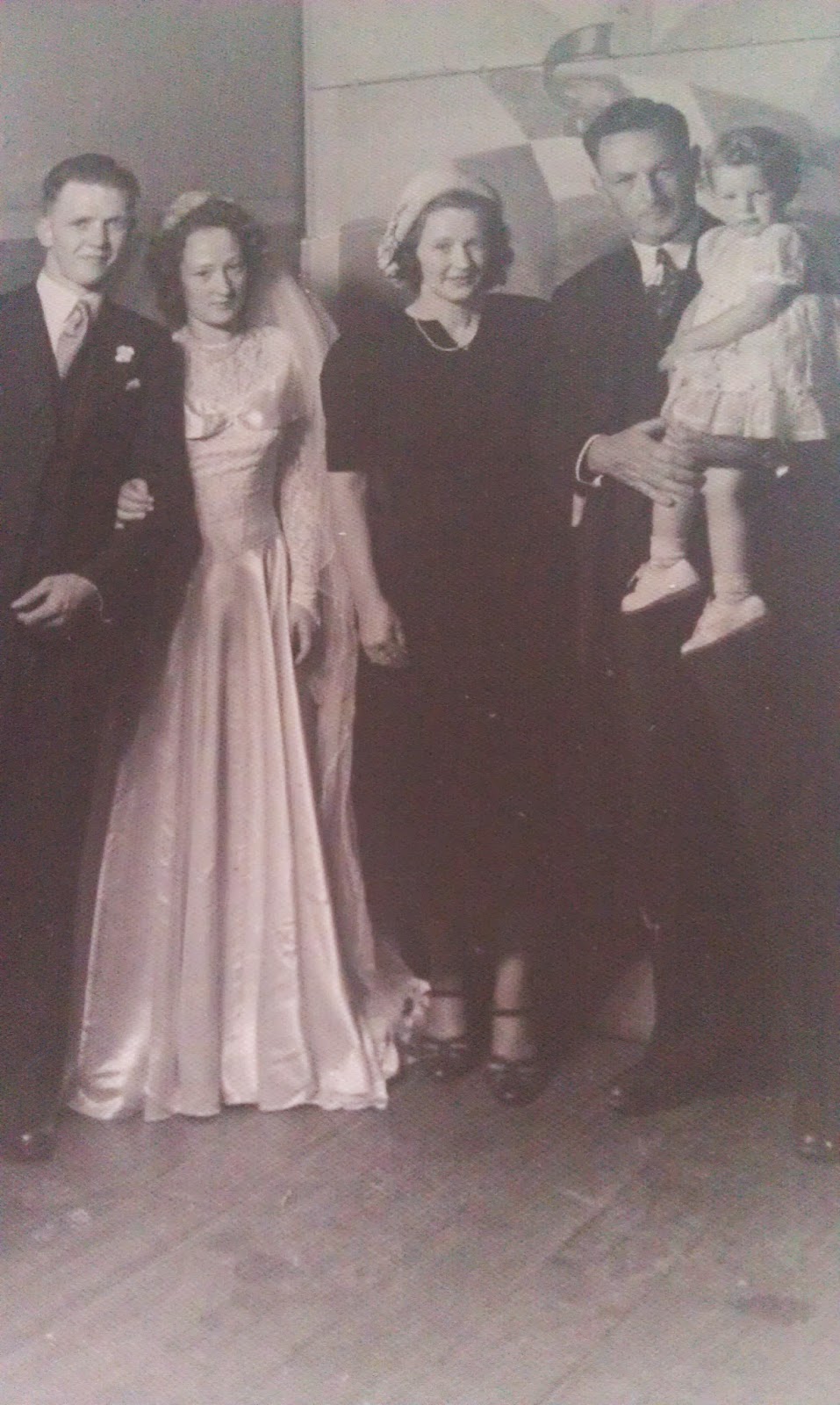
This brings me to another one of those dates - December 15th. My paternal Grandmother, Eunice Dyer had five siblings. Two of those siblings were Noel George Dyer and Earle James Dyer (known to my family as Uncle Curly). Uncle Curly was born in 1918, while Uncle Noel was born in 1926. I never met Uncle Noel, but in his later years he was in a wheelchair. Uncle Noel died on December 15th, 2008. Uncle Curly worked right up until he died. He grew large fruit, had a beehive in his backyard and made his own honey, and invented cleaning products. The day before he died he had been working in his front yard doing some potting. Uncle Curly died on December 15th, 2011. Three years after his younger brother Noel.

Uncle Noel's Wedding, 1949.
L-R: Noel, Ada, Eunice (Nanna), William (Poppa) &
Aunt Elizabeth
[Source: Personal Collection]

I was not able to tell my Nanna that two of her brothers died on the same day, three years apart, as her dementia was quite bad. I think she would have liked it though, if that makes sense. She was very close with both of them. I did tell one of my Nanna's sisters, Aunty Vera. She had not realized this and was a bit stunned herself. I think it is always interesting when there are dates like this. Having birthdays on the same day is awesome itself. My brother was born on my other Grandfather's birthday, and I was born on my maternal Grandparents wedding anniversary. I think generally there's always a good chance of those things happening though. I certainly would not have expected my Poppa to die on the same day as my Great Great Grandmother, or my Uncle Curly to die on the same day as Uncle Noel. It is when you don't expect it that makes it trippy, and kind of special.  

So, what DATES are trippy in YOUR family?

Until next time genea-friends!

Tuesday, 26 August 2014

Sharing a Small Success

I keep my public tree on Ancestry.com. I know there are other options, but Dad kept his tree there; and, when I took it over, it seemed easiest to leave it there. I have learned a lot about “proper” genealogical research since I began in earnest two years ago, though I still have a lot to learn.

I want to write a book for my father this year about our Scottish Muir ancestors since he didn’t have access to the information I do today and doesn’t know much about them. His great great grandparents had 78 grand children so I have a LOT of records. As I started writing I quickly grew frustrated because I was always opening the same record over and over to glean information. Each time I did, it seemed I learned something new from a record I’d looked at several times before.

I finally stopped researching and writing and started transcribing all the records as well as creating source citations for the non-Ancestory.com information I had, which was most of it about the Muir family.

My transcription of Robert Muir's birth registration

Original remains of Robert Muir's birth registration

 As I was working on Dad’s grandfather’s second family – his mother’s half siblings – I realized I didn’t know much about them at all beyond their names – Robert, Jr.; Verna; Henrietta; and Margaret Muir. I noticed one other person had Robert Muir, Jr. in their tree of 3 people! But she was the home person so I contacted her.  She had last logged on to Ancestry 4 months ago; I didn’t know if I would ever hear back.  But she had called me during the day! 

We had a lovely conversation that evening and we were both able to help each other. The only record she had found for her and my father’s grandfather, Robert Muir (1875-1956), was a marriage record for his second marriage to Elizabeth Fausz. On that record, Robert claimed to be 18 years old. But it was definitely the right Robert Muir.

Missouri marriage license for Robert Muir
and Elizabeth Fausz found on Ancestry.com

Because of that record, my newly discovered first cousin once removed didn’t think he could have been married before and that Alice, my grandmother, must have been his sister. She stopped researching in total frustration because she couldn’t find any other records that supported those facts.

Robert Muir and Elizabeth Fausz on their wedding day on 26 Sep 1911
in St Louis, Missouri

She had no idea her grandfather was born in Scotland, who his parents were, and so on. My tree helped her make a breakthrough, especially when she discovered we each had the same photo of Robert Muir and two unknown people; and I was glad for that. What did I get? Photos! Lot’s of old photos of Robert Muir and his second family…and one photo of my Dad at age 10 or 11 with his maternal grandfather that was unknown to our family. What a find!

Robert Muir and my father taken in
1941 in Arlington, Virginia


My small success was a result of always looking at tree hints from other people. We hear so many horror stories about bad trees and sloppy research and many are true. But I look anyway for clues to other possible sources. And this time I got very lucky indeed!