Showing posts with label Travel. Show all posts

Thursday, 31 December 2015

And Who Might You Be?


Are you planning on going to Germany in 2016? And are you looking for the graves to visit and for cousins to say hello? Things might turn out to be a bit difficult for both.

I wrote about the difficulties of finding your German ancestor’s grave on August 31, 2015 in my blogpost “Finding your Ancestor’s Grave (Or Not)” which you can find here http://bit.ly/1O2Lyi2. But finding relatives actually isn’t that easy either.

The main reason for the difficulty of finding German relatives simply is privacy. Not only are the privacy laws in German very strict and it is complicated, time consuming and sometimes simply impossible to find information on living people. But even when you manage to find them, you might not be able to get in touch with them or even be invited to their house. The reason for this is that Germans like to keep their privacy. They like to stick with their own family and friends and are rather reserved with getting in touch with people they do not know. And most of them simply aren’t looking for new found cousins, be it first, second or third.

Another reason is that in Germany genealogy is a more or less exotic thing to do. Remember, Germans usually stayed put and think they know where they come from. There simply doesn’t seem to be a need to know more and dig deeper. Therefore, most Germans aren’t even aware that they have relatives abroad. It happens quite often that I find relatives but they simply are unfriendly and hang up, making it very clear that they aren’t interested.

Often, there are no relatives in that area, their ancestors simply moved and their descendants are impossible to trace. The earlier emigration took place, the harder it is to find relatives.


But there still is hope and it is in fact possible to find relatives that know about the emigration and welcome you to Germany (which does not mean to their house). These are some examples where I found family members:

The emigrating ancestors had come from a small village close to the Dutch border with a very active Historical Society. They had information on everything a genealogist could ask for and knew directly which family member had emigrated and what became of the siblings. And as it was a Historical Society of a small village, many of its members were related. It only took one phone call and the research was more or less completed. And within 2 months about 200 family members from all over Germany met and welcomed their new found family member from America!

The emigrating ancestors came from a small village in Baden. I found out that there was a journalist living in the village, who also wrote about the old houses in this area. He agreed to meet my client and it turned out that they were distant cousins.

The family moved overseas in the 20th century; therefore the memory of them simply was alive and the remaining cousins knew about them and wanted to meet (but not in their home). I was only able to find them, because I turned every (and I mean EVERY!) stone around.

Once, I found the name in an online family tree; a sibling had married into this family. The researcher had more information and put me in touch with the lady who had provided him with that part of information. It turned out that she not only was a distant cousin of my client, but also a genealogist and archivist who had actually wondered what had happened to the cousin who all of the sudden vanished.

So, you see, it is possible to find relatives, but you really need time, know your way around, be creative, and, most of all, you need luck! Without luck you will not be able to get there!

But even without meeting your relatives, you will meet a lot of kind and friendly people in Germany. And who knows, maybe it turns out that you are related?
Enjoy your trip! 


Friday, 16 January 2015

On the Road Again, Cemeteries, Yes, They Can Go Together

.
This month, Man and I will be parked with our RV in the midst of BLM (Bureau of Land Management) land, somewhere about 6 miles northeast of Quartzsite Arizona with about 160 other friends from our online camping group.  There will be between 500,000 and 1 million others camping in the acres and acres of BLM land that surround "Q" (as we affectionately call it) during January.  There is a huge RV show as an additional draw and hopefully warmer and dry weather. Dry is good when you are sitting on the desert floor.  Yes, I have experience in "wet" while sitting on the desert floor.  That desert floor turns into a sloppy quicksand-like consistency.  4-Wheel drive trucks can and do get stuck.  Dry IS good!

Anyway, I am preposting this month's post here at Worldwide Genealogy, because I fully intend to be having a lot of fun on the 16th.


This month, I would like to share with you another way to blend my love of the life of a nomad (RVing) and genealogy.  Visiting cemeteries!

You know, as a family researcher, you snoop out cemeteries, you can almost smell them.  You will find a cemetery no matter what!  It is a challenge, it is necessary.  You understand, I know you do.

Man and I and friends were visiting Big Bend National Park two years ago.  I spied (at 45 MPH) what I just knew was a cemetery.  It was.  One grave, one Nina Hannold.  (The links herein will lead you back to the full blog posts at Reflections From the Fence, my main blog.)  And, yes, there are two stones here for Nina.


One year Man and I visited Little Bighorn Battlefield National Monument.  General Custer died here. Custer has a connection to our area of SE Michigan where we live when we are not RVing.


We stopped several years ago in McIntosh County Georgia, where my my great-grandparents lived and are presumably buried (long story that), and stopped at Fort King George, where we found the burial spot of 140 British Soldiers who died there between 1721 and 1727.


Along the Natchez Trace, Man and I found this spot marking the loss and burial of 13 Confederate Soldiers.


Also along the Natchez Trace, we found slave burials, at Mount Locust.


Terlingua, Texas, The Ghost Town, has a great old cemetery, full of local color and customs.


A day spent in the Bok Gardens, and, yes, friend Charlie (also a family history researcher) found the burial spot of Edward William Bok.


Sometimes Man and I get a bit of a surprise.  One research trip through Georgia we ended up, well, go read the post.  Have to say, that cemetery hunting in rural Georgia is a challenge, and we thought we had come up with a great way to get some information from the local funeral homes - - really, go read this one!  (The photo is not from THAT funeral home.)


One must do, what one must do, here I am gaining access to my family's cemetery in rural Virginia.


Yes, my love of family history/genealogy and RVing do blend together quite nicely.  Kismet discoveries along the roads and highways and back country of the USA feed my need to touch the elders as well as a method of paying my respects and honor to those who have passed before us.

Next month, we will be, well, we don't know.  Probably where ever the dust blows us.  We'll let you know when we get there.  I'll have my eyes open for cemeteries and research opportunities, that is a given!


We also partake of Geo-Caching now and then.  My first cache find, while we were in Gulf Shores Alabama for the winter, and, yes, it IS in a cemetery!


.

Tuesday, 9 December 2014

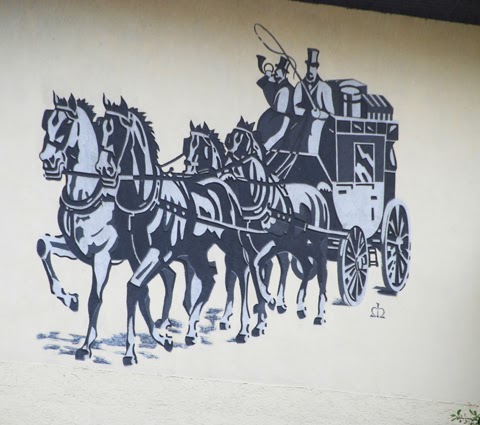
Stagecoaches - Romance v. Reality

I am striking a seasonal note with this post by looking at the Images of stage coaches on Christmas cards.   They look colourful, dashing and rather romantic, but what was the reality like for our ancestors traveling 170 years ago?


Stagecoaches were public service vehicles designed specifically for passengers and running to a published schedule.  Eight passengers could be packed inside, with others sitting at the back of the coach and the poorest passengers atop along with the luggage. A newspaper report  of 1846 (below) refers to a heavy coach of 18 to 20 passengers.  

The coaches ran in stages, usually from 10-15 miles depending on the journey, the type of countryside travelled and the availability of inns and staging posts en route. 

The  driver was often the sole crew member responsible for the coach, the passengers, timekeeping and dealing with minor incidents.  Coaching inns acted as stopping points for travellers and  were where  the ostlers changed and fed  the teams of horses   On the Edinburgh  to London journey there were twenty eight changes of a team of four horses.  In 1819 in the Scottish Borders  the published time for a journey from Edinburgh to Hawick was just under six  hours for the 54 miles distance - a twisting route over rolling hills -  and  could involve three changes of horses.
   
For Mail Coaches the primary concern was the delivery of mail  although passengers were also taken.   In 1786 the first mail coach arrived in the Scottish capital from London. welcomed by the ringing of church bells,  and guns fired from the castle ramparts - even though on its inaugural run it was twelve hours late!  

The hey day of stage coach travel was the early 19th century, with  improvement in road building techniques, the development of the turnpike system (where tolls financed  road consgtruction),  and  increased comfort of the coaches themselves.  

*******  
The romantic picture  of stagecoach travel has been   perpetuated by many writers including Jane Austen and Georgette Heyer.  American author  Washington Irving (1783-1859)  described his experiences in England  in his "Old Christmas" sketches, 


"I rode a long distance in one of the public coaches on the day preceding Christmas   The coach was crowded both inside and out with passengers who by their talk seemed principally bound for the mansions of  relatives or friends to eat their Christmas dinner.  The coach was loaded with hampers  of game and baskets and boxes pf delicacies....

A stage coach carries animation along with it and puts the world in motion as it whirls along.  The horn sounds at the entrance to a village  and produces a general battle.    As we drew into the great gateway of an inn, I saw on the  one side the light of a roaring fire kitchen fire, beaming through a window.  I entered and admired the picture of convenience, neatness and broad honest enjoyment  - the kitchen of an English inn,  it was of spacious dimensions hung around with copper and tin vessels, highly polished and decorated here and there with Christmas green".
 
Charles Dickens in "David Copperfield" published in 1850 painted a rather different picture of the reality of a winter stagecoach journey. 
"How well I recollect the wintry ride! The frozen particles of ice brushed from the blades of grass by the wind and borne across the face; the hard clatter of the horses' hoofs beating a tune upon the ground;  the stiff-tilted soil,   the snowdrifts, lightly eddying in the chalk pit as the  breeze ruffled it;  the smoking team stopping to breathe on the hill top and shaking their bells musically,..........
 **************

Less poetically local newspapers are full of items on stagecoach travel:

"The Border Watch" - 19 November 1846: 

“A SLOW COACH. – The Edinburgh and Hawick coach, which left Princes Street, Edinburgh on Saturday afternoon at 4pm  did not reach the Bridge Inn, Galashiels, until about 10pm; thus accomplishing the distance of thirty-two miles in the astonishing period of six hours!   

The pace was such that an ordinary pedestrian would have found little difficulty in keeping up with the coach. The road was by no means heavy, although in some places newly laid with metal. The coachman did his duty well with whip and voice, constantly urging forward his jaded steeds, and employing the box seat passenger to assist him with a spare thong.
But it was all of no avail. The animals would not move one foot faster than another. Up hill or down hill there was little perceptible difference, and several times the vehicle came to a dead halt, almost on a level.

The coach was full from Edinburgh, but a passenger having been let down on the road, another person was taken up. In spite of the loud remonstrances of the passengers, a second was buckled on behind, and a third was allowed standing room beside him. It appears there is now no restriction as to the number a stage coach may carry, and consequently three poor miserable horses were forced to drag, throughout a weary stage of fifteen miles, a heavy coach loaded with eighteen or twenty persons.

If there is any law against cruelty to animals, surely it must apply to a case like this. Whatever grievances attend railway traveling, it will be something, at least, to get rid of this wholesome horse murder.”
Reports on accidents,  present a graphic picture of the perils facing passengers and  (and pedestrian) alike.

"The Kelso Chronicle": - 16 June 1837: 

"ACCIDENT. – On Tuesday evening when the coach from Kelso had passed Ord, the reins broke, and the driver left his seat, and went along the pole to recover them. His foot slipped, and he fell between the pole and the horses to the ground. Fortunately, the wheels passed on both sides of him, and he escaped with no other injury than a slight blow to the head.The horses set off at rapid pace, and ran through Tweedmouth. The passengers kept their seats, and the horses while running furiously along the bridge, were stopped by a young man named Robert Robertson, who, with great personal risk, seized the horses’ head.Had they not been stopped, in all probability, from the speed with which they were proceeding, the coach would have been upset at the turn of Bridge Street.  The conduct of the young man deserves great praise.”
"The Kelso Chronicle" -  4 October 1844:
“WONDERFUL ESCAPE. – As the Defiance Coach was leaving the town on Friday last, a girl, about 10 years of age, daughter of Mr. Ferguson, tailor, who was hastily crossing the High Street, and not perceiving the coach, ran in betwixt the fore and hind horses, by which she was struck down, when the horses and coach went over her, to the horror of the spectators, who could do nothing to save her. The wheels on the one side passed over one of her legs, bruising it most severely in two places, while the opposite wheels went over the top of her bonnet, close to the head, but without doing any injury. The poor girl’s thigh was also much bruised, apparently by one of the horses’ feet. We are glad to state that she is recovering from the effects of her injuries.”.
************

The development of the railways marked the end for stagecoaches  but the iconic image remains of a mode of travel that still captures our imagination. especially at Christmas time.  

Sources:
Border Highways by John James Mackay, 1998 
http://en.wikipedia.org/wiki/Stagecoach
Local newspapers of the Scottish Borders 

Tuesday, 25 November 2014

The Importance of Planning

My husband commutes to Albany, New York, a couple of times a month for work. Last month I accompanied him on one trip, and we drove instead of flying. Neither of us have any known ancestors near Albany, but his paternal ancestors lived in the Hazleton, Pennsylvania, area. We are stopped there to do some research and visit the cemetery where his grandparents and several aunts and uncle are buried.

We’ve been to Hazleton before, but I was a neophyte about genealogy trip planning and did none. We found the cemetery but not their graves; found and photographed their house; and learned a bit about what the lives of anthracite coal miners were like.

The Saints Peter and Paul Lithuanian Roman Catholic Church Cemetery in
Hazleton, Pennsylvania

 This time I followed Heather Wilkinson Rojo's advice. Before we left I did the following:
  • Called the Saints Peter and Paul Lithuanian Catholic Church only to discover the church closed in 2009 and their records are now housed at Transfiguration Church.


Saints Peter and Paul Lithuanian Roman Catholic Church
in Hazleton, Pennsylvania, which closed its doors on
8 July 2009


  • Called Transfiguration Church and learned they do not allow the public to look at their records. They were, however, willing to provide information if you knew specific ancestors’ names and birth and death dates of the events. The church secretary very thoughtfully emailed me the plot locations the day before we left.
  • Made an appointment with the Hazleton Historical Society Museum, which is open only by appointment. The appointment needed to be made at least a week before the trip.  The society has some back issues of the local newspaper and old city directories. 
  • Learned the Luzerne County Historical Society's collection of Hazleton newspapers is not available to researchers because they are being digitized (yeah!) So I struck this stop off our list.
So how how was our trip? Much more fruitful than our 2009 trip when we arrived with a map no plan. We photographed the headstones of Adam and Cecelia Dagutis, my husband's grandparents; his first cousin, who was killed in a sledding accident at the age of 4; his uncle's grave; and his by-marriage uncle, father of the little boy mentioned previously. We also made some stops along the way to photograph and transcribe war honor roll memorials for Heather's Honor Roll Project.


My husband's paternal grandparents' headstones at the Saints Peter and
Paul Lithuanian Cemetery
The host for our private tour of the Hazleton Historical
Society and Museum. He said he was Tyrolean; Pete
was Lithuanian; and I was a disappointment because
I had no ancestors from Hazleton. Quite a character!

I certainly learned the importance of planning a trip as we would have been disappointed at every turn if we thought we could just drop in and start researching! Thank you, Heather!

The church secretary later sent me copies from their "death book" of the entries for my ancestors. There is just one wee problem. The church secretary thought they were in Lithuanian and my work colleague, who emigrated from Lithuania and can read and speak the language, doesn't recognize it but thinks it Latin. 

Saturday, 3 May 2014

Family History - A Key to Meaningful Conversation

I am presently on the high seas on a cruise ship and have lost track of time. I note that the post for the 3rd of May has already appeared but I also note that in Hawaii and other places in the Pacific it is still the 2nd of May so I am bashing out a post and hoping that the ship's internet will behave and allow me to post it before midnight.

What strikes me as I enter into conversations with fellow cruisers and visit sites in various countries is that many people outside my genealogy circle are interested in family history especially if it relates to a place or location familiar to them. Being able to make a connection with a fellow traveller from a village or town through a story of one of my ancestors from that area breaks down barriers and enables one to enter into meaningful and interesting conversations. 

I just had coffee with a Scotsman who loves whisky, he was waiting for the bar to open. When I told him we had ancestors from Islay, home of eight malt whisky distilleries, we were able to skip those questions one normally asks when meeting someone new and launch into a meaningful conversation about Islay, the clearances and beautiful 12th century Scottish Churches. That gentleman is presently paying someone to research his Scottish roots. When his wife from Aberdeen joined us I told her of my issues in tracing my "James Duncan" from Aberdeen ; she wished me luck and said "That is like trying to find John Smith".

Yesterday a lady noted that I had a Familysearch pen and that started a conversation. It turns out that she is an avid family historian and was most impressed that I had such a prize. Our conversation immediately turned to the village in which she lives, the lectures she attends and a discussion of the  1801, 1811, 1821 and 1831 English Censuses.

The Americans on this trip are well travelled but very few of them have ventured to the genealogy mecca of Salt Lake City. So many have been interested in our stories of visits to that place for Rootstech and The Family History Library and have asked many probing questions..

On this trip I have connected with people from the UK, Ireland, Canada and the US with whom I have been able to discuss family history and places that are familiar to them. My family history stories have given me a set of keys to enter into interesting conversations with fellow travellers.