Showing posts with label American history. Show all posts

Sunday, 9 November 2014

A Transatlantic Collaboration on a Yosemite Traveller

You come across some amazing stories when you start to delve into family history and such was the life of John Kinsey Smedley (left)  - a naval engineer in the American Civil War, later inventor and traveller who wrote an account of his journey into the Yosemite Valley in 1874.  

I am grateful to John's  great granddaughter Gail in California  for supplying me with photographs and other memorabilia, whilst I have undertaken additional research to compile this profile - a true transatlantic genealogy collaboration between Scotland and the USA. 

Father - Jeffrey Smedley
John Kinsey Smedley  was born 10 July 1839 in Willistown, Pennsylvania   the fourth child of Jeffrey Smedley (1811-1861) and Catherine Denny (1803-1877)); with siblings  Lydia, Amy, Isaac, Abiah T., Catherine Ann, Anna Mary, Jeffrey and Charles.  He was a fifth generation American of English Quaker  heritage.   So far the origin of his distinctive middle name has not been traced.  It was not a name from either his parents or grandparents,  though his uncle was Kersey Smedley  - a similarity in spelling which deserves more investigation


John as a Civil War Naval Engineer 
In September 1862 at the age of 23, John  enlisted in the Union Navy as a naval engineer. He  participated in blockade duties and attacks on the Confederate forts in Charleston Harbor including  Fort Sumter,  and served aboard vessels Nantucket, Wabash, Mohican and Tullahoma.

The family is fortunate to have details of his service, written down by John's daughter Hattie. 

John Kinsey Smedley resigned from the Union Navy on 13 March 1866, and the family  still holds, among the family treasures, his naval sword, sheath, and belt, shown in this photograph below.


Heading West 
Unlike his brothers, John's life was to move far beyond Pennsylvania to Utah and California.
Golden Spike Ceremony
According to a story  passed down through the family,   he was present  on 10 May 1869 at the driving of the Golden Spike at Promontory Summit, Utah to mark the joining   of two sets of rail tracks on the  completion of the Transcontinental Railroad.     This meant that travel time between America's east and west coasts was immediately reduced from months by wagon  to less than a week.

In the US Census for 1870 John  was working as a steam engineer at Corinne, Box Elder County, Utah.

In 1872 the California Voters Register showed John to be in Sacramento where he was staying at the Pacific Hotel. 

1874 - a Yosemite Journey 
In 1874 John wrote an account of his trip by coach and four to Yosemite Valley - in a journal which has been transcribed by his great granddaughter.   

Front Cover

 An entry from late May 1874 reads: 
“Crossed the Tuolumne (River) at 9pm.   Arrived at the foot of Rattlesnake Hillat 10pm. Then it was our turn to walk. 


Just think of a hill two miles long and rising 1700 feet.  We all got out to walk but Sutton who was the smallest of the party.  Up, up, up we went and I thought we had walked five miles when Chase  said "This is halfway."  Oh goodness.  Only a mile, and up, up another.  Then we began to change riding as some had done the first quarter mile.  Around and around, thinking every turn would be the last. Coats and hats off, and 11pm.  By this time, we had all climbed in the carriage.


Finally, we heard the bark of a dog, knowing a house was near.  In a few minutes we reached Priest's, the best place and table in the whole land, and a pretty girl to attend to the table.  They were all snug in bed, but when we called they got up, and in 20 minutes, had a steaming hot dinner of fricasseed chicken, fried ham, beefsteak, good coffee and tea and milk, pie and cake and strawberries.  Such a luscious supper!  May Priest's shadow never grow less!


We enjoyed our supper and did not tarry long before retiring where we had good beds and slept sounder than ever.  In the morning, Saturday the 23rd, the sun was shining beautifully and when I got up and went down, I saw we were really above the clouds and to look down that awful long hill I could only laugh and think we would have the best of Old Hill when we returned.  Sure did!”


This is a section of Old Priest Grade – or Rattlesnake Hill as John Kinsey Smedley knew it, so named for Rattlesnake Creek flowing down the centre of Grizzly Gulch in Tuolumne County, CA.  It’s a shorter, narrower, steeper (15-17% grade) route up one side of the gulch.  It rises 1700 ft. in elevation in 2 miles.  The main highway on the opposite side of the gulch known as New Priest Grade (built in 1915) takes over 6 miles to climb the same rise in elevation with countless switchbacks. 

In California John worked as an engineer for rail, mill and mine companies from Monterey to Silver Mountain in Alpine County.  In the same journal as he recorded his Yosemite journey,  he jotted down notes about turntables being in good shape or needing repairs, and work needing to be done to mill and mine machinery. 

MARRIAGE
At the age of 38 in 1878, John Kinsey Smedley  married,  in San Francisco,  Ella Chase Taylor ten years his junior, with their only child Harriet (Hattie) Bell born a year later.    

Ella’s mother died when she was a young girl and she was raised with her father’s sister’s family back east,  while he went out west to Sacramento, California to open an apothecary shop and tend, as a doctor, to injured gold miners.  

Her father  remarried whilst in California and he and his second wife had a daughter  Eliza. On the death of her father and step mother, Ella traveled to California by ship around the “horn” of South America – with a piano, no less - to  look after her younger half sister.
Ella (right) with her sister Eliza

The voters' registers and census returns  continued to track John's moves across the state from San Francisco  to Alameda. 

In the 1889 census,  he was still in San Francisco, described as an Engineer with Ella's  occupation given as "Keeping Home".  

John later found steady employment with the US Post Office but his love of engineering did not fade and in 1898 he invented a "New Streetcar Fender" (right)   to be attached to the front of trolley cars - though there is no evidence that it was actually adopted in practice. 

Ten years on, in 1900, the family was in Oakland, Almeda with John described as:   aged 61,  a Stationary Engineer.  Besides Ella and Hattie was a "roomer" - 45 year old Elizabeth Soundry, a German widow. 

John Kinsey Smedley (1839-1905)

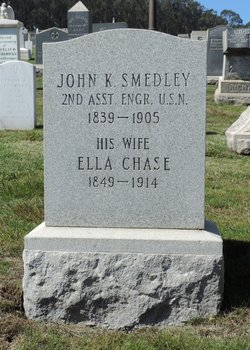
John died 22nd July 1905 at Alameda buried at San Francisco Cemetery with his gravestone paying tribute to his Civil War Service.

John Kinsey Smedley

With special thanks to John's great granddaughter Gail
for her contributions to this post, which is based on earlier posts on the Smedley family  that appeared on my personal blog. 

 Sources:
  • Family Notes, including those written by John Kinsey' Smedley's  daughter and transcribed by his great great granddaughter.
  • www.ancestry.co.uk
    • US Civil War Draft Registration Records 1863-1865
    • US Civil War Soldier Records and Profiles 1861-1865 
    • Officers of the Continental & US Navy & Marine Corps 1795-1900. 
    • US Navy Pension Records
    • US Veterans Grave-sites
    • US Federal Census Returns 1850-1900
    • US Quaker Meeting Records 
    • Obituaries of the Members of the Society of Friends in America,  1861.
    • Quaker Journal, 1877
    • California Voter Registers  
    • US City Directories 
    • California Death Index 
    • US National Cemetery Interment Control Form  
    •  Biographical and Portrait Encyclopedia of Chester County, Pennsylvania
**************

Friday, 7 November 2014

Researching Your Mayflower Ancestors

Celebrating our Mayflower ancestry!
Every year, just before Thanksgiving, some folks  want to know if they have a ancestor from the 1620 ship Mayflower.  My first advice is that it will probably take you more than a few weeks to prove a lineage back to someone born in the late 1500s, who might qualify as a passenger on this ship.  After all, it has been about thirteen or fourteen generations since those passengers were born.  But, if you work hard at it, you might be able to introduce your Mayflower passenger ancestor to your friends and family around the 2015 Thanksgiving table.

Mayflower descendants live all over the globe.  There are active Mayflower Societies in all 50 states, Washington DC, and Canada.  Societies are being considered for the United Kingdom and Australia because there are descendants living there, too.  Many descendants live in the Netherlands, because the Pilgrim families left siblings and married children behind in Leiden.  There are good numbers of other descendants scattered across the map.  Are you one of them?

1.   Start with yourself and work backwards in time.  It is impossible to start with a passenger and try to work forward to yourself along a lineage.  Besides, there were 102 passengers.  Even if grandma swears you descend from William Bradford, you just might be a descendant of Myles Standish or Priscilla Mullins. You will never know unless you follow proper genealogical practices of starting now and working back through the generations.

2.  Become familiar with the surnames of the 102 passengers, their descendants and where they lived.  Yes, BREWSTER is one of the Mayflower names, but there was also an early Brewster family in New Hampshire.  They were not related. Some of the passengers had common names like BROWN and WHITE.  However, if your BROWNS lived in southeastern Massachusetts in the 1600s and 1700s, this is worth researching.   You can find a complete list of passengers with known descendants are at these links:


Scroll down to “Mayflower Research” on this page to read sketches on each Pilgrim family from early Plymouth, Massachusetts: http://www.americanancestors.org/articles-topics/

3.  If you can work your family tree back to about the mid 1700s your next step is to review the Silver Books published by the General Society of Mayflower Descendants.  These are books produced by the “Five Generations Project” to document the first five generations of each Mayflower passenger. Some of the finest colonial genealogists have been part of this project.  Most of these lineages have been published, and the project is now called “Mayflower Families in Progress” as they continue researching the sixth and seventh generations.  You can find these books in good genealogy libraries, book stores, and for sale online at this link: https://www.themayflowersociety.org/membership-info16   For a good listing of all the books, see this link: http://mayflowerhistory.com/mayflower5g 

4. Use primary source documents (birth, marriage and death records) if you are planning to submit your research to a lineage society.  Deeds, probate (wills), gravestones, diaries and family bibles have also been used to establish lineage.  Some of this is available on the internet, and are acceptible if they are scanned images of original documents such as censuses and birth records.  Note all records with proper citations (page numbers, microfilm numbers, etc.).   User submitted trees on www.familysearch.org and www.ancestry.org are not acceptable because they lack documentation, but you can use them as clues to help you find primary source materials.  Don’t forget to make photocopies of everything you find.  Click this link to read about “The Best Records to Prove your Case” by Mayflower genealogist Alicia Crane Williams:

5.  In rare cases, you might want to consider DNA testing.  Many of the Pilgrim family associations have DNA projects.  However, for acceptance into a lineage society such as the General Society of Mayflower Descendants, DNA testing must be backed up with a paper trail.  DNA can help establish that two men descend from a common ancestor.   Several DNA tests have been used to in the lineage application process for GSMD. 

Let’s say you find a link to one of the Mayflower families.  What happens next?

1.  Congratulations!  You are connected to some of the most well researched group of immigrants on the planet earth.  There are endless books, articles, blog posts and all sorts of stories, documents and things to learn about your ancestor to keep you busy for quite some time. New research is being published every year.

2.  You've earned your bragging rights.  Not just that you have a famous ancestor, but you have done an impressive job at researching thirteen or fourteen generations.  You can now take those documents and research papers and apply to family associations (more than half the Mayflower families have family associations), to the General Society of Mayflower Descendants, Colonial Dames, or any number of other lineage societies.  Here is a link to the “Join GSMD” webpage: https://www.themayflowersociety.org/membership-info16

3.  Double check your research against these links to common Mayflower genealogy hoaxes:


4.  If the historian of a lineage society questions your lineage application papers, don’t worry.  They are just asking you to clarify a point with additional documentation.  They usually can help point you where to look for that additional piece of information.  Remember that lineage societies are actively recruiting for new members, they don’t want to keep you out of the club!

---------------------------

Some good links for online information on the Mayflower Passengers:

The General Society of Mayflower Descendants  https://www.themayflowersociety.org/

Leiden, Netherlands Pilgrim Archives  http://www.pilgrimarchives.nl/

Leiden American Pilgrim Museum Foundation  http://www.leidenamericanpilgrimmuseum.org/

The Pilgrim Hall Museum, Plymouth, Massachusetts   http://www.pilgrimhallmuseum.org/  

Plimoth Plantation Museum, Plymouth, Massachusetts  www.plimoth.org

The New England Historic Genealogical Society  www.americanancestors.org 

Caleb Johnson’s Mayflower History website   http://mayflowerhistory.com/

Sail 1620 (Pilgrim Biographies)  http://sail1620.org/


Thru the Looking Glass:  Mayflower Families   http://mayflowerfamilies.com/

------------------------------------------

Good Books (there are many, but here’s a good place to start):

The Great Migration Series, The Great Migration Begins (3 volumes)  and The Great Migration (7 volumes) by Robert Anderson published by the New England Historic Genealogical Society

The Pilgrim Migration: Immigrants to Plymouth Colony, 1620 – 1633  by Robert Anderson, NEHGS, 2007

William Bradford’s Of Plymouth Plantation, edited by Caleb Johnson, 2006

The Mayflower: A Story of Courage, Community and War, by Nathaniel Philbrick, 2007

Strangers and Pilgrims, Travellers and Sojourners: Leiden and the Foundations of Plymouth Plantation, by Jeremy Dupertuis Bangs, 2009

Making Haste from Babylon: The Mayflower Pilgrims and Their World: A New History, by Nick Bunker, 2010


Saturday, 4 October 2014

A Baker's Dozen of Genealogy/Family History Books

A few from my list - you can find many of these at your local library!

Last month at this time I shared ten books (well I cheated a bit with some series books but hey, what is a bibliophile to do) that have had an impact on my life. I promised that I would be back this month and share ten books that have had an impact on my genealogy life (could not fit all that in the title - too long!). That might seem like a tall order, but I think I can handle it. So let's get sharing (if you have a book that has impacted you, please share it so we can all benefit!).

(1)  Evidence Explained: Citing History Sources from Artifacts to Cyberspace by Elizabeth Shown Mills - this book is simply the best! If you want to understand how citations work and why they are important, look no further than Evidence Explained. Ms. Mills not only explains the reasoning behind various citations, she also shares examples of most every type of source citation. And if you read the beginning chapters and pay attention, you will be able to craft you own source citation for any work for which she did not provide an example. I am a huge fan of "watching/reading and learning" and Ms. Mills' writing is clear, concise, and gently nudges genealogists and family historians to reach for the next level. Every genealogist needs to own this book.


(2)  Professional Genealogy: A Manual for Researchers, Writers, Editors, Lecturers, and Librarians edited by Elizabeth Shown Mills - what can I say, this woman is on a roll! Whether you want to take your hobby, passion, or profession seriously and understand all the important business, financial, and ethical requirements or you simply want to understand how to make the best use of a genealogy professional, this is the book for you (put it right next to Evidence Explained). Professional Genealogy serves as the textbook for ProGen Study Groups. You will definitely wring everything out of this book if you join a ProGen group. Whether you join a ProGen group or go it alone, you need Professional Genealogy.

(3)  Destination America: The People and Cultures That Created a Nation by Chuck Wills - do you want to understand how all of the people who came to America shaped and added to our nation's rich tapestry of multiculturalism? This gorgeous book (spoiler alert - maps and lots of photos - you won't be able to put it down) was the basis of a PBS series by the same name put together by David Grubin. Destination America contains amazing stories of where immigrants came from and why they left their native lands, lovely photos and maps (oh yes maps!) and the chance to gain a better understanding of how our freedoms (freedom to worship, freedom from oppression, freedom from want, freedom from fear, and freedom to create) have been strengthened due to the efforts of all our people. Destination America introduces us to the original native Americans as well as most religious or ethnic groups that joined them here. As a country, we don't always get it right (and sometimes we get it very wrong) but we do aspire to be better. Destination America will remind you of what your own group(s) went through and help you appreciate the stories of other groups of your fellow Americans.

(4)  Our America: A Hispanic History of the United States by Felipe Fernandez-Armesto - American history is often taught through a prism of British history, but that is only a part of our story (think about the Native American population, as well as French, Russian, and Spanish interests). Our America serves as a reminder that the United States' history is just as much the story of Spanish colonization as any other group's colonization. Our America reminds us of the Southwest and West regions' rich history. Our Hispanic past is just as important as any discussion of the Pilgrims and the 13 colonies.

(5)  Geography and Genealogy: Locating Personal Pasts edited by Timothy Dallen and Jeanne Kay Guelke - this one is a bit hard to find (go to your college and university libraries) but is worth the trouble. Geography is such an important aspect in genealogy and it usually gets short shrift. I recently took several courses in cultural and physical geography and they opened my eyes to all the factors that affect people, culture, and place. Whether you want to understand the questions of why people settled where they did, how they lived, how natural and man-made barriers affected their lives, what migration patterns were and how they have changed over time, the push-pull factors of migration, and a host of other topics - the study of geography provides the answers. This book provides an introduction to the field of geography as it relates to genealogy. Combine Geography and Genealogy with a few classics like Longitude: The True Story of a Lone Genius Who Solved the Greatest Scientific Problem of His Time by Dava Sorbel and Geography: Realms, Regions and Concepts by Harm J. De Blij and Peter O. Muller (the newest edition is available as a rental eBook!), as well as the very readable newer entries that combine history and just plain fun, including The Discoverers: A History of Man's Search to Know His World and Himself  by Daniel J. Boorstin and Maphead: Charting the Wide, Weird World of Geography Wonks by Ken Jennings - and you will see our world in a whole new light.

(6)  Tracing Your Irish Ancestors: the Complete Guide by John Grenham - this book is an excellent primer on Irish family history research. It is important to understand the history of a place, its physical layout and system of record-keeping and, of course, what is available (offline and online). For anyone serious about researching their Irish ancestors this is the book. Mr. Grenham has a number of other publications (in both book and CD-ROM format) that are also especially helpful - Clans and Families of Ireland, Grenham's Irish Surnames and Grenham's Irish Recordfinder. Combine Tracing Your Irish Ancestors with A New Genealogical Atlas of Ireland by Brian Mitchell and Irish Records: Sources for Family and Local History by James G. Ryan, and you will have your Irish research resources covered.

(7)  Finding a Place Called Home: A Guide to African-American Genealogy and Historical Identity by Dee Parmer Woodtor - for African-Americans researching their genealogy and family history and for all those wanting to understand the family history of African-Americans in our county, this is the book. An excellent resource to find out about how slavery (and the concept of people as property) affects our research from as early as 1790. Finding a Place Called Home is not only a genealogy resource but a fascinating history of a people through time - slavery, the Civil War, Reconstruction, WWI, WWII, the Civil Rights movement, and migration resulting from these events. African-American history is American history and African-American genealogy is American genealogy - it touches all of us and this book is an excellent introduction.

(8)  The Source: A Guidebook of American Genealogy by Loretto Dennis Szucs and The Red Book: American State County & Town Sources edited by Alice Eichholz are essential genealogy reference books, so much so that Ancestry.com puts them front and center on their learning page (in front of their pay-wall - run don't walk there - okay use the magic of the internet!). If you want to figure out what records are available - whether on the Federal or local level, where those records are located in various State and County repositories, and how to get your hands (real or virtual) on them, these two books are the place to start. A note: researchers need to take the contact information and update it as more information becomes available online and datasets and office information change - but these books provide the history, the guideposts, and those all important breadcrumbs for further research. These books are at many libraries and sit happily alongside my copies of Evidence Explained and Professional Genealogy - they are that good and that useful.

(9)  Albion's Seed: Four British Folkways in America by David Hackett Fischer - a look at four waves of immigration to America: the Cavaliers to the Atlantic Southeast (Virginia), the Puritans to New England, the Quakers to Pennsylvania, and the Scots-Irish or Borderers to the Appalachians. This is an interesting book that speaks to English culture and its impact on populating the colonies in the 1629-1775 time-frame. I would encourage readers and researchers to take Mr. Fischer's conclusions and generalizations with a grain of salt - I don't think everything is so neat and tidy, but Albion's Seed does provide lots of information on the cultural and social history of these groups, together with references and suggestions for additional reading.

(10)  Organizing Your Family History Search: Efficient & Effective Ways to Gather and Protect Your Genealogical Research by Sharon DeBartolo Carmack - if you are anything like me you would like to know that you are on the right track and that you are approaching your genealogy and record-keeping in an efficient and effective manner. Simply put, genealogists want to know how to put all the information we gather together. Well Ms. Carmack does a fine job of helping us out in an easy to read and incorporate way. Sometimes you will nod your head (done that) and other times you will have an "aha moment." The best method of organizing our research and results is the method that we will actually use day in and day out. Check out Ms. Carmack's suggestions and get organized!

(11)  The Surnames Handbook: A Guide to Family Name Research in the 21st Century and DNA and Social Networking: A Guide to Genealogy in the Twenty-First Century both by Debbie Kennett - these areas of research are relatively new to most of us. Both DNA and Social Networking and The Surnames Handbook are well-written and contain a wealth of website links and resources to assist us in our studies. Ms. Kennett's clear and concise explanations of DNA studies (so much has changed since my university biology classes!) and social networking (how to best use all the tools at our disposal and not be overwhelmed by them) help genealogists and family historians understand how to make the best use of both. Ms. Kennett's guide to surname research is thorough and quite readable. Surname research, as a facet of family history, is expanding on a worldwide basis and Ms. Kennett's guide is an especially helpful introduction.

(12)  Seven Pillars of Wisdom - The Art of One-Name Studies edited by the Guild of One-Name Studies and Putting Your Ancestors in their Place: A Guide to One Place Studies by Janet Few - those of you who know me, know that I am working on a one-name (surname) study and a one-place (location) study. At some point I hope to encourage enough Keoughs to join the existing Keough-DNA study (but that is still a future thought). While our own family history and genealogy is interesting, I do think that putting those who share our surname or our place in context is a fascinating area of specialized family history research. The methodology and projects suggested in Seven Pillars and Putting Your Ancestors in Their Place are incredibly helpful to the family historian who wants to take her/his research further and connect it to the bigger picture or puzzle out possible connections.

(13)  A People's History of the United States: 1492-Present by Howard Zinn - what can I say - a history of the United States told from the viewpoint and in the words of the people who have made this country and who are not often heard from - the women, the Native Americans, the immigrants, the factory workers, the farmers, the laborers, and the working poor. This is not the history you learned in your unwieldy and cursory high school or college textbooks. This is not the history told by the establishment. Be sure to take Mr. Zinn's A People's History with a grain of salt, but also realize that history is written by the winners. It is important to understand our past and look at all sides of the story. Wear your critical thinking eyeglasses with this one, but it is just as important to not wear our rose-colored glasses while we read either.

(14)  And because I am a bit of a cheat (I am sure you have counted more than my baker's dozen here) EVERYTHING by Ken Burns & Company is, in my humble opinion, brilliant and shines a light on our American family history. We and our extended families exist in a time and place and our experiences affect other people and other countries as well as our own. Be sure to check out these books which serve as companions to the Ken Burns for PBS documentary films. Although the films are wonderful, these books include much more detail (no time constraints, unlike film productions), provide additional resources, and explore the American experience from a variety of events or topics, large and small. My choices include the following:
    • The Civil War: An Illustrated History by Geoffrey C. Ward, Ric Burns and Ken Burns
    • Lewis & Clark: The Journey of the Corps of Discovery by Dayton Duncan and Ken Burns
    • The National Parks: America's Best Idea by Dayton Duncan and Ken Burns
    • Jazz: A History of America's Music by Geoffrey C. Ward and Ken Burns
    • The War: An Intimate History, 1941-1945 by Geoffrey C. Ward and Ken Burns
    • Mark Twain: An Illustrated Biography by Geoffrey C. Ward, Ken Burns and Dayton Duncan
    • Not for Ourselves Alone: the Story of Elizabeth Cady Stanton and Susan B. Anthony by Geoffrey C. Ward and Kenneth Burns
    • The Shakers: Hands to Work, Hearts to God by Amy Stechler Burns and ken Burns
    • Horatio's Drive: America's First Road Trip by Dayton Duncan and Ken Burns
    • The Roosevelts: An Intimate History by Geoffrey C. Ward and Ken Burns
Books - Glorious Books! (image made with wordle.net)
Okay - there you have it! Did I miss anything that you think is a must read? You will notice that I have a bit of an American bent (hey I'm American), but I hope I have included enough varied topics and types of genealogy and family history books so that there is something you know and agree with and something that is new to you. Please share your choices of genealogy or family history books that have had an affect of you in the comments section. 

Cheers and Enjoy!
Tessa 

Friday, 4 July 2014

Independence Day - Happy Birthday USA!

Image courtesy of  FreeDigitalPhotos.net ID-10042229

This month's topic for Worldwide Genealogy was an easy choice for me since my posts appear on the 4th of each month. I am a citizen of the USA and July 4th is a big day for us - it is our birthday - the USA turns 238 today

We celebrate on a grand scale - it is a federal holiday and there are events all weekend at the Mall in Washington, D.C., at Liberty Hall in Philadelphia, at the Charlestown Navy Yard and Harbor in Boston, and in most major cities. The day's events often culminate with a concert and fireworks display (two of the most famous - the Boston Pops and the Capitol Fourth - are shown live on television). We celebrate on a local scale with parades, festivals, rodeos, revolutionary war-era reenactments, baseball games, classic movies, scavenger hunts, concerts, picnics, barbecues, carnivals, fairs, family reunions, political speeches and ceremonies, and local and individual fireworks displays. 

But what exactly are we celebrating? We commemorate July 4, 1776 as the date when a small band of the men finished the work of writing, arguing, persuading, rewriting, and finally encouraging each other to come to agreement on a 1,337 word document that took a stand and told their sovereign king "thanks but no thanks - we have had enough, you don't listen, you don't respect us, you don't treat us right - we don't want to work it out, we want to break up (oh, and it is you, not us!)." 

And so began the long, hard struggle for independence. Although Great Britain's heavy-handed actions (unfair taxes as well as refusing to allow real representation or self-governing) had brought matters to a political standoff between the British government and the colonists, it is one thing to complain - and quite another thing to act on it. In fact we now know that many of the colonists thought the British government would understand the seriousness of their position and finally work out more reasonable governance. However, the colonists found out that Great Britain had no intention of listening to them and no interest in walking away from their investment in land and resources, and so that final break was made. Since the winners get to write history, that little matter of treason is often forgotten. But it is important to understand what our forefathers said and wrote, what they were willing to fight and die for, and what they wanted their fellow countrymen to embrace. 

Today many focus on the Declaration as being about individuals and recall only 7 words "life, liberty and the pursuit of happiness" to the exclusion of the other 1,330 words. But a serious reading of the Declaration shows the larger and true meaning of this document. Today is the perfect day for Americans and those all around the world to read the expertly crafted Declaration of Independence in its entirety and put all the words in context. The Declaration has a conclusion (read the last sentence first) with supporting arguments for that conclusion (the rest of the document). The Declaration is about working together to form something bigger than ourselves and our self-interests. All Americans should put Our Declaration: A Reading of the Declaration of Independence in Defense of Equality by Danielle Allen on their summer reading list. She provides some food for thought and an opportunity to gain a better understanding of this important document. 

Our form of government has never been an easy thing. It took the Declaration of Independence, the Revolutionary War, the Articles of Confederation, the Constitution, the Bill of Rights, the Civil War, and the Civil Rights Acts to work at getting it right. And that never-ending process continues today. The Declaration and the Constitution are blueprints for where we have been, how we see ourselves (our aspiration or ideals), and how we plan to achieve our ideals. The hard work is in embracing and living up to our ideals not only on July 4th but every day. 

Happy Birthday USA - thanks to the men and women
who have done the difficult work
throughout our history!

Image courtesy of FreeDigitalPhotos.net ID-10042231