I
moved to the village of Earlston in the Scottish Borders three years ago and soon became involved with the local heritage group Auld Earlston,
researching and writing for its blog.
For over 200 years, textile production was an important part of the Earlston economy, but little documentary evidence appears to have survived. I was keen to find out more, but was very reliant on secondary sources and the knowledge of local people.
We have one of the earliest descriptions of the village in "The First Statistical Account of Scotland, 1791-1799," edited by Sir John Sinclair, where each parish minister was charged with writing a chapter on their parish. For Earlston, the Rev. Lawrence Johnston wrote:
"The principal manufacture is linen cloth. There are between 40 and 50 weaver looms mostly employed weaving linen........ We have only one woollen manufacturer, though no place could be better situated for carrying out that branch of trade. The Leader Water runs along the west and there is plenty of wool to supply 20 manufacturers."
Later, a cauld (or weir) on the Leader Water came to provide the mill lade with the water to power both Rhymer's Mill and Mid Mill.
In the 18th century, RHYMER'S MILL was a corn mill before being transformed by the Whale family into a textile mil, where the manufacture of gingham was introduced by Thomas Whale.

A carved inscription on the old mill building,
with the names C & M Whale clearly visible.
The 1891 publication "Two Centuries Of Border Church Life V2 - with Biographies Of Leading Men And Sketches Of The Social Condition Of The People On The Eastern Border", by James Tait. includes a paragraph on the Whales Family.
"Thomas Whale died on the 11th March 1814, aged 74 years; and his widow died two years afterward; but the business was carried on with great skill and success by their daughters, Chritian was the elder, and was a very clever woman, but she modestly gave the first place to her younger sister Marion and the designation of the firm was "Marion Whale Co," The gingham was manufactured of cotton and the weaving was done in private houses; in some of which there was a factory containing twenty or thirty looms. The colours were woven into the cloth, not printed as is now generally done; and everything was of the best material One of the sisters travelled to Edinburgh, along the Northumberland coast and even to London, which was very inaccessible in those days. After a life of great activity and usefulness, Christian Whale died on the 22nd July 1872, aged 75 years, and is designated on her tombstone "late manufacturer of Earlston".
The
1851 Census identified Christian Whale as a 64 year old manufacturer
of gingham and cotton, employing 60 workers, mainly weavers and winders
of cotton. Also in the business was her sister Marion aged 56. Ten
years on in 1861 Christian, now aged 7) and Marion 56, were both
described as Gingham Manufacturers.
There were close connections with the Clendinnin family, though I have not yet identified the exact relationship. The 1851 census recorded that Elizabeth Clendinnen. aged 39 and a widow was a "manufacturer of plaids", and her son was named Thomas Whale Clenddinnen. Other family members were employed in the mill with 15 year old Lancelot described as a "cotton warper".
In Slater's 1903 Directory of Berwickshire, Thomas Clendinnen & Sons,were named as "gingham manufacturers, tailors and drapers". They also had a shop on the High Street.
Rutherfurd’s 1866 Directory of the Southern Counties, published in nearby Kelso, commented :
“Earlston produces quantities of the Earlston ginghams. There is no other place in the country where the same class of gingham is made”.

Two rare surviving examples of the Earlston Gingham in the collection of Auld Earlston
The photograph below from the Auld Earlston collection is captioned:
Rhymer's
Mill later became a dye works run by a firm called Sanderson and the
path alongside the Leader Water is still referred to as "The Tenters"
where the dyed wool was hung out to dry. In 1911 the premises were
taken over by John Rutherford & Sons, agricultural engineers, who
operated at the mill until the business closed down in 2014.
*************
A Diverse Direction
"Thomas Gray, (1856-1910), Manufacturer of Gingham - a cotton fabric originally made in India Gray. He lived in Earlston and was a well-known Border fiddler"

I had often heard reference locally to the Whales sisters as gingham manufacturers, but had never come across the name of Thomas Grey before. Here were specific dates and I fully expected it to be easy to trace more information on this Thomas. But I came to a brick wall. I could not find any record for his birth, and death on ScotlandsPeople - the key genealogical web site for Scotland. However I came across on Ancestry an entry (transcription only) in the 1881 census for Earlston listing a Thomas Gray, a gingham manufacturer born in Earlston, living on his own at Kilknowe Head, but his age was given as 85, so born c.1786.
Could this be a mis-transcription that should have been written as 35, born 1856. I became more and more convinced that this was the most likely scenario. Frustratingly the 1881 census on ScotlandsPeople is the only one which does not offer a digitized record, so it was off to my nearest archive centre (Heritage Hub, Hawick) to see their microfilm census records - and it clearly said Thomas's age was 85. Could the caption on the photograph above be so wrong?
As you will probably gather I was becoming totally wrapped up in the story of Thomas Gray and diverting from my main theme - one of the perils of research. Suffice to say here that Google gave me several leads as did British Newspapers Online - and I now have some fascinating material for another blog post on a man who was known locally as "Gingham Tam"and regarded as an antiquarian. But that is another story!
*************
To return to Earlston's textile mills. At MID MILL Charles Wilson & Sons manufactured blankets and tweeds. The 1851 census described him as a "of the firm of Charles Wilson & sons, blankets and plaiding manufacturers employing 18 men 7 women and 19 girls". Ten years on, the business had extended to making tweeds, and employed "28 men and 44 women, boys and young women".
Slater's Commercial Directory of 1882 records Roberts, Dun & Company as Tweed Manufacturers at Mid Mill. Subsequently Simpson and Fairbairn took over the business and greatly extended its operations. A 1903 Directory described Simpson & Fairbairn as a tweed manufacturer and dyers at Mid Mills.
It appears that the firm later adopted the name of Rhymer's Mill, as in the photographs below.


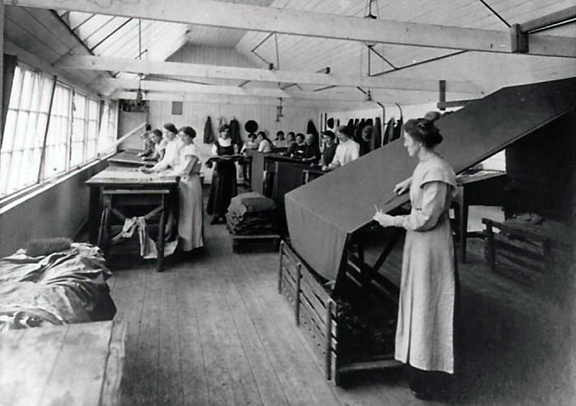

Always at the mercy of the dictates of fashion and economics, Border woollen manufacturers between the wars had a hard and stressful time. The global depression, tariff barriers and instability especially in Eastern and Central Europe made export markets difficult. Cheaper competition from areas like Yorkshire and North America plus the reduced purchasing power of the unemployed resulted in idle plants and closures. In nearby Galashiels a third of the manufacturing capacity of the town was lost in the 1930's

Mill Road houses, built for the workers.
However Simpson & Fairbairn weathered the storm, although short time working was often prevalent. During World War Two, the mill was fully employed on service and utility clothing. The early post=war years saw s a boom time for the Borders as world wide stocks of clothes had to be replaced. The firm was employing more than 300 workers. making it the economic mainstay of Earlston - where the population in 1951 was just 1,761.
But
by the late 1950's and early '60's, the old problems of cheaper
competitors and vulnerability to changing fashions had returned. The
firm tried to innovate by making cellular blankets and moving into ladies' wear.
A faded press cutting in the Auld Earlston collection from "The Southern Reporter" of 13th June 1961 read "Closing of Earlston mill shocks 200 workers", with a skeleton staff retained in the hope the mill could re-open, once orders were forthcoming. The tidal wave of workers coming up Mill Road was reduced to a trickle.
After a few months, the mill did restart with the weaving and finishing
department only and in 1966 a Mr Claridge (a textile designer) took
over and oversaw a brief period of expansion.
But the decline could not be stemmed. The mill finally closed in 1969 when a workforce of almost 100 was made redundant. Some of the workers
went to Wilson & Glenny of Hawick who like Simpson & Fairbairn
were part of Scottish Worsteds & Woolens Group. But they in turn closed
along with William Brown of Galashiels who were also part of this group.


Earlston's role in the Borders textile industry came to an end.

Today a street name sign reminds us of the village's past.

Today a street name sign reminds us of the village's past.


Two photographs taken in 1974 of the derelict Rhymers Mill
***************
***************
Notes:
- With Borders newspapers unindexed, I am trying to find out locally an indication of what time of year, the Simpson & Fairbairn Mill finally closed in 1969, so I can try to trace press coverage of the impact on the village.
- Auld Earlston is at the early stages of a "Sharing Memories" project to interview older residents and gather their experiences in growing up in the village. This should provide some fascinating material from former workers at the Simpson & Fairbairn Mill.
- The population of Earlston during this period:
1791 1351
1801 1478
1841 1756
1851 1819
1861 1825
1871 1977
1881 1767
1911 1749
1921 1641
1931 1689
1951 1761
2011 1779
- Earlston census returns for the mid 19th century identified workers in the following occupations:
Piecer in a Woollen Factory (a 13 year old boy)
Machine Feeder in a Woollen Factory (15 year old girl)Steam Loom Weaver of Wool (18 year old girl)
Cotton Weaver, Cotton Winder, Cotton Warper, Cotton Gingham Weaver, Clerk in Gingham Warehouse. Agent for a Gingham Warehouse
Blanket Weaver, Power Loom Weaver, Hand Loom Weaver, Wool Carder, Wool Picker, Overseer in Woollen Factory, Power Loom Tuner, Spinner in Woollen Factory


