Showing posts with label Resources. Show all posts

Tuesday, 7 October 2014

How to research your New Hampshire Ancestor, even if you are nowhere near the Granite State


With permanent European settlement that started in 1623, New Hampshire has a long history.  It is also one of the thirteen original English colonies that revolted against King George in the American Revolution.  There are a plethora of documents, records and archives to explore if your American ancestry started in New Hampshire, or passed through here on their way to other states.  Here is a list of ways to access those resources from your home.

Places you can search online:

FamilySearch.org – This website has NH births from 1714 – 1904, Deaths from 1654 – 1949, Marriages from 1637 – 1959, several county probate files, and town clerk records.  Many are complete with scanned images.  There are 18,960 books that came up when I searched for the words “New Hampshire”.   All Federal Census records 1790 – 1940 (except for 1890) are available here. Their research wiki for the state of New Hampshire is: https://familysearch.org/learn/wiki/en/New_Hampshire

Cyndi’s List of New Hampshire resources - http://cyndislist.com/us/nh/

The Lane Library, Hampton, NH- Hampton was founded in 1638 and has a wonderful collection of online resources that include many of the original seacoast communities in Rockingham County.  See this page for their genealogy page: http://www.hampton.lib.nh.us/hampton/genealogy.htm

Linkpendium New Hampshire links:  http://www.linkpendium.com/genealogy/USA/NH/

New Hampshire Deeds Online http://www.nhdeeds.com/  dating from the 1620s to the present

NH Search Roots website http://www.nh.searchroots.com/

The Pelham Historical Society Online Library – from Pelham, NH, this is a wonderful, little known resource of local history records online http://www.pelhamnhhistory.org/library/onlinelibrary.html

Where to Write for New Hampshire Vital Records http://www.cdc.gov/nchs/w2w/new_hampshire.htm

Good books:

Documents and Records Relating to New Hampshire (known as the NH Provincial and State Papers) in 40 Volumes available online at http://www.library.unh.edu/diglib/bookshelf/NHPapers/volume.shtml  the links lead to Internet Archive, and you can read online (searchable) or download several versions of files.  These papers are the accumulated documents from the settlement of New Hampshire to the year 1800.

Genealogical Dictionary of Maine and New Hampshire, by Charles T. Libbey, 1928  available online at http://search.ancestry.com/search/db.aspx?dbid=3166&cj=1&netid=cj&o_xid=0001231185&o_lid=0001231185&o_sch=Affiliate+External  searchable and browsable with paid subscription

Genealogists Handbook for New England Research, 5th edition, edited by Michael Leclerc, NEHGS, 2012

Index to Genealogies in New Hampshire Town Histories, by William Copely, 1988

The New Hampshire Genealogical Record, the journal produced by the New Hampshire Genealogical Society from 1900 to the present.


Social Networking  and Message Boards:

All Things History- Rockingham County, NH on Facebook https://www.facebook.com/groups/200460270133276/

Descendants of the First Families of New Hampshire on Facebook  https://www.facebook.com/groups/NHFirstFamilies/

New Hampshire Mayflower Society on Facebook  https://www.facebook.com/groups/NHMayflower/


NH Genealogy, Digging New Hampshire Roots on Facebook https://www.facebook.com/groups/DiggingNHRoots/

New Hampshire Genealogy Network on Facebook https://www.facebook.com/groups/205180789528062/

(don’t forget that many New Hampshire historical societies have websites and Facebook groups, and some even have Twitter accounts)

Societies:

American Canadian Genealogical Society    www.acgs.org
Association of Historical Societies in NH   www.historicalsocietiesnh.org
Manchester, NH Historic Association   www.manchesterhistoric.org
New England Historic Genealogical Society  www.americanancestors.org
New Hampshire Historical Society   www.nhhistory.org
New Hampshire Mayflower Society  www.nhmayflower.org
New Hampshire Society of Genealogists   http://nhsog.org
Order of the First Families of New Hampshire   http://offnh.homestead.com/
Strafford County Genealogical Society   www.straffgen.org


Places that can help you by fee:

American Canadian Genealogical Society – located in Manchester, NH, this is the largest resource facility for French-Canadian research in the United States.  See this webpage for their research services http://acgs.org/research/services/

National Archives at Boston, located in Waltham, Massachusetts.  The staff will provide reference assistance to you but also maintains a list of researchers for hire at this link:  http://www.archives.gov/research/hire-help/

The New England Historic Genealogical Society – Located in Boston, it is the oldest genealogical society in the world.  You can reach their research Services department at this link: http://www.americanancestors.org/research-services/

The New Hampshire Historical Society Library- located in Concord, NH, their research services can be ordered online and by telephone or mail.  For details see the page http://www.nhhistory.org/research-services.html or call the reference staff at 603-856-0641.  Photocopies are 35 cents per page for non-members and 25 cents for members, plus $7 for mailing or fax.

The Portsmouth Atheneum – This private library dates from 1817, and is the repository of hundreds of family papers, manuscripts, photographs, and ephemera from New Hampshire and New England.  It is located in Market Square in Portsmouth, NH, and the staff will do quick reference requests as time allows, and in-depth research requests for $30/hour with a 1 hour minimum.  See this link for more information: http://www.portsmouthathenaeum.org/collections.html

And…

Don’t forget your local Family History Library.  You can order microfilms from their website to be delivered to your local Family History Library, and you can look at them there for a small fee. If you need assistance, the volunteers will even help you to search for the records online and help you place your order.  

Wednesday, 25 June 2014

Genealogy Resources at the Library of Virginia

The city of Richmond, Virginia, dates to the early 17th century and has been crucial to the development of the Colony of Virginia, the Revolutionary War, and the Civil War. It became the capital of the commonwealth in 1780. The city is situated on a high hill overlooking the falls of the James River.

"Richmond, from a hill above the waterworks" circa 1834
Engraved by W J Bennett from a painting by G Cooke
Image courtesy of Wikipedia

The Library of Virginia, located in Richmond, was founded by the Virginia General Assembly in 1823. It is now the library agency of the Commonwealth of Virginia and is the archival and reference library for the state. It houses what many believe to be the most comprehensive collection of materials about Virginia government, history and culture. According to Wikipedia, its research collection includes “808,500 bound volumes; 678,790 public documents; 410,330 mircoforms, including 46,684 reels of microfilmed newspapers; 308,900 photographs and other pictorial materials; 101.8 million manuscript items and records; and several hundred thousand prints, broadsides and newspapers.”

Library of Virginia courtesy of the library's website

I am fortunate; I live two hours north of Richmond and have been able to make several trips to the library. I found the Visitor’s Guide to be extremely helpful in planning my first visit to an unknown library. I also called ahead and received great assistance in optimizing my research agenda. 

If you cannot visit the library in person, don’t be alarmed. Much information is available online:
  • Find It Virginia is the free access to a collection of Virginia databases
  • Virginia Memory includes the library’s digital collections of newspapers, prints and photographs
  • Virginia Heritage – a guide to the library’s manuscripts and archival collections

I use the library mostly when doing newspaper research, but I have also found copies of old family wills that have been helpful in making relationship connections between ancestors, such as Sue Adams described in a recent post. If you have branches of your family tree that lived in Virginia,* I hope you will take time to discover the research resources available at the Library of Virginia. And don't forget to peek at the Chancery Court records. You'll find your Virginia ancestors were a litigious lot and the information in those records can provide a wealth of "color" about a person -- some even include descriptions of their character and not always in a good way.

I'm using #WWGenealogy when tweeting about this collaboration project on Twitter (@TweetTRnT).

_______________
* Don't forget Virginia was once a vast portion of what is now the United States;  records from that area that are now other states are sometimes found in the library.

Tuesday, 25 February 2014

My Favorite Virginia Genealogy Resource

The first successful English settlement in the new continent called America began in 1607 at what is now the Commonwealth of Virginia on a spit of land at the mouth of the James River. Everyone is likely aware that settlement was known as Jamestown. By the 1630s English settlements dominated the eastern portion of the Virginia Peninsula, though Indians still attacked intermittently.  Middle Plantation was established in 1638 halfway between the James and York rivers on high ground. By 1699 Middle Plantation was renamed Williamsburg in honor of the English king, William III, and replaced Jamestown as capital of the colony. The College of William and Mary began holding its first classes in temporary quarters at Williamsburg in 1694.

Print of the Bodleian Plate, depicting the colonial architecture of Williamsburg, Virginia. 
The plate, discovered in the Bodleian Library at Oxford, was critical to the reconstruction of Williamsburg 
in the early-mid 20th century. Courtesy of Wikimedia Commons.

The College of William and Mary includes the Omohundro Institute of Early American History and Culture. The institute publishes a wonderful resource for history buffs and genealogists entitled William and Mary Quarterly, which began publication in 1892. Chronologically it ranges from the first Old World-New World contacts to about 1820. The focus is North America and includes articles about all disciplines.

Why should family historians and genealogists care about the William and Mary Quarterly? Here’s one page from the table of contents of the July 1904, issue:

Index page from a William and Mary Quarterly

We should care because it’s loaded with 122 years of useful information. The trick is finding exactly the information you need. That’s when the Earl Gregg Swem Library’s Special Collections Database becomes very helpful. Some of the content is digitized, but not all. When something I am looking for has not yet been made available in an online format, I Google the issue specifics. I’ve found the issues I need on Ancestry.com’s Card Catalog, eBay, Google Play, available for sale at used bookstores through Amazon or ABE Books or I look it up on WorldCat and find the nearest library with a copy. I hope I’ve been able to help you discover a new source to use when tracing your Virginia ancestors.

I'll be attending the Fairfax Genealogical Society's Annual Spring Conference on 28-29 March 2014. I hope to see some of you there.

I'm using #WWGenealogy when tweeting about this collaboration project on Twitter (@TweetTRnT).

Saturday, 25 January 2014

Hello from the Old Dominion

I first heard about Worldwide Genealogy -- A Genealogical Collaboration from Fran Ellsworth, author of the Branching Out Through the Years blog. She sent me to Julie Goucher, of Anglers Rest, who told me there was one spot still available -- the 25th. Today is my day; but, after reading all of the previous posts, I feel seriously outclassed as a genealogist. I am a rank amateur. I am obsessed, though.

I hang out at my blog, Tangled Roots and Trees, Facebook, Twitter and now here. My social media goal for 2014 is to become active on Google+. I got my love of family history and genealogy from my father. He was the genealogist in our family for years, starting before the Internet made it so much easier than it was then. He wasn’t the best typist in the world so he would save up all his data entry tasks for my next visit. We spent hours together in his home office as I entered his latest research into the computer – all the while Dad would tell stories about our ancestors. He was a natural born teacher and storyteller.


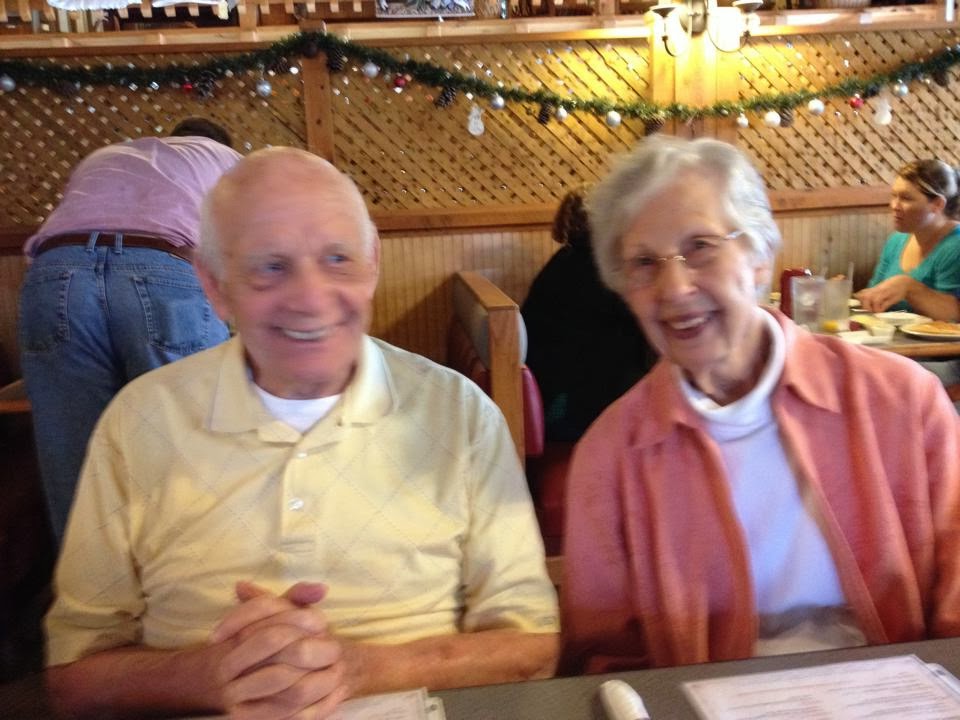
My octogenarian parents 

When I got a personal computer in 1994, the first software application I bought was for family trees. Since Dad was working on our family, I started on my husband’s. I didn’t get very far.  His parents were first-generation Americans whose parents came from Lithuania (Russia at the time), Austria, and Serbia (though they considered themselves German). My first big discovery was on the Ellis Island website when I found my husband’s paternal grandfather on a passenger list.

I would put down my research for months and years at a time and then pick it back up again. I’d find some new bits and pieces of information before hitting another brick wall. And so it continued until last year.

Dad suffered a massive cerebral hemorrhage and could no longer research our family. After seven months of brutal physical, occupational and speech therapy, he is again able to walk and understand what we are talking about, but he is not able to speak. I’m a Daddy’s girl so I was suffering. When Mom decided it was time to move into an assisted living facility with Dad, I brought all Dad’s genealogy files home when we emptied out their house.

Dad's genealogy files and old photo albums

And so began my obsession. I’ve connected with several genea-cousins online, and a couple of them have become friends and research collaborators. I purchased more old, musty books than is reasonable and haven taken a few genealogy vacations (thankfully I have a very understanding husband who goes with me). My biggest find that caused a happy dance, lasting for days, was connecting with a woman who owned two unpublished manuscripts written by my aunt’s brothers. Their father was a Church of God missionary, who took the family to British East Africa (now Kenya) in 1920. The family lived there for nine years. The stories of that time from the memoirs are wonderful and I’ve written about them on my blog in an ongoing “Out of Africa series.” Dad and I now have plenty to talk about, and we’ve discovered that while he can no longer speak, he can read. (The brain is a mysterious thing!) So I print out my posts and take them me when we go to visit. I also tell him about new genea-cousin connections I’ve made and how we are related.

Showing Dad how I was related to a recently discovered 4th cousin from New Zealand

Google Play has become a favorite app for my research. So many old county histories, written for the country's centennial anniversary, which contain biographical sketches, and old genealogy books are available. I also spend a lot of my research time on newspaper archive sites. Many require a subscription but others located at county historical societies or on Google are free. I do this because I enjoy learning more about an ancestor than just dates and places. I have discovered my ancestors did two things well: marry into interesting families and die in very creative ways!


I live in Fairfax County, Virginia, and am more than willing to photograph headstones in the northern Virginia, Washington, DC, and southern Maryland area. I keep an up-to-date bibliography on my blog of books I own (digital and old fashioned). If I can look anything up in one of those books for you, I am happy to do so.


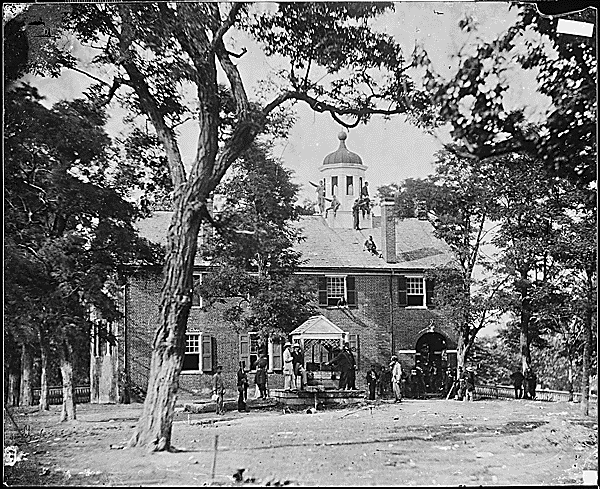
Union soldiers at the Fairfax County Courthouse in 1863 during the Civil War.
Photograph by Timothy H. O'Sullivan and courtesy of Wikimedia Commons

I work full-time and that seriously cuts into my research obsession, but it won’t last forever. When I retire I would like to start writing books. I consider my blog and this collaboration project good practice! Tangled Roots and Trees is not a typical genealogy blog; I leave the documents and the source citations on my tree. I tell stories instead about incidents in the lives of my ancestors and places in which they lived. I enjoy being able to marry my life-long love of history with my genealogy obsession.